Monthly
Pacific Islands Monthly
April, 1964
Vol. 35. No. 4.
Ibh
istered at G.P.O., Sydney, and at P.O., a, for transmission by post as a Newspaper.
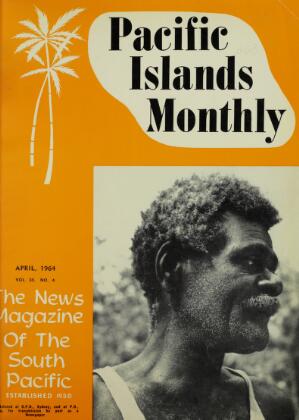
OUR COVER: This fine head study of a Tannese was taken during a recent visit to Tanna, New Hebrides, by Rob Wright of the Fiji Public Relations Office. Tanna, which is further south than Suva or Papeete, is an attractive, fertile island, with a constantly active volcano, Mt.
Yasua. New Hebrides Airways runs a regular air service to Tanna from Vila.
Advertisements & other items, pp. 2-8 (6 items)
When In Australia Fly Taa
s
L TAA
—T.
WHEN IN AUSTRALIA FLY TAA
Trans-Australia Airlines operates the largest single domestic airline in the British Commonwealth, serving 140 cities and centres throughout Australia and Papua/New Guinea. TAA’s modern aircraft connect with all incoming and outgoing International flights. This year TAA will provide the speed and comfort of pure jet travel within Australia with the introduction of Boeing 727 T-Jets.
TA A Fly-away Holidays. TAA offers a huge range of packaged Fly-away Holidays to the most popular holiday resorts throughout Australia and Papua/New Guinea.
And TAA takes care of everything travel bookings by air, road, rail or sea, accommodation, sight-seeing tours even theatre tickets!
Contact your nearest Travel Agent or Trans- Australia Airlines Office.
TAA
THE FRIENDLY WAY
Trans-Australia Airlines
Mcr 4V s Tf, *o ***K 1* There really is nothing quite like Erinmore’s rich, satisfying flavour.
It comes from a century-old blending process SECRET to the makers of Erinmore.
Treat yourself to a tin of Erinmore today - taste the rich flavour of this cool, slow-burning tobacco!
ERINMORE
FLAKE AND MIXTURE IN VACUUM TINS
EF2
If he’s not eating as well as he
should try a little
MARMITE
the appetite
builder
TtAST AND VECfTAItI OW
MAKES YOUNGSTERS HUNGRY AS YOUNG LIONS
Finicky eaters soon become hearty eaters when you give them Marmite on toast ... as a hot drink . . blended into soups and gravies. Out on its own for sparking tired appetites, making youngsters hungry as young lions! Saves money, too, because you use much less. At good grocers everywhere.
H Ml4>
New South Island air services fly you to the top resorts.
Ski-plane flights fly you to the mountain tops.
TEAL will fix your hotel reservotions, hire a car for you, reserve transportation. . — r< ,
tr^Trrv nH
3 We've a bagful of new, nearby holiday suggestions: party tours, individual itineraries, self-drive holidays the lot.
Hasten the cure from your travel agent or T'EAL obtain the prescription without cost or obligation now.
NEW ZEALAND'S
[INTERNATIONAL AIRLINE
IN ASSOCIATION WITH
QANTAS AND 8.0.A.C.
Nothing finer under the sun to put some punch back in you than a New Zealand holiday elixir.
A ME
PCK
UP TO
YOU
PEP
UP
TEAL
take
to Tell TEAL what you would like to spend on the cure (time and money) and they’ll suggest a mixture or two.
They’re specialising in holiday-planning nowadays. And they’ll comfort you with motherly care throughout your tonic trip.
ZEALAND
TEAL
Holidays in New Zealand have never been so good as they are today. New resort hotels (try The Hermitage and Te Anau), new jetage transport spice-up N.Z. sightseeing. Ask about the new Skyrama tours—piquant.
Hire car service from £8 per week.
TEE
TT 1 A? 3b 3b
POWER-MATCHED PARTNERS FOR FAST
RELIABLE PLANTING
Hitch an MFSOO Disc Drill or MFS6O Toolbar Planter to either the MF3S or MF6S tractor and you’re all set to step up planting capacity.
The MFSOO comes in 12, 16, 20 and 24-row sizes and is renowned for its light draft, accurate sowing and uniform fertilising. Cultivating section comprises 13" discs which are raised and lowered by a constant height mechanical or hydraulic lift. Large-capacity, all-steel hopper, with step-up footboards for easy loading. Choose steel or pneumatic tyred wheels.
The MFS6O Toolbar Planter (shown at right) will sow maize, peas, beans, broom, sorghum, turnips, onions and peanuts. Each unit attaches to a single toolbar and is self-contained, with seed and fertiliser box, furrow opener and press wheel. One or two units may be used with the MF3S and up to three with m the MF6S. Seed and fertiliser are spwn through a partitioned chute, with a divided furrow opener that ensures band placement —seed in the centre and fertiliser on each side. If fertiliser is not required the partition can be repositioned to increase hopper seed capacity.
SEE YOUR MASSEY-FERGUSON DISTRIBUTOR E 4557
New Hebrides Condominium Agence Pentecost Santo and Vila Fiji, Tonga, Western Samoa and other Sth. Pacific territories Burns Philp (Sth. Sea) Co. Ltd.
New Caledonia Meto, Noumea Tahiti Ets. Donald, Papeete Papua and New Guinea Burns Philp (New Guinea) Ltd.
British Solomon Islands R. C. Symes Pty. Ltd.
“ Honiara, Guadalcanal
OUTSTANDING SUCCESS!
i V
A.S.P. COCOA DRYERS
• PLATFORM DRYERS • BULK BIN DRYERS • ROTARY DRYERS WITH HEAT EXCHANGERS OR WITH DIRECT FIRED UNITS Illustrated A.S.P. Direct Fired Unit
MARK 1/15
FOR FULL PARTICULARS
OF A.S.P. COCOA DRYERS:-
WRITE TO ;
A.S.P. extends thanks to these Plantations for their confidence , . .
DYLUP PLANTATIONS LTD.
RAINAU PLANTATION
ARAWA PLANTATION
GIRI GIRI PLANTATION
GAVIT PLANTATION
LILI-NA-KAIA PLANTATION
BURNS PHILP (N.G.) LTD.
CHOISEUL PLANTATIONS LTD.
NUMA NUMA PLANTATION
AROPA PLANTATION
BALI PLANTATIONS
TOLAI COCOA PROJECT
and to many, many others.
(N. G.) LIMITED
RABAUL, T.N.G.
Box 166 P. 0., Rabaul.
Telephone 2370 Cables "Chatspa" Rabaul Australia a
OVERSEAS
N.R.M.A. HOUSE,
26 Ridge Street,
NORTH SYDNEY, N.S.W.
Cables “Chatspa" Sydney *ALSO CONSULT A.S.P. FOR SUPPLY AND ERECTION OF COMPLETE COCOA FACTORIES
HAVE YOU
NOTICED
HOW MUCH
BETTER
GILBEY’S
r
GIN
IS!
So why mix with others?
GILBEY’S
GINA
*ow/«
1
ACIFIC ISLANDS MONTHLY— APRIL. 1964
2
APRIL, 1964 PACIFIC ISLANDS MONTHL
3
kCIFIC ISLANDS MONTHLY APRIL, 1964
4
APRIL, 1964 PACIFIC ISLANDS MONTHL
1 Acific Islands Monthly— April, 1964
Pacific Islands
Monthly
A product of Pacific Publications Pty., Ltd., 29 Alberta St., Sydney.
Publisher: R. W. ROBSON.
Editors:
Judy Tudor Stuart Inder
Manager: SELWYN HUGHES.
Telephones: Ma9197, Aaa 7101, Ma 4369.
G.P.O. Box 3408, Sydney.
Telegraphic Address: PACPUB, Sydney.
Annual Subscription Rates:
(Aust. currency; includes surface postage) Pacific ,s -—P-'N.G., Fiji, Samoa, Norfolk, Nauru, 8.5.1., Cook Is., Tonga, G.&E. Grp., Niue, New Hebrides, and Br. Pacific Is 40 French Pacific Territories .. £1 7 o Australia and N.Z £1 10 0 U.K., British Commonwealth and Foreign (40/- Stg.) £2 10 0 U.S.A. and U.S. Pacific Territories ($7.00 . U.S.) £3 t 3 Single Copies (postage extra) ... 26
Branch Office In Papua-Ng
Pacific Publications (NG) Ltd., Theatre Building, Fourth St., LAE. Tel.: 2577. Miss Pat Robertson, Manager.
Branch Offices In Fiji:
Suva: Fiji Times Building, 20 Gordon St.
Tel.: 5601.
Lautoka: Fiji Times Office, Vidilo St. Tel.: 420.
Representative In N.Z.:
J. D. Whitcombe, C.P.O. Box 2229, Queen Street, Auckland. Tel.: 70409.
Representative In Hawaii:
C. C. Spencer, 203 Yap Bldg., 3465 Waialae Ave., Honolulu. Tel.: 775538.
Representative In U.S.A.:
R. G. Craib, 153 Laidley St., San Francisco 31, San Francisco, California. Tel.: Mission 8-1075.
Representatives In U.K.:
S. R. Warman, 73 Cheapside, London, E.C.2.
Tel.: City 2355.
H. A. Mackenzie, 4A Bloomsbury Square, London, W.C.I. Tel.: Holborn 3779.
MELBOURNE OFFICE: Newspaper House, 247 Collins St. Tel.: 63.7053.
AGENTS: All main trading firms and stores in the Pacific Islands.
Pacific Publications Pty. Ltd, is the Australian agent for THE FIJI TIMES.
In This Issue
General
lew Australian Territories Secretary 12 roblems for South Pacific Commis sion 15 PC Quarantine Conference 18 ATA Conference on Tourism 35 Vork of British and Foreign Bible Society 50 lan for New "Endeavour" 97
American Samoa
Pegging Ban Law Defeated 12 fiew on Future 28 /\any Changes in Two Years 71
Iook Islands
Jew Minister's Visit 12 loyal Visit Hopes 65 Vchaeological Discoveries 83 Jew Roman Catholic Bishop 118
Hi And Rotuma
ierious Floods 11 HP's on "Familiarisation" Tours ... 14 Acre Canadian Tourists 38
-igarette-making 40
/isas Abolished for Transit Passengers 49 Vhen Levuka Had Its Stocks 81 iuva's Memorable Bus Rides 87
Mea on Unseaworthy Ships 103
mmunisation Campaign 113 'omposition of Civil Service 113 'Jew Students at School of Medicine 113 Jook on Colony's Flowers, Plants 115 Jig Expansion for Sugar Millers ... 121 Sold Mines Want Subsidy 122 lapanese Projects 122 FV Company Registered 123 Mew Hotels 131 Development Plan for Rotuma 142
French Polynesia
Big Build-Up for Nuclear Tests 10 TEAL Hopeful on Coral Route 29 Underground Water on Harbour Islet 99 Excursions in Tahiti 131
Gilbert And Ellice Islands Colony
Astronomical Observations 113 Copra Production Up 114 Advisory Council Meeting 115
Lord Howe Island
Ball's Pyramid Climbed 18
New Caledonia
Lenormand Out of Politics 15 TEAL Begins Service from NZ 29 Site Fixed for 1966 Games 57 lie Nou's Guillotine 81
New Hebrides
Who Solved the "Boussole" Mystery? 19 Murder of White Trader in 1887 77 Postage Stamp Design Contest 113 New Airfield at Tongoa 113 Joint Agricultural Training Institution 114 Mild Measles Epidemic 115 Archaeologists at Tanna 118
Norfolk Island
Air Charter Plan 132
Papua-New Guinea
Assembly Elections 9, 11 Facts Wanted for History Books 17 Madang's Beautiful Trees Axed 18 Stock Exchange Suspends Sangara Trading 20 Cargo for Buka Cargo Cultists 27 Territory Has Lost Aviation Lead 31
Mace Designed for Assembly 34 Death of Alice Bowring 39 Australia Active on WNG Border 53 Moresby May Be 1969 Games Site .■ 56 RWR Looks at "Patrol Into Yesterday" 59 Drift from Laughlans to BSIP 99 Extensions for Nautical School 101 Strange Sampan Sighted 105 Nakanai Resettlement Plan 113 New Cathedral at Alexishafen 113 New Badges for PIR H 5 Resolution on Drinking Containers 115 Toting Timber to the Territory 121 Coffee Marketing Board 122 Oil Search Plans 123 Tonolei Harbour Timber 123 Copra Trends 124 New Hotels 121
Pitcairn Island
Archaeological Finds 55
Solomon Islands
Memories of Old Hands 27 Complaint on PWD Transactions 28 Rice Growing 29 Sir David Trench Farewelled 48 Native Claim to Honiara Land 67 A. C. Blair, Radio Ham 79 Deposits of Copper Ore Likely 113 Temporary Changes in Top Posts 116
Tonga
Circular Postage Stamps 18 Vaccination Project H 5 Desiccated Coconut Factory 123
Us Trust Territory And Guam
Growing Shipping Needs 103 Tourists Welcome in Guam 132
West New Guinea
Natives Sold Down the Drain 25
Western Samoa
107 In Election Contest 13 Director of Agriculture Retires 117
DEPARTMENTS: Topicalities, 17; Letters to the Editor, 25; Territories Talk- Talk, 41; Magazine Section, 77; Book Reviews, 89; Shipping Section, 97; In A Nutshell, 113; People, 116; From the Islands Press, 119; Commerce, 121; Deaths of Islands People, 129; Travel Talk, 131; Shipping and Airways Infor mation, 134.
Advertisements & other items, p. 10 (1 item)
Braybon Light And Power
I A B I » 3 0 / X A * © an©™
AND
PETROL s DIESEL GENERATORS
GIVE YOU ALL THE CONVENIENCES OF MODERN LIVING
WRITE FOR FURTHER INFORMATION
¥ «L Manufactured by: BRAYBON BROS. PTY. LTD., Electrical Engineers and Manufacturers 27-33 Washington Street, Sydney Telegrams: "Braybonian", Sydney Telephone: MA 6853
DISTRIBUTED BY
TUTT BRYANT (PACIFIC) LTD.
COLYER WATSON (N.G. ) LTD.
Common-Roll Election
It's A Patchwork Quilt
Result For First
P-NG Election Survey by Judy Tudor.
Results to April 1 in the Papua-New Guinea elections — and counting of preferences and absentee votes will be con cluded only after this is in print-—are interesting for the candi dates who appear likely to lose as much as for those who seem likely to succeed.
EXPERTS have already been at tempting to see some sort of >olitical pattern in the results of the )rimary count, but all that really merges is a crazy-paving of local sectional foibles; and the ;ood old New Guinea idea that when n doubt leave it to the Kiap (Goy ;rnment officer). Or the ex-Kiap, in his case.
In short, things have turned out ather as expected by Territorians, ifficial and otherwise, who closely jbserved the voting. They believed hat just about anything could hap ien, and just about everything has.
See-saw Voting
Natives in many electorates voted n blocs, as communities or clans, for ;he candidates they knew, and as a result the fortunes of some candi dates see-sawed several times during counting. For example, in the special electorate of South Markham, Lloyd Hurrell was trailing his two op ponents until the votes from Men yamya came in and put him slightly ahead. Mr. Hurrell is now a Wau coffee planter but he was formerly the Assistant District Officer who took government to the Menyamya area. He did a good job—and the Kukukukus from there apparently have not forgotten.
The same sort of bloc voting in the Moresby Open Electorate— where no less than 12 candidates stood —appeared to have put paid to the chances of Oala Oala Rarua, of Port Moresby. He was being beaten by sheer weight of numbers—and possibly a little Port Moresby Euro pean prejudice—by an unknown in terpreter from primitive Goilala called Erika Rarupa, His chances rose later when it was seen that though the urban voters marked pre ferences, most Goilalas did not.
It could mean Still that sophisticated natives around Port Moresby will have no representative of their own in the new House of Assembly, while Oala Oala Rarua, who many people see as Prime Minister material, has to wait another four years for another chance.
Whatever personal opinions there are about this young man, he is welleducated, intelligent, eminently presentable and head and shoulders above most of the native members who are going to sit in the House.
Further, he is politically ambitious.
The place for Oala Oala Rurua and his ambitions is in the House of Assembly; not reduced to some back-
Former cult leader Yali, of Madang, sur prised many by failing in the elections.
His failure may or may not be significant —the elections were such a patchwork of results that nobody can tell for certain. ground noise in the P-NG Workers’
Association, of which he is president.
That the Goilala vote was going to outnumber the coastal vote was a mathematical certainty.
There were only minor sensations in the 10 electorates reserved for non-native candidates. One unfor tunate casualty was Ron Slaughter, an able member of the last Legisla tive Council, whose new electorate of West Papua takes in huge areas, including the Southern Highlands, where he is unknown. He was
The main tally room in Port Moresby was a busy place in March as election results came in. Radio stations remained open to the early hours of the morning to broad cast details.— P-NG Official Photo.
beaten by Mr. R. T. D. Neville, of Mendi.
Of the four elected European mem bers of the old Council who offered themselves for the reserved electo rates, he is the only victim. The other three—John Stuntz of East Papua, Lloyd Hurrell of South Mark ham and lan Downs of the Highlands —all came out on top in the primary count, but Mr. Hurrell with only a small majority. Preferences could change it yet.
The biggest personal triumph of the whole election went to lan Downs who received the colossal total of 113,373 votes. As the majority of electors were natives and as many of these didn’t bother to cast votes in the special electorates this total is amazing.
Of the other special electorates at the end of primary counting, the Rev. Percy Chatterton was narrowly ahead in Central; Frank Martin was leading in Madang-Sepik; Roy Ash ton in New Britain: Jim Grose in NG Islands; Don Barrett (very narrowly from Albert G. Price), in West Gazelle. In North Markham Special electorate, H. L. (Home) Niall was unopposed.
Guise In Again Of the eight native ex-members of the Legislative Council who offered themselves for election in open electorates, only two at the end of primary voting were sure of success.
These were John Guise from Milne Bay and Nicholas Brokam from New Ireland. Mr. Guise was opposed by Bob Bunting, a well-known Terri tonan businessman who was expected to d o much better than he did.
Mr. Guise has already won hand somely and no one will grudge him his victory. He was the most able Papuan in the last Legislative Council and although he spent his initial period there with his prickles out, bflit y matUred SWifUy With res P° nsi - Nicholas Brokam worked no miracles in the old Council and was • e l rd I rom only rarel y- His victory !S harder to account for in the light v; n th t de ? eat of such ex-MLC’s as Vm Tobainmg, a recognised Tolai leader, and of Somo Sigob of the Finschhafen Open, both o£ whom ?9fiTfi1 ha uK PUI K d c. their wei * ht “ 61-63. although Sigob was said to be unpopular with some electors. an! 1 ? - * way from th e tested and tned MLC s is not so surprising m other cases but in no case is there * ny ? b u OU ? J reasons why the new ™°ue el .h S anl d eo e id. reBarded 35 be “ er The changes cannot be accounted
for either as a swing to young—or even old—nationalists. Yali, who led an anti-Establishment Cargo Cult in the Madang district shortly after the war and still is believed to have a fanatical following in that area, failed badly at the polls. So did Francis Hagai, a leader of a more recent cult in Bougainville.
But, at the same time, Paliau, a cult leader of about the same vintage as Yali, appears sure of winning Manus Open; and Epineri Titimur came close (but not close enough), to doing the same thing in Rabaul.
Epineri’s greatest claim to fame was his public announcement in 1960 that as the Australians had been 50 years in New Guinea it was about time they got out. During his electioneer ing however he said he had changed his mind and now wants the Aus tralians to remain.
Greatest interest of all was in 20 of the 44 open electorates where European candidates stood against native opponents. This was regarded in the Territory as a test of con fidence in Australia and the results are regarded as completely gratifying.
It was believed, when the new political set-up was designed, that Europeans would have very little chance in an open contest against natives—not because Europeans were not wanted but because of tribal loyalties. For this reason the 10 special, non-native electorates were devised.
Big Vote For Europeans
However, European Territorians took up the challenge and results in the primaries show that 36 per cent, of votes went to Europeans and that six look sure of election and four others are possibles.
The six who seem sure of victor are John Pasquarelli (Angoram) Keith Levy (Hagen); Keith Teller (Gulf); Grahame Pople (Gumine)* Barry Holloway (Kainantu); anc Tom Leahy (Markham). Of the six four are former patrol officer: or Administration officers and al are post-war arrivals in the Territory This constitutes the nearest approach to a “pattern” in native voting bui too much should not be made of it Four other possibles—depending or absentee votes and preferences—are Bill Bloomfield (Kaindi); Ben Hal! (Ramu); Arthur Wyborn (Fl> River)); and Scotty Uroe (Rigo- Abau) who aren’t patrol officer types or new arrivals.
Probably the most disappointing aspect of the whole election so fax is that so few members of the old Legislative Council will be appearing when the new House meets on June 8. This may be written off to the processes of democracy but in terms of practical politics it means that most members are going to have to learn their business from the begin ning with few tutors.
The 10 official members have yet to be announced; of the 10 elected from reserved electorates, only three are ex-Legco members; of the 44 from open electorates, probably six will be Europeans of no legislative experience; and 38 will be natives only two of whom have sat in the Council.
Part Value The first year is, therefore, likely to be mainly educational and there after, if the old Legco is any criterion, about 25 per cent, of the native members will be of some value while the rest will never earn their parliamentary salaries.
Whichever way you look at it, what Australia has attempted to do in this primitive country, with this election, earns the description of fantastic. But the main results have been only two: • It has been shown that the vast majority of P-NG natives still do not think on a national basis but cling to their clan affiliations; and • This attempt at Australian style democracy in full blast has failed to throw up the native leaders that the Territory so badly needs.
One facet of the elections that led to more confusion than any other was the so-called preferential system of voting. This system works equit ably when it is carried out fully but
(Continued on p. 129)
quite late in the day in P-NG it was decided that if a voter only marked number one, the vote would be valid.
Preferential voting therefore be came a hit-and-miss affair, left to the whim of the voter, so that while some candidates in some areas are now going to get the benefit of pre ference, some others, in areas where native voters didn’t bother, will, through no fault of their own, get no benefit from it at all.
It is equally true, of course, that if it had been necessary to mark ballot papers in complete order of preference, the number of informal votes would have been tremendous.
The simplest solution, which would have done away with much of the confusion, would have been to make it a first-past-the-post ballot.
The change of heart prior to the elections that decreed that voters could choose whether they voted pre ferential or not, has also had legal complications (see story on p. 11).
Voting was not compulsory but 65 per cent, elected to vote. The per centage was very much less than this in the special electorates which many natives regarded as “something be long Master”. According to our calculations only about half the voters on the roll cast a vote for these electorates—and over a fifth of them were those cast for Mr. lan Downs, in the Highland electorate.
Big French Build-Up
For Nuclear Tests
Fifteen hundred French soldiers and civilians will be stationed in Tahiti by the end of this year for France's nuclear testing programme in the South Pacific.
The French Prime Minister, Mr.
Georges Pompidou, said this in the French Parliament in March in reply to a written question from Mr. John Tearii, Deputy for French Polynesia.
Mr. Pompidou said that "owing to the nature of the tests", exact figures could not be given for military and civilian personnel in the whole of French Polynesia for the tests.
35 Electorates
New Polls Could
Be Forced In
If an apparent flaw in Papua sJew Guinea’s electoral ordinance s exploited, new elections may be forced in up to 35 of the 54 electorates where elections for the new House of Assembly
were recently held.
A SECTION of the ordinance pro vides that before a candidate :an be returned he must an absolute majority of votes. “An absolute majority” is defined by the ordinance as meaning more than half the total votes cast in any elec :orate.
Few candidates received the neces sary majority on primary votes alone and there were few preferences to distribute as electors were not obliged to mark preferences on their ballot papers.
By mid-March, one native candi date had already indicated his inten tion to call for the election in his electorate to be nullified if he failed to be returned. And many others— both European and native—were ex pected to follow suit.
This situation could not arise in Australia where voters are required by law to fill out ballot papers com pletely.
Modifications to the Australian electoral laws were made in the Territory to cater for the special needs of its one million primitive voters so that they only had to mark their first choice, but could mark preferences if they wished.
In passing the ordinance last year, the Territory’s Legislative Council seems not to have foreseen what would happen if natives marked only one candidate on the ballot paper.
Legal experts in Port Moresby say that candidates in an electorate where the winner did not achieve an abso lute majority could successfully appeal to the Court of Disputed Re turns.
When primary vote counting had nearly been completed, only 19 elec torates looked likely to be won according to the provisions of the ordinance. It was then thought that candidates narrowly defeated on primary votes or in danger of losing their deposits were the most likely to appeal.
four 5S
Confusion Follows Serious Fiji Floods: Two Dead
Serious flooding in Viti Levu, the main island of Fiji, between March 21-25, caused damage conservatively estimated at more than £500,000. The main areas affected were the Rewa Valley, the Sigatoka Valley and Nadi, but because mam arteries were inundated there was widespread confusion on the island.
TWO people lost their lives— strangely enough in areas affected only relatively lightly. One was at and the other at La, The%xtent of the damage: • The main circuminsular road washouts 311 ♦ W cropland bananas
four 5S
feeding into the Rewa River; • Shops under water and heavy material stock losses in Nadi; • Crop losses in the Sigatoka Valiev and • Extensive flattening of cane crops in a wide area from Nadi to the eastern side of the Sigatoka River, The Sigatoka River bridge, a massive concrete structure, carrying road traffic and a SPSM Ltd. tram-line,
was seriously damaged. More than half was washed away, and arrange ments were made f.,“ vit |i as a road link. While it “ Suva 1 * and"UTttot , Kind’s Road Many clock to restore the King's Road for e the mainly between east and west and the Phots flew long hours keeping essential traffic moving. Handicapped because three Herons were grounded overseas one at Honara and two at Apia, for several days, the remaining Heron and the Drover were seldom on the ground during daylight.
As it was Nauson airport near Suva was frequently under water in parts and heavy vehicles ferried pas
Nadi township from the air—an amazing sight for Fiji. —RNZAF photo.
sengers, mail and cargo from the ter minal building to the aircraft.
Nadi Airport was out of commis sion for a day and overseas airliners were delayed because of severe elec trical storms in the area. A Qantas Boeing, northbound, was within half an hour of Nadi and had to turn back to Sydney. A TEAL Electra from Auckland got even closer, with in 10 minutes, when it had to turn back. A PAA Boeing got over Nadi and tried several times to get down.
Finally the pilot gave up in disgust and flew on to Pago Pago.
Nadi Airport had a near record rainfall.
Relief organisations soon swung into action to bring succour to those who had lost most of their posses sions. There was immediate help from New Zealand, Australia, America, Great Britain and nearby island groups.
Within a few days a flood disaster fund reached more than £30,000, with some magnificent contributions trom overseas.
New Secretary
For Territories
Mr. George Warwick Smith, OBE, has been appointed Secretary to Australia's Department of Territories to succeed Mr. C. R. Lambert, CBE.
He will take over on May 15.
Mr. Warwick Smith has been Deputy Secretary in the Department of Trade and Industry since July, 1960. Before that he held senior positions concerned with inter national trade relations and trade
policy.
He has represented Australia at several top level international trade conferences and negotiations.
He is a Bachelor of Arts and a Master of Commerce.
Nine Survive Capsize
Six men and three boys who were in a canoe which capsized off the in aP P^ n t T/ 51 ? ver Easter a re safe ort Moresby after surviving a grim ordeal at sea. The boys and five ot the men were rescued by a US nfrn C „°i Pter af ‘ er dr *ft>ng on the up man d p canoe f .? r 66 hours - The other fhnnd Ra .V m °nd Lewis, 32, single, was SanH fin Ve T Apnl 1 on a small island fiO miles south-east of Port r f by Ku er drifti "S for tour days on a rubber mattress. A seventh Sin"’ tned t 0 ! wim ash °re, was rV i?TT ing on A P ril I- He is Sndren Ham Iton ’ married ’ with four
American Samoa's
Legislators Boggle
At Begging Ban
Members of American Samoa’s two Houses of the Legislature voted solidly in March against a law proposed by Governor H.
Rex Lee to outlaw begging in
the territory.
IN lively debates in both Houses, the legislators argued that the proposed legislation would outlaw many of the customs and traditions of American Samoa which could be interpreted in the Courts as begging However, although the bill was de feated, it is still possible that it will be passed, as the Speaker “returned the bill to the House floor”. This means that the bill still “lives” and can come up for further considera tion later in the session.
Speaking about the proposed law at the opening of the legislative session, Governor Lee said begging was a problem among both children and adults, and that “tourists and their actions” were mainly to blame for it.
“If there is anything that is contrary to Samoan nature, this is it,” he said.
Governor Lee said the Legislature should also consider the problem of tipping, which could become very burdensome, as in many other parts of the world.
He said American Samoans should be prepared for the changes that were taking place in the Islands.
Important Role
The opening of the educational television system would enhance education opportunities of the people, and would “form the base for whai we think will still be an outstanding school system”.
This system, plus the new hotel that it was hoped to open within a year, would “play an important role in the initiation of American Samoa into the world of tourism”.
Governor Lee said that a false start on tourism would “kill the opportunities . . . and we will forevei pass up opportunities for you people.”
All plans for the development of the territory were conceived with the ultimate purpose of opening doors of opportunity for the Samoan people and not outsiders.
Governor Lee’s assurance on out siders did not entirely convince the
legislators as both Houses later passed a strongly-worded resolution calling on him to place limitations on the number of aliens entering the terri tory, and to offer the Legislature “a comprehensive and effective immi gration law”.
The resolution also called on the Governor to require all aliens not en gaged in essential jobs to leave the territory, and to limit the stay of visiting aliens.
The number of registered aliens on Tutuila in mid-March was 4,800, and there were believed to be about 200 in Manua. American Samoa’s total population is estimated at 24,000.
New Minister Pays
Visit To Cooks
New Zealand’s new Minister of Island Territories, Mr. J, R.
Hanan (pictured), paid his first official visit to the Cook Islands in March. At both Aitutaki and Rarotonga, Mr. Hanan said he had come to look, listen and learn about the problems and as pirations of the Islanders, and he expressed the hope that they would choose to move with all deliberate speed into the 20 th century, as the New Zealand Maoris had done.
In Rarotonga, Mr. Hanan re marked on the number of new houses being built under the Government’s housing loan scheme, but said much had yet to be done before the people were adequately housed.
Election Since Independence
107 To Contest First Samoan Election Since Independence
From R. F. Rankin, in Apia.
Any doubts about change in Samoan custom have been dispelled by response to Western Samoa’s general election due on April 4—the country’s first since it became independent on January 1, 1962.
VITH widespread resentment against the recent Government iposition of school fees, great iblic interest is being taken in the ection, in which 106 men and one oman are contesting the 47 seats.
The days when the word of higher liefs was law; when a coveted seat parliament was rotated among llages in each district as the election me around; and when a representa /e could be selected by public dis ission among chiefs, are fast dis >pearing—thanks to the secret lllot.
The set-up is still far from demo atic in the commonly accepted eaning of the term, but democracy oks a lot closer than it did even ree years ago.
The franchise is still largely a prop the traditional social system and ily matai (family heads) have the >ht to be nominated or to vote.
The minority population of 1,225 gistered European, Chinese, part imoan and non-Samoan voters living itside the matai system has two ats in parliament and all these dividual voters over 21, male and male, have the right to be candi ites or to vote for these two seats.
As a result of the restrictive anchise, out of about 45,000 adults 'er the age of 21, only about 6,000 ive the right to vote.
Change Will Come There is no vociferous demand om the unfranchised for a vote, it with the rapid progress in educa )n, the change from a subsistence a more individualistic money onomy, and increasing contact with e outside world, change is bound come.
“There will be universal suffrage ;re within six years,” claims one imoan candidate in the election, tiis may appear wishful thinking to me observers but with change ling upon change so rapidly in imoa, it is not beyond the bounds ? possibility.
Greatest electoral interest lies in e district of Lotofaga where Prime
Minister Matafa is being challenged by Fonoti loane, businessman, planter and former bank director.
An experienced politician of con siderable talent, Fonoti is however not given much chance against the prestigious name of and country-wide respect for Mataafa.
“I am not bothering about a cam paign. It is up to the people to make up their own minds who they want,” said Mataafa when asked about his electioneering plans.
In a campaign free of party politics, he is content to rest on his personal record and appears uncon cerned about the outcome.
Another electorate holding major interest is at Palauli, where Afoafou vale Misimoa, most outspoken critic of the Government, is opposed by last-minute nominee, 32-year-old chief parliamentary interpreter and former scholarship student in New Zealand, Aioolupotea Palemene.
An outspoken, often contentious, skilful debater, and a politician of unquestionable ability, Afoafouvale was expected to be returned un opposed after discussions with district matai , but Palemene was drafted by his family, influential in the district, and entered his nomination 10 minutes before closing time.
The calibre of candidates is higher than at any time. The first Samoan university graduate. Public Service Commissioner Leiataua Vaiao Alai lima, is campaigning in the district of Aiga-i-le-tai against former Euro pean member Hans Keil, known as Lesa Anisi under his new status. In this district there was agreement among matai on one candidate (Lesa Anisi) but when nominations closed it turned out there were two other candidates aiming for election.
Another public servant, New Zealand trained Treasury investigating officer, M. McCarthy (Fuimaono Moasope), is opposing Minister of Education Tuatagaloa in a three cornered contest in the Falealili electorate.
With constitutional changes reduc ing the previous five European seats
on a population basis to two seats, the contest for the individual voters is particularly keen.
The two seats are being contested by Minister of Finance G. F. (Fred) D. Betham, Minister of Public Works F. (Frank) C. F. Nelson and back bencher Tom Allen, Both Ministers have done good work and they are generally expected to hold their portfolios again if re elected. Tom Allen has, however, made a name for himself as a battler oyer the past three years and with his own plus dissident support he is giving the two main contenders a worrying time.
History has been made in the electorate of Faasaleleaga No. 3, where a 39-year-old housewife and mother, Lefine Satia, is contesting the seat with former policeman Tole’afoa Talitimu. With the franchise re stricted to matai and with matai honours only rarely bestowed on a woman, it is most unusual for a woman to be playing an active part in politics.
Cabinet Changes
Unless there is a major upset, it is almost certain that Mataafa will again be Prime Minister but there are likely to be some changes in the Cabinet, members of which are selected by the Prime Minister who himself is elected by Parliament.
Among the 14 candidates elected unopposed are two Ministers; Fa’alava’au (Post Office and Radio) and Asiata (Agriculture). Neither
Samoan Prime Minister Fiame Mataafa is expected to be returned, but Fiame him self is reported to be unconcerned about the result.
of these two are certain of Cabinet selection. Fa’alava’au, former secre tary of the Mau and a popular politician with long years of political service, may be thought too far on in years to stand up to the rigours of the development era ahead.
Asiata’s rather off-hand approach has not made him many friends among rank and file politicians, and he has also been involved in the demand of the Public Accounts Com mittee for a Commission of Enquiry into banana cartage contracts where his close relatives proved to be suc cessful bidders.
Although 107 candidates are offer ing themselves for election, there are not many of ministerial calibre among them. It is generally expected that at least four of the present Ministers will be re-appointed. They are Tuatagaloa (Education), Toomata (Lands), Betham (Finance) and Nelson (Public Works).
Backbenchers who may make Cabinet rank are Tuaopepe Tame, Pilia’e, Magele Ate and Afoafouvale Misimoa. Newcomers of ability are former Minister of Health now re entering politics, Luamanuvae Eti, Public Service Commissioner Vaiao Alailima and prominent planter Kolone Vaai.
All this of course is contingent upon their being elected. With as many as 12 candidates contesting one seat in places, the outcome is far from certain.
Advertisements & other items, p. 15 (1 item)
13
ACIFIC ISLANDS MONTHLY APRIL, 1964
Leaves ASOPA
Mr. C. D. Rowley Leaves ASOPA
After 13 years as Principal of the Australian School of Pacific Administration, Mosman, Syd ney, Mr. Charles Rowley is to take up a new appointment as Director of the Social Science Research Council’s project on Aborigines in Australian Society.
In those 13 years, Mr. Rowley has substantially assisted the natives of Papua and New Guinea by training hundreds of young Australian officers in their work.
Members of the staff of the school and others of his many friends will entertain Mr.
Rowley at a farewell dinner at the Hotel Mosman on April 10.
The Deputy Principal, and Senior Lecturer in Law, Mr. J.
R. Mattes, has been appointed Principal of ASOPA.
They Took A Look
Look At Fiji
From a Suva Correspondent Fiji had its share of VlP’s, of
varying degrees, in March. They
included half - a - dozen New Zealand MP’s, a top official from the Colonial Office and a United Kingdom delegate to the United Nations. All were on what they called “familiarisation” tours.
THE MP’s spent a week touring the Colony, looking at various projects, and then went off to Western Samoa and points east. They were a little nervous of publicity, and soon made it clear that they were unable to make policy state ments on behalf of New Zealand, which was quite understandable.
However, they did, through their leader, say that although the future of the RNZAF base at Laucala Bay was a matter for consideration by the New Zealand Parliament, the past record showed that New Zealand would never deliberately damage Fiji.
They were unable to say what the future air policy would be, or how much longer the Laucala Bay base will remain in existence. Neither did they promise that New Zealand would buy more bananas from Fiji!
The delegations comprised three members of the National (Govern ment) Party and three Labour (Opposition) Party. The Nationalists were Messrs. G. A. Walsh (leader), Sir Leslie Munro (better known as a former president of the United Nations General Assembly), and R.
J. Tizard. Those from the Opposition were Messrs, W. A. Fox, M. Rata and D. S. Thomson.
Colonise Office Visit While they were on their trip, Mr.
Philip Noakes, head of the informa tion section of the Colonial Office, arrived for a two weeks’ tour. Mr.
Noakes made no startling pronounce ments—in fact he made it clear that he was here just to learn something about the Colony at first hand.
Before starting his Fiji tour he went to the New Hebrides, and while in Fiji took a few days off to fly to Tonga.
The last of the VlP’s, Mr. Cecil King, British Minister for Trustee
Affairs at the United Nations, wa certainly not the least.
Mr. King, handled Fiji’s case las year when it came up before the U> Committee (of 24) on Colonialism He let it be known in Suva tha the UK attached little weight to th< resolution passed in the UN Genera Assembly last year calling on thi British Government to give indepen dence to Fiji immediately.
Bitter Comment Delegates on the Committee of 2 made some startling statements whe: the committee discussed Fiji, an these caused a lot of bitter commec in the Colony.
Mr. King commented in Suva tha he would like to know in some case where members had got their Suv “misinformation”. They had prc duced some curious facts and figure! especially the Soviet delegate.
He added that the final resolutio was not binding on anyone, and was based on a complete misconcej tion of the state of affairs in Fiji.
Mr. King also explained why tw high Fijian chiefs, Ratu Penai Ganilau (Deputy Secretary for Fijia Affairs) and Ratu George Cakoba (the paramount chief of Fiji), wh were in the United States at the tim< were not called before the committei He said that the committee did n( originate invitations, and did not ii vite people to talk to them.
But the possibility of Ratu Penai and Ratu George applying to t heard did come up, and the questio was discussed with them. But thei were difficulties as the men were o a State Department tour.
The matter had been referred t the Fiji Government, which had d( cided against applying for a hearin for the two chiefs.
Collapse
Mr. King saw a number of politic: leaders during his Fiji visit.
He also held a Press conferenc near the end of the visit. During i Mr. D. Krishnamurti, assistant editc of the Pacific Review, Nadi, collapse and died. Mr. Krishnamurti was controversial political writer, an was closely associated with Mr. A. E Patel, and Mr. S. M. Koya, tw Indian MFC’s. Mr. Krishnamurti ha been asking a question when he co lapsed across the table.
The Deputy Director of Medic: Services (Dr. D. W. Bookless) w£ called from an adjoining office an the conference was adjourned.
Mr. King visited Papua-Ne 1 Guinea after leaving Fiji.
Advertisements & other items, p. 16 (1 item)
14
APRIL, 1964 PACIFIC ISLANDS MONTHL
Governments Rethink The Problems
Problems Of The SPC
By Stuart Inder.
The five member nations of the South Pacific Commission are having to rethink the details of proposals made last year to give an important new voice on the SPC to Islands people.
IS a result of legislative difficulties and changing attitudes the pro osals, put forward at a review con srence in London last July, will not dw be carried out.
But it is possible that some of le more important proposals will be ilvaged and made to work in a ifferent way, which will result in le Islanders getting a much larger ly in SPC affairs *han they have DW.
Last year’s London conference, hich was attended by the UK, the
US, France, NZ and Australia, dis cussed a scheme for drastically over hauling the Commission’s charter (drawn up in 1947).
It was proposed among other things to re-organise the Research Council and to set up an additional body called a Regional Council, which could meet every year and which would have delegates elected by Islands legislatures. This Council would be in a position to take a close interest in SPC direction.
The London conference also dis cussed a new financial formula of contributions, and the admission of Western Samoa as a full member following her independence. The conference broke up on a note of optimism.
By October, however, when the Commission met in Noumea, it was obvious that there were serious diffi culties in the way of the proposals being carried out by the member governments. France and the US especially were unable to get approv ing bills through their legislatures in time, and the passage of the bills themselves could be guaranteed to raise other difficulties.
Since then it has become clear that the complications of getting five Powers to agree to new sets of pro posals that could have deep ramifica tions in other ways are too much for there to be an easy solution. Ap parently none of the Powers is willing to risk throwing open the SPC charter to an extent which could one day allow political control of their own territories to slip away from them.
All are agreed that the SPC is not political, and that its main role is to provide technical assistance—to be a library of technical brains the territories may call on as their technical and scientific problems grow.
None of them wants the SPC as a possible nucleus of some loose South Seas federation—nor do they want to greatly sharpen its teeth, for it might use the teeth to bite the hand that feeds it.
Nevertheless, it is possible to do a
great many things within the frame work of the present charter—just so long as all the member governments are agreeable.
It is probably possible to have a Regional Council without altering the charter, by developing such a body as a kind of select committee of the South Pacific Conference. The Conference could continue to meet and discuss general matters on a pre set agenda every three years, as it does now, but the select committee mignt meet annually and frame recommendations for the Commis sion, It is along these lines that a number of member governments are now thinking.
Samoan Membership
Meanwhile, the new financial ar rangements seem to have worked themselves out well enough—tem porarily, anyhow—although the plac ing by Congress of a lower American “ceiling” than was expected caused some embarrassment among Ameri can officials and may cause some difficulties with the SPC budget if it remains on in the next few years.
The Commission’s failure to find a formula to admit Samoa after 18 months of effort has also caused em barrassment in some places, with the result that in late February there was another London conference of the Big Five aimed at finally solving the problem.
Reports from London indicate that a formula has been approved which will enable Western Samoa to obtain full membership by the next meeting of the Commission in October.
Mr. W. D. Forsyth, Secretary-General of the SPC, in March visited Saipan, HQ of the US Trust Territory, and South-East Asia on SPC business.
New Caledonia
Lenormand Out In New Caledonia
New Caledonians and French itizens in the New Hebrides will
0 to the polls soon—probably
1 June—to elect a deputy to the Chamber of Deputies of the 'rench Parliament to replace Mr. laurice Lenormand, who has the two territories as eputy for a number of years.
LENORMAND was relieved 'A of his position in January for Dmplicity in the dynamiting in April, J 62, of L’Avenir Caledonien, the Hieoed news sheet of Mr. Lenor land’s party, Union Caledonienne. [r. Lenormand was accused and con icted of “knowing a crime had been immitted and not denouncing same,” id was given a suspended sentence f a year’s imprisonment with a eavy fine.
He took his case to the highest rench court without success.
As a result, he lost all his civil ghts for five years, ceased to be a eputy, and ceased to be a member f New Caledonia’s Territorial As ;mbly.
Mr. Lenormand’s followers believe lat Mr. Lenormand was the victim f political moves, and that the 'rench Government is out to ruin is Union Caledonienne.
Advertisements & other items, pp. 17-18 (2 items)
15
ACIFIC ISLANDS MONTHLY APRIL. 1964
Morris
HEDSTROM
LIMITED
HEAD OFFICE: SUVA, FIJI
LONDON OFFICE
Morris Hedstrom Limited Barclay's Bank Buildings, 73 Cheapside,
LONDON, E.C.2.
AUSTRALIAN REPRESENTATIVE
Morris Hedstrom (Aust.) Pty. Limited Wales House, 27 O'Connell Street,
SYDNEY
REGISTERED CABLE ADDRESS:
deumba—suva, morrished—levuka, morstrom
SYDNEY, SUVAAAARK— LONDON, AAORRISCO
NUKUALOFA, DEUBA—APIA, CODES: ALL
For Friendly Service and complete satisfaction it's Morris Hedstrom Ltd. in General Merchants
Produce Buyers
Importers and Exporters
Ship Owners
Plantation Owners Commission and Insurance Agents
AGENTS & DISTRIBUTORS FOR;
Adhesive Tapes, Ltd.
Bush Radios, Ltd.
Bowater—Scott Corporation, Ltd.
China Navigation Co.
John Dewar Gr Sons, Ltd.
Electrolux Limited.
Evinrude Outboard Motors.
Ford Motor Co.
General Electric Co. Ltd.
Goodyear Tyre Gr Rubber Co.
Guinness Exports, Ltd.
Medley, Thomas Gr Co. Ltd.
Imperial Chemical Industries, Ltd.
Matson Navigation Company.
Mobil Oil Australia Pty. Ltd.
Max Factor Gr Co. Inc.
Parker Pen Company.
Ransomes, Simms Gr Jefferies, Ltd.
Rootes, Ltd.
Smiths English Clocks, Ltd.
Tanqueray Gordon Gr Co. Ltd.
Taubmans, Ltd.
Yorkshire Imperial Metals Ltd.
Morris Hedstrom Limited are
LLOYD'S AGENTS
in Fiji and Samoa
FIJI - SAMOA - TONGA
Tropicalities
Although the new Papua-New Guinea Liquor Ordinance provided for the establishment of taverns — which would serve food and drink but not provide accommodation —the idea has caught on slowly.
CHE one pictured at Binnen Point, Madang, is the first in the Terri )ry to open for business.
Most other proposals to build iverns have met with opposition om police, local residents and re gions organisations who seem to ave the idea that a tavern will turn ut to be just a native grog-shop.
If this one in Madang is a sample, ssidents can set their fears at rest. ; has a good position with a large eer-garden (left) and a big effort being made to cater for Europeans i well as natives.
It does, in fact, provide far better rinking conditions than many public otel bars in the Territory. Although le number of customers drinking in otel bars has increased several-fold nee the prohibition on native drink ig was lifted 18 months ago, few üblicans have made any effort to ccommodate them.
Opposition against taverns now ;ems out of place. The time to rotest was in 1962, before pro ibition was lifted, but at the time ; was stated that the natives “de landed” drink and that to keep jstrictions on would be the rankest ind of racial discrimination. Prob bly no more than a few thousand
town natives “demanded” anything, the vast majority of the Territory’s two million-odd natives did not know or care a thing about it.
And not even the sophisticates knew what kind of a loaded pistol they were putting at their own heads, More and more native women are be coming active anti-drink campaigners and it is largely due to their op position that it is unlikely that wlll a PP ea I J such native urban areas as Hohola, in Port Moresby.
The average wage of a town native jf .around £3 per week, about suf ficlent for one nl B ht out on ,he town ' C nmo Carte Wanted For iome raCTS VVaniea POr
History In The Making
1 v PPHINGS seem to be happening so A fast in Papua-New Guinea these days that even recent history seems m danger of being overlooked. Two people trying to save some facets of d before memory dims are Captain lan Grabowsky, of Melbourne, and Mr. W. R. McGrath, of Port Moresby. lan Grabowsky is looking for in formation for a history of Territory
aviation he is compiling, and Bill McGrath wants his facts for a history of the Papua-New Guinea Volunteer Rifles, which is the Territory’s CMF unit.
Captain Grabowsky, who has helped make a lot of Territory avia tion history himself, has found there is an almost total absence of civil aviation records of the Territory be tween 1926 and 1930 and he asks for help in those years especially.
He says: “Official files just don’t exist, ex cept for brief references in some De partments of Home and Territory files in the Commonwealth archives.
With the exception of Melbourne Argus no newspaper had a reference index covering these years, and even then reference to aviation in New Guinea was very limited.
“Resorting to the memories of ‘old timers’, though reasonably reliable as to incidents, lacks accuracy when one asks ‘what date was that?’.
“Except for a period from March to July, 1927, there was no official from Civil Aviation stationed in New Guinea until 1934.
“In 1928, a flight from Point Cook to Rabaul and back was done by Capt. E. C. Johnston, of the Civil Aviation Branch. His report is un obtainable—probably lost in the in cinerator.
“I have obtained much help from The Rabaul Times and Papuan Courier, also Guinea Gold and G.A.L. Board minute books, but the two latter must be treated with care as often decisions recorded were not implemented. All correspondence of those companies has been sacrificed in the demand for space.
“I find that whilst some of the
The first liquor tavern in NG to open for business is this one at Madang.
books written make excellent reading, for historical use they are not of much assistance.
“Most unfortunately, the records of transport other than by G.A.L. were not kept or have been destroyed. Be cause so many miners, mining syndi cates or companies financed the air operators, it is necessary to refer at some length to these interests and what I term the battle of transport philosophies, i.e., the road versus the rail, versus the air.
“And does anyone know what hap pened to W. E. Goff? I think his initials were W. E. He was Guinea Airways’ agent in Sydney and it seems to me that if still alive he might have some useful information.”
You can write to Grab care of the Department of Civil Aviation, Box 1839 Q, P.O. Elizabeth Street, Mel bourne, C.l.
Mr. W. R. McGrath, who can be reached through the Department of Lands, Port Moresby, is a PNGVR officer and former patrol officer who is writing an unofficial history of the PNGVR and the little-known 126 Heavy Battery RAA, which was formed in Port Moresby in 1939 to man the guns on Paga Hill, over looking Moresby harbour.
The PNGVR started life as the NGVR in September, 1939, and was disbanded in early 1943. It became the PNGVR in 1951. There were no war diaries except for one minor one in 1942 so that the history of this unit is largely in the memories of its many members. Bill McGrath wants to hear from former members or their associates who can supply unit details and activities, including photographs.
In Apia, Too Little
And Too Late
South Pacific Commission has . been working lately to improve its public relations and gain some much-needed publicity for the vital job it’s doing in the South Seas, but much is still wrong with the work ings, and it showed up during the plant quarantine conference held in Apia in March. As a result we can’t give you any information about the decisions of this significant meeting.
We don’t know any of them.
We do know that just about every body attended the conference (which was called to see what can be done to stop the big economic losses caused m the Islands by accidentally intro duced crop diseases and pests) be cause when we wired our man in Samoa for the details we finished up with nothing but a list of their names.
But it seems that nobody was mak ing any detailed statements.
In an editorial, the Samoa Bulletin got a little short-tempered about it.
It commented: “All sessions are closed and the findings will only be learned through emasculated newsletters and slow policy decisions at some time in the future. . . . Unless the present visitors wish to be classified in the public imagination as more experts, who have come, gone and left no im pression, they should make some effort to capture the people’s imag ination and goodwill.”
But we don’t think the lack of information is the fault of the delegates. The blame is with the SPC, which should arrange a Press coverage of its own big meetings as intelligently and as speedily as it covers its three-yearly South Pacific Conferences. Or else make it easy for somebody to cover them. The time and place to get the news out is when it’s happening, and at its source. The SPC is still far too involved with useless protocol on these matters.
How To Make Money
Without Even Trying
/'\NE day recently, while walking ” through one of Sydney’s shop
ping arcades, we noticed in a stamp dealer’s window a complete set oi Tonga’s circular postage stamps foi £B/10/-.
This seemed rather a lot for a sei of stamps issued less than a year ago so we did a little mental arithmetic to figure out the dealer’s profit on the stamps’ face value. The result was 566-2/3 per cent.—the face value of the stamps being £l/10/-.
A little further along in the same arcade, we came to another stamp dealer who was offering the seven lowest denominations in the same series for 21/-. More mental arith metic revealed that this dealer— reckless fellow—was contenting him self with a mere 484-2/3 per cent, profit, the face value of his stamps being 4/4.
Back at the office, we looked up the story we published on these circular stamps last July (p. 39) and found we had quoted a Nukualofa correspondent as saying that the local Post Office had sold out of the stamps within two days of their go ing on sale.
The correspondent added: “So it looks a profitable business for dealers in this latest Tonga Government venture in a most unconventional lot of stamps.”
To which we say: “ You can say that again!”
The stamps, by the way, were issued in three sets: Ordinary mail, airmail and official airmail. The de nominations were: Ordinary mail.
Id, 2d, 6d, 9d, 1/6 and 2/-; airmail, lOd, lid, 1/1, 2/1, 2/4 and 2/9; and official airmail, 15/-.
Madang's Beauty Falls
To the Axe
THOSE beautiful old raintrees that have been the pride of Madang, New Guinea, are coming down and ending up as butts of timber in a local joiner’s yard. Before and aftei photographs are opposite. The trees are 60 to 70 years old and were planted by the Germans.
There are two reasons for this execution—firstly, they are said to be unsafe and that branches drop oft them; secondly, Madang is getting sealed roads, and sealed roads and tree roots don’t go together.
Madang is the most beautiful town ship in P-NG and a lot of its charm depends on its shade trees.
At one time Rabaul ran into second place in the beauty stakes but things used to drop off Rabaul’s trees, too, and most of those have been cut down The result is that Rabaul’s main busi ness street, Mango Avenue, has noth ing growing in it now larger than a
libiscus bush and has become a two vay stretch of bitumenised hell, [uaranteed to fry anyone who tries o walk the length of it.
Madang’s raintrees are a valuable >roperty either up or down.
In Hawaii, rainwood tree is known is monkey-pod and the basis of a lourishing adjunct to the tourist in lustry when turned into wooden datters, trays, bowls, etc. It is used or the same purpose in Fiji.
A/ho Solved The
'Boussole" Mystery?
REECE DISCOMBE, Vila’s inde fatigable La Perouse enthusiast md skin diver, must sometimes vender whether the whole of the French-speaking world is not against iim in his efforts to find out what jecame of La Perouse and his men ifter their ships Astrolabe and Soussole were wrecked at Vanikoro n 1788. Reece is a Kiwi.
Although Reece has been the prime never in the search for La Perouse •dies in recent years, the French Press always seems to play down his ichievements, get things wrong, or gnore him altogether.
Reece first went to Vanikoro in 1958 with an expedition headed by Mr. Pierre Anthonioz, the then French Resident Commissioner in the New Hebrides. On that occasion, he relocated the remains of the Astrolabe (first seen by Peter Dillon’s ex pedition in 1827) after a French Navy expedition had failed to do so in 1956 and had lost its diving equip ment in the attempt. Reece got no credit for that.
Next year, Reece went to Vanikoro with an expedition headed by the French vulcanologist Haroun Tazieff.
Subsequently, an article on the ex pedition’s achievements appeared in the French magazine Paris Match illustrated with colour and black and white pictures taken by Reece.
Reece, however, got no credit for taking the photographs; he was not even mentioned in the article; and —bitterest blow of all—he never got his pictures back.
Despite all this, Reece’s enthusiasm for La Perousiana waxed rather than waned, and in June, 1962, when he visited Vanikoro on a private busi ness venture, he decided to search for the wreck of the Boussole (which had never been located) on his own account.
He had the good fortune to find it —it was in deep water on the outer edge of the reef—but mindful of his previous experiences, he kept the discovery to himself for the time being.
Six months later, he went to Vanikoro again and recovered sufficient relics from the seabed to put the solution to the mystery of the Boussole beyond doubt. (P/M, Jan., p. 11, and April, 1963, p. 87.) Having thus solvedcoveri prise that the French Press did not seem to care.
In fact, about the only French news organ that even bothered to record his discovery was the infermative bulletin of the French Residency in the New Hebrides.
This paper, in its issue for March 14 1963, published a five-paragraph story headed; “The Wreck of the Boussole, vessel of La Perouse, has been found 175 years after its disappearance.” Reece was given full credit for his lone-hand discovery.
In February, however, the French Residency’s bulletin took the credit
away from him and—possibly with the idea of pleasing the boss gave it to the French Resident Corn missioner Mr Maurice Delauney Said the bulletin. One of the most intriguing mysteries in the
es°of ‘appears
Maurice Delauney . . . made to Vanikoro from February 6 to 9, 1954”
Tb e bulletin went on to say that j^ r D e i aune y, accompanied by a COU pi e 0 f top French officials and a s fi n diver, Mr. Charles, had gone to Vanikoro in the Aquitaine and had there met Reece Discombe on February 6. (Reece had been there f or several weeks on another private venture.) Mr. Delauney and Co. went out to the spot where Discombe had found the remains of the Boussole, and, using skin diving equipment, had re
Top shows Madang's avenue of raintrees —and the lower picture shows what happened to some of them.
covered a number of items from the sea bed, such as cannon, lead ballast blocks, etc.
But, said the bulletin, “the enigma (of the Boussole ) still remained” as “all the objects recovered could have belonged to the Astrolabe” .
However, “M. Delauney and his companions continued their re searches” until eventually Mr.
Charles recovered a bronze or copper plaque on which was the following inscription: Langlois, Ingenieur Du Roy Paris aux Galleries du Louvre Avril 1736 The bulletin added: “The National Archives will certainly say if this ‘in genieur du Roy’ was on board the Boussole or if he made one of the numerous pieces of scientific equip ment that the ship carried. . . .”
And if it does, the bulletin implied, the mystery of the Boussole will be solved and Mr. Delauney will deserve the credit.
All this, of course, was not calcu lated to make Reece Discombe feel terribly happy, particularly as Mr.
Delauney had gone to Vanikoro at his suggestion and was shown where the Boussole was by him, and par ticularly as it was he (Reece), and not Charles, who had found the in scribed plaque Charles having merely brought it to the surface!
However, when Mr. Delauney re ported the discoveries that had been made to Paris, and the French Navy and the Maritime Museum decided to send experts to Vanikoro to see what
more could be retrieved, Reece accepted an invitation to guide them.
The last we heard was that Reece and the experts had gone to Vanikoro in mid-March in the French Naval vessel Dunkerquoise.
Stock Exchange Suspends
Sangara Trading
WHEN the Sydney Stock Ex change, on March 24, suspended Sangara (Holdings) Ltd. from trad ing, pending clarification by the com pany of matters raised in the auditor’s report, the situation of the Papua- New Guinea group of companies known as Hamac became even more confused and obscure.
For the last two months there had been lively trading in Sydney in Sangara’s 5/- shares. The price paid for them ranged from 6d to 1/6.
Some 2,400 were sold on March 23 at 1/2.
It was generally known that a Sydney buyer, with a wide know ledge of Territory affairs, was the buyer, and he said at the end of February that he had thus secured control of Sangara which, he hoped, would give him control of a group of hotels.
Sangara is the nominal owner of Morobe Hotel Ltd. (Cecil, Lae, Wau Hotel; Goroka Hotel). But last year after appeal to the Territory’s Supreme Court by a group of un secured creditors, Messrs. Burns Philp (NG) Ltd., nominated a Re ceiver who, since then, has been in charge of the hotel operations.
It has been reported that the hotels have nearly liquidated the debts, and
might soon return to Sangara con trol. The Cosmopolitan Hotel Rabaul, and the Guinea Brewery Ltd., in Lae, are in some way con nected with the Sangara organisa tion.
There were several other com panies, besides Morobe Hotels Ltd., m the group called Hamac Ltd. which was formed in P-NG a few years ago by the McEachern in terests, and the affairs of which gained a good deal of publicity in 1961-62. About then, the Sangara Group entered the picture. The man chiefly concerned in the organisa tion and reorganisation of Hamac, and the appearance of Sangara in the picture, Mr. Len McEachern, is now the manager of the Cosmopolitan Hotel in Rabaul, where an active programme of improvement and de velopment has been under way.
The auditor whose report has brought a demand for “clarification” of Sangara’s accounts is Mr.
Raymond Lord, of Port Moresby. It is indicated that the accounts of Sangara are related to the accounts of some other Territory companies —namely, Morobe Hotels Ltd., Coffee Products Ltd., Guinea Brewery Ltd..
Territory Finance Ltd., Humbley Electronics Ltd, There are other Sangara companies —namely, Sangara Rubber Plant ations Ltd., Sangara Plantation and Development Ltd.—and Mr. Lord has been the Receiver for the latter com pany for some time.
Hamac and Sangara and associated companies, in face of this latest de velopment, present a picture of singular complexity.
What's Cooking
With Gass
Now that Sir David Trench has relinquished his post as Wes tern Pacific High Commissioner {to be kicked upstairs as Gov ernor of Hong Kong ) it breaks up a very happy and efficient working combination between Sir David and WHPC Chief Secretary, Mr. M. D. I. Gass.
Which reminds us of the time three years ago when Sir David's appointment was first announced and the wags in Honiara were saying to each other, “Have you heard? We’re to have Trench warfare, using Gass!”
They Climbed
Ball’s Pyramid
Two Sydney men, David Rootes, 32, and Richard Hig gins, 21, on March 22 became the first men to land on Ball’s Pyramid, 12 miles from Lord Howe Island, in 30 years. They climbed 1,300 ft up the 1,850 ft peak when time ran out and they had to descend to a wait ing boat. But they left their climbing spikes in the cliff and plan to complete the full climb at another attempt.
Ball’s Pyramid rises sheer from the sea. The only other perse x to attempt the climb, a man named Morrisby, gave up at a height of about 400 ft.
Rootes and Higgins were taken to the pyramid by Carl Dignam, of Lord Howe. When it was found to be too rough to get the boat close to the rocks the two men swam ashore, taking their climbing gear in sealed drums. They began their climb right away, “making it look easy work”, said a correspondent.
Advertisements & other items, pp. 22-26 (1 item)
Beauty Hint
Advertisement
A Facial
Give yourself one of the most youth giving and beauty reward- •ng treatments of all—a facial.
Start by cleaning thoroughly and then, using a vitalising night cream, massage the face and neck always in an upward and outward direction. In addition, pat the ulan night cream generously around the eyes to keep this tender skin youthfully smooth. Now give your skin a lemon toning and apply a film of moist oil of ulan and complete your make-up—you will feel as radiant as you look. . . . Margaret Merril.
Now "FASTABEND
Both are a
“MUST” in
your work-
shop.
as well as "FASTACUT'
The Power Hacksaw is Precision Built. 5 in. Capacity, Swivel Vice (Automatic settings for 90° and 45°. Uplift action on non-cutting stroke.
Motorised £5O/15/-.
Less Motor £3B/10/-.
The Pipe Bender is actuated by a “Joplin" 5 ton Hydraulic Jack which can be used conventionally when not required for bending. £26 complete. Or with 7 ton Jack,
£27/3/-, F.O. B . ,
Sydney.
Enquiries through your local buying Agents or direct from:
STEAD & BAKER PTY. LTD.
208 Parramatta, Camperdown, Sydney.
■SMSSP
TJotheni
Choice
mother
dunce?
self-raising
FLOUR
rtm fimfi
tMIfICHtP
Botheni
a'-od£&
IIN
u„trt )OR
®t?g’S- S &
it « XV
* inf/
SELF-RAISING FLOUR
MOTHER’S CHOICE con-
tains “Aerophos” the raising ingredient that needs moisture plus oven heat to fully activate it.
Women in New South Wales like Mother’s Choice best for all their cooking, because it’s so reliable, no matter what the climate. That is why it is the top selling Self Raising Flour.
tested-
best
for the
tropics
YOUR scones, biscuits, cakes and pastries will always rise to perfection when you use Mother’s Choice Self Raising Flour.
They’ll be better for you too, because Mother’s Choice is Vitamin enriched.
Buy Mother’s Choice Self Raising Flour in 2 lb and 4 lb cartons, and in 5 lb, 25 lb Calico bags. Ask for Mother’s Choice Plain Flour too, it’s of the same high qaulity.
TRADE SUPPLIES AVAILABLE THROUGH YOUR SYDNEY BUYING AGENTS Other Mother’s Choice quality tested products available are Spanish Delight, t^ lX ti^ad\ Flummery. Jelly Crystals, Mocha Whip and Cordial Base. And for a really good cup of tea try KINKARA.
LVSI/61
I
EVAPORATED
MIL
«HT 14V, 02.
in its most convenient form
Here s the liquid milk you can use for cooking and drinking, for creaming coffee, and as a topping on desserts. Carnation Evaporated Milk is simply country-fresh milk with over half the water removed, leaving pure, double-rich milk with the texture of finest dairy cream. jnSraPl
AS MILK
Dilute creamy-rich Carnation with water for pure milk.
One 14i oz. can makes IS pints.
Wherever a recipe calls for milk, use diluted Carnation,
Carnation is 100% pure and safe
Carnation Evaporated Milk is sterilised not once, but twice the second time after the milk has been sealed in the can. Unopened it keeps indefinitely. No other form of milk is so safe . . . none so nourishing and digestible.
AS CREAM
Pour creamy-rich Carnation straight from the can.
Delicious with coffee, fruits and favourite desserts.
EV ED L
WEIGHT
14 '3
CM2O
Choose your
rize from
the
Electrolux
new economy line
n \ ■ V A Full range of models Low priced Economical to run Luxuriously equipped Efficient Renowned for reliability
sIEW COMPRESSOR REFRIGERATORS
or homes with electricity. These elegant models are itted with extremely economical cooling units which empress electricity costs to the minimum.
KEROSENE REFRIGERATORS
For perfect cooling in non-electrified areas. Electrolux kerosene refrigerators are completely silent and have no moving parts to wear out rr r“ fhe new Electrolux economy line offers you a full range of refrigerators which caters for everybody—with both compressor models hat really economises on eelctricity and kerosene models. fhere's a wide range of sizes, all beautifully equipped, with plenty of space for food and large bottles. You II find exactly whal (Tou need—in the size that you want—in the Electrolux new economy line.
Distributed by:
W. R. CARPENTER & CO. LTD.
and their agents.
NEW GUINEA CO. LTD.
RABAUL, MADANG, LAE, KAVIENG, KOKOPO.
BURNS PHILP (N.H.) LTD., Vila, Santo
ISLAND PRODUCTS LTD.
PORT MORESBY.
E. V. LAWSON, Honiara
Enjoy VEGEMITE
nature’s richest source of
VITALITY
Spreads so smoothly on toast for a delicious breakfast.
Here’s the wonderful way to get the fresh supply of Vitamin B you and your family need every day for happy vitality. Delicious Vegemite is a pure concentrated yeast extract, and yeast is nature’s richest source of precious “B” group vitamins. Vegemite gives you Vitamin B 1 for healthy nerves, B 2 for firm body tissue, and Niacin for good digestion. Keep up your good health and vitality . . . be sure to enjoy your Vegemite daily . . . on toast, in sandwiches and as a soup or gravy flavouring.
Letters To The Editors
[?]Atives Sold Down
[?]He Drain
Sir, —American diplomacy is
:e a lottery on a grand scale, herein you sometimes win, but ostly lose. The Americans
iven’t the calm, logical long-
of the older Euro jan nations.
MdE Americans sold the indigenes • of West New Guinea down the ain. But for that, those natives, a very short time, would have ined their independence under the tidly Dutch rule.
Why do the Australian and New laland Governments, and the Press both countries, handle the threat om Indonesia with delicate kid oves, and half shut eyes, instead a bold declaration by both •untries of full military support in ly crises that might arise? Only ich a firm stand is likely to give mse to Soekarno.
The editorials of The Fiji Times, jva, are the only firm and clear [pressions on the situation that I ave read, and I heartily concur ith their views.—Yours, etc.
H. S. Faddy.
adroga, iji.
"Old Glory"
Sir,—With reference to Captain tan Brown’s article on the Fijian hief Veidovi, which was published i the magazine section of the De ember, 1963, of PIM, I enclose nother portrait of him. This is an ngraving taken from a drawing by dfred Agate, one of the two official rtists in the United States Explor ig Expedition and was made during le voyage.
Veidovi’s skull is stored among the thnological collections of the mithsonian Institute, Washington, )C. Several months ago I obtained holographs which I sent to the De triment of Fijian Affairs.
The brig Charles Doggett, which ost so many of her crew owing to feidovi’s treachery, was closely con iccted with the occasion on which he American flag was first named Old Glory”.
William Driver (1803-1886) was ippointed captain on August 10, 831, when the vessel lay at Salem, Massachusetts. He produced a flag
which had been made by his mother for his 21st birthday. This was hoisted to the masthead and as the breeze unfurled it he exclaimed, “There it is—Old Glory! I name thee Old Glory.”
Captain Driver has a number of descendants in Fiji who bear his name. —Yours, etc.,
Christopher Legge,
Administrative Officer (Retired).
Chicago Natural History Museum, Chicago, Illinois.
Ranald Maclean's Death
Sir, —I wish to correct some errors which appeared in the obituary of my friend, the late Ranald Gregor Mac lean, which appeared in your March issue.
You will note that both Christian names were incorrect.
Prior to the war Ranald did not live in Malaya, but was on a planta tion in Java, then in the NEI. His father had planted up Vunalama and Ranald was educated at the Brisbane Grammar School.
Ranald came from Java to Aus tralia to enlist in the AIF, passed through the OTC at Liverpool, and was commissioned lieutenant. He went to Malaya on the Aquitania as a reinforcement officer, arriving shortly before the capitulation.
Because of his knowledge of the Malay language Ranald was of great help to his fellow prisoners of war, particularly in making contact with the Malay people to obtain food. On discovery of this by the Japanese,
Veidovi, from the drawing by Alfred Agate.
anald was put in solitary confine ent. The ill-health which led to his sath had been ascribed by the Re itriation Department to his war rvice.
Ranald went to New Guinea after ie war to manage and rehabilitate unalama. Subsequently he served veral years at the Lowlands Agri iltural Station, Keravat, and then signed to go back to Vunalama and i supervise Kleinwata. 111-health msed him to resign as manager of unalama several years ago. lan succeeded Ranald on Vuna ma but went to Sydney over two ;ars ago and now lives at Suther nd.—Yours, etc.
Dudley Jones.
ownsville, ueensland.
Solomons Old Hands
Sir, —The letter from Mr. A. H. rreen, of St. Helena Island, about le old days in the Solomons ( PIM , larch), revived memories for me nd doubtless for many ex-Solomons ands who will recall him as “Sol” rreen, one of W. R. Carpenter’s lanagement men who frequently did stint as supercargo in the com any’s ships.
I remember him in the Mascot , in diich he made several voyages in 923, and he may be interested to ear that some of her old crew are till on deck.
Walter Buckley was skipper in 923 and ran her as skipper-super argo. He now is living at Faulcon ridge, NSW. Buckley ran the trad ig station at Graciosa Bay, “Big” ianta Cruz, for many years before e came to Sydney just before World Var II began.
Dave Lazarus, Mascot's mate, yhen last heard of was on the NSW Coast after 30 years in the jroup, during which he ran several hips and traded at Ontong Java.
Cliff Welsh, onetime Mascot man, etired in March last as Deputy Chief if the Sydney Metropolitan Fire brigade.
Carpenter’s Solomon Islands mana ;er, Harry Chaperlin, was for years n the Taxation Department in Sydney and on being retired took )n a job at Vanikoro.
Buckley, Lazarus, Sim (engineer), Jill Russell and myself were in Vtascot when she was wrecked at Jtupua in March, 1924. Lazarus md Sim sailed back to Tulagi in the ;hell boat, Arethusa, then owned by ;he Korean diver, Ito. The rest of us stayed on at Utupua (about six iveeks) until picked up by Lever’s steamer Kobiloko, then skippered by Captain Dreever.
Kobiloko, about 100 tons, was on her annual recruiting voyage to Santa Cruz and with her full complement of 100 recruits and the Mascot’s castaways had more than 140 of us on board. By a strange co incidence the then resident Commis sioner of the Solomons, Broadhurst- Hill, arrived at Utupua in the Govern ment yacht Tulagi about half an hour after Kobiloko. He had been attracted by the strange wreck on the reef. So two ships arrived at once at an island that was visited only once a year.
“Strewth, it’s getting like Circular Quay,” Buckley said as Tulagi’s mast head appeared over the point near our camp on the beach.
After we got back to Tulagi, Buckley and I went into the Vella but after about a month Buck left her for, I think, the Royal Endeavour or one of the Malaita Company’s other ships, and that great old pioneer Jack Newman and I punched Vella round the Solomon coast. Last I saw of her was in 1928 in Rabaul.
She piled up a year or so later in the Fead Group.
Lou Austin salvaged Mascot’s engine, which was later installed in the Duranbah in Sydney.
Bill Russell later left the Solomons for the New Guinea goldfields and died at Wau.
We distributed tons of junk from
the Mascot’s trade room so it is gratifying to learn that at least one item we sold, Sol Green’s safety razor, is still in daily use 40 years later. I still have one souvenir of the old ship—her engine-maker’s plate.
Reminiscences of the old Solomon days are always interesting, but what intrigues me even more is what the devil Sol Green is doing at St.
Helena. Island life certainly has got him!—Yours etc.
Bill Baverstock.
Mosman, Sydney.
Future Of American Samoa
Sir,—The article by the Honolulu lawyer, Mr, John Alexander, about the difficulties in American Samoa (PIM, March, p. 63) was an intelli gent piece of work. However, no doubt many other people on this side of the Pacific noted that while America is happy to give immediate independence to the rest of the world’s so-called colonies, she sees her own territories in a somewhat different light.
Mr. Alexander makes the comment that the final solution in American Samoa will call for the nicest possible adjustment of competing values “probably over a longish transitional period”.
There aren’t any long transitional
periods any more. The Americans are always telling us that! The pressure is on, and while most of us hate it, because things are going too fast for people’s own good, there doesn’t seem anything that anybody can do about it.
Who of us in New Guinea five years ago could have foreseen a 64member House of Assembly elected on a common roll with an over whelming native majority! And look what is happening in the Cook Is lands, the Solomons and Fiji—as re ported from month to month in PlM’s pages. Look what has hap pened to Western Samoa, right next door to the American “unincor porated” territory.
Certainly the American Samoans owe America a great deal, just as Fijians owe a great deal to Britain and the New Guineans owe a great deal to Australia. But what has that got to do with nationalism?
Even though they can’t afford it, I can’t believe that the American Samoans won’t insist on going their own political way also, and anybody who thinks there is going to be a “longish transitional period” which will enable all the problems to be sorted out is just asleep.
America ought to fix a few political tar Bet dates in Samoa, and do some thing specific about giving it auto nomy. before that infamous UN committee of 22 gets its hooks in.
Yours, etc
“Winds Of Change”.
Port Moresby, P-NG.
P| M In A Packing Case
Sir,—May I congratulate you on the ‘‘set up” and writings in the Pacific Islands Monthly. I find it instructive and most interesting, How did I “discover” the maga
zine? Well, I found an old copy j some packing that came froi the Islands. I read what I could, ar my mind went back to the time lived on some of them. Maybe will go back some day to get aws from the “rat race”.
However I am glad I found tl old copy, and have instructed m newsagent to deliver the magazine.
Should you have time to come 1 my Studio I would be pleased to r ceive you and show you a lar| ceramic-mosaic “light, sound an vision that will be erected i Sydney shortly. I have been commi; sioned to execute the murals on tli Empress of Australia. Maybe will work in something of the Island Meanwhile, here’s to the old copy i the packing case!—Yours, etc.
Byram Mansell.
Sydney.
A Complaint
Sir, —I would like you to publis this transaction which I have had wit the Public Works Department of th British Solomons.
I recently purchased a Bedfor truck from the Public Works Deparl ment. They are the only people wh< use Bedford trucks.
When overhauling it was foun< that a new clutch plate was require* and I applied to them for a new plate This is the account I received:—
Bsip Government Store
1 Only Clutch Plate—cost £3 10 < plus 25% duty . £ 1 17 ( 4 7 ( plus 100% ... 4 7 ( Total £8 15 ( This is a fair example of profiteering by Government.—Yours, etc.,
K. H. Dalrymple Hay
Honiara,
Bsip
Rotuma's Tombstones
Sir,—The article on Rotuma, plus Rob Wright’s pictures ( PIM , March, p. 37) were of great interest to me as I have just been reading The Western Pacific and Mashonaland by H. H. Rom'illy, who was Britain’s first Commissioner on Rotuma after the island became part of the Crown Colony of Fiji.
Romilly’s book throws some interesting light on how Rotuma be came a “land of tombstones” for he was there when the first tombstones arrived.
In an extract from his journal for November 10, 1880, he said that
a trading ship bound for Sydney had just arrived whose cargo for Rotuma consisted “almost entirely of tombstones”.
“The chiefs were much excited some time ago,” Romilly went on, “when they heard of the existence of such things, and have ordered a lot, which have now arrived.
“The Rotuman names are almost all wrong, but to a man who can’t read that is a trifle. The price was rather a staggerer to some of them.”
Romilly also explained why the Rotumans have “an almost Oriental reverence for their dead”.
The Rotumans, he said, are “quite a distinct race from any other South Sea Islanders, being a mixture of the Chinese and Samoan races, hav ing the faces of the Chinese with the enormous bodies of the Samoans”.
Yours, etc.,
J. G. Peters.
Parramatta, New South Wales.
Bsip Rice Plan
Sir, —In your February issue there was a short article on our operations in the Solomon Islands. Some of the information given was inaccurate and I would like to make the following points clear: (1) I am the Common wealth Development Corporation’s representative in the Solomons and not the manager; (2) The Corpora
tion has its headquarters in London, but is not a company as stated in your article; (3) The tractor is be ing used for general agricultural culti vation, such as ploughing, etc., and not for pulling up stumps.—Yours, etc.
R. H. W. Johnson.
Commonwealth Development Corporation, Honiara.
Advertisements & other items, pp. 27-28 (1 item)
Make-up
Advertisement
Warm Weather
To look your prettiest on brilliant summer days take extra care in the application of makeup. to prevent it from looking caked and greasy. Before beginning your make-up, cool and tone your complexion with delph lemon freshener, patting gently with cotton wool until the skin is clean, clear and refined. An important point—the hotter the day the lighter should be your make-up. Heavily applied foundation and powder means a greasy and caked makeup. Use a film of petal smooth oil of ulan as a powder base as this will encourage a matt appearance. If you use rouge apply it lightly; too much rouge means a florid complexion when you get overwarm. Then powder lightly. ... Margaret Merril.
"HANDBOOK OF FIJI"
A comprehensive and authoritative reference book with a wealth of information on Fiji.
Price: 15/-, plus 1/3 posted (2/3 to foreign countries) or $2,00 U.S. (including postage).
Pacific Publications Pty. Ltd.
29 Alberta St. (G.P.0., Box 3408), Sydney, Australia.
Advertisement
To Beautify Oily
Skins
Skins which carry too much oil can now be cleared to normal radiant loveliness with a wonder acting pink milk. This pink entration milk, when smoothed on, absorbs excess skin oil and on contact with moisture, drains it from the complexion in seconds. It refines enlarged pores, cleanses greasy patches and corrects greasy skin conditions that lead to blemishes, blackheads, and keratinisation.
To give your complexion a peaches-and-cream softness, ask your chemist for a supply of entration milk.
NON-IRRITANT Aerosol!
nutrax
Kills flies, mosauitoes, fleas, carpet beetles, silverfish, ants, etc., and resistant cockroaches.
INSECT
KILLER
(22) UN Flick Nutrax is a new, more effective insecticide with a fast fumigating vapour action. There’s more power in Nutrax because the vapour spreads throughout the room, even killing insects not exposed to the direct spray.
Flick Nutrax is non-irritating—it will not affect even the most sensitive nose or throat. Use it in the bedroom, nursery, living room, kitchen, etc., without fear of residues or irritating odours.
Control for expert personal atttention.
enquire** through*; 1 * kTw
*SS?t3i. NEW‘^AL^AJlo^ete^Ha^aS
CTeryhewere. 6 ' Noumea - BURNS PHILP BRANCHES NUVAN(R) —trade mark of CIBA Ltd., Basle, Switzerland.
"Remember—one Flick and they're gone!" 1
Sr
CAAfMJk
HOLE
CUTTING
SAWS
A PRECISION TOOL
3 jF 'XfH r
REMEMBER
Gamma Hole Saws are a new concept in hole cutting.
A - Never before a Hole Saw to cut fibre and other similar materials. ★ New metal cutting ability makes it possible to cut holes up to eight times larger than your power tool's normal capacity. ★ First Hole Saw with positive Locking Replaceable Blade. ★ All Sizes—| in. dia. to 4 in. Various Pitches for different materials. ★ When worn, simply change THE BLADE ONLY at lowest cost.
A' Ask for and see the new Gamma Hole Saw to-day!
Available from ALL LEADING Supply Houses
MADE IN AUSTRALIA.
Export Representatives:
NORITA (AUST.) PTY. LTD.
212 New South Head Road, Edgecliff, N.S.W., Australia.
Cargo—Of “Galorious” Booze
Buka’S Cargo Cultists Get A
For more than 20 years, some of the people of the northern part of Buka Island, Bougainville, have been a problem to the P-NG Adminis tration and to missionaries.
The trouble is that, besides having independent minds, these is landers are cargo cultists—believers in local prophets who promise them such things as free food, free drink, unlimited sensual pleasures, and no work.
Now, judging from reports that reached Rabaul early in March, some of the prophesies of Buka's cargo cult prophets have come true.
The reports say that after the 303-ton trading vessel “Karu” ran aground off Buka on January 24, part of her cargo, consisting of beer and spirits, was taken ashore and stacked on the beach to await shipment back to Rabaul.
Later, it mysteriously disappeared, and when a police officer was sent to investigate, he got very small change from the Buka Islanders.
His conclusion was that the liquor had either gone underground or been consumed—as in Compton Mackenzie’s “Whisky Galore".
Meanwhile, the owners of the “Karu”, G. and M. Shipping, of Rabaul, abandoned hope of refloating the vessel, and employees began removing engines and other valuable equipment.
They are presumably keeping a closer watch on this material than they did on the liquor, which was originally destined for plantations and outstations on the east coast of Bougainville.
PlM’s grapevine has not reported whether these thwarted consignees have now replenished their cellars (or whatever they stow their liquor in) from other sources, or whether they are drinking water.
Advertisements & other items, pp. 29-30 (2 items)
27
PXCIFIC ISLANDS MONTHLY APRIL, 1964
A luxury talc to keep you
cool on the hottest day
Yardley Talcum Powder pampers your skin, soothes it, makes you feel so fresh, keeps you so nice to be near with its own subtle temptation ... its own very special fragrance. Choose from Yardley April Violets, Red Roses.
Freesia, English Lavender.
TEAL Hopeful
On Coral Route To Tahiti
The chairman of TEAL, Sir Andew McKee, said on March 17 that he had every hope that TEAL's Coral Route to Tahiti might be resumed “some time in the future."
Sir Andrew was speaking at Noumea's Tontouta Airport fol lowing the arrival of the first plane on TEAL’s new weekly service between Auckland and Noumea.
All of Noumea's notabilities, headed by the High Commis sioner, Mr. Marc Biros, were present to see the plane arrive.
Replying to Sir Andrew, Mr.
Biros said that TEAL, UTA and Qantas were to be congratulated for their work in bringing the peoples of the South Pacific into closer contact.
He added that he hoped the new TEAL service would help develop contacts between the two countries.
Mr. Biros’ gratuitous reference to Qantas could have been sig nificant as both Qantas and TEAL have been denied traffic rights in Tahiti by the French Government since the end of last year.
Advertisements & other items, pp. 31-32 (1 item)
Coleman
A. B. DONALD LTD.
AUCKLAND NEW ZEALAND
Cables and T'grams.: "KINGDOM" Auckland. P.O. Box 1509.
Fruit, Grain and Produce Merchants. General Merchants. Shipowners and Island Traders.
PACIFIC ISLANDS BRANCHES
General Merchants (Wholesale & Retail) & Shipowners Importers & Exporters
EIABEISSEMENTS DONALD TAHITI
QUAI DU COMMERCE, PAPEETE. Telegraphic address: "DONALD, PAPEETE"
Branches throughout the Marquesas Islands
A. B. DONALD LTD.
RAROTONGA COOK ISLANDS
Branches throughout the Cook Islands
Brilliant light in
all weathers . . .
Coleman
Kerosene LANTERNS
Robert Gillespie's bring to the Pacific Islands Cole lightweight lanterns. These popular brand-name lanterns maintain a steady, dependable light in high winds and torrential rains. Triple nickel-plated with brass founts.
Two models available: No. 237—up to 500 c.p.; No. 249 —up to 300 c.p. . . . both tested to 200 lb. pressure.
Quick to light . . . just preheat with methylated spirits.
No need to repump each time lantern is lii . . . the positive shut-off valve keeps pressure in the fount, tasiiy serviced and spare parts readily available.
Representatives for the Pacific Islands:
ROBERT GILLESPIE PTY. LTD.
22 Young St., Sydney. 334 Queen St., Brisbane.
Cable: "Robergill".
ROBERT GILLESPIE (N.G.) LTD.
Rabaul, Port Moresby, Lae, Madang.
PEARCE & CO., LTD., Suva.
INTERNATIONAL MOBILE CRANES WITH POWER
STEERING AND ARTICULATED SLEWING ACTION
GIVE EASE OF HANDLING AND ALL-ROUND
EFFICIENCY FOR LOWEST-COST OPERATION
INTERNATIONAL A4l-2
mm m V J The versatile International A4l-2 mobile crane weight, and the lifting clearance for loading anc ITTS nark pacior onrl trounl. «I ° & lifts loads easier and travels safely with any type of load from 3Vz to 5 tons. The A4l-2 is especially useful in confined areas such as timber mills and factories. Power steering and articulated slewing action make light work of the most difficult situations. The rugged frame is enginworking under low doorways is exceptional.
The International A4l-2 is available with petrol engine 52 h.p. or diesel 55 h.p. An optional jib extension with 2-ton capacity and hook height of 21 ft. further increases the crane’s versatility. iiiw i USSUU Name 10 Cllgllr 1 «-■ 'uiuiui muitaoco me bianco vcioauiuy eered for maximum strength with minimum dead Contact your local International Distributor today
DISTRIBUTORS
NEW GWNEAr New Guinea Goldfields Ltd., Wau.
N.G.G. Trading Company, Lae.
Colyer Watson (New Guinea) Ltd., Rabaul.
PAPUA; Steamships Trading Company Ltd., Port Moresby & Samarai.
SOLOMON ISLANDS: Solomons Motors Ltd., Honiara.
NEW HEBRIDES: Kerr Bros. Pty. Ltd., Sydney.
NEW CALEDONIA: Agence Automobile, Noumea.
FIJI: Niranfan's Service Station, Suva.
TAHITI: Hintze & Company, Papeete. .!!'!"“1 HARVESTER COMPANV 0F AUST - m - ITD ■ SOUTH MELBOURNE. WORKS; DAMDENONG, GEELONG, PORT MELBOURNE
New Guinea Has Lost Its
Sydneysider Goes Walkabout
New Guinea Has Lost Its Lead In The Air
There may be something poetic in the fact that although New Guinea was air-minded while the rest of the Pacific was getting about on metaphorical high-bikes, the Territory's link with the outside world is now a decade behind the times. But there isn’t much justice in it.
Papua-new guinea was due for modern planes on the service o Australia years ago but as things ire working out, it will still likely be the end of the year, or even longer, jefore the two airlines operating the service can introduce Electras.
This depends now, not so much >n the lengthening of Lae airport— vhich is currently going on—but the irrival for service in Australia of the Boeing Ill's which the domestic drlines will introduce into Australia services. This will release Electras for the Sydney-Lae route.
Inadequate Service
The DC6B aircraft put on the service by the two operating air companies, Ansett-ANA and TAA, when Qantas withdrew its Super- Constellation service between Sydney and Port Moresby in 1960 were not adequate then and are far less so now even though the number of services has been stepped up to eight a week plus a weekly Fokker-Friendship be tween Lae and North Queensland air ports.
The high rate of seat occupancies on the Australia-NG service no doubt delights the air companies, but under
present circumstances it can be sheer discomfort for the customers.
The aircraft are divided into first class and tourist, but the first class is about on a par with international economy class and the tourist class is somewhere down below that.
This would have little significance on a journey of a couple of hours, as between Brisbane and Sydney or Sydney and Melbourne. But because of the equipment the elapsed time of the journey between Sydney and Port Moresby is more than eight hours, and on the north-bound trip it takes place between 9.45 p.m. and 6 a.m.
Furthermore, these planes have only two lavatories, placed just for ward of the tourist compartment.
Without putting too fine a point on it, that isn’t enough to go round on a service which carries about 70 people, of whom a high proportion are children and an even higher pro portion men who drink large quanti ties of beer!
This present set-up is probably not the fault of any one instru mentality. Up to date it has been a matter of not getting the right kind of aircraft until there were the right
kind of airports to land them on while at the same time no one has got very busy providing the right kind of airports because those already there are adequate for the planes already on the route.
For the world traveller, this journey, in its way, provides a good introduction to a territory which, despite all rumours to the contrary, still retains many of its old Wild West ways. And, having reached Port Moresby, only one more surprise awaits the traveller: That in the Territory the present policy of non discrimination applies also to first and tourist airline seats.
A couple of weeks ago, when I re sumed my journey to Lae after hav ing spent several days in Port Moresby, I was shown into one of the tourist seats, although I held a first-class ticket. As no doubt dozens of first-class ticket holders had done before me, I protested. The hostess finally produced a beardless youth from the ticket office.
Only One Class “What,” he said in tones one might employ to a moronic kindergarten child, “appears to be the trouble, madam?”
I told him. But, I was mistaken, he said. In New Guinea there was only one class and there was no reason why I should not be put in what were the tourist seats on the way up. However, no doubt the hostess could find me a seat in the first-class seats at the back after take-off.
It is possible that the captain of the aircraft felt, on that occasion, that he would be unable to get the plane into the air unless my 1\ stone
THE GOOD OLD DAYS of aviation in New Guinea date back to the late 1920's when pioneer airman Ray Parer was using this aircraft on a service between Port Moresby and the goldfields. The plane is seen landing on Port Moresby's Ela Beach.
fere stowed up forward instead of i one of the several vacant seats I ould see in the erstwhile first-class action, but at the time I didn’t be eve it.
Wedged into a window seat along ide a Papuan and his wife, two xldlers, a babe in arms and two appy bags, I reflected on the fact hat if the metamorphosis must take lace in the DC6 once it reaches loresby, there were two things an irline could do in the interests of ood customer relations: Change all ne seats over at that point; or let veryone scramble for what there fas, as the airlines do in Europe.
I was also uncomfortably aware lat the Papuan probably thought I 'as putting on my big act because was forced to travel in the bosom f his family.
"Gesture To Freedom" 1 was still so mad at Lae that I opped out and booked my passage ack to Sydney by the “other airline”, ven though while doing it I knew lat it was inconveniencing no one ut myself.
But, with this gesture to freedom nder my belt, I continued on to loroka and Madang appeased. * * * If travel between the Territory and aistralia continues to be the mixture s-before, civilisation has hit internal jrvices in the Territory with a lump. Gone are the days when you it side-saddle in metal seats, with le unlined fuselage boring holes in our back; or rode with galvanised inks, rolls of barbed wire or hens i crates. And nobody speaks of le “boong run” any more.
To be sure, the rumours of four ;ars ago that turbo-prop aircraft ere to replace the old DC3’s has jmained just that—except for weekly irties of Fokker Friendships out of forth Queensland, But the old work orses have been prettied up, have
hostesses (who can show the southern variety a lot of points), and food.
No longer is it necessary to go the long way round to anywhere and starve to death in the process —if you couldn’t manage to pinch the pilot’s lunch in Madang or Momote. Now they serve out break fasts and lunches and tea at the drop of a hat; likewise cold towels and magazines.
True to the rule for non-discrimi nation, indigenous travellers come in for their full cut, with a pretty hostess asking solicitously if they take milk with their coffee or would care for a magazine.
However, even this occasionally misfires. There is the story of the savage straight from the bush who, having just polished off a mess of fruit and cornflakes and two fried sausages, was offered, along with everyone else, a cold towel so that he could clean up a little.
It was one of those small blue and white affairs of artificial fibre mesh and it nestled on the tray with all the others, neatly folded and covered with melting ice-cubes.
The fellow obviously didn’t know what it was but he took it gingerly and, keeping his head in the forward position, rolled his eyes first to the left and then to the right. He couldn’t get a clue so at last popped it in his mouth and thoughtfully chewed it up. As his introduction to civilisation it was guaranteed to set racial relationships in the Territory
back a hundred years, I should think.
With the rejuvenated DC3’s are coming new terminals, with coffee bars and bookstalls. One is being started in Rabaul, another is nearing completion in Madang and Lae’s terminal is being extended.
The work at Lae is running about three months behind schedule and even when completed will probably still be inadequate for the tre mendous number of people who pass through this airways junction.
It will have about three times the public space of the old building, plus better “amenity” blocks which have dispensed with the time-honoured
The new general hospital at Lae, New Guinea, at right in this composite picture, has just been completed. It supersedes the old "paying" section on the upper terrace and the old native hospital at Malahang. The two sections are now called respectively, public and intermediate sections. The new hospital is a complex of narrow buildings joined together by about a mile of covered walk-ways that are guaranteed to keep the medical staff in good physical condition. At left in the picture is the end of Lae airport. Currently the road (left centre) is being diverted to bring it close to the front of the hospital and to leave room for the airport to be extended to 6,000 ft. to take Electra-standard aircraft.
Australian Ladies and Gents and got down to fundamentals more fit ting to P-NG in its present mood b> being labelled simply Male and Female.
A year ago it was decided tc lengthen the present Lae airstrip tc bring it up to Electra standard rathei than build a new airport up the Markham Valley. About 300 feet oi runway have already been added and trees lopped in the approaches. Wori is now in progress diverting Mark ham Road to the north where it wil join Milfordhaven Road at a nev roundabout and so leave room foi the airstrip to be extended to 6,00( ft.
Long before it was decided tc lengthen the existing strip, anothei set of planners decided to place the new Lae Base Hospital on the fla land on the northern side of Mark ham Road. The hospital is just beinj completed and with the new roac diversion and airstrip extension wil find itself not only with a main roac on its doorstep but placed in the approaches of the Territory’s busies airport.
In an air-minded place like Nev Guinea this is probably consideree fitting, but in most other places towi planners would consider it prett] eccentric.
Advertisements & other items, pp. 34-36 (2 items)
Trrrrrm
I * 1 3 m 1 m 1 ii Timbrock can be fixed easily and quickly by one man Always Vt/hite-ant Proofed fi.
FOR LINING WALLS
THE BUILDER’S BOARD
TIMBROCK, a dark hardboard made from quality Australian hardwood. Large range of sheet sizes, from 6' to 12' lengths in 4' and 4' 6" widths. Standard or oil-tempered boards in natural and paint-primed (Readi-cote) surfaces, in textured and smooth finishes. Ask for a free brochure
Made by CSR BUILDING MATERIALS
Division of the Colonial Sugar Refining Co. Ltd. ~V.WIWIHUI ougar Kenning v.o. Lra.
AVAILABLE AT LEADING
ISLAND MERCHANTS
-I \tlf n &m\>m!U
Advertisement ”
BEAUTIFY YOUR NECK
A smooth, clear neck can be one of your beauty assets. Smooth on a little lemon delph complexion butter after cleansing, and watch all traces of sallow and crepey skin fade away. The lemon tones and stimulates, bringing up a clear, healthy colour, whilst the rich oils in the butter melt into the skin to soften and beautify. Ask your chemist for Lemon Delph Complexion Butter.
PACIFIC CONSULTANTS
Consulting Engineers and Architects Vita House, 412 Lower Khyber Pass Road, Auckland, New Zealand.
Reports, Design, Supervision in the field of Civil, Mechanical and Structural Engineering. Highways, Bridges, Harbours, Quarries, Aerodromes, Soil Mechanics, Public Health, Water and Sewerage, River Control, Factories, Buildings, etc.
Principals ROBERT L. JAMES, B.Sc., M.1.C.E., A.M.I. Struct. E., M.N.Z.I.E.
J. BRUCE WALLACE, 8.E., A.M.1.C.E., M.N.Z.I.E.
J. DON DUNNING, A.M.1.C.E., A.M.I. Struct. E., A.M.1.W.E., M.N.Z.I.E.
Cables: "PASCON". 'Phone: AUCKLAND 549-995.
Turn grass into lawn easier with a ’64 Obtainable from: SUVA MOTORS LTD., Suva, Lautoka.
ISLANDS PRODUCTS LTD., Port Moresby.
NEW GUINEA CO. LTD., Rabaul, Madang, Lae, Kavieng, Kokopo.
33
ACIFIC ISLANDS MONTHLY APRIL, 1964
Mace Designed For
P-Ng Assembly
Papua-New Guinea's new House of Assembly will have a Mace which will be carried by the Sergeant-at- Arms. The mace will be a tapering shaft of local timbers, covered with appropriate ascending motifs in gold.
It will be 4 ft. 3 in., overall, with a knob at each end.
At the lower end the knob will be three-sided and will carry the Australian coat of arms. The top will consist of a large stone, sup ported by claws, and surmounted by a Crown.
The prototype has been made, but the design has yet to be approved by the Queen. Some members of the Federal Parliament object to the Mace being presented at all.
Some local wags have already sug gested that the Crown should be fixed by a screw and easily remov able so that it can be replaced by something else "when the time comes".
Advertisements & other items, p. 36 (1 item)
34
APRIL, 1 9 6 4 - P A C I F I C ISLANDS MONTHLY
Tourism Prospects
South Seas Awaken To Tourism Prospects
By a Staff Writer
The South Pacific took its closest ever look at the tourist industry in March, and went back home again a little sobered at what it had seen.
THE occasion was the 13th annual conference of the Pacific Area Travel Association, an organisation of 23 governments, and scores of air lines, shipping companies, hotels and travel agents, dedicated to promote tourism in the Pacific.
The conference had a record at tendance of more than 700 delegates, no doubt due to the big proportion of hotel and travel people from Aus tralia, New Zealand and the South Seas who turned up to get the latest Pacts on bed and butter prospects for 1964.
When PATA last held a meeting in Australia, in 1957, South Pacific tourism was hardly taken seriously.
This time, many South Pacific people learned something they hadn’t realised before—that the PA in PATA takes in a hunk of the world that Antipodeans normally refer to as South East Asia, and that the South Seas are at present the country cousins of what the rest of the world thinks of as the Pacific area. This fact brought about some kind of awakening.
Tahiti, Fiji and New Caledonia are members of PATA, but so are Korea, Taiwan, Japan, Hong Kong, Singa pore, Indonesia and even India.
Korea will be host country for next year’s conference, and the one after that will be held in Delhi—
which to many South Pacific dele gates seemed a million light years from the kind of tourist problems presented by Pago Pago.
None of the conference executives was even sure just what sort of image popped into the average American’s mind when you yelled
“Pacific!” (surely it didn’t conjure up the Taj Mahal?).
Nevertheless, the new season’s publicity drive will make an effort to sell specific areas in the wide Pacific, instead of diluting the pro motion over the whole brimming basin of sights and smells.
As one of the advertising men told the conference: “The campaigns we have run since the inception of PATA’s advertising programme in 1958 have been aimed toward de veloping an awareness of the Pacific as a whole as a holiday area, as opposed to the far better known travel areas such as Europe and the Caribbean.
“In this our campaigns have suc ceeded remarkably well. The trend is towards the Pacific. Now is the time to move to the next step and get specific about the attractions of the Pacific.”
The best clue available to the South Seas delegates about their own chances was the report of a survey last year in America which found
When it comes to tourism the Pacific is a pretty big place, as these signs show at the Pacific Area Travel Conference in Sydney in March. The delegation from little Tahiti found itself crushed between the millions of the Philippines and China.
that the countries most frequently mentioned when asked “What in terests you most about the Pacific?” were: Japan, Australia, Hong Kong, New Zealand, Hawaii and the South Pacific Islands. But three of these countries—Hawaii, Japan and Hong Kong—had the lion’s share of actual visitors, for between them these North Pacific countries accounted for more than 50 per cent, of total visitors to 22 PATA member areas.
Thailand, India, Australia, Singa pore and New Zealand between them could account only for another 32 per cent.
Pacific 'Amateurs 7 And two other sets of facts made an impression, for better or worse, on South Seas’ minds: One was the information that de
spite the big increase in tourism in the whole of the Pacific area (240 per cent, in the last five years) the Pacific people are still amateurs when it comes to getting the tourist dollar away from competitors else where.
"Remarkable Results"
Tourist countries of Europe, the Caribbean and North and South America receive more visitors by chance than the Pacific gets by de sign. On the basis of percentage in creases the Pacific can still speak only in hundreds of visitors while Europe speaks in thousands.
The second impressive fact was that Fiji has had “remarkable results” with one of the smallest budgets of any national tourist office, thus prov ing just what can be done if you try. Fiji in January had the largest number of tourists ever to come to the Colony in one month (with the exception of the South Pacific Games month last year), with a 35 per cent, increase on the figures for January, 1963.
Also, instead of arriving in Fiji mainly between November and March, as in previous years, Ameri cans are now arriving throughout the year.
PATA quite clearly has had much to do with this, But Mr. Don Lane and Miss Iris Hunt, both represent ing Fiji, also gave warm credit to a special promotion, “Destination South Pacific”, which the Australian National Travel Association launched in America last year with the help of NZ and the big carriers.
This promotion, which will be continued this year, ties in various South Pacific territories with NZ and
Australia, and the main business it has generated has yet to come.
The scheme will probably be the forerunner of similar South Pacific co-operative promotions, meaning even closer South Pacific liaisons.
Some people see it as the begin ning of a South Pacific promotions organisation which may eventually take the place of PATA in this area.
Undoubtedly such an organisation will appear as Pacific tourism is stepped up (in only eight or nine years’ time, the conference was told, supersonic jets will bring Sydney within 5i hours of San Francisco and 3i hours of Hong Kong).
But despite its disadvantages of having to splash about in a very big pond, PATA even in this sub sonic and piston-driven age is selling the South Seas far more cheaply and efficiently than can any South Pacific organisation, including ANTA, going it alone—a fact of life gladly con ceded by the South Seas people at the conference.
But that doesn’t mean that the South Seas aren’t—now—interested in discovering all the tricks of at tracting the tourists to the South
The two P-NG delegates to the Sydney tourist conference, Port Moresby business men Mr. Noel Maloney (left) and Mr. R.
L. Claringbould, of the P-NG Department of Trade (right), discuss some points on New Guinea tourism with Mr. Jack Gabriel, PATA publicity director. Mr.
Gabriel planned a short visit to New Guinea before he returned to San Francisco.
icific—and at the expense of The 'g Three up north, if need be. And e problem doesn’t end with Fiji, ahiti and New Caledonia —for these rritories are better off than most, anks to the fact that they are on e existing tourist routes.
As PATA investigations have und, most tourists want to see as uch for their money as they can, id if they head for Australia they e just as likely to stop-over in ahiti, Fiji and New Caledonia if eir transport touches down at ose points.
But territories such as Papua-New uinea have to start from the begin ng. New Guinea’s enormous oblems were summed up in a para aph for his fellow delegates by [r. Noel Maloney, of Port Moresby, ho commented: “Firstly, we have a Government iat is not inclined towards tourism, jcondly, we have hotels that are not 3 to standard. Thirdly, very few Dtels have been built in the last 10 *ars. Our problem is this: How can ATA, or the members of PATA, ;lp us to become a tourist country?”
How, indeed?
NG Tourist Scheme The first requisite, obviously, had > come from New Guinea itself— iat is, Government co-operation. A :cond requirement is transport ser ices, and New Guinea certainly eeds something better than the pre ;nt poor air roads in from Australia nd Fiji via the Solomons, and it eeds an outlet to the north, so that avellers can get in and out without oing through Australia twice.
As a matter of fact, sponsorship as already arrived in New Guinea, nd some people think it will get an dded fillip soon when the report of
last year’s World Bank survey of New Guinea is released. The report is expected to suggest, among other things, that P-NG develop its tourist potential.
And Canberra is at the moment pondering the merits of a Govern ment-sponsored tourist development scheme for New Guinea which would be designed to promote the building of new hotels using com bined Government and private enter prise capital.
The Government would have its
own representatives on the boards of directors, but the hotels would be conducted by private enterprise. The Government money, it has been sug gested, could also be used to support other tourist ventures.
One of the merits of Government sponsorship, as the Government sees it, is that official participation is a guarantee of security for private capital which might otherwise not be prepared to risk money in New Guinea’s uncertain political climate.
It was noted at the conference that
TAHITI FEELS THE PINCH: The number of tourists arriving in Tahiti has dropped alarmingly since the French Government cancelled Qantas and TEAL traffic rights at the end of last year. Tahiti and Hono lulu traffic agents said in Sydney during the PATA conference that American book ings into Tahiti had fallen off because, although they could easily get to the island by plane, only one weekly plane was available to take them on to other parts of the Pacific. Several delegates to the PATA conference discussed this and other problems of Tahiti tourism with Madame Jeanne Winkelstroeter, mana geress of Royal Tahitian Hotel, at a dinner at the hotel on March 12. Madame Winkelstroeter (extreme left) is pictured during more promising days for Tahiti tourism—at a feast to welcome passengers in the inaugural Qantas flight from Sydney last November.
although from the tourist point of view New Guinea has so far even less to show than has, say, the in dependent State of Western Samoa, at least P-NG is doing something at the Government level, which is more than Western Samoa is.
Western Samoa, Where?
New Guinea did have a Govern ment man at the PATA conference, as did Fiji, Tahiti, New Caledonia and American Samoa, but Western Samoa didn’t, and this fact was noted by those in Apia who can see the value of the tourist industry to the South Pacific. Western Samoa’s
official attitude is shared by a num ber of other South Sea territories.
The weekly Apia newspaper, Samoana, the week of the conference in Sydney, commented rather bitterly that the Government’s diffident atti tude towards tourism was hard to explain.
“While planters are exhorted to grow more and are given assistance from the Government to increase production,” it said, “those in the tourist business who are doing just as much to earn foreign exchange to the benefit of the country as a whole are ignored by the Government.
“In increasing the welfare of the people of this country it is just as
important to build up a tourist in dustry as it is to sell more bananas —and from the experience of othei countries tourism offers faster and easier profits than most other de velopment projects.
“In co-operation with America!
Samoa these islands could offer the most unique and enjoyable tours available in the whole of the Pacific However until the Government plays its part in actively promoting tourism and generally supporting the tourisl industry, Western Samoa will con tinue to play its role of poor relatior to American Samoa, standing by anc hoping to catch some crumbs.”
Agitation and internal pressures foi action like this can be expected tc increase in the South Seas as the tourist figures rise. As the trickle widens to a stream all territories wili be forced to evaluate tourism as ar industry, and an industry that the> probably cannot afford to be with
out, notwithstanding the frequentl>
expressed fear that tourism coulc harm what is loosely termed the ole way of life.
The fear is a real one.
Problem of Traditions Yet tourism does not mean thal traditional values have to be blowr away in the wake of the jet trails, as conference speakers stressed or several occasions.
It is as much in the interest of the tourist business as the Islanders themselves that Miamisation does nol take over the South Pacific, foi people and their customs, rather than places, are what the Soutl Seas have to sell.
The next 10 years might well be trying ones in the South Seas as the pressures build up, but it is becoming daily more obvious to many Islanders that the pressures will build up, and none of the problems will be over come by failing to acknowledge their existence.
Advertisements & other items, p. 37 (1 item)
World's Fastest Growing Tourist Area
• The Pacific is the fastest growing travel area in the world. Last year visitor traffic to that area showed a 16 per cent, increase, which is about twice the world average growth rate. There has been a 240 per cent, increase in the last five years. • In 1962 visitors to the Pacific area spent $9OO million, compared with %870 million in 1961. The 1963 figure is expected to top one billion dollars. • Americans continue to form the largest single identifiable bloc of visitors —34 per cent, for areas beyond Hawaii, and 42 per cent, when Hawaii is included. Visitors on UK-British Commonwealth passports are the second largest bloc—amounting to about 22 per cent., of which Australians account for nine per cent. • Travel agents and operators still regard Europe as the “easiest to sell”, but the Pacific has moved up to second place, replacing the Caribbean in that position. • Travellers who visit the Pacific are mostly seasoned travellers, who have already seen Europe and other world points - The average pleasure traveller in the Pacific visits about six Pacific Islands or countries on his trip, and stays about six weeks.
Japanese Tourist
Flood Expected
West Germans and Japanese are considered to be among the best future tourist prospects for the Pacific, the travel conference was told. The German citizen is regarded as “a ready-made and avid tourist' and German visitors to European countries spend al most as much as American and British tourists combined.
The Japanese are expected to enter the tourist market in a big way when restrictions on Japanese nationals being allowed to travel abroad for pleasure are lifted. This is expected to be any week now.
Those Superb
Fijians!
Putting in a word on be half of the charm of Fiji, Ratu Edward Cakobau told a meeting in Melbourne which preceded the Sydney tourist conference: “Fiji’s greatest attraction is its naturalness and friend liness. Sophistication has not spoiled its smiling, friendly people. Commer cialism has not corrupted them. Artificiality has not debased them. They possess the pure South Seas magic —the indefinable charm which the traveller so often seeks in vain.”
Advertisements & other items, pp. 39-40 (2 items)
37
ACIFIC ISLANDS MONTHLY APRIL, 1964
Mungo Scott Pty. Ltd
Established 1894
AUSTRALIAN
OC U 4 1
SYDNEY
AUSTRALIA
FLOUR MILLERS
SUMMER HILL, NEW SOUTH WALES
Cables & Telegraphic Address; SUPERB, Sydney
SINCE 1974
S. E. Tatham & Co. Pty. Ltd.
414 COLLINS STREET, MELBOURNE, AUSTRALIA
Cables: SET’ Telephone: 60-1125 Australian Buying & Shipping Agents for Gilbert fir Ellice Islands Colony Wholesale Society
Pacific Islands Agents
Tor many leading Australian manufacturers of
• CONFECTIONERY • BISCUITS
• CANNED MEATS • FLOUR & RICE
• MILK PRODUCTS • SOAP PRODUCTS
etc., etc.
Resident Representatives in
PAPUA and NEW GUINEA
FIJI, TONGA and SAMOA
BRITISH SOLOMON ISLANDS
GILBERT & ELLICE ISLANDS
FRENCH TERRITORIES
Associate Company
S. E. TATHAM (Fiji) LTD.
Suva G.P.O. Box 671 Lautoka PO . Box 366 Our watchword is SERVICE!
More Canadians
The sales director of Canadian Pacific Airlines, Mr. F. B. Holland, who visited Fiji in March, says Canadian tourists are broadening their horizons and Fiji is accommo dating them in growing numbers.
The number of Canadian Pacific pas sengers who disembarked at Nadi was 30 per cent, greater last year than it was in 1962.
Travellers from Eastern Canada find the South Pacific a more practical vacation area now that direct trans-continental flights link them with the West Coast.
Distinguished
Death Of A
Lady
If in fact Mrs. Alice Bowring kept diary, the story of how life began ?r her in the Islands at the age of 0, would make an adventurous and appy book. But perhaps she didn’t, v Alice Bowring was always so usy doing things that she probably ad no time to write her story down.
VLICE BOWRING died in Sydney on March 1 at the age of 82. etween her 50th and 75th birth ay, this remarkable woman: • Successfully worked her own old claim with teams of New lew Guineans, at Edie Creek: • Almost lost her life in a fall own a 120 feet precipice, but sur ived to work again; • Shared in a lottery prize of 215,000. • Directed American canteen ser ices in World War II in New Caledonia and became known to housands, who referred to her ffectionately as “Mom”.
Mrs. Bowring, born at Goulburn n 1882, married at the age of 20, ,nd was widowed only 10 years later, n 1912, with one son.
For the next 20 years, Mrs. lowring was a nursing sister, and a estaurant proprietor. She put her on through college—he now is a veil-known barrister in Sydney—-and hen. having attained her 50th birth
day, she decided that life was just beginning. She turned her gaze towards the then rapidly-developing Morobe goldfield in New Guinea.
The tough community of adventurous types that, responding to the lure of new gold, had assembled in the Morobe fields did not know what to make of the middle-aged, square-face blonde woman who arrived in Wau in 1932 to take charge of the New Guinea Goldfields mess.
But she had an irresistible smile, and a great capacity to manage staff, especially New Guinea natives, In a few weeks, she had the out-
spoken goodwill of the miners, who all called her “Alice”, and the un questioning regard of the natives.
Edie Creek fascinated Mrs.
Bowring. To get there from Wau she had to climb seven miles up rocky mountainsides, much of them perpendicular; but she went up these prospecting whenever the chance offered, and so she bought the “Queen of Sheba” lease, Much of the best ground now had gone; but she gave up her Wau job. and settled in Edie Creek as a gold miner, and made enough to keep go ing.
The publisher of the Pacific Islands
Mrs. Bowring.
Monthly met her there in the early Thirties, and they became fast friends. Already, she was famous for her nursing skill—unstintingly given —her hospitality and the vivid phrases which she applied to un wanted interlopers and recalcitrant labourers. You always knew where you were with Mum Bowring.
It was about then that the tireless miners somehow constructed a sort of goat-track up the terrifying slopes and razorbacks from Wau to Edie; to be followed by the introduction of motor-transport by Fred Deckert.
He widened the track, and then cut down a small motor-truck to about half normal width, and carried goods and passegers up and down. In places, he had to reverse, once or twice, to get around the bends.
Passengers at the rear, end of Deckert’s famous “Bitser” would find themselves looking down into seem ingly bottomless gulches.
One day the “Bitser” slipped over the edge, and Mrs. Bowring, a passenger who had her own choice, unprintable name for the “Bitser”, went bumping down a 120-ft precipice.
She lay helpless in the scrub, with a complex fracture of the lower spine.
It was ten hours before a team of natives, directed by miners who had lashed her under a few saplings, carried her up onto the track. That place is still called “Bowring’s Leap”.
She was many weeks in the Wau hospital; and she got out of there by bribing her faithful boys to carry her on a litter up to her home at Edie Creek.
It seemed that Mrs. Bowring then was doomed to the life of a cripple.
But nothing could daunt that in domitable spirit.
Disability Conquered
For Mrs. Bowring somehow con quered her broken back, at first hobbling about on a stick, and was walking almost normally, and the owner of valuable property, when the Japanese invasion forced a general evacuation of New Guinea in 1941.
Mrs. Bowring accepted this reverse philosophically, and bought and ran a poultry-farm not far from Syd ney.
The Americans’ first Island base when they commenced, in 1942, the huge task of driving the Japanese out of the South Pacific, was hr New Caledonia. The American Red Cross established there a chain of canteens for the US forces. It had the great good luck to appoint Mrs. Bowring as the director of this New Cale donian organisation.
She was 61 years old when, in 1943, she took over the job. The rest is history. The Americans loved her. She ran the canteens in a way that they never forgot. Every Mothers’ Day, in a broadcast to
United States from Noumea, sh told the people about their boys ii the South Pacific battle-areas. Th official Americans’ name for he was “The First Lady of the Pacific” but to the thousands of servicemei she was simply “Mom”.
In 1946, after the war, Mrs Bowring returned to the Morob goldfield and worked the Midas gold mine, and lived there, one of th Territory’s most respected and well loved residents, until 1958, when sh. decided that she should retire to < quiet life out of the tropics. She wa 76.
A quiet life! She decided, in 1959 that she would take her grand daughter, Diane, on a visit t( Europe, via America. The Ameri cans had word of her coming. Th records of the recent visit of th Beatles pales to insignificance be side the account of how “Mom” wu: feted in USA.
"First Lady"
She was guest at dozens of “wel comes”; she was obliged to speal on all kinds of television and radk shows all over the country; anc finally General A. Gruenther, on be half of the American Red Cross publicly presented her with < certificate describing her services tc the Americans during the war, anc naming her “First Lady of the South Pacific”.
Mrs. Bowring left Miss Diane Bowring in London at the end o; their tour (Miss Bowring has onlj recently returned) and settled dowr —finally— to a quiet life in Sydney Her health deteriorated seriously ir the last year, and she said she wa: “glad to go”.
There was a big crowd at hei funeral service in Sydney, which wa: conducted by the Rev, Alan Dougan principal of St. Andrew’s College. He described how, typically, Mrs Bowring had appeared at the college in 1920 during a serious flu epidemic, and had nursed the boys.
“Mrs. Bowring was a distinguished lady who did the most amazing things,” said Mr. Dougan. “Her life followed no regular patterns—she carved out careers in so many areas.”
Among the many New Guinea old hands at the service were Captain and Mrs. O. Denny, Mr. and Mrs.
H. C. Holliday, Mrs. H. Johnston, Messrs. T. Zoffman, Tom Yeomans, Don McDonald, Mrs. Frank Thomas, Mrs. Bert Bellhouse, Mrs. E.
Ecclestone, Mrs. Jessie Ross, Mrs.
Lee Ashton. Messrs. W. Farrum, N.
Cowper and V. Bulgin represented NG Goldfields.
Advertisements & other items, p. 41 (1 item)
Philips
RUIN AND
SELF RAISING
FLOUR.
Ci(Uc frfc 4#/
ESTABLISHED 1868
Agents for Fiji, Tonga and Samoa: C. SULLIVAN (PACIFIC ISLANDS) LTD., Suva, Fiji
PHILIPS
PHILIPS
quality products
designed for your country,
your home, your family.
Representatives in the South Pacific area:
B.N.G. Trading Co. Ltd., Part Moresby. Rabaui, Lae.
British Solomons Trading Corporation, Honiara. British Borns Phllp (Mew Guinea) Ltd., branches in Papua and Burns Philp (New Hebrides) Ltd., Viia and Luganvlite.
Burns Phllp (South Sea) Co. Ltd., Nuku Afofa, Vavau and Burns Phllp (South Sea) Co. Ltd., Pago Pago, Eastern S* Max Haleck, Pago Pago, Eastern Samoa.
Borns Philp (South Sea) Co. Ltd., Apia, Western Samoa.
Borns Philp (South Sea) Co. Ltd., Norfolk island.
Comptoirs Franpals des Nouvelles Hebrides, Vila and Luj|| Etablissemenls Bailande Noumea, New Cafe-dor- Fiji Trading Co. Ltd., Suva. Fiji Island*.
Gilbert & Eillee Islands Colony Wholesale Society, Set; R. j. A. Ingram, Rarotonga. Cook Islands.
Societe Franco Oceanienno, Papeete. Tahiti, British Phosphate Commissioners, Chilstmas t ; PHILIPS FOR- LAMPS • RADIO • TELEVISION • RADIOGRAMS • RECORD CHANGERS • ELECTRONIC VALVES • MEASURING APPARATUS • ELECTRIC DRY SHAVERS • HOUSE- HOLD APPLIANCES • X-RAY APPARATUS • H.F. GENERATORS • WELDING MACHINES • FLUORESCENT LAMPS • AMPLIFIERS • CINEMA EQUIPMENT •TELECOMMUNICATION EQUIPMENT• AUTOMATIC AND LINE TELEPHONY INSTALLATIONS • TAPE RECORDERS (See advertisement on page 70)
Smokes In The
Making
The Fiji Tobacco Co. Ltd. (an offshoot of the Wills Cor poration) is en couraging Fijian and Indian farmers to grow tobacco in the Sigatoka Valley. Top photo shows how a farmer places his leaves in drying racks beside the road, where the company's lorries pick them up and take them to the company's nearby line of curing-houses (below). From the curing houses, the product is taken to the cigarette-making factory near Suva.
Territories TALK-TALK
Under the heading “Anything Can Happen to Patrol Officers on Sydney Leave” Port Moresby’s South Pacific Post recently ran quite an interesting story on the Odyssey of two P-NG patrol officers, Tom Steen and Noel Cavanagh.
rOM came from the country of the Kukukukus and Noel from the sepik area. For some reason—best mown to patrol officers from P-NG in leave—they met up in the pre scription bar of the “Australia” [where Dispenser Jean holds sway).
They decided on a motor trip to Melbourne, calling at Berrima on the way (which is erroneously described is being on the NSW South Coast, but it is some 30 miles inland).
Here they were served with Port Moresby’s local South Pacific lager and were supplied with a dozen and a half bottles to take away. That is the punchline, but . . .
No explanation is made how the South Pacific lager came to be there in Australia’s oldest pub, “The Surveyor General”, built circa 1834.
I offer this explanation: The licensee of the “Oldest Inn”, one Graham Percival, was previously licensee of the “Good Intent” Hotel at Campbelltown.
His father, Ray, a widower, made a trip to P-NG a few years ago and returned with some of the precious “SP” lager, bows and arrows, Hagen axes and a couple of Mae West glasses from a Port Moresby pub, as tour souvenirs. He also married again, to a lady who at one time (so she informed me) was a nursing sister at Lae. Hence the milk in the coconut or rather Australia’s newest lager in Australia’s oldest inn.
There are many NG-ites who are acquainted with the “Good Intent” in Campbelltown.
When I came there in the middle ’Forties I remember meeting Keith McCarthy and his wife, Ted Fulton and family, Ken Douglas and family and Fred Archer, all of whom were staying there.
And even now, the present licensee, Mrs. Ireland (nee Berner), was for a while a NG visitor when, back in 1937, she was the guest of the late Flo Gilmore, who was then living on Put Put plantation, down the South Coast of New Britain.
With Tolala
Something of Value I have always had mixed feelings on the policy Australia has adopted, and the Administration compelled to implement, of putting the primitive New Guinean into pants and prefabricated, iron-roofed houses, encouraging the suppression of their age-old customs and traditions and creating thus a second-class counterpart of a civilised Westerner rather than a first-class One phase of our civilising influence which I have admired beyond all else is the work being carried out quietly and unostentatiously by the health and hygiene sections of the Administration I was pleased therefore not so long ago to meet up with Dr. Jan Saave, who is in charge of P-NG’s malaria
contro] programme, who told me he had recently returned from a con ference in Singapore, as temporary adviser to WHO on malaria eradica tion. main objective> he said> was the discussion on the malaria im munit su conducted by Prof. R. s Desowitz , of the Singapore Uni yersit and himself in August, 1963, in the Maprik (Sepik River) area .
There was also planning for future research and a of the possi bihty of establishing sistable *? r y facilities m th^ s , ma J^J}® the Territory the first and o y country in the S-W Pacific: where such . highly specialised tests malaria eradication are adopted, This r> good news in anybody’s
Dr. Jan Saave.
A quiet corner of the McAdam Memorial Park at Wau, New Guinea. Mr. J. B.
McAdam was the P-NG Director of Forests when he died suddenly in 1959, and probably did more than any one man to protect NG's timber resources and de velop new programmes for the future. He went to New Guinea in 1938. -P-NG Official.
anguage. Malaria is the main pain n-the-necV. of all New Guineans.
Dr. Saave told me they had been uccessful not only in controlling tialaria in some districts, but they lad eradicated it and he was opti nistic in his hopes of, in time, ichieving its eradication throughout he Territory.
Now that is something which will eally benefit New Guinea. Good uck to them.
Pronunciation
)f Papua
Prime Minister Menzies, noted for lis correct pronunciation of proper tames (let’s see, how d’you pro lounce Menzies?), started off a ontroversy when he referred to *apua as “Pah-pooher”, accentuating he “pooh”.
“Of course,” wrote a critic to the 'ydney Morning Herald, “it is ‘Pap i-ah’ with the accentuation on the Pap’. The raw native pronunciation m’t far from that either—it’s ‘Pap >oh-ah’, still with the ‘Pap’ em »hasised.”
Other writers followed endorsing Pah”, or “Pap”, quoting natives’ (renunciation or European usage as heir authorities.
But why Papuan native pronunci ition was quoted goodness only mows.
The word “Papua”, as most Euro •eans in the Territory know, is a dalay word Papuwa(h), meaning rizzy-haired and was applied first by orge de Menezes (not Menzies!) in 526 when he discovered the island.
It has no connection with any *apuan dialect.
As a rule the native is the last one 0 quote for correct pronunciation of 1 foreign word, and the majority of *apuans (until quite recently, at east) had as much idea that their country was designated “Papua” as he New Britain natives were aware, luring the German regime, that they ived in a portion of the “Bismarck Archipelago”. The critics wouldn’t isk an Australian aboriginal how to >ronounce “Australia”.
The pronunciation of words vary vith every NG tribe, according to heir individual alphabets and their ibility (or otherwise) to pronounce consonants, especially.
For example; Take the natives of he Gazelle Peninsula in New Britain.
Matupi natives call Rabaul Ra-“ >owel”; travel along a few miles to he North Coast and natives refer to t as “Ram-bowel”, and their own irea, generally known as Kabakada s to them “Kam-bakanda” because heir “b” has the quality of “mb” and
their “d” of “nd” (even as Nadi airport in Fiji is “Nandi”).
One of the most outstanding examples of native mutilation of an imported word is the present-day pronunciation of lava-lava (from Polynesia) which has been contracted to the übiquitous “lap-lap”.
What knowledge has the un sophisticated native from the High lands, the Sepik or the hinterland of Bougainville of the names adopted by European cartographers to their area or island, much less to the country as a whole?
Which reminds me of the story of the District Officer who some years ago endeavoured to impress upon a
chief how small and insignificant was his island in comparison to the whole world.
Producing a large map of the Pacific, the DO pointed out the tiny pinpoint designating the chiefs island and the expanse occupied by other countries.
“You see how small it is?” in quired the DO, assured that he had won his point.
“Yes,” said the chief reluctantly, “but who made the map?”
“We made the map,” replied the DO, wonderingly.
“Oh, well. That explains it,” said the chief.
Grim Relics Of The War A report of four skeletons being unearthed near the Lae aerodrome, and that they may have been those of victims of war-time Japanese occupation, recall to mind my war time days in the Nip “boob”. From the windows of the Rabaul freezer during 194243 we used to see trucks passing periodically with our Air Force men, standing up with hands tied, on their way to the Kempei Tai headquarters in Chinatown. Seldom did we see them return.
Our scouts —Asiatics and natives— used to tell us of summary trials, followed by executions, which were meted out to raiding airmen who were looked upon as spies.
We heard of one exception, how ever, when a top-ranking US airman received VIP treatment and was flown back to Tokyo and ultimately exchanged.
I also remember a good-looking New Guinean, an ex-police boy, who was wearing the Japanese Army cap, and who invariably accompanied these trucks and, rumour had it, he attended the executions.
Today he is a prominent member of the native community.
Those 'lazy Natives"
When you have “28 full-time European journalists” assigned to Papua and New Guinea (P/M, March, p. 71) at the one time, with chiefs-of-staff breathing down their neck for “copy”, it is little wonder that by the time some of their stories make the printed pages of metro politan papers there are phrases and descriptions which are criticised by some analytical readers in Australia.
Recently R. B. Dakeyne, of Sydney University’s Department of Geo graphy, took exception to a state ment in an article by an Australian newspaper group’s “Special Repre sentative in New Guinea” who had claimed “the indigenous people of P-NG were lazy and their sub sistence agriculture wasteful and in efficient”.
Dakeyne omits to quote the journalist’s opening words: “In the old days . . .” not realising, per haps, that the journalist was really only quoting some routine hand-out from the P-NG Information Depart ment which invariably plays up the progress of the present and plays down the performance of the past.
However, the point raised by the critic is a good one.
He says that the opinion that the P-NG indigene is “lazy . . . per
petuates a myth, not based on fact, which has been current in Australia for the last 70 years”. And that is very true.
The reason for this is simple: We use the same yard-stick to measure their vigour as we do to measure our own, which has to supply us with the means for the highest standard of living—hire purchase, “Keeping up with the Joneses” and the multitude of modem gadgets which we have grown to regard as dire necessities for our Way of Life.
I often wonder whether our streamlined, “labour-saving” rat race of modern living, with its attendant snarls, coronaries and neuroses, is preferable to the leisurely, tranquil existence of the New Guinea primi tives whom we are determined to burden with our own standards of living. (Tut, tut! We must expand our exports.) Bits and Pieces Ben Cropp, who has made a name for himself as an underwater film photographer and who recently went to the USA to collect an award as “underwater photographer of the year”, is a Buka product. He is the son of Methodist Missionary, Rev.
A. H. Cropp, for some years stationed at Skotolan, Buka ... A traveller recently to Indonesia, mixing with top-level government officials, tells me they often refer to Australia as South Irian. Only a geographical term—l hope . . . Wally Corden, well-known, old-time transport mag nate of the Wau goldfields, returned
to Australia early in March from an extended tour of the UK and may settle along the Gold Coast some where . . . Just to put the record straight: Dianne Cilento was not born in NG ( Tropicalities, March, p. 20) “nearly 30 years ago ...” Hex father, Dr. Cilento (now Sir Raphael) left NG in 1927 (which, according to my electronic computer is 37 years ago). In 1928 he was Director of Tropical Hygiene in N-E Australia.
When I lived on Namanula (Rabaul) in 1925-26 the Cilentos were next door neighbours and I remember young “Raffles” (now a medico in Sydney) and his little red-haired sister—l think it was Margaret, who became an artist.
Advertisements & other items, pp. 44-48 (1 item)
Malto-Milk
t C L o Whatever the ° ccasi °" there’s one to ase yo Mak e frieodSW HM^te^e 0f s d " biscuits from Bt °f h ° ' all ma de from the most varieties to choose fr . Brockhoff wholesome, finest qu h finest biscuits.
There’s a biscuit to please you. Whatever the occas.o ■ Here are afewtochoose from.
OCKHOFjf)
MINCE PIES
A delicious fruit mince and rich shortcake biscuit, topped with almond icing.
A wonderful dessert when heated and served with custard.
SAVOY
A crisp, nutty-flavoured base for savouries, specially treated to ensure that savouries stay fresh for hours.
EDINBURGH
SHORTBREAD
Made in the true Scottish tradition with fresh eggs, sugar and rich dairy butter.
Onon shapes
SHAPES
These delicious, one-bite ready-made savouries are ready to serve anywhere, in the convenient tray pack. Savoury Shapes, true nutty flavour.
French Onion Shapes, real onion flavour.
DUNDEE
SHORTBREAD
Traditional Scotch shortbread made from pure dairy butter and sugar and packed in a special presentation gift tin printed with attractive Tartan designs.
Australia’s finest biscuits baked oven-crisp by Brockhoff.
Wrapped in MXXT/A, the most moistureproof ‘Cellophane’ in the world.
Look for the baker on the packet.
aisrarai
BROCKHOFF
BIS
It
CRESTA
I BkOOtHOff 1 imwd
TARTAN
piped edp Shortcake —' BKoamoff •
BROCKHOFFS BISCUITS PTY. LTD
53-71 Huntingdale Rd., Burwood E. 13, Victoria, Australia.
Cables ‘ Brockbick ’ Melbourne.
Telephone 28 0222
Malto-Milk
tf; Coconut Bar 2849
TURNERS & GROWERS LTD.
AUCTIONEERS FRUIT & PRODUCE MERCHANTS
AUCKLAND, NEW ZEALAND
WE SPECIALISE IN THE EXPORT TO THE TROPICS
OP NEW ZEALAND PRODUCE, POTATOES, ONIONS,
APPLES AND FRUITS IN SEASON
All Inquiries to our Export Organisation:
Turners Supply Company Limited
Box 1370 Cables: Auckland, N.Z. “Tusco”, Auckland.
KINKELDER Spraying Equipment
Produced by Leading European Specialists in Plant Protection There is a model for
PLANTATION,
EVERY BUDGET and
Most makes of Tractors With the "KINKELDER" LOW VOLUME mist blowing system you can SAVE UP TO 40% on your Spraying Costs— Write for free brochure describing this system to: Sole Distributors for Pacific Islands —
KERR BROTHERS PTY. LIMITED
4 O'Connell Street, Sydney P.O. Box 3838, G.P.0., Sydney. Cable Address; "Carefulness".
m*
a quick
does the trick
C 8360.92 m
VICTORIA BITTER
BREWED BY CARLTON & UNITED BREWERIES LTD.
SHELF*
COVERING
POWDER
A favourite haunt for cockroaches is under the paper linings of drawers and shelves.
This offers an excellent opportunity for wiping them out.
Simply sprinkle Pea Beu odourless, non-poisonous cockroach powder under the shelving paper and all cockroaches will be completely eliminated.
THE STEEL TUBE AGE
Steel tube Is, almost without exception, the best way to convey things. Oil, gas, chemicals, wires, voices and water —all can be carried equally well, r Steel tube is, also, a most versatile structural medium, especially suited to humid climates with its resistance to corrosion when ends are properly sealed.
Stewarts and Lloyds are also distributors for galvanised iron , electrodes and welding equipment —John Valves and Saunders Diaphragm Valves.
STEWARTS AND LLOYDS
(DISTRIBUTORS) PTV. LIMITED
For enquiries and supplies, contact any of tho following merchants: New Guinea: Burns Philp, Steamship* Trading, Colyer Watson, New Guinea Co., Rabaul Metal Industries.
Fiji Agent: Burns Philp (S.S.) Co. Ltd., Suva.
AMERICAN G.M.C. 6x6 (illustrated) Fitted with ten 7.50 x 20 tyres.
CANADIAN G.M.C. 6x6
Fitted with 11.00 x 20 single tyres. Duals if required.
FEDERAL TANDEM DRIVE DIESEL
Six cylinder Cummins Diesel engine. Develops 175 B.H.P. Fitted with 25,0001 b. capacity Garwood Winch. Ten 11.00 x 20 tyres.
CHEVROLET AND FORD V 8 4 x 4 BLITZ TRUCKS Fitted with 10.50 x 20 single tyres or 7.50 x2O duals.
WINCHES, HOISTS AND TABLE TOPS AVAILABLE FOR ALL UNITS Direct from Disposals. Completely Overhauled.
SPARE PARTS ALWAYS AVAILABLE
RUSSELL PEARSON MOTOR SALES PTY. LTD.
393 PACIFIC HIGHWAY (Cnr. Hotham Parade), ARTARMON, SYDNEY. 43-4746
New Adventure
Skipper Quinn And His Girts In A New Adventure
Lee Quinn, 37-year-old skip
per of the 45 ft. ketch Neophyte, who was divorced in San Jose, California, in February, and who specialises in sailing the Pacific with all-girl crews, was married in Honolulu in March to one of his former crew members, Mrs.
Bernice Berkson.
LESS than 24 hours later, Quinn flew to Tahiti to prepare for a cruise to Australia in the Neophyte with an all-girl crew of four.
His wife, who divorced her former husband to marry him, was reported to be planning to join him in Aus tralia.
Quinn’s former wife Mary, 35, was granted a divorce on the ground of extreme mental cruelty. The Quinns had been married for 18 years.
Mrs. Quinn told Superior Court Judge M, G. del Multolo that Quinn told her to stay home while he and his girl crews sailed the seas. She added that Quinn had fallen in love with one of his crew members.
The judge gave her the couple’s house at Los Gatos, California, but awarded Quinn the Neophyte.
On land, Quinn runs a steeplejack business which ex-Mrs. Quinn says is “devoted to painting anything that no one else will”.
His cruising exploits with all-girl crews first aroused the curiosity of the Press in January last year after he completed a crossing in the Neophyte from San Francisco to Hawaii. Later in the year, Quinn and an all-girl crew sailed the Neophyte from Honolulu to Tahiti.
More Docile According to United Press Inter national, Quinn claims that women make better crew members than men as they are more docile, they want to please, they take orders, and do not cause trouble at sea like some men.
Quinn’s latest women crew mem bers are: • Barbara Sodt, 27, advertising copy writer for the Chicago Tribune. • Mrs. Virginia Frey, 35, a divorcee from St. Petersburg, Florida. • June von Donop, 42, from Seattle, an apartment owner who for the past three years has been an ac countant for a Honolulu firm. • Mrs. Mary Worden, 49. of Baltimore, Maryland, school teacher. (Over)
This photo of one of Lee Quinn's girl crews was taken by Warren Roll in Hono lulu last August. Seen with Quinn in the centre is his former wife Mary, who divorced him in Febraury. On the right is his second wife, formerly Mrs. Bernice Berkson.
Miss Sodt is making the voyage because she is “a romanticist” who wants to see places she has read about in adventure books.
Mrs. Frey is making the voyage “simply because of the love of travel, and time on my hands”.
Reports reaching PIM did not make it clear whether the Neophyte was already in Tahiti when Quinn flew there; but the reports say that Pago Pago will be a port of call en route to Sydney.
Advertisements & other items, pp. 49-50 (1 item)
Iikiwdunii
YOUR NEXT
LEAVE
Modern up to the minute homes between Dee Why and Palm Beach available to Island Residents for Holidays. Write for information to;—
J. T. STAPLETON
PTY. LTD.,
ESTATE AGENTS,
133 PITT STREET, SYDNEY.
BE 5305, BE 1737
or any of the Branch Offices located at Dee Why, Narrabeen, Mona Vale, Avalon or Palm Beach.
iIKIWDUNIi
Vigour Renewed
WITHOUT OPERATION
If you feel old before your time or suffer from nerves, brain and physical weakness, you will find new happiness and health in an American medical discovery which restores youthful vim and vieour quicker than gland operation. It is a simple home treatment in tablet form, discovered by an American doctor. Absolutely harmless and easy to take, but the newest and most powerful invigorator known to science. It acts directly on your glands, nerves and vital organs, builds new, pure blood, and works so fast that you can see and feel new body power and vigour in 24 to 48 hours. Because of its natural action on glands and nerves, your power and memory often improve amazingly.
And this amazing new gland and vigour restorer, called VI- Stim, has been tested and proved by thousands In America, and is now available at all chemists here. Get Vi-Stlm from your chemist to-day. Put it to the test. See the big improvement in 24 hours. Take the full bottle under the guarantee that it must make you full of vim, vigour and energy, and feel 10 to 20 years younger, or money back.
Vi-Stim
To restore Vim and Vigour
m A HEALTHY CHILD . . .
THANKS TO GLAXO BABY FOOD
Glaxo milk-food gave me the right start to a healthy, happy childhood.
It’s pure, nourishing and easily digested. There’s no check to baby’s steady progress with Glaxo
PERFECT MILK-FOOD FOR BABY
1 8
GLAXO LABORATORIES (N.Z.) LTD.,
PALMERSTON NORTH, N.Z.
VV '-nv>V\vn\ \y v\v\y.\\\ \ \
Books For Fiji
The Fiji Government has agreed to buy the Pacific library of the late Harold Gatty, pioneer aviator and well-known figure in Fiji, for £1,250. The library was offered to the Fiji Government at that price by Gatty’s widow, now Mrs. Maurice Scott, al though it is worth much more.
From Chop-Chop
B.S.I. P. Farewells Sir David Trench
To Talk-Talk
In Three Acts
A five-minute play, staged by
natives of Malaita, BSIP, to de pict progress in the Protectorate during the past 50 years, was a highlight of the BSIP’s farewell to the High Commissioner for the Western Pacific, Sir David
Trench, and Lady Trench, at
Rove on March 7. Sir David will be the next Governor of
Hong Kong.
THE Malaitamen’s play was in three acts. Act I depicted bush men with axes killing Mr. Bell and a policeman in 1927 and carrying away the corpses. Act II showed the District Officer, Mr. D. C. C. (now Sir David) Trench touring Malaita in 1943 explaining district councils to the same bushmen. And Act 111 showed Solomon Islands District Officers arriving at a con temporary council meeting.
A narrator linked the three parts of the play and thanked Sir David Trench for helping the people to learn and understand new ways.
Fourteen other sections of the community contributed five-minute items of entertainment.
The BSIP Chief Secretary, Mr. M.
D. Irving Gass, said in a farewell speech that during the last three years, Sir David had encouraged, guided and initiated an astonishing number of significant and welcome advances.
Exciting, Stimulating
He added that this might well prove to have been a critical period in the history of the Solomons, and one in which everyone would be grateful for having been allowed to play a part under Sir David’s leader ship.
Sir David Trench, in his farewell speech, said he would have liked to have completed five years in the Solomons as High Commissioner be cause the next few years in the Protectorate’s development were un doubtedly going to be exciting and stimulating.
He said he had noticed with pleasure the friendly manner in which the variety of people at Rove
id mixed together for an after jon’s enjoyment.
This was not only healthy in self, but was also a sign of the lies. The Solomon Islands were tanging every day, and the world itside and its ideas and modes were itering in.
All this was inevitable, and in the ng run was certainly in the best terests of everybody in the demons.
The world outside was sometimes amorous and untidy, but it was e only world available, and the oblem was to make the best issible place for the Solomons in Sir David added that if the Gov nment continued to retain the con lence of the people and encouraged em to work together with other terests, he was sure that progress uld be made in an orderly way wards the goal of making the ilomon Islands a peaceful, osperous and happy place for eryone to live in.
New Hebrides Visit Shortly before he left Honiara, Sir avid made a flying visit to the New sbrides Condominium to say his rewells there. After leaving the electorate he travelled to Hong 3ng via Sydney.
The new High Commissioner, Mr.
S, Foster, will not take up his ties in Honiara until late in June, r. Foster, the Deputy Governor of yasaland, is 50 and he will be ac mpanied to Honiara by his wife, ley have no children.
Sir David Trench.
No Visas Needed For Fiji Stops
Apart from nationals of several Communist countries, transit pas sengers with a scheduled stop-over of up to 72 hours may now land in Fiji without a visa.
The exemption applies to transit passengers who hold an onward ticket for travel from Fiji to another country for which they have any necessary visa, and who are con tinuing their journey on any ship or aircraft scheduled to depart not more than 72 hours after they have dis
embarked.
The exemption does not apply to nationals of Albania, Bulgaria, the Chinese People’s Republic, Cuba, Czechoslovakia, East Germany, Hungary, North Korea, Mongolia, North Vietnam, Poland, Rumania and Russia, British subjects and nationals of several other countries including the US do not need visas to land in Fiji and are therefore not affected by the change.
Advertisements & other items, p. 51 (2 items)
49
ACIFIC ISLANDS MONTHLY APRIL, 1964
Chip Bath Heaters
MODEL "A" (Down-draught type) Gives you steaming hot water in abundance, at low cost. Easy to install and operate. Solidly constructed to give a lifetime of dependable service. Available in galvanised or chrome-plated finish. With or without stand.
For added convenience you can convert your Malleys Model "A"
Chip Bath Heater to kerosene burning simply by putti n g a Malleys uf* Kero-heat in place usual draught cone.
Adaptor of the down-
"INSTANTA"
(Up-draught type; Gives peak performance from either high or low pressure water supply.
'Jp-draught principle with in-built grate and ash tray to facilitate cleaning. Solid construction, first-grade materials. Available in galvanised or chrome-plated finish. With or without shower.
Order through your usual Islands' Agents.
built BETTER TO SERVE YOU BEST
BRISBANE • ADELAIDE
1 IB 1:1 m
ill
SYDNEY
MELBOURNE
Ml 56
Big Task
After 160 Years, Famous Bible Society Still Has Big Task In The Pacific
By Staff Writer Robert Langdon
After 160 years of effort, during which it has circulated translations of the Bible or parts of the Bible in 1,213 languages, the British and Foreign Bible Society is still faced with the job of circulating the Bible among the people of some 950 language groups in New Guinea whose languages have not been translated.
THE society, which has just cele brated its 160th anniversary, was founded in England on March 7, 1804. Its object is “to encourage the wider distribution of the Holy Scriptures without note or comment.”
The 1,213 languages in which the society has so far circulated the Scriptures represent just over one third of the world’s languages. But this impressive figure includes only 44 of New Guinea’s estimated total of 1,000 languages, of which about 700 are spoken in Papua-New Guinea and the others in Indonesian West New Guinea.
However, the task of getting the Bible into print in the unpublished languages of New Guinea, is now be ing tackled with greater energy and method than at any other time, and many more NG languages -will have their Scriptures within the nex* decade.
Translations Adviser In November last year the Bible Society appointed a translations adviser to its Australian headquarters in Canberra to assist translators in New Guinea and other parts of Oceania—Australia, Polynesia, Micro nesia and the rest of Melanesia.
The translations adviser is the Rev.
W. J, Culshaw, a Methodist minister, who was born in India and who was previously translations adviser for India, Pakistan and Ceylon.
Individual translators or translat ing teams are now working on about 150 languages in New Guinea and other parts of the Pacific, with Mr.
Culshaw’s assistance, where they are beyond the learning stage.
About 130 of the languages are tongues of New Guinea. Of these, 54 are being handled by the Wycliffe Bible translators of the Summer In stitute of Linguistics. Missionaries of various denominations are working on the rest.
The Bible Society, or associated bodies, will eventually publish the work of these various translators.
The Summer Institute of Lingu istics, a non-profit organisation sup ported solely by gifts, has been estab lished in New Guinea since 1957.
Its objects are to: • Make a study of Pacific languages and to translate into them books of high moral and cultural value, par ticularly the Bible, and to prepare introductory reading materials for these languages and to promote the reading of it. • Seek to carry out its linguistic investigation in co-operation with Government agencies and su c h organisations as pursue related objec tives to those of the institute.
The institute trains its translators to study languages scientifically—by recording them phonetically—and, according to the Bible Society’s Com monwealth Deputy Secretary, the
Rev. R. A. Hickin, they are doing “a very good job”.
However none of their Bible translations, has yet reached the stage of publication.
Mr. Hickin says it is the aim of his society to publish translations of the Bible in every language of the world.
But as many of the small language communities, particularly in New Guinea, will inevitably link up with larger language groups as communica tions improve, it is the society’s policy “not to perpetuate the tiny languages by unwise Scripture translation.”
Explaining this further, Mr. Hickin says: “Broadly, we try to concentrate on those languages where we can do the most good in the shortest pos sible time. In other words, we work on thd languages of the biggest tribal groups first and progress towards the smaller ones.”
Mr. Hickin says that missionaries, working in the field, are usually the first to realise the need for a trans
This drawing, from the recently-published Book of Genesis in the Toaripi language of New Guinea, was done by the book's translator, the Rev. H. A. Brown, of the London Missionary Society. The drawing illustrates Verse 3 of Chapter 12, part of which in the English Authorised Version, reads: "And in thee shall all families of the earth be blessed."
lation of the Scriptures into a par ticular language.
Usually, they then begin to trans late a portion of the Bible them selves. But sometimes, after having got the job well in hand, they become so busy with other matters, that they :annot devote adequate time to it.
In such cases, the Bible Society sometimes arranges to have the missionaries seconded to its own staff until the task of translation is com pleted.
This means that the Bible Society substantially subsidises the salaries and expenses of the missionaries con fined.
The Rev. Percy Chatterton, of the London Missionary Society, and the
Rev. A. H. Hall, of the Methodist Church in New Zealand, are two translators working on Oceanic languages who are now on second ment to the Bible Society.
Both are working on translations of the Old Testament—Mr. Chatter ton is doing the Motu language of southern Papua, and Mr. Hall is do ing the Roviana language of the Solomons. The New Testament has already been translated into those languages. 11l Pacific Languages Mr. Hickin says that the Bible or parts of it have now been translated into and published in 111 Pacific languages. This figure includes the 44 New Guinea languages, but excludes Australian aboriginal languages.
The Bible Society has been associ ated with the publication of the Bible in Pacific languages since the very beginning, as it provided the paper to print the first South Seas Scriptures—the Gospel of St. Luke in Tahitian.
This Gospel, which was translated by the Rev. Henry Nott, of the Lon don Missionary Society, was printed at Afareaitu on the island of Moorea in 1818.
Nott went on to translate the whole of the New Testament into Tahitian, and this was published in 1829. The complete Bible followed in 1838.
The Tahitian Bible was the first in a South Seas language, and, of course, the first in a Polynesian language.
The first Melanesian language to have a complete Bible was Fijian.
This Bible appeared in 1864. The translators were J. Calvert and E.
Hazlewood.
Only 14 other Pacific languages— six Polynesian and eight Melanesian —have complete Bibles. The Poly nesian languages are those of Tonga, Samoa, Rarotonga, Hawaii, Niue and New Zealand. The Melanesian languages are those of Uvea, Lifu and Mare (New Caledonia’s Loyalty Islands), Mota (Banks Islands, New Hebrides), Marovo (eastern part of New Georgia, BSIP), Mukawa and Dobu (New Guinea) and Aneityum (southernmost island of the New Hebrides).
Dedication Translations of the complete New Testament have appeared in 31 Pacific languages, and several others will be published soon.
It goes without saying that the translation of the complete Bible, or even a Testament or Gospel calls for
endless patience, energy and dedica tion.
Yet the names of the translators never appear on the title pages of their work when it appears in print, and their names seldom become known outside a limited circle.
One such translator is Mr. Norman C. Deck, who now lives in Sydney, after spending much of his life with the South Seas Evangelical Mission on Malaita, BSIP. Mr. Deck trans lated the whole of the New Testa ment into the Mwala Kware’ae language of Malaita.
Another translator is the Rev.
H. A. Brown, ' of the London Missionary Society, who is working on a translation of the Old Testa ment into the Toaripi language of Southern Papua. Mr. Brown lives at a lonely spot about 30 miles in from the Gulf of Papua.
His translation of the Book of Genesis was recently printed by the British and Foreign Bible Society. It was unusual in having an attractive
cover design and illustrations by the translator. These caused it to be singled out for high praise from friends of the Bible Society, Except for complete Bibles, which are published in London, the Aus tralian branch of the Bible Society (founded in 1817) handles the publica tion G f a \\ Testaments or portions of the gjble in the languages of New Guinea and the Solomons, Polynesian and other Melanesian languages are dealt with by the society’s New Zealand branch.
As the major Polynesian languages b 4n , ra * slated the B ra *, n °* rev,sl ° n - According to the latest (1963) annual report of the society, two of the Polynesian translations of the Bible are now being revised—Samoan a nd Tongan.
The report says that the Tongan revision, under the direction of Dr.
John Havea, an outstanding Tongan
leader, “may lead eventually to over coming divisions in the Tongan Church.”
This is understood to be a refer ence to the breach that developed back in 1885 when Tonga’s King Tupou I, with the assistance of the Rev. Shirley Baker, seceded from the Wesleyan Church and established the Wesleyan Free Church of Tonga.
Subsequently, the Tongan Govern ment forbade the use in schools of a translation of the New Testament by the Wesleyan (but not Free Church) missionary, the Rev. J. Egan Moulton, which was published in London in 1880. But it approved the use in schools of another version of the New Testament by the Rev, T. West, which was published in London in 1884.
The rift between the Wesleyan Church and the Wesleyan Free Church of Tonga remained until 1924 when Queen Salote (the head of the Free Church) persuaded 12,000 mem bers of her faction to unite with 4,000 Wesleyans.
New Body
However, some 6,000 members of Queen Salote’s Church refused to unite with the Wesleyans, and many of these formed a new body called the Free Church of Tonga.
Meanwhile, the members of the various bodies have used one or other of the two available Scripture trans lations as their “Authorised Versions”, and this has hindered further reconciliation among Tonga’s churchgoers.
A conference on the revision of the Tongan Bible, presided over by Tonga’s Premier, Prince Tungi, and attended by Tongan church repre sentatives, was held in Tonga in 1962.
Interestingly, the meeting was at tended by the Rev. Harold Moulton, of the Bible Society’s London trans lations department, who is a great nephew of the Rev. J. Egan Moulton, whose translation of the New Testa ment into Tongan is one of the points at issue in Tonga’s Church rift.
During the same year, the Rev.
Harold Moulton also visited Fiji where, according to the Bible Society’s 1963 report, a need was ex pressed for Fijian Bibles in a bold clear print “because of the poor eye sight of many Fijians”.
Society Was First
Of Its Kind
The British and Foreign Bible Society, which has the Queen and Queen Mother as its patrons, is the oldest society of its kind in the world. But since its foundation in 1804, 24 similar societies have been established, all of which work closely with it.
The original society, which relies for its existence on gifts, looks on itself as three things in one: a publishing house, a learned society and a missionary agency.
As a publishing house it is unique in that all its publications are versions of the same book—the Bible, or portions of it. These are invariably sold at a loss because the selling prices are fixed at what "average people can afford to pay".
The Bible Society is a learned society because it has a translations department at its London head quarters and translation advisers elsewhere who assist Bible trans lators in the field and prepare their manuscripts for publication.
And it is a missionary agency in that it supplies missionary societies with Scriptures and has its own itinerant agents —colporteurs—who circulate the Bible in remote places.
When the society was founded, the Bible or parts of it had been translated into only 72 languages.
Now there are more than 1,200 translations.
The affairs of the society are in the hands of a committee of 36 laymen—ls from the Church of England, 15 from other denomina tions, and six foreigners.
Advertisements & other items, pp. 53-54 (1 item)
Beautitui hair styles are now be-
Beautitui hair styles are now being made to look more attractive with the “Peek-in” Glow of beauty.
The rich delightful translucence you see when looking into the depths of amber or a precious stone—it is not a glitter—not a shimmer or polish, but something far more beautiful. It is a glow that enables you to look into the hair and see its loveliness at depth.
It leaves the hair silkily soft, yet more manageable more youthful, cleaner and radiant and your hair gleams with rich glowing highlights and deep down natural beauty. It imparts a rich lustre that lives deeply down in the waves, to reveal the beauty of the hair and style in their fullest glory.
Discovered by Delph of London the “Peek-in” Glow shampoo clears the hair of lacquer and shellac in just one shampoo. Available from chemists and cosmetic counters, there is “Clear” suitable for all types of hair, “Creamed” for excessively dry or soft hair and “Medicated”, rich in natural oil to eliminate dandruff and promote sound scalp health. (Advertisement)
A COMPREHENSIVE & PROGRESSIVE
BANKING SERVICE THROUGHOUT THE
SOUTH WEST PACIFIC
Y our enquiry will be welcomed at any of the following A.N.Z. Bank Branches Port Moresby: Champion Parade. Lae: Cnr. Coronation Drive and 7th St.
Rabaul: Mango Avenue. Sava: Victoria Parade. Lautoka: Naviti Street
A-N-Z
A*N*Z BANK
AUSTRALIA AND NEW ZEALAND BANK LIMITED
AUSTRALIA AND NEW ZEALAND SAVINGS BANK LIMITED
CHEQUE ACCOUNTS SAVINGS ACCOUNTS ANZ .39268
Australia Active
On West New
Guinea Border
The most isolated patrol post
i Papua-New Guinea is being
stablished at Olsevip, high in
le Star Mountains in the far
orth-west corner of Papua.
T will bring a measure of . civilisation to 5,000 Faiwolmin lountain-men and to an extremely rimitive group of 300 semi-nomads ho live in a remote valley into hich no white man has yet been.
The Star Mountains, rearing to low-capped peaks of over 13,000 let, span the border with Indonesian test New Guinea.
In valleys shrouded by mist and it off behind jagged ridges have yed tribes who knew nothing of ie outside world and followed a ay of life in which ritual scarce imoved from the Stone Age played ie dominant role.
Since Indonesia took over from 'olland in West New Guinea, -NG’s Administration has been >ending big money in the Western id Sepik Districts along the border, itablishing a string of patrol posts ) watch the tracks linking the ustralian Territory with West New uinea.
Top Priority
It is top-priority policy to bring ie entire border area under control ; quickly as possible.
About a year ago Patrol Officer D. Fitzer with another officer, ) native constables and 30 carriers lent 184 days exploring the foothills I the Star Mountains—they had ;en sent to contact the people and id a suitable airstrip site.
They slogged through country om 2,000 to 8,000 feet high, over mestone ridges, down gorges, over aoded mountain streams and irough rain forests where they had ) hack every yard of the way with ush knives.
Among the Faiwolmins they found “foreign” group of 300 extreme rimitives who had never before :en a white man. Except for a snital gourd the men went naked.
They planted a few vegetables and loved about the country hunting igs and birds.
Fitzer found only one site suit ble for an airstrip—this was at
Olsevip in the headwaters of the Fly River, 280 air miles from Daru.
It was perched 800 feet above the Fly—the only piece of flat land in more than 2,000 square miles of Faiwolmin tribal territory.
Four months ago, a second party under Patrol Officer Mike O’Conner flew from Kiunga to Telefomin, then walked to the site.
They told the Failwolmins the strip would bring the aircraft which before they had seen only from a distance.
This caused a sensation—several hundred natives turned out demand ing picks and shovels so they could work on the project.
O’Conner cleared a heliport and built a rest house.
For the past few weeks a helicopter
based on the Upper Fly has lifted five tons of suppies to the new post.
It has been making return trips with one ton of cargo in only 70 minutes.
District Officer lan Holmes says that material was first shipped to Kiunga by Administration launch— from there to the helicopter base 70 miles upstream it was taken by outboard canoe.
It was unloaded at the farthest navigable part of the Fly and taken in a further 55 miles by helicopter.
But much work remains to be done before the airstrip opens. The area is covered with limestone boulders which are proving difficult to remove.
But the strip should be open within the next three months.
Two patrol officers are to be stationed at Olsevip,
Advertisements & other items, pp. 55-56 (2 items)
53
ACIFIC ISLANDS MONTHLY APRIL. 1964
frigate
BURNS PHILP (New Hebrides) LTD.
REGISTERED Office: VILA, NEW HEBRIDES
Branch office at SANTO
Exporters, Importers and General Merchants
Commission, Shipping and Customs Agents
Representatives for BURNS PHILP TRUST CO. LTD., QUEENS- LAND INSURANCE CO. LTD., and LLOYD’S OF LONDON, Agents for SOCIETE DES PETROLES SHELL DES ILES FRANCAISES DU PACIFIQUE, and numerous overseas manufacturers of all classes of merchandise.
Sydney Agents: BURNS. PHILP & CO., LTD., 7 Bridge St.
San Francisco Agents; BURNS-PHILP CO. OP SAN FRANCISCO INC., 311 California St.
London Agents: BURNS, PHILP & CO., LTD., 35 Crutched Friars, E.C.3.
n'jiu j jj j jj j / j ijsu-j-jjj ujtjj
For
RUM
at its best. say
frigate
9ta Bfanded Overproof, underproof, in quarts, pints & Sox. flasks
BLENDED AND BOTTLED BY JOHN WALKER
y' -rrTrry-/ r r / s *///77z
KER AND SONS LTD. fS
F.7.6/\ /V 7 y’rV77777^,
ALL THE POWER
with
•LED
LISTER
POWERED
W
PLANTS
"At Available with manual, remote or automatic control starting. Ask your nearest distributor for literature on Dunlite heavy duty power plants or write for a copy of the Dunlite brochure "How to choose your power plant", which explains in detail what to look for in a plant, the size required to cope with your needs and the application possible from each type.
FOR YOUR NEEDS
42 KVA
SUPPLY ALL POWER NEEDS FOR PLANTATION
- WORKSHOP - COFFEE MACHINERY -
HOUSEHOLD APPLIANCES
Whatever your demand there is a Dunlite heavy duty plant to exactly suit you—with plenty of power in reserve. Similar units to these are supplied to the Administration of the Territory of Papua and New Guinea. ★ All Dunlite plants incorporate the Single- Unit design—proven by years of tests and service under all conditions to offer the most simple, trouble
free method of power plant construction—while
providing extreme reliability, accurate voltage
regulation and ease of maintenance by unskilled personnel. ★ Every unit is thoroughly load tested, run in and tropic proofed.
DUNLITE BELT DRIVEN ALTERNATORS
The easiest way to convert existing plant to 240 V AC. Can be coupled to existing stationary engine.
Simplicity to install and easy to maintain. Available 1-10 KVA single phase . . . 10-60 KVA three phase.
2 KVA £Bl 4 0
4 KVA £lOO 16 0
6 KVA £164 10 0
10 KVA £196 14 0
12 KVA . . . . . £l9B 16 0
18 KVA £217 14 0
DUNLITE HI-RATE BATTERY CHARGER
This charger will charge at trickle, normal or high rate charges. Special design transformer and tapping gives complete control of charging currents without use of resistors. • Simple to operate • Completely safe • Portable • Robust construction £25 packed F. 0.8.
Manufactured by
DUNLITE ELECTRICAL CO. PTY. LTD.
FROME STREET (Formerly Tavistock St.), ADELAIDE
SOUTH AUSTRALIA
Telegrams/Cables: "DUNLITECO"
Distributed by:
RURAL SERVICES PTY. LTD., 65 Ipswich
Rd., Woolloongabba, Brisbane.
STEAMSHIPS TRADING CO. LTD., Port
Moresby.
N.G.G. TRADING COMPANY LTD., Lae.
NEW BRITAIN ELECTRICAL CO., Rabaul.
COLYER WATSON (N.G.) LTD., Goroka.
[?]Ts Prehistoric
[?]Itcairn Gives Up
[?]Secrets
A party of six archaeologists
rom New Zealand’s University
if Otago has found evidence of irehistoric habitation at two ilaces on remote Pitcairn Island.
CHE archaeologists returned to New Zealand on February 24 fter spending 61 weeks on Pitcairn, laking the first intensive survey of le island’s pre-Bounty mutineer past.
Their expedition was sponsored y the Natural Science Foundation f the United States as part of a big ;search programme in Polynesia nder the general direction of Hono ilu’s Bishop Museum.
The expedition leader, Mr. P.
Jathercole, said in Wellington that vo habitation sites had been in estigated—one on the western side f the island and one near the resent-day settlement of Adams 3wn.
The site near Adamstown appeared 3 have had “an intensive occupa on”. Wooden structures had been uilt and probably rebuilt there, hellfish, small fish and pigs were aten, and the food had possibly been tored in pits.
At the other settlement, evidence •f buildings and a wide range of tone-working activities was found.
Tool-Manufacture Mr. Gathercole said it was fairly lear that the pr t-Bounty occupation if Pitcairn took two main forms, fhe evidence suggested that it had leen both a more or less permanent tome for the ancient Polynesians and i quarry that was visited from astern Polynesia for materials for tone tools.
Of overriding significance was the juarrying of a fine-grained basalt vhich was worked into adzes and )ther tools.
The expedition found evidence of 001-manufacture at many places, but he most dramatic site was a ‘factory” on the south coast where arge quantities of adze roughouts md possibly other tools were made.
The working area covered about wo acres. The ground there was ittered with thousands of flakes and
many cores, rejected roughouts, hammer stones and beach boulders which were apparently used as an vils.
The extent of the factory suggested it was the main attraction of Pitcairn for the pre-historic Polynesians.
During their stay on Pitcairn, the archaeologists were billeted with is land families. One of the men was Mr. Murray Howse, a former Education Officer on the island.
In a letter which he wrote to the island’s roneoed newspaper, Pitcairn Miscellany, during his stay, Mr, Howse said he had noticed a “most
alarming difference” since he left the island two years ago. This difference was the island’s much smaller popu lation.
Mr. Howse went on: “Even though this was inevitable to a certain degree with higher educational advancement of the younger folk and greater con tact with the outside by you all, a drop of nearly 40 per cent, in two years has resulted in a very difficult situation for the older people remain ing.
“This is more so when it is realised that it has been mainly the able bodied people who have left.”
Advertisements & other items, p. 57 (1 item)
Electro Motion (Export) Limited
Suppliers of New and Reconditioned Power Plant at a
Fraction of Original Cost Offer:
2.5 KW Lister Start-o-matic Diesel Lighting Sets. 230/1/50 AC, complete.
Immaculate. Price: £l6O each. 1.5 KW Lister Start-o-matic Diesel Sets, air cooled, 3 HP engine, type LD, 230/1/50 AC, fully automatic. Price; £l2O each. 4.5 KW Lister Start-o-matic Diesel Lighting Sets, 230/1/50 AC, complete.
Immaculate. Tank cooled. Price: £lB5 each.
All prices quoted include packing, insurance and delivery to your nearest Pacific Island port.
Write for photographs and stock lists of compressors, pumps, electric motors, welding sets, machine tools, large diesel alternating sets, horizontal diesel engines, etc., to: —
ELECTRO MOTION (EXPORT) LIMITED
BARKBY ROAD, LEICESTER, ENGLAND
Cables; "ELMOTION", Leicester, England
Established Cable Address:
1870 “ WEYSEAS, SYDNEY ”
Place yourselves in the hands of Specialists for your requirements in
FRESH FRUIT & VEGETABLES
POTATOES & ONIONS
★ We invite your inquiries WEYMARK & SON (Overseas) Pty. Ltd.
14-18 STEAMMILL STREET, SYDNEY, N.S.W.
1969 Games ?
Moresby For
It will come as a big surprise to all those connected with athletics in Papua-New Guinea if Port Moresby isn’t named as the venue for the 1969 South
Pacific Games.
THE committee of five set up by Administrator Sir Donald Cle land to report to him on the com parative suitability of Port Moresby, Lae and Rabaul, has already filed its recommendation, but both Ad ministrator and committee refuse to discuss the findings.
“I’ll announce the venue for the games when I’m ready,” said Sir Donald testily at a Thursday morn ing Press conference after having been pressed on the question foi weeks.
And, he added, the recommenda tion from the committee need not necessarily be accepted.
A probable venue for the Games has been under discussion since P NG offered to play host for the 1969 games at Suva in September last year.
From the outset Rabaul, Lae and Port Moresby athletics officials have been shouting the respective merits of their existing sporting facilities.
Or if they haven’t had much of which to boast they have pointed to the ease with which facilities could be provided.
Lae argued that Moresby just
didn’t have a track big enough or with suitable spectator facilities to match its new Showgrounds; Rabaul argued against Moresby in much the same way and was quick to add that it had greater accommodation poten tial than Lae.
Both Lae and Moresby said that Rabaul was too distant from major airports.
Moresby’s strongest arguments against the other two towns have been that their weather in August is too unreliable, that it could pro vide more paying spectators and that its accommodation facilities were more adequate.
Surrounded by this tangle of argu ments the committee—Central Dis trict Commissioner Mr. R. Galloway, President of P-NG’s South Pacific Games Association Mr. Reg John stone, ex-Morobe District Commis sioner Mr. H. L. R. Niall, Rabaul sporting official Major Don Barrett and Works planning officer Mr. Eric Flower—set out to examine the argu ments.
They have heard submissions in Port Moresby, Lae and Rabaul.
Eruptions?
One factor which is believed to have strongly influenced them against recommending Rabaul is the fear that seismic disturbance could over night wreck any athletic circuits and tracks built there to international standards.
Apparently the advice of Adminis tration vulcanologists was sought about this.
There can be little doubt they found Lae has the most suitable track now in the Territory, but like
both other towns under review, it lacks a suitable swimming pool.
Administrator Sir Donald Cleland has often said Administration was anxious to establish the most suit able venue as quickly as possible so that Works and Treasury Depart ments could begin planning and budgeting.
“We want to spread the cost of staging the games over the next five years,” he said.
All official statements so far have indicated that neither the Adminis tration nor experienced athletics officials consider any existing grounds suitable for such a prestigious event.
It is almost certain funds will be made available for the construction of an athletics stadium of inter national standard.
And it is almost just as certain it will be in Port Moresby—either on the Hurbert Murray Reserve, near Administration headquarters at Kone dobu, or at Murray Barracks.
But the site for a swimming pool remains a mystery.
Wide Interest Again While New Guinea and New Caledonia (see opposite) discuss Games sites, many South Seas terri tories have already embarked on training programmes for the next Games.
The most enthusiastic programme was begun in the Cook Islands in March, when athletes began work for 1966 on courses marked out on the airstrip at Rarotonga.
The Cook Islands plan in future to have training meetings every Sat urday afternoon, using new equip ment bought especially for Games training. The equipment includes javelins, shots and discus.
The Cook Islanders are also get ting into training for the marathon, which is something these islanders excel at. They had no chance to demonstrate their skill in Suva be cause the marathon was cancelled, although it will be on the list for the 1966 programme.
The Cook Islands won two gold medals and three silver at Suva—a remarkable record in proportion to the size of the team it fielded. One of the silver medals waj for the 5,000 metres.
Port Moresby, capital of Papua-New Guinea, which could be the site for the South Pacific Games in 1969. It is not as populated as Noumea but it is prob ably more widespread as a town.
Noumea Games
Site Fixed For Noumea Games In 1966
After studying at least three proposals, New Caledonia’s
Territorial Assembly has decided
that Magenta Beach, just outside
Noumea, will be the venue for the Second South Pacific Games in 1966.
THE authorities will take over an uncompleted sports ground from the Olympique Sports Club at Magenta Beach for 20 million francs (£100,000), and will spend another 30 million francs to complete it.
The original idea was to reclaim land and build a sports stadium at Montravel on the outskirts of Noumea. But this was rejected on the grounds that the project could not be finished in time and that it was undesirable to build a stadium in an industrial area, especially in the vicinity of the municipal rubbish dump.
The local government will also spend 33 million francs on the con struction of a Maison des Sports in the centre of Noumea. This will have a playing area measuring 44 x 24 metres, plus dressing rooms and gymnasium facilities. There will be spectator accommodation for 1,400 people—l,2oo seated.
The Magenta stadium will seat some 3,500 people, with 3,000 stand ing. The playing area will contain
a football field 109 x 67 metres, and a Rugby field 118 x 66 metres.
The Rugby field will be surrounded by an athletics track. A smaller football field will have a cycle rac ing track surrounding it.
Government Aid Little difficulty is expected in rais ing the £415,000 needed to carry out the Games projects, as the French Government has already agreed to contribute £160,000, and it is hoped that more will come from the same source.
Aquatic events will be held in an Olympic pool to be built by the Municipal Council of Noumea on a site near Anse Vata, the local beach.
Two smaller pools are to be built nearby.
The area chosen is up from the beach in a wooded part of the coast.
This area will be developed as a natural park.
The pools will normally be filled with salt water, but it will also be possible to use fresh water.
The authorities propose to hold a French exposition during the Games.
The Metropolitan Government is to be asked to arrange conferences and to organise exhibitions of French goods, etc.
Noumea, New Caledonia, where the Second South Pacific Games will be held (the inaugural Games were in Suva last year) is one of the bigger centres of the South Seas, and stands on one of the prettiest harbours. Population is about 35,000 (compared with about 44,000 in Suva). Like all major South Pacific towns it is expanding rapidly.
This view, by Fred Dunn, is from one of the hills looking towards the harbour.
Advertisements & other items, pp. 59-60 (1 item)
Quickly Curbed
RidKidneysof
MnuUdds
If you suffer from Rheumatism, Sleepless Nights, Leg Pains, Backache, Lumbago, Nervousness, Headaches and Colds, Dizziness, Circles Under Eyes, Swollen Ankles, Loss of Appetite or Energy, you should know that your system is being poisoned because germs are impairing the vital process of your kidneys.
Ordinary medicines can’t help much, because you must kill the germs which cause these troubles, and blood can’t be pure till kidneys function normally.
Stop troubles by attacking cause with Cystex—the new scientific discovery which starts benefit In 2 hours. Cystex must prove entirely satisfactory and be exactly the medicine you need or money back is guaranteed. Get Cystex from your chemist or store today.
fIERYtCZEMfI
Quickly Curbed
Don’t let ugly, disfiguring Pimples, Eczema, Acne, Ringworm, Psoriasis, Blackheads or Itching. Cracking, Peeling Burning Skin Troubles make life miserable and spoil your fun.
Don’t be embarrassed and feel inferior because of a bad skin.
Now every chemist has a new American Hospital Discovery called Nixoderm that stops the itch in 7 minutes, kills germs and fungus and in 34 hours begins to heal the skin clear, soft and smooth. No matter how long you have suffered or what you have tried, get Nixoderm from your chemist to-day under positive guarantee to return your money if not entirely satisfied
Mm
MBM
If you cough, wheeze, can’t breathe or sleep well due to Asthma, Catarrh or Bronchitis attacks, get MENDACO from your chemist or store today.
MENDACO works through the blood and bronchial tubes to dissolve and remove offending phlegm congestion. Then your cough is curbed, you can breathe freely, sleep like a baby, and regain natural energy.
Satisfaction or money back is guaranteed. Save this notice.
ANSETTANA
GOLDEN ORCHID SERVICE
V 3 E333k
FINEST SERVICE TO THE MAINLAND
Flying to the mainland? One ticket is all you need when you fly Ansett- ANA. Just walk into any Ansett-ANA or Ansett MAL office and they’ll take care of everything. You get one ticket and it takes you from any point in Papua/New Guinea to any port on Ansett-ANA’s vast mainland system.
You’ll enjoy the luxury of big Ansett- ANA DC6B airliners three flights weekly to Brisbane and Sydney. Plus speedy prop-jet Friendship services to Cairns and Townsville.
From reservation to destination, you’re in good hands all the way when you fly Ansett-ANA . . . with extra service, extra attention, extra experience.
ANSETTANA
GOLDEN ORCHID SERVICE
Corner 4th St. and Coronation Drive, Lae. Phone 2291 Champion Parade , Port Moresby. Phone 2113 & A 0
e/? +'°U fly ANStfi
The Things That
Went On!
A Sour Commentary
By R. W. Robson
There have been times in the past 30 years, after learning of
bureaucracy’s bunglings in New
Guinea, when I have shut myself in a quiet room, and tried to control my blood presure.
“VjtfHATS the use of howling »» against the bureaucrats?” I have asked myself. “The practice of plac ing authority in the hands of rule of-thumb officials is part of the sys tem of democracy. The blighters will always be with us. Calm down. Make the best of them!”
Of course, in a true democracy, one can always get after the more intolerable bureaucrat through Parlia ment. But there are few elected Parl iaments in the Islands, and little men usually get away with their stupidi ties, to end up often with decorations and a place high on the lists of pro minent citizens. Yet, for every half dozen pinheads, there usually is one man of sound judgment.
I suppose I mellowed, with the years, and forgot my hates. But
Mr. J. K. McCarthy, as seen by Bretl Hilder, and sketched specially for PIM.
memories of them came flowing back, in full measure, as I read J. K.
McCarthy’s new book, Patrol Into Yesterday, which has already been favourably reviewed in PIM.
McCarthy went into New Guinea, a talented youngster, in 1927. I launched the Pacific Islands Monthly, and so began to take a personal in terest in P-NG Administration, in 1930, As I read the book, I began to notice how often McCarthy’s history of events I well remember faded out when, if he had carried on, he was bound to make acidulous comment upon stupidity and incompetence in high places.
Mutterings In The Club For example, away back in the thirties he was a young ADO in New Ireland, and he noticed that the vil lagers, under an ironbound system maintained by the merchants and planters, with the help of Adminis tration, were forced to sell their copra at a miserable price to the licensed trade stores, spaced rigidly every two miles along the Bulominski Road.
So he encouraged the natives to make a better grade of copra and sell it, to their much greater profit, to small, independent traders in Kavieng. He laughed at a warning that he was taking his official life in his hands—he pointed out that his immediate superiors in the District Service approved of what he was do ing. But soon afterwards, he found himself posted to the new port of Salamaua, and down-graded to Patrol Officer. The Kavieng Club’s mutter ings had been heard, and bureaucracy had spoken—and that was that.
Back in the thirties I often talked to crippled George Murray, who probably was the most devoted and enthusiastic Director of Agriculture that New Guinea, or any other Paci fic territory, had ever known. He spent his duty hours, and his nights, and his leave, working out detailed plans for agricultural development.
I still have copies of his plans— together with the letters by means of which high bureaucracy dumped him and his ideas, and tried to keep him quiet.
Old George died miserably in Rabaul in 1942. Since then, the bu reaucrats have spent millions in trying to do the things he fought for vainly a quarter-century be fore. For the last few years now scores of high officials are spending their energy, and huge sums of Aus tralian money, in going up and down
the Territory, urging the natives to become independent producers and merchants on their own account.
But it is in that section of the book dealing with the Japanese invasion and the Pacific War that my memory becomes furiously alive.
The Tragedy of Rabaul Intelligent observers knew 30 years ago that the Japanese, sooner or later, would attack us in the South Pacific. But it was not until after Hitler struck in 1939, and established the Berlin-Rome-Tokyo “Axis”, that Australia’s bureaucracy reluctantly accepted the warnings and placed an Australian “garrison” in Rabaul in 1940-41.
There are few worse examples of incompetence than the story of what happened in New Guinea after that.
By now, McCarthy was an ADO at Talasea (on the north coast of New Britain) and he saw it all.
Through his book, he lets daylight in on many things that high officialdom kept hidden in wartime, and no doubt some people had hoped were now long forgotten.
Curiously enough, McCarthy makes no reference to the most damnable bit of official bungling in the history of New Guinea—namely the failure of the Canberra Pooh- Bahs to get 200 official and non official men out of Rabaul at the end of 1941 when it was clearly known that a Japanese expedition was com ing to seize the port.
The fact was kept hidden for years; but now it is known that Acting- Administrator Harold Page actually sought permission to evacuate the Europeans from Rabaul on a large Scandinavian motor-ship that had gone in there to load copra.
He never received that permission —the result, I believe, not of de liberate refusal, but of bungling offi cial incompetence during a sacrosanct Canberra weekend—with the result that Page and hundreds of Australian men were lost, and the big motor ship was sunk in Rabaul harbour.
Some Pointed Questions Again and again, at that time I tried to get from the Canberra archives some explanation of how and why that Rabaul community (European, Chinese and native) was sacrificed; but bureaucracy always ganged up to hide the blunder and conceal the names of the fools re sponsible for it.
In his book, however, McCarthy tells much of the circumstances sur rounding that debacle; and, on what he says, it is possible even at this late
date to ask a series of pointed ques tions—questions which bureaucracy never has answered and, of course, never will answer. For example: Why was no attempt made to put into operation the defensive civilian (not military) organisation created by John Walstab and set out in the “Blue Book” which he circulated long before the Japanese invaded?
Caches of essential supplies were established in designated places, and duties were allocated to both official and non-official civilians. But in De cember, 1941, and January, 1942,
when it was known that the Japs were coming, and the men around the coasts of New Britain, New Ire land and New Guinea frantically sought information and advice, in ac cordance with “Blue Book” plans, no comprehensible orders could be got.
Australia’s 22nd Battalion was in Rabaul nearly a year before the Japs invaded —why was nothing done to train those men in the techniques of jungle warefare, or how to live off the country?
When the enemy landed in Rabaul in overwhelming force all the Austra
lian citizen-soldiers who could escape became scattered in the New Britain jungles. McCarthy describes how he and his men, scouting in from Tala sea practically to the back door of Rabaul, found scores and scores of these soldiers, disease-ridden and dis pirited, starving alongside supplies of native foods which they could neither recognise nor render palatable.
Over one hundred soldier escapees were rounded up by the Japs on the south coast, and systematically mas sacred on Tol plantation; but a couple of hundred who struggled out onto the north coast were rescued by the McCarthy organisation, and even tually got clear. If the bureaucrats, military and non-military, had given that battalion even rudimentary jungle-training in 1941, many more lives would have been saved.
McCarthy tells how he had offered to train some of them, but his re quests had received no reply.
He Got An MBE Under what system were courage, resourcefulness and determination to fight on in the New Guinea area recognised by Top Brass?
Certain military talent which was rescued in the jungle by McCarthy, and which finally escaped westward in one of McCarthy’s precious small boats, ended the war with high deco rations. But McCarthy, whose courage and resource saved scores of men from certain death in the jungle, was not—as far as I know—even officially praised. He does not men tion it in his book, but the records show he was awarded only the MBE!
When Australia Rejected Manus Treasure-Trove New Guinea, in an economic sense, was battered almost out of existence
by war. The Americans had created an enormous base at Manus, At war’s end, they offered the Manus base to Australia —and the never-to be-forgotten Dr. H. V. Evatt, then a responsible Minister, rejected it.
So then the Americans proceeded to dispose of huge masses of equip ment, building material, etc., at a peppercorn price—to the great en richment of Chinese traders, who were first in, and of scores of “dis posals merchants” who came later.
McCarthy was now DO at Madang, and desperately needed such
things as building materials, engines, sawmills, transport, for the work of rehabilitation. All he wanted was there at Manus, only 200 miles away.
Australia’s Top Brass did nothing about it—getting hold of this stuff when it was needed but later spent tens of millions of pounds buying the kind of stuff that was going begging in Manus in 1945-6.
There are many little things in the book which point the same way, but about which McCarthy, being a serv ing officer and a gentleman, does not make the obvious comment.
Advertisements & other items, pp. 61-66 (1 item)
that Cadbury taste
Nothing else has got
% because . . . there’s a glass and a half of pure, fresh, full-cream milk in every half pound of Cadbury’s Dairy Milk Chocolate
MD3/2FC/4
Attention , Essence Users!
BLUE ARK" ESSENCES WILL PRODUCE
A BETTER PRODUCT
Established 1882 V\ » G * O </» •A I r y v U R Unsurpassed for—
★ AERATED WATERS AND CORDIAi.S
★ SYRUPS
★ CONFECTIONERY
★ CAKES, BISCUITS AND PASTRY
Orders should be placed through your usual Islands' Agents
ALFRED LAWRENCE
& COMPANY PTY. LTD.,
437 Kent Street, Sydney, Australia World-wide Suppliers of Essences and Edible Colours
GILLESPIES
Gillespie’s Anchor Flour is milled from selected high quality Australian wheats and is entoleted for purity. Its consistent high quality has made it the best-known, most asked-for brand of flour in the Islands. (Entoletion is a speci a 1 purifying process which reduces the risk Of insect infection.)
NCHOR
FLOUR
GILLESPIE BROS. PTY. LTD., ANCHOR FLOUR MILLS, SYDNEY Cable Address: Gillespie, Sydney.
LOCK UP WITH
1 :
for top security..
Don’t take risks when your valuable and often irreplaceable possessions are at stake. Invest in a first class padlock —
a Lockwood —for “top security”.
Up to 78,000 different key combinations
ensures that only your key will open your padlock. The shackles are of casehardened steel or all brass, and are available in various lengths. Most
Lockwood pin-tumbler padlocks can be
“master-keyed”.
L Sturdy, reliable mechanism. Avad able with or without snib. Nos. 100. 201 and 206 illustrated.
Many A^opiSJ
No 211 illustrated. No. 200 Mar rostile” also available. cylinder mortici
LOCKS.
Precision, depend ability, security Moving parts solid brass Over 30 ap- -3 Plications in aJJ J Available as a master-key’ system.
“ latch. lust push door to open, puJj i t to close j Easy to install and features strong snib.
NO’s 300. 300/101 LATCH
Sturdy. Attract- - Iv* • Can be snib bed from inside. 300/101 P as exterior 'ever handles. -\\
PNEUMATIC CLOSER NO.
401. For all doors up to 40 lbs, weight.
NO’s 403 , 404 HYDRAULIC
CLOSERS.
For all doors. Brackets and arms for every installation.
OGDEN INDUSTRIES PTY. LIMITED
Edward Street, Huntingdale, Victoria.
Largest manufacturers of cylinder locks in the Southern Hemisphere .
For a healthier, happier
life in the tropics ...
si n> m $ m I m * ■
ONE MYADEC
CAPSULE DALLY
HELPS MAINTAIN
NORMAL HEALTH!
Hot, humid conditions in the tropics cause heat exhaustion. High temperatures and steaming humidity combine to make the body perspire more freely, with resultant loss of important vitamins and minerals.
This daily deficiency is further aggravated by today’s modern methods in the storage and cooking of foodstuffs, which actually destroy part of its natural vitamin-mineral content.
One Myadec capsule daily, for just 9d. a day, supplies factors essential for resistance to infection and for maintenance of normal appetite. These factors are also important for healthy nerve tissue and improving digestion.
Promote maximum good health in the tropics. Ask your chemist or supplier of Parke-Davis pharmaceuticals for Myadec —the carefully compounded 9-vitamin, 11-mineral capsule.
PARKE-DAVIS
MYADEC
VITAMIN-MINERAL CAPSULES
Bottles of 30 Capsules .. . 22/6 * Bottles of 100 Capsules .. . 60/m i
MYADEC
CAPSULES
mm* fat ■ * Of « nmt Davis & co. * < ¥&. n#
k A
SUVA C LAUTOKA
For all your Canvas Goods
• AWNINGS
• BOAT COVERS
• CANOPIES
• HATCH COVERS
• WATER BUCKETS
• SEA ANCHORS
• LIFE BELTS
TENTS
ICE BAGS
HAVERSACKS
MAIL BAGS
SAMPLE BAGS
SAILS
LIFE JACKETS
Quality Canvas and Workmanship
Made to measure —made to last
FREE QUOTATIONS AND ADVICE
MILLERS LIMITED, Suva & Lautoka, Fiji
G.P.O. Box 296, Suva.
Cables: "Lumba", Si
BABY NEEDS THIS HELP
TO KEEP HAPPY & WELL!
Unhappy babies can’t tell you what makes them cry with pain and discomfort. Even the most attentive mother sometimes is at a loss to knowhow to comfort her little one. So frequently it’s teething trouble that causes crankiness, feverishness and other distressing symptoms. You can relieve these troublesome upsets by giving your baby Fisher’s Teething Powders. Since 1876 mothers all over Australia have found Fisher’s Teething Powders the most effective and soothing aid to baby’s sore gums, digestive disturbances and intestinal upsets due to teething. The original Formula is further improved in accordance with the latest medical knowledge.
Another great virtue of Fisher’s Teething Powders is their safety. They do not contain Calomel.
Opiates, Bromides or any harmful substances. Even if the babe by mischance should eat several, they could do no harm.
By giving your baby a Fisher’s Teething Powder as needed, you not only keep the little one happy and well, but save yourself all those upsets and nervous tensions that beset a mother when her baby suffers distress. Be sure to get a supply of Fisher’s Teething Powders from your chemist or store. Only 2/6 for 20. If you have any difficulty buying Fisher’s Teething Powders, write direct to Fisher & Co., Manufacturing and Pharmaceutical, Chemists, 554 George Street, Sydney., Australia.
EXPORTERS ... Catering to the South Pacific
C. SULLIVAN (EXPORT) PTY. LTD.
66 Pitt Street, Sydney (Corner of O'Connell and Pitt Streets) Telephone: 8L5071 (6 lines). Telegrams and Cables: CHASULL, Sydney.
C. SULLIVAN (Queensland) PTY. LTD. 318 Adelaide Street, Brisbane Telephone: B 4958. Telegrams and Cables: CHASULL, Brisbane.
C. SULLIVAN (N.Z.) LTD.
Windsor House, Queen Street, Auckland Telephone: 43-307, Telegrams and Cables: CHASULL, Auckland.
Offices at: London, San Francisco, Hong Kong, and at Suva and Lautoka, Fiji; Rabaul and Lae, New Guinea.
BUYERS OF ISLANDS PRODUCE
Cook Islands Would
Like Royal Visit
The Leader of Government Business in the Cook Islands, Mr. D. C. Brown, has expressed the hope that the Queen Mother will visit the Cook Islands when she "pays her deferred visit to New Zealand".
Mr. Brown said this when he spoke by telephone to a senior official at London's External Communications Centre on February 13 to inaugurate a direct telephone service between Rarotonga and London. The service, which is via Wellington and the new COMPAC cable, bridges a gap of 16,000 miles.
Advertisements & other items, pp. 67-68 (1 item)
Hellaby’S
m
CANNED MEATS
ff
CROWN
” PACIFIC
ARROW
11 0 11 ff M to
HEILA£y
12 *5 m nun CO
EASY WAY TO KILL
COCKROACHES, ANTS,
FLEAS, BEDBUGS, TICKS
ITS NEW! SAFE TO
BREATHE MOSQUITO
AEROSOL
kills
HES-Aljg
JOHNSTON'S
NO-ROACH
Scientists recommend that you control cockroaches, ants, and other insects the modern way . . . with Johnston's No-Roach.
Brushed just where you want it, the colourless, odourless coating kills these pests. In just a few days your home is cleared of crawling insects, and the coating remains effective for months to kill any strays. Easy to use.
Sanitary. Available in 8 oz. and 16 oz. bottles.
JOHNSTON'S
HADABUG
Press a button and clear the room of all mosquitoes and flies.
Hadabug is safe to breathe, it's non-toxic and quick acting. And Hadabug is pleasantly scented as well. It's safe to use around children and pets, and wonderful to keep handy in the bedroom for a good night's sleep.
Distributed by:
BURNS, PHILP & CO. LTD. ESf-
SALES AGENT: KAY JOHNSTON, 88 Hopetoun Ave., Vaucluse, N.S.W.,
i*TO* lC j
H
SAK
SfBttOOM iW
MOSQUITOES
* mu WWW nrmo
&FE TO USE NEAR L
* CHttoefm
III**"
Aust.
k
tVe have been providing efficient
WM 11 WE 1 specialise in the requirements of the Pacific Islands.
The experience of 70 years blended with the vigour of youth offers YOU a world-wide buying and selling network which cannot be excelled.
riNG
SELLING
W. S. TAIT & CO
PTY. LTD.
22 Jamison Street, Sydney Cables: "SUCCESS"
SERVICE
Since 1890
Native Claim To
Honiara Land
Rejected
A native claim, disputing the BSIP Government’s title to land comprising the Honiara town site, was rejected in the BSIP High Court in Honiara on Feb ruary 24 by the Chief Justice, Mr. Justice G. G. Briggs.
Honiara is the capital and biggest settlement in the Solomons.
THE case was similar in some ways to Papua-New Guinea’s Varzin land case in which Tolai natives have challenged the validity of a European title to the Varzin plantation, near Rabaul, However, the P-NG case has still to be resolved.
The Honiara case involved a native named Baranamba Hoai, of Matanikau Village, who claimed ownership of part of the Honiara town land on behalf of himself and the Kakau and Habata lines of the village.
The BSIP Registrar of Titles, Mr.
G. A. Reeves, required Hoai to give reasons and grounds for his claim, and to bring witnesses. The claimant and four others accordingly gave evidence.
On this evidence and that con tained in his registry and files, the Registrar of Titles concluded that there was not even prima facie evidence to support Hoai’s claim, and he therefore rejected it, and stated a case for decision by the High Court.
History Of The Land Giving judgment, the Chief Justice summarised the history of the land.
In 1919 and 1920, he said, the Gov ernment appointed a Commission of Inquiry to inquire into claims made by natives to land then held by non natives.
The present Honiara town land was at that time held by Lever’s Pacific Plantations Limited, as part of a much larger area.
Suala, a Matanikau chief, claimed part of the land. The Lands Com mission heard the claim and recom mended a settlement by which Lever’s were to give up part of the
land, a village was to be moved, and a small sum of money was to be paid.
In 1924, the UK Secretary of State for the Colonies confirmed the recommendations of the Lands Com mission, with the effect that these recommendations became binding on the parties concerned, and after legal requirements had been complied with, the recommendations had the force of law.
Lever’s gave up their old title, and received in exchange a con veyance of a smaller piece of land, including the Honiara town site.
Later, Lever’s Pacific Plantations Limited transferred the land to
Lever’s Pacific Plantations Pro prietary Limited, and the latter company conveyed the Honiara town land to the Protectorate Govern ment in 1947.
The Chief Justice, in his judgment, said that no evidence of a reliable nature had been produced, in the course of the latest proceedings, to support Hoai’s claim, . . , . c , - , The claim made Suala formed part Qf the settlement made in 1924, and it was this old claim that, j n effect, Hoai was resurrecting, The Chief Justice added that there W as conclusive evidence that Lever’s title to the land was valid. Hoai’s case must therefore fail.
Advertisements & other items, pp. 69-72 (1 item)
It kills me, but / love it!
Mmm . . . RATSAK
The proved ratkiiler—RATSAK—is certain death to rats and mice.
Safer to humans and easy to use— just place RATSAK in the infested area, puncture the carton and RATSAK flows out. Rats and mice can't resist it. They keep coming back for more until RATSAK kills them.
Manufactured and Distributed by:
GEO. C. WARNER LABORATORIES
Pound Road, Hornsby, N.S.W., Australia.
RATSAK is available in 4 oz., 12 oz. and 5 lb. cartons and in 35 lb. drums. A concentrated product is also available in 8 oz. and 5 lb. containers. □ N
kr>V»-Coagulant
»AT KILUR
SMI SHYUmi
j - A.
THE PROVED RAT KILLER
NEDERLAND LINE ROYAL DUTCH MAIL
AMSTERDAM, HOLLAND
ROYAL ROTTERDAM LLOYD
ROTTERDAM, HOLLAND
Regular sailings by Fast, Modern, Cargo Vessels from
EUROPEAN PORTS and UK. via PANAMA
PAPEETE, NOUMEA, HONIARA, PORT MORESBY, RABAUL
LAE and MADANG
other Ports called at subject to sufficient inducement.
Vessels are equipped with refrigerated and (deep) freezing cargo space.
Also equipped with facilities for self-loading and discharge of heavy cargo of up to 240 tons.
Most vessels are equipped with comfortable, air-conditioned, passenger accommodation. to
ETS. DONALD TAHITI,
Papeete.
For further particulars apply to Agents —
AGENCE MARITIME PENTECOST, BURNS
Noumea.
BURNS PHILP (NEW GUINEA) LTD.,
Port Moresby and Lae.
WM. BRECKWOLDT & CO.,
Honiara.
NEW GUINEA COMPANY LTD.,
Rabaul and Madang.
Continental
Famous throughout the World for Troublefree Service - High Mileage Outstanding Quality - Superior Comfort - Maximum Safety Proved under all climatic conditions on every kind of road in more than a hundred countries (Snliiienlcil Ciummi Werke Aktiengesellschaft Hannover largest and Leading Tyre Manufacturers in the Federal Republic of Germany Oneofthe World's Oldest, but Most Modern Tyre Factories
Sole Distributors:
Wm. Breckwoldt & Co.
RABAUL
P.O. Box 222.
Tel: 2143
HONIARA
P.O. Box 136.
Tel. : 84
SUVA
P.O. Box 369.
Tel: 3254
APIA
P.O. Box 47.
Tel: 76-3 R jor New Hebrides contact: H. M. S. Wright.
NOUMEA
B.P. 352.
Tel: 3506
Post this
coupon now
for
miniature
portfolio
of
LYSAGHT
HOME PLANS
■A '-* r t ; : »■ vv vV'iA
t~ in : c*- tf|
STEEL
s»s » ,W : V- -1 «pl N h one of these architect created Lysaght is offers interesting variations on the ■ld-wide trend towards lower-pitched Hines . . . and is ideally suited to the jamlined ‘new look’ of steel sheet, ichever plan you choose, there is no subate for Lysaght Steel Sheet. No other fing material is as strong a Lysaght roof reproof and weatherproof, with durability ured by a protective heavy zinc coating of east 1.75 ozs. per sq. ft. Costs less than st other roofing materials . . . needs little intenance.
LYSAGHT
HOME PLANS
SERVICE
John Lysaght (Aust.) Limited, Port Line Building, 50 Young St., Sydney, N.S.W.
Please send me, without cost or obligation, the new Lysaght Portfolio of Low Cost Home Plans.
I Name Address ithorised Steel Sheet distributors: Burns Philp (New Guinea) Ltd i vieng, Lae. New Guinea Co. Ltd., Rabaul, Madang, Kavieng, Goroka, Lae, Mount Hagen. Steamships Trading Co. Ltd Port Port Moresby, Rabaul, Samarai, Madang, Goroka, Wewi Lae. Colyer Watson (New Guinea) Ltd., Rabaul, Madai Moresby, Samarai. Rabaul Metal Industries Ltd., Rabaul.
PHILIPS
\ Pain stops with the Philips inf raphil KL 7500
PHILIPS
NEWS FOR
MODERN HOUSEWIVES
Domestic appliances must be elegant Look at the illustrations of Philips domestic appliances in this advertisement. To get an even more accurate impression, go and see them in their true size and full colours in the show-window and store of your Philips dealer. The most striking feature of Philips domestic appliances at first sight is their elegance. Of course, you do not buy a fan, a hand-mixer or a vacuum’cleaner for elegance only. They must be efficient too.
But when you buy a Philips product, you can be absolutely sure of its efficiency and its economy. Philips products are so reliable that in their case elegance of design may guide your choice.
The handy three speed Philips food mixer HM 3040, solid construction, simple operation.
Philips table fan HA 2732, maximum air-displacement at minimum current consumption.
PHILIPS
FOR LASTING VALUE
For Philips' Agents/Distributors, see page 39.
Changes To American Samoa
Two Years Have Brought Many Changes To American Samoa
From Edward Johnson in Pago Pago
Since the frenzied construction of buildings about two years ago to house the delegates to the Fifth South Pacific Conference, building work in American Samoa has shown little change of pace, and all the indications are that the next three years will be equally busy.
Meanwhile, the people of Samoa are changing radically in their dress, customs and outlook, and the future seems much brighter for them than it has ever been.
The quickened pace and the chang ing ways are largely due to American Samoa’s dynamic, hard-working Governor H. Rex Lee, who thinks nothing of having half a dozen con ferences on Sundays as well as week days, and who averages four trips to the US and a couple elsewhere every year.
April 17 this year will be a day for Governor Lee to remember, for on that day many important people will come to American Samoa for the opening of two fine new terminal buildings at Tafuna Jet Airfield, and the dedication of the South Pacific’s first television studio.
The VlP’s will include the US Secretary of the Interior, Mr. Stewart Udall, and the Governor of Hawaii, Mr. John Burns.
The new terminal buildings are unique in design, with a sheltered corridor between them.
At the back of the corridor is a Samoan fale where people may wait to greet incoming passengers.
The new buildings house rest rooms, storerooms, a restaurant, and offices for the major airline agencies using Tafuna.
Nearby is a building for plane maintenance.
TV Studio In February workmen were still busy on the TV studio at Utulei, which will house equipment worth nearly $500,000.
Meanwhile backbreaking work continued on the rigging of a cable from Leloaloa to Mount Alava where
another TV building and tower will go up.
Later, a heavier cable will run from Mt. Alava across the Bay (Pago Pago Harbour) to provide an aerial tramway for tourists.
TV education is scheduled to start in September, six months later than was originally expected.
Other projects currently in progress or recently completed are: — • An addition to the telephone exchange building in the Bay area to enable 200 more telephones to be put into use. • The construction of 26 houses for Federal Aviation Agency and Weather Bureau personnel. These houses will bring the number of houses at Tafuna to at least 120. • The enlargement of the main power system. • The sealing of the road through Leone and the jet airport, and the paving of the easterly road from the Catholic Church at Lepua through Fagaitua village. • The completion of the first major village schools at Nua-Seetaga, Aoa, Lauli’i, Vatia and Il'i’ili, each with quarters for a US teaching couple.
All these projects, which have been looked on as urgent, have held up the erection of a new hospital and a new Customs warehouse; and before long a start will be made with the construction of a new hotel at Goat Island.
Slow and Costly Progress on some of the projects has sometimes been slow and costly due to equipment delays, or lack of a vital part for heavy equipment.
Also, the Samoan is not noted for his industry—he will work, but at his
own pace—and there has been a lack of skilled labour.
US employees have therefore been brought in—sometimes on loan from Pearl Harbour Navy Yard.
Another thing that has slowed down some of Governor Lee’s projects is the Samoan outlook on land ownership.
Warnings from Navy days and the land scandals in Hawaii, where vast tracts went over to white men, have made the Samoans cautious, and they think long and hard before letting any land go.
Over half of the 20 projected village schools have been held up because of unavailability of land;
and work has also been delayed occasionally on the widening and sealing of the main road because of reluctance of the reigning chief to give up roadside land for public use.
Changing Rapidly
Except on the question of land, the people of Samoa, particularly the young ones, are changing rapidly.
The change is due to a large extent to the increase in the number of Caucasian employees allowed in government positions.
In 1962 the allowance was about 50. Now it is 130, and as over two-thirds of the newcomers are married and have children, hordes
of American children have arrived including many of high school age.
These children have quickly blend ed with the Samoan youth; and the addition of 40 Stateside teachers, generally in their twenties and early thirties, has helped accelerate the change.
Samoan fathers and mothers may shake their heads at the noticeable difference in Tusi and Tina, but as it does not yet seem to be for the worse, they are accepting it.
Their children now study more, use more English and want Euro pean clothes.
High school graduates do not find it hard to win scholarships with a reasonable amount of serious study, and these are much sought after.
Unfortunately, scholarships or not, many students emigrate to the US after graduation.
Merchants Changing
Meanwhile, American Samoa’s merchants also seem to be changing their ways. B. F. Kneubuhl’s Inc., recently initiated a serve-yourself store with considerable success.
They also have refrigeration space for rent in a large new building near Satala in the Bay area.
They have a new source of busi ness in cars, which they are import ing, To early February, they had sold 60 Datsun automobiles from Japan at from $1,500 to $l,BOO each.
With the advent of many new small stores, competition in business is keener.
One business that has grown from a small shop and is now rivalling the leading merchants is Nia-Marie, a family run store, located handily to the bus area where homeward-bound islanders go nightly for transporta tion to their villages.
A newly erected Coca-Cola plant at Tafuna is dominating the soft drink trade.
Another business, the Walker- Moody (Samoan Construction Com pany) has been most successful in manufacturing and selling cement bricks for housing. It can also build houses at a reasonable figure.
Both Van Camp and Star Kist continue with fish production and have a 100 fishing ships operating for them. Meanwhile, the Copra Processing Plant is installing its plant for operation near the canneries.
All in all, things in American Samoa are looking up, and if the Goverment continues to be headed by Governor Lee, there will probably be more changes for the Samoans and even brighter years ahead.
Advertisements & other items, pp. 73-78 (1 item)
Yorkshire
To cherish a clear, youthful complexion, areas where age signs first begin to show should be given extra rich nourishment at night.
Massage gently with Ulan vitalising Night Cream along the deeper expression lines in an upward and outward movement.
Be very careful with the delicate skin tissues around the eyes.
THE
YORKSHIRE
INSURANCE
CO. LTD.
(Incorporated in England)
ALL CLASSES OF
INSURANCE
Including
Fire Accident Guarantee —Motor Workers Marine
PAPUA AND NEW GUINEA BRANCH
James Arcade, Cuthbertson St., Port Moresby.
Manager, K. S. Ewing.
CHIEF ISLAND REPRESENTATIVES
Port Moresby . . . E. A. James & Co.
Rabaul A.S.P. (N.G.) Ltd.
Lae Paul Hyman Madang . . . Rabaul Trading Co. Ltd.
Manus ... Edged & Whiteley Ltd.
Honiara, 8.5.1. P. . . E. V. Lawson, Ltd.
Suva ... Williams & Gosling Ltd.
Noumea R. Laubreaux Norfolk Island . . . Martin's Agencies Apia E. A. Coxon & Co.
MORRIS HEDSTROM
(AUST.) PTY. LTD.
We are Australian Agents for:
MORRIS HEDSTROM LTD., Fiji, Tonga,
West Samoa.
W. R. CARPENTER & CO. (FIJI) LTD., Suva.
MILLERS LTD., Fiji.
NEW GUINEA CO. LTD., Rabaul, Kavieng, Madang, Lae.
ISLAND PRODUCTS LTD., Port Moresby.
G.&E.I.C. WHOLESALE SOCIETY, Tarawa.
MORRIS HEDSTROM
(AUST.) PTY. LTD.
ISLAND MERCHANTS
Wales House, 27 O'Connell St., Sydney Box No. 2512, G.P.0., Sydney. Phone: 8L5421.
Cable Address: "Morsfrom", Sydney.
Bank of New Zealand, Sydney; Bank of New South Wales, Sydney
THE CHINA NAVIGATION CO. LTD.
(A British Company incorporated within the United Kingdom)
SlcM/' Ui^C
Passenger Liners:
M.S. "SHANSI"
M.S. "SOOCHOW"
M.S. "ANKING"
M.S. "ANSHUN"
Regular services between Australia, Papua and New Guinea.
Setoff
s I N «.
Regular monthly service with the modern motor-ships:
"CHENGTU"
"CHUNGKING"
"HERBJORN"
(Cargo only)
Connecting Japan, Hong Kong,
New Guinea, Solomon Islands, New Hebrides, New Caledonia, Fiji and Tonga, returning Japan direct.
For further particulars please apply to Agents or refer to the weekly advertisements in the South Pacific Post
AGENTS:
PAPUA: Steamships Trading Co. Ltd., Port Moresby, Samarai.
Cables: "Steamships".
NEW GUINEA: Colyer Watson (N.G.) Ltd., Lae, Madang, Rabaul.
Cables: "Colyeram".
KAVIENG: New Guinea Co. Ltd. WEWAK; lan A. Simpson Ltd NOUMEA: Etablissements Ballande Rue de L'Alma, Boite Postale 18, Noumea.
HONIARA: British Solomons Trading Co. Ltd.
VILA Les Comotoirs Francaise des Nouvelles-Hebrides.
JAPAN: Butterfield & Swire (Japan) Ltd., Tokyo, Yokohama, Osaka, Kobe. Cables: "Swire".
FIJI: Morris Hedstrom Ltd.
SANTO: Les Comptoirs Francaise oes Nouvelles-Hebrides.
APIA: Morris Hedstrom Ltd.
NUKUALOFA: Morris Hedstrom Ltd.
TAHITI: Establissements Donald.
EASTERN MANAGERS: Butterfield i Swire Ltd., 9 Connaught Road Central, Hong Kong. Cables; "Swire".
General Agents in Australia
WIRE & YUILL PTY. LTD
SWIRE HOUSE", 8 SPRING ST
SYDNEY
STEAMSHIPS TRADING COMPANY LTD.
General Merchants, Wholesalers and Retailers, Shipowners, Shipping, Customs, Insurance Agents, Stevedores, Sawmiliers Shipwrights and Engineers, Aerated Water Manufacturers, Cold Stores, Rubber, Coconut and Cocoa Planters.
HEAD OFFICE : PORT MORESBY, PAPUA
BRANCHES IN : MADANG POPONDETTA
SAMARAI GOROKA
COLYER W ATSON (NEW GUINEA)
a wholly owned subsidiary
LAE RABAUL
MOUNT HAGEN
LIMITED
REPRESENTING:
SHIPPING:
The China Navigation Co. Ltd.
The Karlander Line
AIRWAYS:
Ansett-A.N.A.
Trans-Australia Airways Ansett-M.A.L.
INSURANCE:
National Mutual Life Association of Australasia Harvey Trinder (N.G.) Ltd. (Insurances at Lloyd's of London)
AUTOMOTIVE & MACHINERY DIVISION:
Armstrong-Holland Pty. Ltd.
British Seagull Co. Ltd.
Carrier Air Conditioning Pty. Ltd.
Crossley Brothers Ltd.
Deutz Plant & Equipment (Aust.) Pty. Ltd.
International Harvester Co. of (Aust.) Pty. Ltd.
Mono Pumps (Aust.) Pty. Ltd.
Outboard Marine International Prince Motors Ltd.
Rootes Ltd. (Export Division) Villiers Engineering Co. Ltd.
Willys-Overland Export Corp.
SHIPYARD & ENGINEERING DIVISION:
Beaufort (Air-Sea) Equipment Ltd Hong Kong Steel Ropes Ltd.
Matthews Fire Alarm Pty. Ltd Orange Steel Tank Co. Pty. Ltd Rolls-Royce of Australia Ltd.
Sidney Williams & Co. (Pty.) Ltd
FREEZER & COLD STORE.
Farbwerke Hoeghst A.G.
J- C. Hutton Pty. Ltd.
International Canners Pty. Ltd Peters-Arctic Sales Division
MERCHANDISE DIVISION:
A.R.C. Engineering (N.S.W.) Pty. Ltd.
Braemar Engineering Co. (Old.) Pty. Ltd.
Burnie Board & Timbers Pty. Ltd.
Butterick Patterns Cottees Ltd.
C.S.R. Building Materials Cyclax (Australia) Pty. Ltd.
Cyclone Co. of Aust. Ltd.
Dorf Taps Pty. Ltd.
Dylon International Ltd.
Email Ltd.
E. Sachs & Co. Ltd.
Eterna (S.A.) Fesq & Co. Ltd. (Red Mill Rum) G. Gramp & Sons Ltd.
Gillespie Bros. Pty. Ltd.
Glenloth Wines Ltd.
Hanimex Pty. Ltd.
Harrison Crosfield (A.N.Z.) Ltd.
Henry H. York & Co. Pty. Ltd.
James Buchanan & Co. Ltd J. J. Cash & Sons Pty. Ltd John Lysaght (Aust.) Ltd Julius Marlow Pty. Ltd.
Lightburn & Co. Ltd.
Mildara Winery Ltd.
Minnesota Mining & Manufacturing (Aust ) Pty. Ltd Mobil Oil Australia Ltd.
N.V. Appleton Pty. Ltd.
Oliver Sports Goods Ltd.
Phoenix Biscuit Co. Pty. Ltd.
Pope Products Ltd.
Swift & Co. Ltd. (Heatane Gas) Taubmans Exports Pty. Ltd.
Turnbull Distributors Pty. Ltd.
Vogue Patterns W. D. & H. O. Wills (Aust.) Ltd William Green & Sons (Grenson) ltd William Rhodes Ltd.
Wunderlich Ltd.
AERATED WATER FACTORY:
Jusfrute Ltd.
COFFEE & COCOA MACHINERY:
E. H. Bentall & Co. Ltd.
SYDNEY
BUYING ENQUIRIES: Nelson & Robertson Pty. Ltd., 197 Clarence Street, Sydney.
Brisbane Nelson & Robertson Pty. Ltd., Stanley Street, South Brisbane.
LONDON
Whiteaway, Bickley & Bell Ltd., 4-7 Chiswell St., London, E.C.I.
Electrolux
Kerosene
Deep Freezer
Electrolux kerosene-operated deep freezer conserves up to 100 lb. dry weight of pre-frozen packaged foods for many weeks in tropical ambient temperatures as high as 100 deg. Fahr. (38 deg. Cent.) or even higher, provided there is a drop at night. Even fresh foods (meat, game, fish, vegetables, butter, etc.) may be kept for several weeks or many times longer in C 80 than in an ordinary refrigerator.
Uses no ice or electricity. The Electrolux C 80 operates anywhere by kerosene, economically and with high efficiency. «
Anywhere
in the
Tropics . , I l > f n i 1 m I \ A
NEW GUINEA CO. LTD.
Rabaul, Madang, Lae, Kavieng Kokopo 5.C.1.E., Noumea
BURNS PHILP (N.H.) LTD.,
Vila, Santo
ISLAND PRODUCTS LTD
Port Moresby
E V. LAWSON LTD ,
Honiara
GENERAL MERCHANTS AND SHIPOWNERS
SHIPPING, CUSTOMS AND FORWARDING AGENTS
Fiji:—
SUVA.
LEVUKA.
LAUTOKA
LABASA.
SAVU SAVU. TAVEUNI.
BA.
SIGATOKA
TAVUA.
ROTUMA ISLAND
BRANCHES
Samoa:—
APIA.
PAGO PAGO.
Tonga:—
NUKUALOFA.
HAAPAI.
VAVAU.
NORFOLK ISLAND.
NIUE ISLAND.
Agents for: —
QUEENSLAND INSURANCE CO. LTD
BURNS PHILP TRUST CO. LTD.
SHELL COMPANY (P. 1.) LTD.
Shipping Agents for:
THE NEW ZEALAND SHIPPING CO LTD.
(Regular First Class. One Class and Tourist Class Passenger Service from NEW ZEALAND PORTS to UNITED KINGDOM, via PANAMA.)
SHAW SAVILL & ALBION CO. LTD.
(Regular First Class. One Class 'and Tourist Class Passenger Services from NEW ZEALAND PORTS to the UNITED KINGDOM, via PANAMA; and via AUSTRALIAN PORTS and SOUTH
AFRICA.)
PORT LINE LTD.
(One Class Passenger Service from NEW ZEALAND PORTS
to UNITED KINGDOM, via PANAMA.)
BANK LINE LIMITED
GENERAL STEAMSHIP CORPORATION LTD.
(Pacific Islands Transport Line. M.V. "Thor I" and M.V.
"Thorsisle".)
BLUE STAR LINE
(Regular One Class Passenger Service to UNITED KINGDOM.)
CUNARD LINE
(General Passenger Agents for Trans-Atlantic Services, Canada and U.S.A., to and from Europe.)
COMPAGNIE DES MESSAGERIES MARITIMES
(Regular First Class and Tourist Class Passenger Services from FRENCH OCEANIA to MARSEILLES, via PANAMA.)
BRITISH INDIA STEAM NAVIGATION CO. LTD
ROYAL INTEROCEAN LINES
(Regular cargo sailings Chinese Mainland Ports, Hong Kong and Singapore to Fiji en route to New Zealand ports.)
NEDERLAND LINE ROYAL DUTCH MAIL/ROYAL
ROTTERDAM LLOYD
(Regular sailings to U.K./Europe via Panama and Suez.
First ar| d Tourist Class Passenger Services.)
AGENTS AND REPRESENTATIVES
FOR:-
N.V. Appelton Pty. Ltd. (Naco Sunsash
Louvres).
Ardath Tobacco Co.
Bradford Insulation Industries Pty. Ltd
Brush International Ltd.
A. J. Caley & Sons.
Dunlop Rubber Co. Ltd.
General Motors-Holden's Ltd.
Hercules Cycle & Motor Co. Ltd.
Charles Hope Ltd. (Cold Flame Refrigerators).
Huntley & Palmers Ltd.
Joseph Lucas (Exp.) Ltd.
Massey-Ferguson (Export) Ltd.
S. Maw Son & Sons (Surgical Dressings).
McAlpine Refrigeration Ltd.
McLeay Duff & Co.
Mullard (Overseas) Ltd.
OXedar Ltd.
Robinson, Thomas & Son Pty. Ltd.
S.F. Appliances Ltd.
Slazengers (Aust.) Pty. Ltd.
Sleepmakers Pty. Ltd.
Standard Motor Co.
Stewart & Lloyds (Aust.) Pty. Ltd.
INTERNATIONAL AIR TRANSPORT
QANTAS EMPIRE AIRWAYS LTD.
TRANSPORTS AERIENS INTERCONTINENTAUX
ASSOCIATION REPRESENTATIVES for
TASMAN EMPIRE AIRWAYS LTD.
ALITALIA PAN AMERICAN AIRWAY!
REGISTERED OFFICE
FIJI
Code Address: "BURNSOUTH
Magazine Section
Pacific Islands Monthly
Pentecost Natives Still Sing Of White Trader’s Murder In 1887
By a Staff Writer
When Mrs. Helen L. Williams, of Subiaco, Western Australia, was in the New Hebrides in 1962, she learned that the natives of Pentecost still have a song and dance about an uncle of hers who was murdered there in 1887.
HER uncle was a trader, Vernon Lee Walker—usually known as Lee Walker—who spent several years in New Caledonia and the New Hebrides in the 1880’s. He worked in a business established by his brother Howard.
Mrs. Williams still has several letters which her Uncle Lee wrote to his mother from those territories; and also one from her Uncle Howard describing Lee Walker’s death.
These letters (which Mrs. Williams recently lent us) throw interesting light on conditions in the Western Pacific, particularly the New Hebrides, in the days when the labour trade still flourished there and Britain and France had not yet established a Joint Naval Commission to protect the lives and properties af their citizens.
The Walker brothers, among other things, had a schooner which went an “blackbirding” expeditions from Noumea to the New Hebrides; and one of Lee’s letters, written in Noumea on February 3, 1885, gives some idea of the commercial side of that business.
“They” (the natives), he wrote
“have to come of their own free will (the Government have their agent on board to see that everything is done lawfully), and you have to pay their friends for them either in muskets, money, powder, etc.
“When the ship is full, she re turns to Noumea, and there you sell them to whoever likes to buy them for domestics, etc. £3O A Head “Some of them are engaged for 3, 4 and 5 years. The longer they are engaged for, the more money you can get for them. Some of them we got as much as £3O a head for.
“The buyer has to give them wages at the rate of, from 9 to 12 francs per month, but does not pay them until their engagement is finished.
“Everything is done through the Government, who see that the canaques are not cheated. At the end of their engagement, they have to be returned to their island.
“There is any amount of danger for the ship in going amongst the Islands, as every time a ship comes back we hear of ships being fired
at and white men killed by the canaques, and often eaten. . .
In a later letter, written from Noumea on January 3, 1886, Lee Walker described how he had just returned from his first trading trip to the New Hebrides as supercargo on “our schooner”.
“Our last supercargo,” he said, “was killed by the natives, and when the schooner returned, we could not find a man to fill his place, as it is rather a difficult position to fill, “I told Howard that I was sure that I could do better than anyone else, and that I would go for him.
He seemed to think that I was not capable, but at the last moment when he could get nobody else to go, he told me to go.
“I rather surprised him when I returned two weeks earlier than he thought I could do the trip in. I made a better trip than anyone who had gone down before me.
“I can get along with natives better than most people and have no fear of them.
“You would hardly know me now.
I am more than brown—almost
slack from the sun. Clothes do not rouble one much in the Islands.
Pajama trousers and singlet are full Iress. (I am) always bare-footed, is I am in the water nearly all day umping from the boat ashore.
“In going ashore, one has always o be armed to the teeth. I am the mly white man that goes ashore Tom the ship. The others, captain md mate (only three white men on >oard), stay on board to look out or the ship.
“I always have four boys (all flack fellows are called ‘boys’ down iere) to pull me ashore, each armed vith a rifle, and I with a revolver.
“We back the boat ashore so as to >e able to pull away quickly in ase of trouble with the natives. I amp ashore and the boat pulls away . short distance, the boys all ready yith their rifles to cover me.
“The first thing on landing, I am urrounded with from 100 to 300 according to the place) natives, all rmed with muskets, rifles or bows nd poisoned arrows.
“They are too frightened of a flute man to attack him when they ee he is armed. It is only when bey see that they can kill you with in any danger to themselves that bey attempt it.
Rough Life
“I find from experience that the ues that are the worst are those bat have been to the white man’s ountry and can speak English. They re the biggest rogues, and the ones 3 be most carefully watched.
“The one that speaks to you the airest is the one that will be the rst to lift his hand to kill you, or 3 start the others to do it. . . .”
Nearly a year later, in a letter written at sea off Erromanga, New lebrides, Lee Walker told his lother that he had been living on schooner of 50 tons for the revious 18 months, going from •land to island in the New Hebrides selling trade, collecting copra, etc., nd when the ship is full, taking it to loumea, and then bringing fresh •ade down again”.
“It is a very rough life,” Walker lid, “but I do not dislike it. )ertainly, you have not got much omfort on board. For instance, 3metimes when short of water, we annot even get a wash for perhaps week. . . .
“There is a fascination about the fe. You never know one minute ut you might get knocked on the ead by a tomahawk , or shot at
with a rifle by the natives, as they all armed. ...
“However, all the time I have been in the Islands, I have never had any trouble with the natives and have always got on well with them. I more i of ? ever of being killed by the natives. . . .
Exactly a year after these words were written, Lee Walker’s brother Howard had the “painful duty” of writing to their mother of Lee’s death. He had been killed precisely m the manner that he had described.
Writing from Bellevue Station, Port Sandwich, Malekula, on Christmas Day, 1887, Howard Walker said that Lee had left there on December 16 to go to Pentecost Island where he (the writer) had a large property.
After calling at this property, Lee had gone up the coast to buy yams.
He was about to land at Steep Cliff Bay when about 100 natives fired on him.
Lee replied with a couple of shots from his Winchester before he was shot in the arm and tomahawked in the back of the head, “The whole affair did not take two minutes, and I think he died without pain,” Howard Walker went on. “The little vessel could render n o assistance as they had only one boat, but they fired about 100 shots.
Next day, they fell in with a Fiji vessel and went ashore in two boats, ‘The natives had all cleared, but they recovered Lee’s body. It had not a stitch of clothing on, and was simply hacked to pieces, two fingers gone (evidently to get his ring).
“The body was brought on here [Port Sandwich] and buried in the French soldiers’ quarters.
“I am sending a report to HBM Consul at Noumea, and also to the English men-of-war, but the English will do nothing, “I have got two vessels placed
at my disposal—one American flag, and the other Danish, and we intend to go to Pentecost and get our revenge. I have got 20 volunteers here, all white men, splendid shots, and accustomed to the islands.
“I expect another 20 from Noumea, and being under foreign flags, no one can interfere with us.
We will make it hot for the natives.
“Lee had a crew of four niggers.
I fancy all were killed, but only one body was found.
“The boat, of course, was plundered and all arms and trade taken worth about 500 frs. The boat, which belonged to me and worth 1,000 frs., was broken and burned, so that with the niggers (who belonged to me) etc., I make a smart loss.
“The previous trip Lee made, he lost a boat worth 1,000 frs. It is very hard lines for me, but I try to keep my pecker up. . .
The sequel to Lee Walker’s murder is told in a clipping from an English paper of February 16, 1889, which is also in Mrs. Williams’ possession.
Village Bombarded
The paper said that HMS Opal had returned to Auckland at the end of December, 1888, after visiting Pentecost “where Mr. Vernon Lee Walker and a boat’s crew had been treacherously murdered”.
“A friendly chief,” the paper went on, “afforded the required informa tion as to the guilty tribe, and the chief of the offending natives was forthwith summoned to come on board the Opal, and pay the penalty of his misdeeds, or war would be declared.
“In reply, the chief sent a refusal, but offered as a reparation a man and two pigs. He next offered to give up the ‘actual murderer’, but no notice was taken of this offer inasmuch as 40 or more were con cerned in the attack.
“The surf was heavy and the men could not well land, but the village was bombarded, the natives flying into the bush.
“At Port Sandwich, the Opal was joined by the French man-of-war Fabert, and each vessel, proceeding to Si, landed together 120 men.
These marched to the village, the natives flying at their approach, and having burned all the huts and destroyed all they possibly could of the plantations, returned on board.
The vessels parted company here.
Opal visited Paama, and burned the village there, and then left for New Zealand.”
Eyrie Sleep-out
Bachelors in Roturna take advantage of their single state to move out from conventional houses at night and sleep in lofty sleep-outs, high above the beach, where the sea breezes are coolest. One side of the shelters is open, the other is protected from the weather.
The sleep-outs are not a new idea. Roturna had them at least 80 years ago when H. H. Romilly, Britain's first Commissioner in Roturna, wrote his book A True Tale of the Western Pacific”, and used a drawing of one on the cover. However, this is the first photograph of one to come our way. It was taken by Rob Wright, of the Fiji PRO, on a recent visit.
Advertisements & other items, p. 80 (2 items)
78
APRIL, 1964 PACIFIC ISLANDS MONTHLI
Bank Commonwealth
ns IT I t
Choose your own golden chariot
Travel in your own car, perhaps. Or choose a comfortable coach, a suitable train, the airline you favour, the ship of your dreams.
You'll need money, here and there: it's our business to make your money available anywhere in the world. You may need information about projected tours and forward bookings: any one of a hundred reliable travel offices will provide it, free of charge.
Point is, we don’t sell trips, or tours, or accommodation. We give travellers banking service— full-time, all the time: efficient: everywhere in Australia: everywhere overseas.
With letters of introduction, letters of credit, travellers’ cheques, to provide money just when and where you need it. With safe, easy savings bank withdrawals at any one of our 800 branches and 8,000 agencies.
Ask your own travel agent about the Commonwealth Banks’ services for travellers.
C 8.34.86
Bank Commonwealth
AUSTRALIA’S MOST HELPFUL BANK
His Master's
He Likes To Hear
Voice
The story in PIM last December (p. 81) about Denis Hampton, Fiji's ham radio "ambassador", has prompted me to write about Mr. A. C. Blair, who, until recently, was the only ham in the Solomons. Now there are three.
Mr. Blair, a South Australian, has been in the Solomons since 1950 when he arrived to work for the Protectorate Government, He has served on the Advisory
Council and now has his own bus* iness interests.
His dog Anzac seems to share his delight in the air waves and always keeps him company "on the air".
As with the BSIP's other two radio hams, most of Mr. Blair's con tacts are with people who have been in the Solomons, especially during World War 11.
Mr. Blair has also furthered the Boy Scout Movement in the Protect orate by enabling BSIP Scouts to speak to their fellows in Australia in the "Jamboree on the Air".—
Gabrielle Lawson
Advertisements & other items, p. 81 (1 item)
79
MAGAZINE SECTION
ACIFIC ISLANDS MONTHLY APRIL, 1964
yesterday
“The South Pacific should soon be clear of the Jap ”
FIM said in an editorial in April, 1944, commenting on the progress of the Pacific war. It said the elaborate Japanese defences in the South and South-west Pacific had collapsed before the slowly-gathering forces of the United States and Australia. The next phase of the war would probably be fought around the Philippines, off the Chinese coast, and on the Asian mainland.
MOST other items in that issue of PIM of 20 years ago were in some way concerned with the war. They included the following: Sergeant laking Iwagu, of the Royal Papuan Constabulary, had been awarded the George Medal for outstanding courage and devotion to duty during Allied operations against Japanese forces at Finschhafen. * * * The production of copra, cocoa and bananas in Samoa had been hampered during the previous 12 months by lack of labour, which had been diverted to war work.
“Though there is now ample labour available”, PlM’s corres pondent reported, “the plantations have been neglected and it will take a considerable time to clean and replant plantation areas”. ❖ * * The British Phosphate Com pany had high hopes of resum ing phosphate shipments from Nauru and Ocean Island in “the near future”. Although those islands were still occupied by the Japanese, PIM said it was expected that “the stay of the Sons of Heaven in those valuable islands will be swiftly terminated”. * * * Australia’s Minister for External Territories, Mr. E. J.
Ward, told a questioner in Parliament that Government policy on Papua had not changed since Mr. Leonard Murray’s assumption of the position of Administrator of Papua. But in vestigations by the Government had established the need for pro tecting the natives against many abuses to which they had been subjected in the past. “The welfare of the natives shall be a guiding principle with the present Government in its plans for the post-war period”, Mr.
Ward added.
After a year of turmoil in the Fiji sugar industry, the British Government had appointed an expert to investigate the situation.
He was Dr. C. Y. Shephard, Carnegie Professor of Economics in the Imperial College of Tropical Agriculture at Trinidad.
The cause of the turmoil was that the Indian canegrowers were demanding higher prices for their cane. * * * Cuthbert’s Misima Goldmine Ltd., which PIM described as “that famous Eastern Papua money-spinner”, was steadily being prepared for the resumption of mining. Although the Japanese were in the Louisiades in 1942, the mine had suffered no direct damage through the war and late in 1943 a mine maintenance party had returned to Misima to restore it. * * * In a little more than two months, the Fiji battalion on Bougainville had killed about 155 Japanese for the loss of one man and two wounded. sjs sfc H 5 According to Mr. Maurice Reymond, who lived on Makin Atoll throughout the Japanese occupation of the Gilbert Islands, the Japanese had talked endlessly of the joys of their New Order and of the pride which the G'ilbertese should feel in being admitted to the Co-Prosperity Sphere. But nothing was done to make this New Order seem attractive.
Mr. Reymond, who was then living in Suva, told a corres pondent that every able-bodied man had been brusquely mobilised to work for the Japs without pay,
Advertisements & other items, p. 82 (1 item)
80
MAGAZINE SECTION
APRIL, 1964 PACIFIC ISLANDS MONTHL
In The Bad Old Days (When
Villains Were Villains),
[?]Evuka Had Its Stocks...
Even in the lawless sixties of last century, it is diffi cult to imagine that Levuka —or any other place in Fiji for that matter—should have had stocks for dealing with wrongdoers.
BUT Levuka certainly did have stocks in those days, for ecently, while looking through Id files of The Fiji Times, I came cross a reference to them.
In the issue for October 2, 869, it was stated that a certain Captain Morgan, who had long jrrorised “the Beach”, had spent night in them.
It could not have been a leasant experience for Levuka is oth hot and subject to tropical ownpours, and there are plenty f mosquitoes which a miscreant, r ith his arms and legs pinioned, ould not brush away.
A Fiery Gentleman It appears that Captain Morgan, fiery gentleman, had come to evuka to take charge of the olunteers who were to have been nrolled to pacify the fierce lountain tribes of the interior.
But when that movement fell irough for want of people nthusiastic enough and fit enough ) take part in it (the main Kerc’ise on “the Beach” in those ays was walking from one rum ouse to another), the gallant aptain was at a loose end.
So, according to The Fiji Times, •aptain Morgan’s “propensity )r fighting took the milder form f breaking glasses and furniture i the hotels, and challenging to duel anybody who objected to ich innocent amusement”.
Following some wild behaviour i Perkins’ Hotel, Morgan was sized by a body of men and laced in the stocks for the night ) cool off.
When released next morning, lorgan remembered that a Mr. linton had been the first to lay ands on him, and he sent word tat unless he was prepared to ght a duel, he (Morgan) would hoot him on sight.
Minton agreed to the duel, but apparently he had little know ledge of firearms and decided to learn how a pistol worked.
He was thus engaged in a room of the Criterion Hotel, when a civil engineer called Hoyle (one of Levuka’s “most respectable settlers”) ran through the door of the room just as Minton fired out of it.
The pistol ball went through Hoyle’s leg—without breaking any bones—and this stirred the people of Levuka into action.
At a meeting next morning, they decided that both Captain Morgan and Mr, Minton should be put under restraint to prevent them holding their duel.
Minton was therefore seized and put on board a ship called the Norman-, and Captain Morgan, who ran true to form by violently resisting arrest, was eventually handcuffed and otherwise made safe to await a decision on his fate by the whole town of Levuka.
Put in Irons At another meeting, presided over by Ratu Meli, sitting with Mr. I. B. Thurston, British Consul, it was decided that Morgan should be kept in irons until he could be sent to Sydney for trial.
Eventually he was shipped to that port, but he was not tried as there was nobody from Fiji to lay a complaint or give evidence.
In any case, there were strong doubts on whether anyone in Levuka had authority to order his arrest and detention.
The gallant Captain, moreover, threatened to take action against those who arrested him. But nothing ever came of it.—
Frank Ryan.
Had Its
And New Caledonia
Guillotine
NEW CALEDONIA’S guillotine, which is said to have been the same one that was used in Paris on January 21, 1793, to behead King Louis XVI, was in use in the Pacific in quite recent times.
According to PIM of June, 1934, it was shipped from New Caledonia to Vila, New Hebrides, about 1930 for the execution of several Asian labourers who had been found guilty of “violent crimes against the French population”. It was then returned to New Caledonia, The above photograph, which was taken on its return, shows the guillotine standing behind the prison buildings on notorious He Nou, just outside Noumea, all ready for business.
PIM has no information on when the guillotine was last used, or if it is still in existence. If it is, and if the prison authorities don’t still use it, it would make an interesting, if rather grisly, tourist attraction.
Advertisements & other items, pp. 83-84 (2 items)
81
MAGAZINE SECTION
ACIFIC ISLANDS MONTHLY APRIL, 1964
Qantas
I m m
ilm *
g mm
i K
The airline with people in mind
Take cocktails. How do you cater for the personal, exacting tastes of 100 cocktail-drinking passengers, when you have only limited space and storage? Most airlines pre-mix their drinks: you get bottled cocktails which might be too dry or too sweet for your taste. Not so with Qantas.
They take everything along and mix your drinks upstairs ... to your own particular taste and liking. And so it is with every personal aspect of Qantas service. Friendly, courteous attention. Freshly prepared food, well served. Anticipation of your needs. V-Jet comfort . . . and for First-class passengers, a la carte menu, meals served on fine bone china, Relaxachair seating, sockettes for inflight comfort.
Whether you travel First or Economy, near or far, Qantas have you in mind all the time. Ask your Travel Agent: he’ll tell you.
QANTAS
43 YEARS OF DEPENDABLE SERVICE
QANTAS EMPIRE AIRWAYS LIMITED, in association with Air India, 8.0.A.C., S.A.A. una i F.aL.
Q 15.86.34
Eager Spades Revealed Clues
To Rarotonga’s Past
From W. H. Percival, on Rarotonga
When Dr. Roger Duff and his Canterbury Museum archaeological expedition visited Rarotonga in December. 1962, and January, 1963, the Cook Islanders showed an un precedented interest in their historical sites, long overgrown with bush.
''HE expedition’s work in the Cook - Islands was part of a three-year ogramme designed to trace the igrations to all the Polynesian lands.
The programme is a joint effort stween Honolulu’s Bishop Museum id New Zealand universities and useums. Besides the Cooks, it ivers the Society and Austral lands, Samoa and Pitcairn.
In Rarotonga, Dr. Duffs small am uncovered foundations of old mses and surveyed ancient marae, te open-air temples of heathen mes.
Most of the marae had been jstroyed and their sites were only arked by heaps of stones, but this was off-set to some dent by the enthusiastic help re lived from the Cook Islanders.
Once they understood that the am’s purpose was to try to trace ic origins of their ancestors, every ne on Rarotonga, from the land wning ariki to ordinary villagers, ive all help possible.
House Foundations The sites of the marae were eared of bush and volunteer labour ;lped to uncover foundations of jry old dwellings.
The best-preserved marae is that E Arai-te-Tonga. It is also the oldest id the most famed in Rarotonga, id probably in all the Cook Group.
As in other Polynesian Islands, ook Islands history was handed awn by word of mouth, because lere was no written language.
But the memory of man is illible, and Dr. Duff believes that le reasonable accuracy of the oral lethod does not extend beyond 500 sars.
Many Rarotongans look on the :gend of Tangi’ia and Karika, which ills of events of more than 600 ears ago, as the beginning of their land’s history. But Dr. Duff
pointed out that the island must have been inhabited long before that—and the legend itself suggests that, any way.
About 1300 AD, so legend runs, a chief named Tangi’ia sailed from Tahiti on a marauding and explora tory expedition. His sea-going, twin hulled canoe is reputed to have carried 150 people, and provisions for some weeks at sea.
Off Mauke, in the southern Cook Group, he encountered Karika, a Samoan chief, with a similar canoe.
They prepared to fight, but after sizing each other up, decided to test their prowess by a marine tug-of war.
A line was made fast between the two war canoes and the paddlers were urged into action. Tangi’ia won and, as a mark of respect, Karika gave him his daughter. From that time on, the two chiefs became firm friends.
Their combined forces invaded Rarotonga and defeated its defenders —so the island was already inhabited —and the victorious chiefs divided the mountainous island between them. Then Tangi’ia ordered the building of Rarotonga’s first marae, Arai-te-Tonga.
Open-Air Court
Arai-te-Tonga was not the usual religious marae, but an open-air court where the chief succeeding to the supreme rank of Makea was formally invested with badges of royalty, the staff, the feather head dress, and the belt. The “corona tion” took place beside a vertical pillar of rock. It stands about the height of an average man and was named Ta’u ma keva.
According to local tradition, a competition was organised between the three tribes of Rarotonga for the honour of being the first to erect Ta’u ma keva.
The Au-ki-Tonga tribe of Avarua
won, probably because they obtained their basaltic “coronation” stone from the nearby slopes of Mount Ikurangi.
The Ta’u ma keva stone still stands today. About 30 yards from it can be seen two ranks of stone seats, seven on the seaward side and four on the inland side of a well-paved paepae (courtyard).
These were the seats of the lead ing chiefs and, for centuries, succeeding generations of them sat facing each other across the primitive pavement. During the ceremonies a brimming bowl of kava was placed on the kumete stone in the middle of the paepae.
Close to this spot stood the Are Karioi, where group singing and dancing took place. Parents sat and watched their children perform, and it was here that marriages were arranged.
Near the corner of this building was the ringitoto stone. Here dis obedient and rebellious children were forced to kneel, hands lashed behind their backs, heads resting on the stone.
Their brains were dashed out with a stone club!
Juvenile delinquents never plagued Rarotonga’s heathen Polynesian society.
About half a mile inland from Arai-te-Tonga is the site of Te Maru o te Ta’iti, a stone-paved paepae
In ancient times, this stone, called Ta'u ma keva, had a part in the "coronation" ceremonies of Rarotonga.
riiich lies at the foot of a 965 ft till called Oroenga. The paepae, a ectangle roughly 25 yards by six rards, contains seven stone seats or the ariki. The seats face those if the supreme chieftain and his rife.
This chiefly court is reached by a emarkably well-laid pathway of flat olcanic rocks which extends some 0 ft.
Pre-Christian visitors were met on his path by a deputation of seven nataiapo (noblemen under the rank if ariki).
One of the seven stood at the foot >f the path and greeted the visitor rith a leather-lunged “Oro mai!”
“Welcome!”) The mataiapo spokesman then nelt and invited the guest to step ver his shoulder, signifying that the uest was of greater importance than imself.
Te Maru o te Ta’iti was strictly lit of bounds for all commoners, nd only important and secret latters were discussed there.
Vomen could be present, but all, in luding the “First Lady”, were orbidden to speak.
The marae of Arai-te-Tonga and he court of Te Maru o te Ta’iti are he best preserved marae on Raro 3nga. Dr. Duff intends to continue is survey of them on his next visit.
Stone-Paved Road Dr. Roger Duff believes it likely hat Rarotonga and the southern ►lands of the Cook Group were ihabited by Polynesians 1,500 ears ago.
He has a sound basis for this leory.
For instance, there is an ancient tone-paved road called the Ara ietua, parts of which are still in se today. This road is believed to ave been built by a chief named ’oi 300 years before the Tangi’ia [arika invasion of Rarotonga.
The Ara Metua is situated inland f the modern coastal road and runs Imost completely around the 21lile circumference of Rarotonga.
To build a road this length, Dr. )uff argues, would have required a opulation that only 500 years of rocreation could have produced.
When Dr. Duff and his team re isit Rarotonga they may well un over charcoal from some primitive iven, which, with the aid of the ecently-developed radio-carbon dat ng technique, may help them stablish when man first came to larotonga.
Advertisements & other items, pp. 85-88 (5 items)
83
MAGAZINE SECTION
ACIFIC ISLANDS MONTHLY— APRIL, 1964
84
APRIL, 1964 PACIFIC ISLANDS MONTHL
2,834 Miles To Go!
mm
Forty-nine of the world’s best sports cars got away to a spectacular start in the Le Mans marathon. Only thirteen finished the course, and the first six place-getters were all Ferraris using Shell X-100 motor oil.
Called ‘the world’s toughest race’, Le Mans is a 24-hour test of speed and endurance over an 8.4-mile circuit of country highways south-west of Paris.
Outright winner, a Ferrari 250 P, driven alternately by Lorenzo Bandini and Ludovico Scarfiotti, covered 338 laps, totalling 2,834 miles, at an average speed of 118 m.p.h. a gruelling ordeal for men, machine and oil. Shell X-100 motor oil, a product of worldwide Shell Research, has passed the most rigorous tests demanded by the world’s leading car manufacturers.
SHELL
It’s got to be good to be Shell
TONGALA
REDUCED CREAM
.TONGALA
REDUCED CREAM
* THE PURE
DAIRY CREAM
ready to serve whenever you want it
DISTRIBUTING AGENTS:
W. ANGLISS & CO. (AUST.) PTY. LTD.
You can Depend on CRAMMOND
CTR 25
TRANSISTOR POWERED
TRANSCEIVER
P.M.G. approved throughout Australia Papua and New Guinea Width: 17 in.
Depth: 11 in.
Height: 10 in. Weight: 30 lbs.
Designed and Engineered by
CRAMMOND RADIO
MNFG. CO. PTY. LTD.,
463 Vulture Street,
BRISBANE, QUEENSLAND.
Territory Distributors
AMALGAMATED ELECTRONICS LTD.
PORT MORESBY
W. H. GROVE
iiif 1
& m.
TO
& SONS LTD.
Established 1896
P.O. BOX 490, AUCKLAND,
NEW ZEALAND.
ISLAND
MERCHANTS
REPRESENTING
MANUFACTURERS
THROUGHOUT THE
PACIFIC ISLANDS
In Fiji as
W. H. GROVE & SONS
(FIJI) LTD.
85
MAGAZINE SECTION
'ACIFIC ISLANDS MONTHLY APRIL, 1964
86
APRIL, 1964 PACIFIC ISLANDS MONTHL
Ride To Remember
A Suva Bus Ride Is A
By Lema Low, Author of “Family in Fiji ”
Visitors to Fiji, expatriates and permanent residents, should not, under any circumstances, fail to enjoy the experience of riding in a local bus. Any route will suffice to give you an unforgettable memory, but the most exhilarating are the quick trips around Suva and environs.
PH ERE is no better way to see the city and surroundings, tcept by hiking (and that is a azardous undertaking in Suva once 3u leave the region of footpaths).
The first essential is to catch the as. The rest is reasonably simple.
Timetables being rather vague, you in wait for half an hour, half a ay, or walk straight on to a bus.
From dawn until 7.30 a.m. a joy der should not try to get on a >wn-wards bus, because they’re ready crammed tight. Nine-fifteen m. is a good time, as the last Dgering civil servant has gone to is day’s toil and the only pas mgers are harried housewives with lopping baskets, and budgets to alance. From 12.30 to 2 p.m. it’s bit of a rat-race, both ways; at .30 p.m. school-children are going ome, and from 4,30 p.m. until lidnight, especially on pay-days, you ften have to run the gauntlet of eery breaths.
Not Temperamental
The driver is usually an Indian, aurteous, and phlegmatically inured > any kind of passenger or cargo, [e seldom gets temperamental. The >ace beside his seat is cluttered r ith taro, bananas, cabbage and shell sh. At each stop, he waits afiently while the disembarking assenger fumbles for his pennies nd disentagles his cabbage from ameone else’s shellfish.
His radio blares programmes in tindi, Fijian and English, providing n exciting accompaniment as the us speeds along Suva’s narrow :reets. You get a lovely view into colourful garden.
Another bus surges towards yours rith no visible slackening of speed,
and you close your eyes in fearful anticipation. There’s no more than a sheet of paper between buses as they pass, but your driver never stops chewing gum. You must be nervy.
The bus passengers present a fascinating study; expressive faces and mellow voices reflect their thoughts and emotions. You receive an impression of grace and relaxa tion, Two Indian men will start a conversation in their own language and finish it in perfect English.
Cosmopolitan
There will be a Fijian chatting with a Chinese, a Tongan with a Gilbertese, a Samoan with a Rotuman, a European with a Fijian —indicative of the surface amity in which the people live, although underneath there are dissensions which all are trying to solve.
The bus has an intoxicating perfume of coconut oil, hair pomade, face cream, soap and shoe polish, mingling with the fish, fruit and vegetables. The thought occurs to you that if this highly concentrated aroma could be bottled, it would cure anything.
The passengers are attired in a kaleidoscope of colour, ranging from muu-muus to matador pants, from sulus to saris. And the buses them selves, apparently not to be outdone, wear all sorts of intriguing insignia, such as leaping greyhounds, bloom ing water-lilies, jet aircraft, sleepy lagoons, hearts and arrows—and rude remarks in several languages.
So—you pay your money and you take your choice. It’s all the fun of the fair, costs only a few pence and will be an experience that you will long remember.
Advertisements & other items, pp. 89-90 (2 items)
87
MAGAZINE SECTION
ACIFIC ISLANDS MONTHLY APRIL. 1964
South
The new look for an old friend
PAPUA
EXPORT SPECIAL
f'/HPAaFIC BREWERY Utf
SOUTH
PACIFIC
The Territories’ finest
LAGER
Brewed just right for your taste
BRITISH SOLOMONS TRADING CO. LTD.
P.O. BOX 94, HONIARA. GIZO. AUKI.
GUADALCANAL. WESTERN SOLOMONS. MALAITA.
Wholesale and Retail Merchants, Shipowners, Airline,
Shipping, Customs and Insurance Agents. Importers and Exporters of all Island Commodities and Produce.
CABLES; "TRADE"
AUSTRALIA:
D. A. Gubbay Pty. Ltd., 149 Castlereagh Street,
SYDNEY.
OVERSEAS AGENTS:
JAPAN:
Mitsui & Co., P.O. Box 822,
TOKYO.
U.S.A.:
Mitsui & Co., 465 California Street,
SAN FRANCISCO 4.
UNITED KINGDOM:
Morris Hedstrom, 73 Cheapside,
LONDON, E.C.2.
INTERNATIONAL AIR TRANSPORT ASSOCIATION REPRESENTATIVES FOR:
Qantas T.A.A. Ansett-A.N.A. Fiji Airways
T.A.I.
AGENTS FOR THE FOLLOWING:
Austin Motor Export Corp. Ltd.
Shell Oil Co.
British Solomons Forestry Co. Lt< Kauri Timber Co. Ltd.
British Phosphate Commission.
Messageries Maritime.
Honda Scooters and Motorcycles.
General Steamships Co.
Shaw Savill & Albion Co.
Philips Electrical Co.
Royal Interocean Lines.
Canon Cameras.
Johnson Outboard Motors. 8.5.1. P. Copra Board.
China Navigation Co. Ltd.
Burns Philp & Co. Ltd.
Bank Line Ltd.
Australia West Pacific Line.
Time and Life International.
Karlander Line (Gizo).
P.O. Orient Line.
Daiwa Line.
Holland Australia Line C.S.R. Building Materials.
Lloyds (Sub-Agents).
Mikimoto Pearls.
Toshiba Radios, etc.
Tarax Soft Drinks.
B.M.C. (Aust.).
Martell Brandy.
Sony Radios, etc.
Noritake China.
Coseley Prefab. Buildings.
fresh ...
sparkling
cooling
RESCH’S
SPECIAL EXPORT
PILSENER
Specially brewed for tropical climates ... never affected by even the hottest temperatures . . . refreshing . . . cooling . . . invigorating.
RESCHS
SPECIAL EXPORT
PILSENER
1
RP.43It.HP
The Month's New Reading
With Judy Tudor
These two drawings, which are believed to be Australia's earliest known fashion pictures, were done by one of two Spanish artists who visited Sydney in 1793 with an expedition to the Pacific headed by Captain Alejandro Malaspina.
The drawings depict (left) a female and male convict, and (right) an English officer and a women, who may have been the officer's wife. The drawings are unsigned, but are presumed to be the work of Juan Ravenet, as the other artist in Malaspina's expedition, Fernando Brambila, seems to have specialised in landscapes. Because little has been published in English about Malaspina's expedition, the work of Ravenet and Brambila is almost unknown in Australia, and it is not mentioned in the book on early Australian art reviewed on this page.
Our illustrations are reproduced from the originals in Sydney's Mitchell Library and are published with the permission of the library's trustees.
A Survey Of Australia’s
Earliest Artists
Early Artists in Australia, an attractively produced book by Rex Rienits and his wife Thea, is yet another example of the growing interest by Australians in their own early history. Rex Rienits is a well-known writer of dramas for television on Aus tralian historical subjects.
rHE book deals in chronological order with the European rtists who have depicted the Aus ralian scene from the shadowy lays of the continent’s discovery lown to 1821, Rex and Thea Rienits first became urious about Australia’s early artists hrough collecting their drawings, laintings and engravings. Finding hat little had been published about hese artists, they decided to do some esearch about them in Australia ind England and to write a book ibout them.
Their book is a most valuable vork of reference for it includes horoughly researched biographies of he artists covered, details of their tublished work, information on the vhereabouts of surviving collections >r examples of their work, dis cussions on the artistic merit of this
work, an extensive bibliography and a full index.
The first representation of an Australian subject by a European artist that Mr. and Mrs. Rienits have located is a drawing of a female kangaroo, with two young in its pouch, which appeared on the decorated title page of Speculum Or bis Terrae, a geography in Latin published in Antwerp in 1593.
This drawing is of particular interest historically for its publica tion predates by 13 years the first authenticated record of a European visit to Australia —by a party of Dutchmen in the yacht Duyfken in 1606.
“It is true,” the authors say, “that the drawing of the kangaroo is far from accurate. The animal lacks the typical pricked ears, its forelegs are much too long, its pouch is placed
much too high (it is actually on the animal’s chest), and its tail is a mere wisp.
“Yet the pouch and the young in it leave no possible doubt that it is a kangaroo, and we can only suppose that it was drawn by an artist in Europe from a description brought home by a seaman who had actually seen such an animal. . .
The Rienits conclude that this sea man must have been a Portuguese, as the Dutch did not penetrate to the East Indies until 1595, whereas the Portuguese were “masters of the East Indies” from early in that century.
The next examples of Australian art that the authors describe are “six sheets of copperplate engrav ings, comprising 15 illustrations” which appeared in a book published in Holland in 1648 on the wreck of the Dutch merchant ship Batavia off the coast of Western Australia in 1629. This shipwreck, which was followed by a mutiny and many other grisly deeds, is the subject of a recent book by Henrietta Drake-Brockman, which was reviewed on these pages last month.
Other artists who depicted Aus tralian subjects before Governor Arthur Phillip’s First Fleet brought the first permanent European settlers to Australia in 1788 included com panions of the Dutch explorers Tasman and Vlamingh, of the English buccaneer and explorer
William Dampier, and of Captain 3ook.
Although the First Fleet did not iring any professional artists to \ustralia, it did include quite a lumber of passable artists among its laval officers, who, as an aid to cartographical work, learned draw ng as part of their normal training.
As a result, Australia has a emarkably good pictorial record of ts earliest days of settlement, even f its artistic merit is not particularly ligh and even if there is a certain lameness about it because the artists :ither learned from the same master )r were taught “within the one ather formal tradition”.
Australia’s first positively identified irofessional artist was Thomas Watling, a convict, who arrived in Australia on October 7, 1792, under ;entence of transportation for 14 'ears. His crime was that he had orged 12 promissory notes for one ;uinea each —a crime for which the prescribed punishment was death.
The Rienits devote a lengthy hapter of their book to Watling, vho, they say, is an important figure n Australian art because he was ‘the first important artist in the olony whose training had been iway from the rigid conventions of he naval school”.
The authors add that Walling’s 'ision of Australia may have been io clearer than that of the naval officers, but he was able to express t more clearly, and therefore “we ;et from Walling’s work today a nuch more vivid and accurate visual onception of the colony and its >eople than from any of the artists vho preceded him, and indeed from my who followed him for an ippreciable time”.
Spanish Artists Ignored
The main artists the Rienits go on 0 discuss are William Westall, who iccompanied Flinders on his voyage ound Australia; John William Lewin, he first professional artist to seek 1 living from his art in New South Wales; and George William Evans, in adventurous type who yearned to [now what lay beyond the next hill op.
Numerous lesser artists are also liscussed —among them the official irtists who accompanied the various French expeditions which touched at \ustralia before 1821.
But the Rienits make no mention )f two Spanish artists who visited Sydney in 1793 and who seem to lave been the only artists of the jeriod who thought that convicts md their overlords and ladies were vorth painting.
Twelve drawings and paintings by these artists—four of New South Wales subjects—are in Sydney’s Mitchell Library; others are in the Naval Museum in Madrid.
The two artists were Juan Ravenet and Fernando Brambila. They were members of a scientific expedition, sponsored by the Spanish Govern ment, which spent several years in the Pacific in the ships Descubierta and Atrevida between 1789 and 1794.
As the present reviewer described in an article in PIM in February, 1962 (p. 19), the expedition was headed by Captain Alejandro Malaspina, an Italian by birth, who fell into disgrace on his return to Spain and was imprisoned for nine years.
Simultaneously with Malaspina’s imprisonment, the King of Spain ordered all the journals, charts and drawings of his expedition to be seized and withheld from publication.
The result was that almost nothing was known of the expedition’s work
until 1849 when a journal kept by one of Malaspina’s officers, which had apparently escaped the general seizure, was published in Spanish in the town of Cerrito de la Victoria.
Malaspina’s own journal was not published until 1885, but it has never been translated into English.
The journal contains several entries on the activities of the artists Ravenet and Brambila in New South Wales which the Rienits should be interested to know about.
One entry, under the date March 25, 1793, states that Ravenet had gone overland from Sydney to Botany Bay with two English officers “so that he would have a better chance of meeting some of the aborigines and sketching them with their arms and customs”. The entry adds that the other artist, Brambila, had undertaken “some perspective views” of Sydney.
Other entries describe how; • Brambila accompanied Mala spina and several of his officers on a trip to Parramatta and that Brambila finished several drawings of that settlement that gave “a better idea of the place” than any descrip tion Malaspina could give. • Malaspina gave Acting- Governor Grose two views of Sydney Cove and one of Parramatta which Brambila had drawn with “a masterly hand”. • Ravanet “satisfied the desires” of most of the principal men and women of the colony by drawing miniatures of them they could send their friends in England.
Acquired in 1961 The 12 examples of the two artists’ work in the Mitchell Library were acquired in 1961; those in Madrid’s Naval Museum were found by an Australian scholar, Father Celsus Kelly, in 1956, and were later microfilmed for the Mitchell Library and National Library, Canberra. it is evident from a study of this unpublished material that Brambila and Ravenet were competent rather than brilliant.
But as they were the first foreign artists to visit Australia after the establishment of the penal settlement in New South Wales, they should certainly merit a page or two in Early Artists of Australia if Mr. and Mrs. Rienits ever bring out a revised
edition of their book.
Robert
Langdon.
(Early Artists Of Australia.
Published by Angus and Robertson Ltd. £5/5/-.)
Advertisements & other items, p. 92 (2 items)
90
APRIL, 1964 PACIFIC ISLANDS MONTHL
This kind of house
This kind of paint
When painting make it worthwhile . . . beautify and protect outside with mould-resistant DULUX Linseed OH House Paint.
The nicest thing about painting is the satisfaction of a job well done and the compliments that follow. People who use DULUX (and that's most people) are the ones who value quality and take pride in their homes. They know that when they use DULUX Linseed Oil House Paint they're protecting their homes with a paint designed specially for tropical and semi-tropical conditions. A special additive makes it mould-resistant and its formulation is designed so that it clings smoothly and effortlessly to rough sawn timber—no trouble with high spots when you use DULUX Linseed Oil House Paint.
Ask your Dealer for a free Colour Card and choose from 45 beautiful, fade-resistant colours . . . Cooktown Orchid, Bamboo, Island Blue. Reef Aqua, Tropic Sand, Palm, Jacaranda, Melon.
812709 LOB
MADE BY BALM PAINTS PTY. LTD.
BACKED BY THE LARGEST PAINT RESEARCH
FACILITIES IN THE SOUTHERN HEMISPHERE
Stone Age
Island
Australian film producer Maslyn Williams, well known in Papua-New Guinea where for the last seven or eight years he has been making excellent documentary films for the Australian Government, has now told something of his adventures there in a new book, Stone Age Island, to be released by Collins in Australia in mid-August.
Price will be 37/3.
The book is a travelogue, divided into three parts — Papua, the Highlands and the Coast—and puts par ticular stress on native attitudes.
Mr. Williams, who has already made more than 30 films on Papua-New Guinea, plans to make more, and to write another New Guinea book, this time for children, and also a book on Indonesia. He lives in Sydney.
Advertisements & other items, p. 94 (1 item)
White Rose Flour Milling Co. Pty. Ltd.
THE PERFECT FLOUR
From the F ...
Comes the Finest Flour
• WHITE ROSE BAKERS EXTRA
• SNOWSTREAM STARCH REDUCED
• WHEATMEALS OF ALL GRADES
• SHARPS
r . • ' fi .
WHITE ROSE FLOUR MILLING CO. PTY. LTD.
HAMILTON STREET, HOMEBUSH — POSTAL ADDRESS, BOX 57, P.O. HOMEBUSH CABLES; 'WHITEROSE' HOMEBUSH SYDNEY — PHONE 760-155 (10 LINES)
New Zealand Labour S
Feet Of Clay
The average observer of the political see-saw in the Antipodes will find John A. Lee's new book a fascinating document.
BRILLIANTLY, bitterly and merci- B lessly written, it tells the story f how Joe Savage, Peter Fraser and Walter Nash in turn became Socialist rime Ministers of New Zealand and, aw each—according to Mr. Lee— t down the Labour side and sent ieir party into the political wilder -sss. The book’s 280 pages accuse icm of incompetence and inability ) understand the fundamental prin ples of Socialist Government ad linistration.
Mr. Lee is a gifted writer and he lakes of his autobiography a ramatic story.
He was reared partly in the gutter ae says so himself), and partly in a oys’ reformatory (he had been con icted of theft); spent his early orking years as a lowly farm bourer; served in World War I ivhere he lost an arm and gained ie DCM); and, before he was 30, as one of the liveliest figures in the eftist section of the NZ Labour arty.
Riddled With Dry Rot There is no doubt that in the dirties the NZ Conservative Gov rnment was riddled with dry rot nd due for defeat; but, also, it is ell known that the clever, tireless ropaganda and the fiery oratory of ick Lee contributed much to abour’s great victory in the 1935 lections, and the personal triumph f M. J. Savage.
Lee seemed a certainty for a high ortfolio in Savage’s first Cabinet; ut when he was dumped by Savage lere began a vendetta which con nued for years, and virtually de troyed the NZ Labour Party as a olitical force.
Lee was a convinced academic ocialist, with a wide grasp of conomics, while Savage, Fraser and lash were not; and Lee apparently eld them in contempt, accordingly, 'or what probably is the first time, nd with brutal frankness, Lee lets ae light in upon the blunders, in rigues and human weaknesses which ndermined New Zealand’s first at smpt at Labour Government.
Savage and his followers proposed to give effect to Labour’s policies by merely re-shaping the capitalistic system. Lee led the majority of Labour parliamentarians in insisting that Savage’s Government should
own or control the little nation’s credit system (banks, overseas ex changes, selection of imports, credit issues based on goods, and so forth).
Savage fought back and defied the Labour caucus. The struggle under mined his health and he died of cancer at the end of 1935. His friends raised a fearful hullabaloo, and publicly accused Lee of “mur dering Labour’s beloved leader”.
The Labour Party’s executive met and expelled Lee.
But Lee was around for many long years after that, and his deadly, uncompromising criticism of men
and machines contributed to the downfall of Fraser and Nash.
The chief purpose of Jack Lee’s eminently readable book is, of course, the white-washing of the parliamentary and party rebel and fierce red Socialist that was Jack Lee in his prime; but it still remains a valuable contribution to political history. Sociological researchers in the future will find here some re markable examples of what happens when individualists come into con flict with caucuses and shibboleths.
Jack Lee, for example, tells the story of how two Labour leaders who were notorious as law-breakers and strike agitators in New Zealand 50 years ago, Paddy Webb and Bob Semple, were included in Labour’s first Government—from which Lee was excluded by Savage. Lee tells, with pawky glee, of how Semple promptly equipped himself with a morning coat and top hat; and here is what he says about Webb (who was Savage’s intimate friend):
"Enough Loving For Two"
“Like Savage, he was a confirmed bachelor; unlike Savage, he did not resist women. An eligible MP racehorse-owner, a man of wealth, it was said he would hold out marriage prospects to any woman to get her into bed.
“The number of women he coaxed into bed was extraordinary. If he was the Prime Minister’s Siamese twin, it could be said he did the loving for both. He could be generous with money up to the edge of marriage, and was never beyond trying to give a dole of entertainment to the flames of the years gone by.
“Moreover, he never grudged generous financial aid to an old Labour pal. Never did Labour saint become metamorphised so rapidly into Labour playboy ... he be came an alcoholic, a chain-boozer, a chain-lover, inveterate racecourse gambler.”
A remarkable record of politico economic history is enlivened by much of this bitter, cruel but enter taining stuff.
Lee, a man of great natural ability, who should have been a distinguished New Zealand leader, but missed, dropped out of politics some years ago, and is now a well-endowed book seller in Auckland. He is the author
of seven books.
R. W. Robson.
(SIMPLE ON A SOAPBOX. Published by Collins. 30/-.)
Australia For The Americans
One of the puzzles faced by those Americans who give any thought to Australia at all is how the big country Down Under manages to share something of both the British and American point of view at one and the same time. Some help on the matter is now offered American readers by Australian writer Ronald Younger, in The Changing World of Australia.
MR. YOUNGER, who lives in San Francisco, has just published his book in New York especially for American readers, but it is also avail able in Australia in the American edition.
Mr. Younger felt the need for such a book when in 1951 he became the director of the Australian News and Information Bureau in New York, a position he held until 1955. He is now North American manager for the Australian National Travel Asso ciation.
His experiences have shown him, he says, what place Australia has in the world, and the book was written with this, and with the American image of Australia, in mind.
Mr. Younger has produced a comprehensive historical-geographical account of Australia’s growth, loaded with statistics, graphs and maps, and some excellent photographs. Some of its detail would even overwhelm an informed Australian reader, and Mr. Younger may in fact have sup plied more information than most American readers could comfortably absorb. But if this is a fault it is no doubt a fault in the right direction.
Mr. Younger does an excellent job of explaining how Australian kinship ties with Britain have been affected over the years by Australia's
geographical position in the South Pacific.
While remaining loyal to the Cown, Australians have found they have had to make their own way in an area of the world which has never much interested British politicians, and Australian attention has been forced to focus frequently on America.
Mr. Younger points out that Aus tralia has taken an interest in the South Sea Islands since last century and that in May, 1918, William Morris Hughes, Australia’s fiery Prime Minister, was telling President Wilson in Washington that the future of the Pacific Islands was of “life and death importance to Australia”, which could be swallowed up if the islands were not made secure.
Calling for an Australian Monroe Doctrine, Hughes told the New York Press that America, Australia and New Zealand had common interests in the Pacific and they had to be guaranteed against enemy aggression in the future.
Hughes could not in fact get his views across to Wilson but he went on fighting for what has long since been recognised. —Stuart Inder.
(The Changing World Op
AUSTRALIA. Franklin Watts Ir*c., New York. Rigby Limited, Adelaide. $6.95 and 47/6.)
Advertisements & other items, pp. 95-96 (3 items)
93
MAGAZINE SECTION
-ACIFIC ISLANDS MONTHLY APRIL, 1964
94
MAGAZINE SECTION
APRIL, 1 9 6 4 PACIFIC ISLANDS MONTHLY
You Can't
m
PACIFIC ISLANDS
YEAR BOOK
and WHO'S WHO
YOU CAN'T
BE
WITHOUT
THIS
BOOK!
PACIFIC ISLANDS YEAR BOOK
and WHO'S WHO
(9th Edition) —Published October, 1963 The World’s Standard Reference Book on the Islands of the Pacific 792 pages of comprehensive reference information on commerce, facilities, tourist data, etc. Includes new section of over 1,500 biographies of people important in the Pacific Islands World.
Special sections deal with: Population of the Pacific Territories; Early History of the Pacific; Political Changes in 1949-63; The South Pacific Commission; The Peoples of the Pacific; Pacific Radio Network; Shipping and Air Services; Brief History and Chronology of War in the Pacific—l94l-45.
EVERY TERRITORY AND ISLAND GROUP IS DESCRIBED IN DETAIL.
There is a COMPLETE DIRECTORY of all the Christian Missions operating in the Pacific. A special section lists the facilities at Islands Ports. There is a GEOGRAPHICAL INDEX AND A GENERAL INDEX—the inclusion of the latter giving the YEAR BOOK increased value as a handy work of reference.
Five detailed, large fold-out maps and 80 sectional maps.
PRICE: 50/- per copy, plus 2/9 postage, packing, etc. (5/- to foreign countries), of $7.00 U.S. (including postage).
Available from the publishers:
Pacific Publications Pty. Ltd.
TECHNIPRESS HOUSE, 29 ALBERTA STREET (G.P.O. BOX 3408),
SYDNEY, AUSTRALIA.
Or from Islands Stores and Booksellers.
Best of The Paperbacks
levels:
The Young Lions, By Irwin
haw, is a reprint of the big Ameri an war novel which put Shaw on le literary map. Blood and guts, ad language and sex is the recipe.
Pan; 7/6.) THE EXILE is Pearl Buck’s story f the wife of an American lissionary in Old China. (Pan; /6.)
Malcolm, And The Nephew
re two novels by James Purdy,
Nd Colour Of Darkness Is
very short novel plus a series of iort stories by this novelist, who i growing in popularity. As one ritic said, “There is only one thing ) do with Mr, Purdy. Read him”.
Four Square; 5/6 each.)
Twilight Of Honour, By
J Dewlen. American court-room rama, surrounding the murder of rich and popular Texan. (Four quare; 7/6.)
The Red Peony, By Lin
Titang. Another story of Old China -this one a love story. (Four Iquare; 7/6.)
Thrillers: There is a fair ration of science fiction this month, the best being
The Man Who Sold The
MOON, by Robert Heinlein, which is the title of one of several stories in this volume. (Pan, 5/6); EARTH LIGHT, by Arthur C. Clarke, which is a novel of moon and planet life. (Pan, 4/-); and CHILDHOOD’S END, also by Arthur C. Clarke, who is one of the best of the science fiction writers. (Pan; 4/-.) YEAR 2018, by James Blish. A project to build a bridge on Jupiter. (Four Square; 4/-.)
The Fourth Pan Book Of
HORROR STORIES, selected by Herbert Van Thai, is not science fiction, but nobody would know the difference, for this book of 19 stories has more than its share of beast liness. (Pan; 5/6.)
The Case Of The Sun
BATHER’S DIARY, by Erie Stanley Gardner, is the usual Perry Mason recipe, and HERCULE POIROT’S CHRISTMAS is another one, natur ally, by Agatha Christie. (Both Fon tana; 5/6 each.)
From Russia With Love Is
the 13th reprint of the lan Fleming James Bond thriller, which gives you an idea of its popularity if you have not already read it. (Pan; 5/6.)
Something Different:
For The New Intel
LECTUAL, contains the main philsophical passages of the four novels of novelist-philosopher Ayn Rand. She is the exponent of a new philosophy she calls objectivism, and these excerpts are meant to be an outline of her thinking so far. (Signet; 6/9.)
The Mountains Of
PHARAOH, by Leonard Cottrell, is an account of the generations of men who have been fascinated by the Pyramids—from the plunderers to the scholars—and of what they found in them. It’s absorbing, fas cinating stuff by the author of THE BULL OF MINOS. (Pan Piper; 7/6.)
Paperback Of
The Month
The writers haven’t wasted any time since President Kennedy’s assassination of last November. Already there have been several full length books on the President, and now there is a paperback: ASSASSINA
Tion! The World Stood
STILL, by John Cottrell. It is published by Four Square at 5/6.
Cottrell’s readable little book does more than detail the death of Kennedy—it gives the story of the assassinations, or at tempted assassinations, of seven previous Presidents. The author had already begun the earlier research for a series of news paper articles before the death of Kennedy gave a sudden new urgency to his' work.
Advertisements & other items, pp. 97-98 (1 item)
Filmo Depot
SAUCER
newspaper
UAM
POWDER
To rid your home of cockroaches, set this simple trap in all rooms where they are observed. If jam is not readily available for the saucer, use food bait. The powder must not have an insecticide poison smell otherwise the insects will become suspicious and it must have a permanent action so it can be relaid each night. Therefore Pea Beu powder is recommended. Cockroaches walking over the powder, will retire to their hideouts and die. Also sprinkle the Pea Beu in drawers and back of range, frig, and radio.
"A FAMILY IN FIJI"
A delightful description of life on a small, isolated coconut plantation on a beautiful Island in the South Seas.
Price: 18/9, plus 1/3 posted (2/3 to foreign countries) or $2.50 U.S. (including postage).
Pacific Publications Pty. Ltd. 29 Alberta St. (G.P.0., Box 3408), Sydney, Australia.
Introducing
CORRASCOPE FILMS
in Beautiful Colour!
50 ft. (8 mm.) £Stg.2/5/- 100 ft. (16 mm.) £Stg.s/l 5/-
175 DIFFERENT SUBJECTS
Japan Hong Kong Philippines Veitnam Bangkok Singapore Borneo Ceylon India Teheran Greece France Italy Spain Switzerland Netherlands England U.S.A. Panama Peru Bolivia Honolulu Tahiti Fiji; Etc.
Catalogues Upon Request
FILMO DEPOT
313 Marina House, Hong Kong.
&*m s ■ * .. » J Ballina, Richmond River , N.S.W.
WOOD AND STEEL SHIP BUILDING
SHIP REPAIRS
AND ALL FORMS OF MARINE
AND GENERAL ENGINEERING
Cargo Copra, island vessels, fishing boats and yachts, cargo
winches and windlasses, etc.
QUOTATIONS INVITED
Ships slipped up to 300 tons
Owned by:
S. G. WHITE PTY. LIMITED
Diesel and General tngineers
WORKS:
10 Lookes Ave., Balmain, N.S.W Phones: WB 2170, W 82171, W 82119
SYDNEY
CITY OFFICE:
30 Grosvenor St., Sydney Phone: BU 5062
Cruising Yachts
Pacific Shipping And Cruising Yachts
Fund Launched For New
"Endeavour" Voyage
A trust fund to raise money for a voyage from England to Australia in a replica of Captain Cook’s ship Endeavour was launched in Sydney in March with a gift of $l,OOO (nearly £A4SO) from an American travel magazine. It is hoped to raise about £150,000.
IHE first contribution to the fund was made after Captain Alan lliers, noted Australian sailing ship pper and author, had addressed a seting of the Pacific Area Travel isociation conference in Sydney, le fund is under the chairmanship Vice-Admiral Sir John Collins.
Captain Villiers put forward the *a about two years ago of sailing a jlica of the Endeavour from Eng id to mark the bi-centenary of >ok’s first voyage to the South Paci . He has offered to skipper the ves- Captain Villiers, who is 61, skip red a replica of the Mayflower >m England to the United States reral years ago.
In his address to the PATA con rence, he said that all necessary in rmation for building a replica of 2 387-ton Endeavour was available the plans for Cook’s ship were in e National Maritime Museum in igland.
He went on: “My idea is to build replica of this ship as a memorial Cook and sail this vessel in the me way, but without Joseph Banks i board (or any substitute for Sir iseph Banks), and finally get out ire the way old Cook came.
“There is still a shipyard at r hitby run by quiet, industrious orkshire fellows who know what do with the business end of an Ize and still know where to find an ik tree. They have the skill to build ie vessel.
“As a great seaman, Cook took
The index to ships in the news appears this month on page 111.
Cape Horn in his stride and came round to the windward. To get wind ward is one horrible slog against the westerly gales at their strongest.
“We will have to go that way, too, without power. I still have a nucleus of sailing ship men who are still in the tradition of the square-rigged, engineless ship who can make these passages whatever odds there seem to be against them.
“I have six such men. I had eight when we sailed the Mayflower, but two have died.”
Captain Villiers said his voyage would be a combination of Cook’s first and third voyages. After round ing the Horn, he would call at Tahiti
and would then go on to Hawaii (“I hope no one kills me there,” he said), New Zealand and Australia.
Captain Villiers said that he would like to begin his voyage in August, 1968, as Captain Cook had begun his in August, 1768.
It was therefore necessary to “get moving” at once, as it would take 12 months to select the oak trees re quired to build the ship and at least two more years for the actual build ing.
“I am not concerned about getting the money for this,” Captain Villiers said, “as there have been many offers of substantial sums.
“But until I came here (to Sydney) it was not appreciated that it would take about a year to get suitable oak trees.
“The plan now is to get the money and get the trees down within six months.”
Captain Villiers said that apart from the departure time from Eng land. he would not try to adhere to Captain Cook’s schedule; and he
Captain Villiers.
uld settle for a crew of 30 instead Cook’s 90. rhe replica would not have most the refinements of present-day sea vel except for radio transmitter 1 other navigation equipment ich the British Ministry of Trans rt insisted on for safety.
• Service To Tahiti Ends:
e Crusader Shipping Co. Ltd. of dlington, has abandoned its bi mthly service to Tahiti. The npany’s ships began calling at peete about 18 months ago on ;ir northbound voyages from New aland to the West Coast of North nerica. The Knight Templar, iich sailed from Auckland on irch 14, was the last Crusader p to call at Papeete.
Commenting on the abandonment the service, a company spokes m said in February; “Our service Papeete has been given a fair trial t has proved a great disappoint ing The volume of cargo has jwn no sign of developing to the ge which would justify the con ned employment of a vessel of er size on a direct basis”.
• Freight Rates Cut:
:ean freight rates for small boats :re drastically cut in the United ates Trust Territory of the Pacific ands in February in an effort by e Administration to spur greater onomic development in the boat filding centres of the Territory.
The new freight rate provides that larges for the shipment of boats ithin the Trust Territory will be i a measurement ton for craft up to > ft long.
Besides encouraging the expansion boatbuilding, the new rate makes economically possible to ship small >ats throughout the Territory.
• Another Long Drift
OYAGE: Two Papuans, who rifted 280 miles in a canoe in Feb iary from the Laughlan Islands, in -NG’s Milne Bay District, to Mono land, BSIP, provided further evi ;nce—if anyone still needs it—that lost of the islands of the South Paci z were peopled by people who did ot really want to go where they ent.
The drifters in this case were ipilia Puruewa, 35, who is married ith three children, and Abakao fogeia, 18, single.
The two men were on their way to /oodlark Island, 40 miles west of
the Laughlans, to do some trading on February 13 when a strong southwesterly wind blew up and they could not hold their course. They carried only enough food and water ‘ff. then ? v for w should have taken a few hours.
Soon they were blown out of sight of land, and they drifted in a northeasterly direction before the wind for four nights and almost four days.
On the fourth day, February 17, they sighted Mono Island, just south of Bougainville, and paddled for it.
They reached shore that afternoon and were taken on board a Methodist Mission boat which was about to leave Mono for Munda, the mission’s headquarters.
Sipilia and Abakao, who were
“fatigued but in fairly good condi tion” after their ordeal, were cared for at Munda until they could be sent to Rabaul for repatriation, I" ** b hope alive” be fore they reached Mono, Much Qf their voyage had been in heavy seas, high winds and driving ra j n two men were t h e third lot of Laughlan Islanders to drift to the Solomons since the war after being blown off course on their way to Woodlark Island.
The last lot- two men, two boys and a girl—drifted from the Laugn lans to Simbo {PIM, June, 1"59, p. 41). In 1949, a canoe-load ot islanders finished up at Mono, like the latest unwilling voyagers.
• Fishing Boat Sinks: The
panese fishing boat Ibisu Maru No. sank 40 miles off the coast of anua, American Samoa, on the ibruary 29-March 1 weekend. The ip became flooded because of a ulty crankshaft. The crew was ken off by another ship.
The ship was owned by the Nippon a Company, of Japan, and was ider contract to the Van Camp ma Company, in Pago Pago.
• Famous Trading
:HOONER SOLD: The 173-ton ands trading schooner Tiare iporo, which was built for A. B. maid Ltd. in 1913, and which ided for that firm in recent years in ; Cook Islands, was sold in Auck id in March to Mr. W. B. Christo ers, of Rotorua.
The schooner will still be used as trading vessel, but it is not yet cer n where she will trade. However, r first voyage for her new owner is to be from Auckland to Raro iga.
• New Coast Guard
ATION: Admiral C. C. Knapp, unmandant of the US Pacific
Guard Region was due in Pago Pago in March with a staff of experts to conclude arrangements for the new Coast Guard station that will be in operation from about July 1.
• Extensions For School:
Tenders have been called for im provements and extensions to the Administration Nautical School and the Artisan Training Establishment at Napa Napa near Port Moresby.
The Nautical School will be ex tended to accommodate 70 students.
Twenty of the new students will re ceive advanced training and will in clude experienced seamen who will study for examinations for ships’ masters and engineers in the coast ing trade.
The school now accommodates 30 men for pre-sea training.
Extensions to the Artisan Train ing Establishment will include
Designed For
SPEED: This unusual boatshed, built over the water, was photo
graphed recently at
Bora Bora in the Society Islands. Be sides keeping both the top and bottom of the boat dry, it enables the boat owner to make a quick getaway.
Photo: Courtesy of Qantas.
mitories for an expected in ase in apprentices and other nees, and married quarters for e couples. )ther extensions will enable the nber of artisans under training in les connected with ship repair to increased.
> New Colours For
4ERS: The 11 ships of the P&O -ent Line passenger fleet are to be nted in new colours. The ships st affected will be the Orient ves ; whose corn-coloured hulls will be nged to white.
"he first vessel to sail in her new t (green name and boot-topping) ; the 45,000-ton Canberra. The t Orient ship to be affected by the nge will be the 29,000 ton Oron when she returns to the UK in ril. explaining the new colours, a com y spokesman said: “In 1960, the 5 and Orient merged their opera is to form the P&O-Orient Lines. 5 ships of both companies have n programmed and operated as a >le fleet and it now seems right to sent them in a common livery.”
'he revised colours will be: hull— te; boot-topping and name— ;n; funnels, sampson-posts, masts derricks—yellow. lote: Boot-topping is the colour i at a ship’s waterline.
» Trust Territory In
REST IN NEW SHIPS: Prelimin design work and cost estimates two new steel ships and several ity vessels to meet growing needs tiin the United States Trust Terri / of the Pacific Islands have been ed of several shipbuilding yards, 'he largest ship to be considered i steel diesel-powered vessel of 125 130 ft for cargo-passenger service hin the Territory’s three million are miles. Eight ships now operate go-passenger services in the Terri /. i second new vessel, in the 90 to i ft class, is being considered as administrative ship. )ther tentative plans call for two to 80 ft diesel-powered units to it administrative requirements in h large areas as the Truk lagoon. >ign specifications call for the js to be equipped with radio and ar, with a cruising speed of 14 »ts.
> Royal Yacht Pays
SIT; The Royal yacht Britannia ied at Palmerston Island, Northern ak Group, in mid-February to
leave 12 gallons of fuel for the radio station there. The yacht was on her way back to England from Fiji fol lowing the cancellation of the Queen Mother’s visit to New Zealand and Australia.
A shortage of fuel at the Palmer ston Island radio station recently made it necessary to cut schedules to one a day, and there was a danger that they would have to be aban doned. The fuel landed by the Britannia meant that the station could continue with one schedule.
This was the second time the Britannia had visited Palmerston.
• Plea On “Leaking
SIEVES”: A Fiji commercial fisher man, Mr. Fred Simonet, said in March that Fiji should have legisla tion to prevent badly equipped small craft from operating commercially.
Mr. Simonet was a close friend of Mr. Pat Ewins, of Suva, who set sail for New Zealand early in November in the ill-equipped Siga Wale, which is now presumed lost ( PIM, March, p. 109).
Together with Suva marine authorities, who have no powers of compulsion on such matters, Mr.
Simonet did his best to dissuade Ewins from making his voyage to NZ, but Ewins was too stubborn.
Mr. Simonet told a PIM corres pondent that there were far too many small craft operating off Vanua Levu and other Fiji islands that were un safe.
These ships, he went on, were not only a danger to their crews, but
they cost others time, expense and danger when they got into difficulties, Quoting an example, Mr. Simonet said be bad once come across an 18 ft boat with a taking hull at Naso nini Passage, off Kubulau Point, Bau, Vanua Levu, a passage which could be most treacherous at times, The boat was loaded to the gun .
W ales and was in trouble with about a dozen people, including women and children on board . .
On going aboard, the owner told him that the 2i hp outboard motor hd bro k en down . Meanwhile, most of , he occupants were baling to pre vent the craft from going under. c . , T Y • . thtx Mr. Simonet s " d ft® engine and found a , emarnated from a spar p 8* P p£ the proper head at the Pomt where t^ e w J re as con ® magneto, there was a 2 m. naff. A , Mr. Simonet said that he even tually made makeshift repairs to tne engine losing an afternoon s fishing in the process—and told the owner that he should get a new spark plug as soon as could - Next day, he was infuriated to nnd that the owner of the boat intended to run it as he (Simonet) had left it until the spark plug gave out again.
Mr. Simonet said it was obvious that the marine authorities should have some power to control craft which could be a danger to life, On the other hand, care should be taken not to destroy the initiative of those who tried to make a living from the sea. (Over)
Presumed Lost: The
30 ft. yacht "Siga Wale", which is now presumed lost be tween Suva and Auckland, was so badly equipped when she set out on her voyage last November that the Suva port authorities tried to dissuade the owner, Mr. Pat Ewins, from sailing.
Mr. Fred Simonet, who also tried to talk Mr. Ewins out of making the trip, recently appealed for legislation to prevent such ill-equipped vessels from going to sea. (See below.) Photo: Stan Whippy.
Writing to PIM about Pat Ewins, the missing Siga Wale, Fiji PRO otographer Rob Wright says: “Pat vins had a wealth of knowledge island sailing but no ocean-going perience. He was a charter mem r of the old Suva Yacht Club iter the RSYC) in 1932, and fore that was part-owner, with Jack uir and Jim Williams, of the sail at Iris.
The Iris and Vai laid the founda ms for sailing boats in Suva, as • back as the early 20’s. There is scarcely a week end when these ilboats would not be seen at ikulau, or further afield.
“The Siga Wale was as familiar sight in Suva Harbour and Laucala y as the knobby peak known as ske’s Thumb. She was badly maged in Suva’s hurricane in 1952 d was practically rebuilt.
“Both she and her master have peared to come to an untimely d, and were it not for the unfor late fate of the younger personnel, might be said that they followed ; best traditions of the sea and ed with their boots on.’ ”
The Siga Wale was carrying Mr. /ins’ son Robert and his nephew tin Caine when she disappeared.
• All-Papuan Crew: Arona,
new 56 ft P-NG Administration astal vessel, which was delivered to rt Moresby by the shipbuilders in arch, is to have an all-Papuan crew six under the command of a puan master, Tom U. Dokoi.
The ship was built to Administra n specifications at the Bundaberg pways, Queensland.
She will carry Government stores d cargo to stations along the P-NG ast, and will also be used on neral Administration work.
The master is an experienced sea m who has commanded the Gov iment vessel Helcaha.
The Arona has accommodation for nr passengers. Her maiden voyage, )ng the southern coast of Papua, is scheduled for the latter part of arch,
• Strange Sampan In
NG WATERS: A mysterious mpan, similar to those seen in igapore, was reported to have ide two unauthorised landings in pua-New Guinea in March. The mpan is believed to have been trying a party of Malayans, Mr. Bill Hallam, manager of an dated string of coconut plantations
on the Fead Islands, 180 miles north east of Rabaul, reported seeing the sampan and trying to board it from his speedboat.
He said he was unable to reach it because the seas were too choppy, but the men on board called out in broken English: “We all right. We friends of England”.
Mr. Hallam, a former ship’s officer, said he saw no elaborate fishing gear to indicate that the sampan was fish-poaching. But the vessel had about 50 empty fuel
drums lashed on deck suggesting that it had carried fuel for long distances.
The vessel had coloured decora tions and Asian-style symbols on its bow and stern. It was carrying two dinghies, which was unusual for a craft of its type.
• Foreign Vessels Seek
AID IN SAIPAN: Saipan’s Tanapag Harbour became an emergency port of call in mid-February for two foreign vessels, with seamen needing immediate medical treatment.
The Kwangsi, a cargo ship of the China Navigation Company, of Hong Kong, sought aid for a Chinese sea man with suspected appendicitis, and the SS Asavcall, a Liberian tanker with Italian officers and men, trans ferred a seaman suffering pain in the back and abdominal regions.
• New R.A.N. Ship Com
MISSIONED: The RAN’s first specially designed survey ship, HMAS Moresby, was commissioned at Garden Island Dockyard, Sydney, in March.
The ship is of 2,300 tons, and has the most modern available equip ment for hydrographic work, includ ing its own helicopter.
• Groper Gives A Tow: A
giant groper towed a small punt carrying an Indian farmer and his son for four hours in Fiji’s Rewa River in mid-March before they were able to capture it. The groper weighed 225 lb and was caught on a nylon line with a 50 lb breaking strain.
The farmer is Mohammed Azam, of Lokia.
IN HONOLULU: After a cruise in the South Pacific lasting more than 18 months, Dave Goeffney, owner-skipper (left), and Fred Phipp brought the 34 ft. yacht "Fortune" back to Honolulu in February. (See p. 107.) Photo: W. R. Roll.
Another Yacht
Missing
"Tontine", a 49 ft. American tri maran sloop, which left Acapulco, Mexico, in January for Punta Arenas, Costa Rica, has been posted as miss ing and communications and port authorities in the South Pacific have been asked to look out for her.
No word has been heard of the "Tontine" since January 18 when she reported by radio that heavy weather had forced her to change course towards the Panama Canal.
Shipping authorities believe the vessel may have been dismasted and jury rigged, and that she may have been forced to follow roughly the same course as the "Kon Tiki" and "Age Unlimited" rafts.
The "Tontine" is the third yacht to be posted missing in the Pacific in recent months. The others are the 52 ft. schooner "Astrea" (see p.
Ill) and the trimaran "Taipan", with a crew of two, which left Sydney on June 28 last year (PIM, March, p. 107).
Advertisements & other items, pp. 99-100 (2 items)
97
ACIFIC ISLANDS MONTHLY APRIL. 1964
Perrier & Dickinson
ttm * mm
I/. r. NAY AKA
Operating in the Mew Hebridt Powered 6v /
. GARDNER
DIESEL EMGIME
#■ Ni
FOR IMMEDIATE DELIVERY
GARDNER 6LX Series 110 b.h.p. at 1,300 r.p.m.
GARDNER LW Series GARDNER 6L38 Series 28 to 94 b.h.p. 150 b.h.p. at 1,000 2 to 6 cylinders. r.p.m.
MARINE
PROPULSION
MARINE
AUXILIARY
DIESEL
ENGINES
x 0..V,V i v Av* f > .\\ s&i v.
The GARDNER BL3B Marine Diesel Engine, 200 b.h.p. at 1,000 r.p.m.
MM COMPLETE STOCKS OF SPARE PARTS AND REPLACEMENTS FOR ALL GARDNER MARINE
DIESEL ENGINES—IMMEDIATELY AVAILABLE.
Sole Agents for N.S.W., Papua, New Guinea and South West Pacific Islands
PERRIER & DICKINSON
Telegrams: "FERREOUS", Sydney. PTY. LTD • Telephone: 43-1215.
Herb P r^* S ER . V,CE SPARE PARTS: POSTAL ADDRESS: eroert street, Artormon, N.S.W., Australia P.O. Box 21, Artarmon, N.S.W., Austral!'
Water, Water, Everywhere—And
Plenty Of Drops To Drink!
The tiny islet of Motu-Uta (pictured), which is about half way between the Papeete waterfront and the entrance through the reef into Papeete's lagoon, has amazed people in Tahiti by proving to be the source of abundant fresh water.
Workmen discovered that Motu-Uta was a veritable oasis in a saline sea early in March when they were drilling there to determine the nature of the rocks which form its base. This investigation was being made as a preliminary to starting work on the £2¾ million harbour scheme (PIM, Dec., p. 95) which will transform the port of Papeete.
The workmen struck water when they had drilled down 350 ft. They believed at first that it was sea water, but on tasting it, it was found perfectly drinkable. Several days after the water first gushed out of the ground, it was still flowing strongly. , Papeete's harbour scheme includes the construction of two wharves, each nearly 500 ft. long, which will link Motu-Uta with reclaimed land at Point Fare- Ute (site of the prominent buildings). Motu-Uta, which is now used as a quaran tine station, will lose its identity as it will be covered with a mass of concrete and steel. The harbour scheme also calls for the construction of a protective dike from Fare-Ute, along the barrier reef, to the pass into the lagoon. One side of the pass is seen in the foreground.
Photograph: Courtesy of Qantas.
Advertisements & other items, pp. 101-108 (8 items)
99
PACIFIC SHIPPING
ACIFIC ISLANDS MONTHLY APRIL. 1964
pjipuì
HONGKONG AND WHAMPOA DOCK
COMPANY LIMITED
(Founded 1863 )
KOWLOON DOCKS, HONG KONG
SHIPBUILDERS
SHIP REPAIRERS
FIVE BUILDING BERTHS
FOUR DRY DOCKS
• • . ' ' ‘i- V-v :* ' . Ililiiii II M.V. "Kion Seng No. 3". Twin Screw Timber Carrier for Kion Seng Milling Company, Kuching, Sarawak. Delivered 1961.
Cable Address: Kowloondocks / Hongkong
pjipuì
he perfect boat's compass
MERIDIAN
ly compensated for use in the Southern Hemisphere These compasses are precision-made in Switzerland from a strong corrosion resistant anodised aluminium alloy. Special selected jewel and pivot ensure maximum accuracy. Unbreakable glass cover. • Type 1540: Small boat's compass. 360° card, 2° divisions, compass points. Dial 2f in.
Weight If lbs. • Type 1543: Large boat's compass. 360° card divided in 2° with prominent cardinal point markings. Dial 3f in.
Weight 7\ lbs.
For further details, please contact / V-
(AUSTRALIA) PTY. LIMITED
291-295 Sussex St., Sydney. Phone: 26-6945
ROLLS-ROYCE
i
Australia's Faste
ik . f -i ms, i ■iiii . .1 •• WE DON'T KNOW... BUT WE DO KNOW:- That at speeds of better than 11 knots this vessel is operating on a fuel consumption of LESS than 3 gallons per hour!
The vessel is the all-fib re glass “ Raylene” owned and operated by Messrs .
K. &, J, Freeman of Greenwell Point , IS,S.W, 9 and powered by a Rolls-Royce “Falcon 99 engine , driving a 29" x 22" propeller through a Capitol reversereduction gear 9 2:1 ratio .
FOR LOW FIRST COSTAND UNEQUALLED ECONOMY OF OPERATION
SPECIFY ROLLS-ROYCE POWER
FROM:
SMITH MARKWELL PTY. LTD.
22 King Street, Sydney, N.S.W.
AUSTRALIA'S LEADING MARINE SPECIALISTS
SINCE 1878
* PRESENT THE AMAZING NEW MARINE ENGINE FROM FINLAND
“VIRE”
For a long time now the boating fraternity have been waiting for a quality 6 h.p. 2 stroke petrol marine engine ideal to power small yachts, pleasure craft, runabouts or fishing boats Here it is now from FINLAND the “VIRE” (pronounced “VEEREE”) • COMPACT • LIGHT WEIGHT • POWER PACKED • RELIABLE • QUALITY m m
"VIRE" MODEL "BV"
• Direct Drive Model. • Weight 86 lbs. • Price £l3B/7/10.
"VIRE" MODEL "BVR"
• Clutch Model. • Weight 97 lbs. • Price £149/6/10.
"VIRE" MODEL "BVK"
• Red and Rev. Gear Model. • Weight 117 lbs. • Price £2lB/0/10.
EVERYMAN'S BOAT MOTOR: An ideal yacht's auxiliary engine for boats up to 35 ft. long including bluebirds, YW. Keel* boat, Thunderbirds, Folkboats, etc. Also fishing craft, runabouts with speeds up to 20 knots in fast planing hulls. Write for details (coupon below).
BRITISH
NEW PACIFIC ISLANDS AGENT
FOR
SEAGULL' OUTBOARD MOTORS
W. Kopsen & Co. Pty. Ltd., Sydney.
“The best outboard motor for the world”
SIZES: 1 TO 5 H.P.—SPECIAL EXPORT PRICE, WRITE FOR DETAILS, COUPON BELOW.
SBAQULL
w n
KOPSEN
WORKBOATS
20 22 24 FT The New Leek "Kopsen" Workboat Practically any size to order A rugged workboat superbly built especially for Island conditions.
Only the best materials used.
Diesel or petrol engine installed. \W
COUPON
Please post further details on: " V,RE " I 1 "SEAGULL" [ "KOPSEN" Work Boats [ ]
NAME
~\ I I I I
ADDRESS
P.I.M.
I a. • 2 ton storage space. • Plus 10 passengers. • Beam approximately 8 ft., draft 2 ft. (Write for details —coupon below)
• BIGGEST RANGE OF MARINE GEAR
AVAILABLE IN THE SOUTHERN
HEMISPHERE AT
W. KOPSEN ptyAtd.
376-382 KENT STREET, SYDNEY.
PHONE; 29-6331.
Cables: "Kopsen" Sydney.
For All Island Boats
Halvorsen and Kessler Pty. Ltd.
(Successors to Bjarne Halvorsen Ltd.) Bradley Avenue, North Sydney, N.S.W., Australia • Please write for details and prices of the faster, more capacious "L" type cargo vessels in lengths from 50 ft. to 70 ft.
POSTAL ADDRESS: CABLE ADDRESS:
Box 508, North Sydney. Berrysboat, Sydney.
AUSTRALIA-WEST
PACIFIC LINE
Linking
PACIFIC
M.V. "SAMOS
with the FAR EAST and AUSTRALIA
Further particulars may he obtained from: MANAGING AGENTS IN AUSTRALIA: WTLH. WILHELMSEN AGENCY PTY. LTD., 13-15 Bridge St., Sydney. Phone: 27-6301.
Branch Office at Melbourne: 51 William St. Phone :MA 3031.
AUSTRALIAN AGENTS: Brisbane & Adelaide—Gibbs, Bright & Ci.
ISLAND AGENTS: Madang (New Guinea)—B. J. &J. R. Back. Lae (New Guinea)—A. H. Bunting Ltd. Rabaul (New Britain)—'To* Transport Limited. Honiara (Solomon Islands)—British Solomon Trading Co. Ltd. Espiritu Santo (New Hebrides) D. J. Gubb£ and Co. (New Hebrides) Pty. Ltd. Vila (New Hebrides)—Burns Philp (N.H.) Ltd.
FAR EASTERN AGENTS: Japan and Hong Kong—Dodwell & C ) Ltd. Manila—Everett Steamship Corporation.
m
PWNT
ENAMELS
DECK PAINTS
VARNISHES
ANTI-FOULING
The BFSTFR/FNDS
a boat can have!
Constant research, years of experience and sheer technical “know-how" back all international Marine Paint Products!
Above or below the waterline, there's an International Paint to protect your boat from harmful parasites, destructive growths and the corrosive action of the sea.
When you buy International Marine Products, you buy essential protection for your craft . . . used by over one-third of world shipping.
Ask for International “Tropex” or “Singapore” antifoulings . . . Interlux Marine Gloss, varnishes and deck paints . . . Lagoline Enamels.
Available at all Bums Philp Stores. \©^_
Wmitonal
MARINE VpAINTS
MADE BY
) INTERNATIONAL MAJORA PAINTS PTY. LTD.
Phillip Street, Concord, N.S.W.
Australian unit of International Paints Ltd—the world’s foremost authority on protective coatings for marine and structural purposes
101
PACIFIC SHIPPING
ACIFIC ISLANDS MONTHLY APRIL, 1964
102
APRIL, 1964 PACIFIC ISLANDS MONTHL
103
PACIFIC SHIPPING
iCIFIC ISLANDS MONTHLY APRIL, 1964
104
• -w -w v r ■ i XT V\ C XT U T
105
PACIFIC SHIPPING
ACIFIC ISLANDS MONTHLY APRIL. 1964
106
APRIL, 1964 PACIFIC ISLANDS MONTHLI
Cruising Yachts
• Extended Adolescence,
I ft ketch-rigged trimaran, was icated by the US Coast Guard on [arch 2 some 165 miles south-west I Honolulu after having been over je at that port since the end of ebruary.
The trimaran was carrying a small ry-rigged main and jib. All aboard ere in good health and were ex ited to reach Honolulu by about [arch 9.
Extended Adolescence, skippered / Jim Thomson, a physicist, for erly with the Lockheed Aircraft orporation, left Hawaii last Sep tember with plans to visit Tahiti, ew Zealand and Australia. Our last port of her was from Tahiti in late ovember. • FORTUNE, 34 ft cutter-rigged agoer, owned and skippered by ave Goeffney, arrived in Honolulu i February 4 after a 28-day passage om Papeete. Aboard as crew was ed Phipp, of San Diego.
Goeffney had hoped to make the [arquesas and go from there to San iego, but adverse winds and un ttled weather changed his plans.
Goeffney and his wife Nellie left onolulu in Fortune in July, 1962, id sailed to Tahiti, Rarotonga, □nga, Fiji, New Caledonia and Aus alia. They reached Brisbane in [ay, 1963, and then cruised the arrier Reef.
From there, Fortune went on to ew Zealand with Mick Hurworth as ew. She sailed from New Zealand •r Tahiti last November.
After refitting in Honolulu, Goef ney was planning to head for San iego. (See picture p. 105.) • SARI MARAIS, 45 ft ketch, Qgle-handed by Royce E. Hubert, banker-turned-yachtsman from Drtland, Oregon, has been in Port
[oresby recently.
Hubert, who is 43, set out four jars ago to travel round the world, it so far he hasn’t got past the acific Islands, and he says the full ip might take him 20 years.
He says his progress has been owed by such adventures as: Five ays at the mercy of a 100 mph iirricane; 11 hours on a reef in onga; and a love affair with a liefs daughter at Manahi in the uamotus.
But he adds: “Tve never been attacked by a whale or eaten by a shark so I suppose I shouldn’t complain”.
Hubert, who spent five years in the United States Navy during the war, later became a mortgage banker in New York.
In May, 1960, he achieved his life’s ambition when he took delivery of Sari Marais in the Virgin Islands and set out to sail round the world.
Since then he has sailed 25,000 miles—more than enough to take him round the globe. Yet he is only halfway.
Unusual in an ex-banker, he doesn’t worry about money and says £3OO a year is enough to keep him
going. Now and then he takes on cargo or charter work.
In New Zealand he held a job for several months. And in New Guinea he took over as master of a coastal trader for a while.
But in February he was ready to move on, although when this story was written he still hadn’t decided whether to go via Darwin and the Seychelles to the Middle East, or whether to call at the Trobriands and Indonesia and sail on up to Japan.
After leaving the West Indies four years ago, he travelled through the Panama Canal, up to Portland, Oregon, then down to Mexico and Central and South America as far as Ecuador.
In the Pacific he has touched at the Galapagos Islands, the Marquesas, Tuamotus, Tahiti, Cook Islands, New Zealand, Tonga, Fiji, New Hebrides, and Solomons besides New Guinea.
His daughter, aged 20, stayed with him as far as the New Hebrides, then returned home to live in Pensacola, Florida.
Hubert says he will never return to banking and that he hopes to cruise on indefinitely, eking out his earnings by collecting and selling rare shells, and perhaps by writing a book.
He dresses simply—in shorts and sometimes a shirt—and says he is “through with shoes, socks and neckties forever”. • WAIRANGI, an American yacht, called at Funafuti, GEIC, in February, en route to Honiara.
Royce Hubert of "Sari Marais".
• SEA FIRE, a yacht which has ?een in French Polynesia recently, irrived in Honolulu on February 27 ifter a 35-day voyage from Bora Bora. • WALRUS, 26 ft Australian :utter, reached Honolulu on Feb ruary 19 to end a hazardous chapter n the lives of Roy and Rosemary kott, who began a honeymoon cruise n the cutter two years ago.
Their last port of call was Christ nas Island, where Rosemary (Ross :o her friends) had an emergency operation for an infected leg and was ucky to survive. Later, on the way ;o Honolulu, their cutter was bat :ered by winds of up to 50 knots.
The Scotts’ adventures began when ;hey left Sydney, their home city, on December 26, 1961, for New Zea and.
In August last year they sailed for lahiti, and from there they headed ;or the Tuamotus.
However, because of unfavourable veather, they changed course for Honolulu. Subsequent engine trouble lid not discourage them, but when Ross developed a badly infected leg,
35-year-old Roy changed course again and headed for Christmas Island, Five days out of Christmas, Ross’s temperature reached 105 degrees and stayed there. With no medical sup plies aboard, Roy kept his wife going on vitamin pills until they reached Christmas Island.
There, two Royal Air Force doc tors—Ali Khan and Brian Henley— performed emergency surgery in the base hospital. Ross’s life was saved, but it was seven weeks before she could walk again, and she lost 28 lb.
The Scotts left Christmas Island
for Honolulu on January 28 and their 22-day trip was a constant battle against high winds and heavy seas. One gale in the doldrums bat tered them with 50 knot winds, and the next two weeks of trade winds averaged 30 knots. • DWYN WEN, 106 ft schooner, which has been cruising the South Pacific for some months shooting an adventure film, reached Honolulu on February 17 with owner Jim Walters, his wife Aloha, skipper Stan Rayner, and 11 others. Dwyn Wen sailed from Papeete on January 9. (Over)
Roy and Rosemary Scott aboard their bat te red yacht "Walrus" in Honolulu in February. Photo: W. R. Roll.
• WINDSONG, 48 ft ketch which :ft Sydney on February 12 with a rew of five Australians, reached Aickland on March 3. Plans then ere to sail for Rarotonga in about vo weeks.
The crew consists of the owner, Ir. P. M. Weate, Captain F. E. /alker and Messrs. R. A. Holden, C. •’Connor and P. Tatzel.
They intend spending a year sail ig in the Pacific and hope to get to an Francisco. • SEAWYF, 45 ft schooner, with wner-skipper Bill Rudolph, Virginia ook, Mohi Finiahi, Tony Richard an, Pedro Vanderent and David .amsey, arrived in Honolulu on ebruary 8 after a voyage from 'ahiti which began on January 10. eawyf will remain in Honolulu for jveral months and then return to r ancouver, her home port. • NEOPHYTE, 45 ft. ketch with ,ee Quinn, 37, and an all-girl crew f four is to make another voyage to ae South Pacific. (See elsewhere for Lirther details.) • AWAHNEE, 52 ft American utter, with owner-skipper Dr. Robert Griffith, 48, his wife Nancy, 29, nd their son Reid, 9, was totally /recked in mid-January when she /as driven on to a reef at Vahanga Uoll in the Tuamotus. Vahanga is me of the Actaeon Group of atolls, ome 80 miles from Mururoa, the entre for France’s proposed nuclear xperiments.
Awahnee, which completed a r oyage round the world when she cached Honolulu last July, was in he early stages of a second attempt it circumnavigation when she was vrecked.
Awahnee began her second voyage m October 24 when she left Hono ulu with the Griffith family and ive crew members —Sharron Antich, Bill Nordhoff, Norman Zalkind, David Lamb and Mike Risdon. Dr.
Griffith’s intention was to sail hrough the Straits of Magellan and circumnavigate the world by heading cast—the reverse of what he did jreviously.
The cutter reached Tahiti on De cember 7. En route she had passed close to the island of Eiao in the Marquesas, where those on board saw some wreckage which they thought might be that of the 52 ft American yacht Astrea which disap peared in the Eastern Pacific last June.
From Tahiti, Dr. Griffith contacted the family of the Astrea’s owner skipper; and on December 15, Awah nee sailed for Eiao so that a closer inspection of the wreckage could be made.
Having satisfied himself that the wreckage was not that of the Astrea, Dr. Griffith continued his voyage to wards the bottom of South America.
By this time, Dr. Griffith had lost two of his original crew members — Sharron Antich, who had stayed in Tahiti, and Mike Risdon, who left in the Marquesas.
According to Le Journal de Tahiti, Awahnee was wrecked after Dr. Grif fith anchored at Vahanga “for rea sons unknown” and had taken “some important material” ashore which he installed in a tent.
This story, however, does not seem to accord with that given in a letter from Dr. Griffith’s wife to her mother in Honolulu. This was that Awahnee struck the reef in a blind ing squall [presumably while sailing] and was driven on to it before those on board could do anything.
The letter added that an attempt was being made to salvage gear from the ship and that the Griffiths ex pected to remain on Vahanga for three months. • MELISANDE, a picturesque 83year-old yacht, put into Townsville in February to take on food and water to enable her to by-pass Indonesia en route to Hong Kong for an over haul.
Melisande is skippered and partly owned by Steve Sansom, who is ac companied by his wife, Patricia, Les Williams (chief engineer) and a crew from England, Belgium, Denmark and Malta.
The Melisande, of 160 tons, was built in England as a steam yacht.
After an adventurous life, she was bought by the present owners in Belgium last June.
Advertisements & other items, pp. 109-112 (3 items)
107
ACIFIC ISLANDS MONTHLY APRIL, 1964
Captain W. L Kennedy
(Established 1931)
SHIFBROKERS, BUSINESS €r REAL ESTATE
32-34 Bridge Street, Sydney
Phone; BU 3797. Cables: “CAPKEN,” Sydney.
EX-FAIRMILE, 112 ft., two each 400 h.p. diesels, 14 knots, copper sheathed, maintained in annual Survey, £12,000.
CARGO VESSEL, 85 x 20, built 1947, main engine BL3 Gardner diesel, installed new 1960, large hold 4,500 cu. ft., el. winch, 4 single cabins, 2 twin cabins and Master’s cabin. This vessel is in Survey and is in excellent condition.
For quick sale owners will accept £12,000.
NEW, STEEL CARGO VESSEL, built to Lloyd’s requirements, 60 x 18, carry 55 tons, large hold/hatch, spacious accommodation, winch, derrick. Can be finished to purchaser’s requirements for about £lB,OOO. Prompt delivery.
TRADING KETCH, 45 x 15 x 5.3, built 1955, SLW Gardner diesel, well kept and with good equipment, £6,600.
WORKBOAT. 36 x 12.6, wheelhouse aft., large hold, Cummins diesel, 10 knots, good seagoer, £5,500. 28 ft. WORK LAUNCH, launched 11/1963, 4 cylinder diesel, 12 knots, large cockpit, 2 berths, toilet, galley, £2,750. 18 ft. HALF CABIN LAUNCH, twin cylinder marine engine, near new, £525.
We shall be pleased to obtain independent Surveys of any craft we offer and subsequently arrange delivery either on ship’s deck or sea as desired.
TAIKOO DOCKYARD
HONG KONG
— - c . Is ss - v&s< ■
SHIP AND ENGINE
BUILDERS AND REPAIRERS
(DOXFORD AND SULZER LICENSEES)
SALVAGE OPERATORS
wm Above: M.V.
"HERVAR", one of two motor cargo vessels built for Messrs Bruusgaard Kiosterud Drammen, Norway.
Left; M.V.
"TARAWERA",
all refrigerated motor cargo vessel built for the Union Steam Ship Co. of New Zealand Ltd.
Right: "LUNG SHAN", one of two bunkering vessels built to the order of Shell Tankers Ltd., for use in Hong Kong, supplying fuel and lubricating oils to ships at harbour moorings. mm ■ m in
AUSTRALIA:
SWIRE & YUILI PTY. LTD.
"Swire House", 8 Spring St.,
SYDNEY
General Representatives:
NEW ZEALAND:
C. W. F. HAMILTON & CO. LTD.
Lunns Road, Middleton,
CHRISTCHURCH
//Vo Specialising in Pacific Islands Insurances
FIRE—MOTOR VEHICLE-
MARINE—HULLS AND CARGO-
EMPLOYER’S LIABILITY.
BONDS —in accordance with Administration Ordinance —COPRA insured from drier to buyer—and all other classes arranged at lowest current rates.
Established Agencies throughout the Territory of Papua and New Guinea.
RABAUL, T.N.G.
Managing Agents; New Guinea Co., Ltd.
Island Representative: G. D. A. Kent, Rabaul Branch.
SUVA, FIJI
Colony of Fiji Branch Office; McGowan’s Building, Margaret St., Suva.
Branch Manager; L. M. Rolls.
Southern Pacific Insurance
Co., Ltd.
Head Office: The Wales House, 60 Pitt St., Sydney.
INSURANCE—
PAPUA AND NEW GUINEA
Southern Pacific Insce. Co. Ltd. requires an experienced Insurance Trained Executive to manage the Insurance Department of a Pacific Island Trading Company and develop Territory-wide agencies.
Applicant must be qualified to perform all usual branch functions, including acceptances of Fire, Accident and Marine insurances, settlement of claims and compilation of returns and re-insurances.
The position offers an attractive salary, accommodation and superannuation with liberal furlough.
Apply in writing, giving full details, age, marital status, etc., to either General Manager, Box 2583 G.P.0., Sydney, or to Mr. G. D.
Kent, Southern Pacific Insce. Co. Ltd., Rabaul, T.N.G.
//OCfVttP 2,4,5-T
KILLS GUAVA
mm '•' v •• v ... ** ■ ■ m m m ■ m i m. m ■i-v--: ... ~... ii V 1 A ■ • ■ £ .
Ik bfe; j 9S NOCWEED 2,4,5-T being applied with a MOTOBLO sprayer to kill GUAVA seedlings on YAQARA estate.
Further information about Lane's weedkillers, fungicides, insecticides, fertilisers and disinfectants can be obtained from Mr. A. H. Cates (Telephone Suva 4867), from W. R. Carpenter and Company (Fiji) Limited or by writing directly to Lane's Pty. Limited, P.O. Box 59, Bankstown, N.S.W., Australia.
All are at your service. w. R. CARPENTER & CO. (Fiji) LTD.
Rodwell RtL, Suva, G.P.O. Box 299 Node St., Lautoka Telephone: SUVA 3801 Telephone: LAUTOKA 7
108
APRIL. 1964 PACIFIC ISLANDS MONTHL
In The News This Month
Arona Asavcall Astrea Awahnee Britannia Canberra Endeavour Extended Adolescence Fortune Hekaka Ibisu Maru No. 2 Iris Knight Templar Kwangsi
Mayflower Melisande Moresby Neophyte Oronsay Sari Marais Sea Fire Siga Wale Taipan Tiare Taporo Tontine Vai Wairangi Wabrus Wild Song
Advertisements & other items, pp. 113-114 (1 item)
Beauty
Advertisement
Lemons That Bring
Give your complexion radiant loveliness with a special type of beauty lemon. It has remarkable properties for beautifying the complexion as it clears, refines and tones the skin to youthful loveliness. It melts out plugged pores, closing them to a beautifully fine texture and gives the skin a glorious bloom. It also helps to clear spots and to quell a greasy nose. This beauty lemon is available from chemists and toilet counters in freshener form.
Ask for Lemon Delph Freshener.
QUEENSLAND
INSURANCE
CO. LTD.
(Incorporated 1886 in Australia) Assets Exceed £20,000,000.
Head Office:
QUEENSLAND INSURANCE
BUILDING, 80-82 PITT STREET,
SYDNEY.
Specialists in South Sea Fire,
Marine & Accident Insurance Apply to:— FIJI —Branch Office, Suva: R.
Quartermaine, Manager and at
LAUTOKA BA LEVUKA
LABASA
Burns Philp (South Seas) Co.
Limited.
NOUMEA—W. Johnston.
VILA —Burns Philp (New Hebrides) Limited.
SANTO—Burns Philp (New Hebrides) Limited.
PAPUA & NEW GUINEA
PORT MORESBY—R. D. Kennedy,
Manager for Papua & New Guinea.
PORT MORESBY—SAMARAI—LAE
—MADANG—RABAUL—
KAVIENG.
Burns Philp (New Guinea) Limited.
Resident Officer at Rabaul: R. P. Hiley.
Resident Officer at Lae: K. J. Clark.
HONIARA (8.5.1. P.):
Wm. Breckwoldt & Company.
PAGO PAGO;
Burns Philp (South Sea) Co. Ltd.
OTHER SOUTH SEA ISLANDS:
Burns Philp (South Sea) Co. Ltd.
Also at any of the Company’s Offices in Australia or N.Z.
HAmNCS PEERING
LAE : PORT MORESBY
REGD. TRADE MARK
SALES • PARTS • SERVICE
.COT
RUBBER-TYRED SCRAPER
HASTINGS PEERING (NEW GUINEA) PTY. LTD.
Are You a Regular Subscriber?
PACIFIC ISLANDS MONTHLY
ii* ’ k e sP s y°u abreast of news and developments in all the islands Territories. Recognised as THE News-Magazine of the booth Seas, RIM provides a complete coverage of affairs and events, and presents their significance against the wider background of the entire Pacific scene. I Place your order with:
PACIFIC PUBLICATIONS PTY
Technipress House, 29 Alberta St., Sydney, Australia, G.P.O.
ANNUAL SEAMAIL
SUBSCRIPTION RATES:
British Pacific Islands, 24/- Aust.; Australia and New Zealand, 30/- Aust.; French Pacific Territories, 27/- Aust.; U.S.A. and U.S. Pacific Territories, $7 U.S.; Elsewhere, 50/- Aust. (40/- Stg.).
LTD.
Box 3408, Sydney
24 Stained-Glass Windows
This new Roman Catholic Cathedral at Madang, New Guinea, is the regional replacement for the pre-war cathedral at Alexishafen, further along the coast.
During their occupation, the Japanese used the Alexishafen cathedral to store explosives and munitions and it was later blown up. It was replaced after the war by a much smaller church.
The new cathedral is of concrete and it has a modern, austere design. Its real beauty comes from within— more specificially, from the 24 stained-glass windows that were imported from Europe.
IN A Nushell
[?]eposits Of Copper Ore Likely On New Georgia
An Australian geologist, Dr.
. L. Stanton, who recently com
eted a geological survey of New
eorgia," BSIP, extending over
:veral years, believes there is a 3od chance that copper will be mnd on that island. )R. STANTON says the New Georgian survey has revealed the lexpected existence of diorite rock, bis is interesting because all ineralisation so far found on uadalcanal has been associated with orite, and mineral deposits, gener ly copper, have been found in asso ation with it in other parts of the orld.
Dr. Stanton says all diorites are Dt necessarily accompanied by ore jposits, but their presence in New reorgia can be taken as “more than good omen” of the presence of eposits of ore. • Fiji’s Medical Department will lunch a campaign soon to immunise bout 65,000 children against polio, iphtheria, whooping cough, tetanus nd, where necessary, tuberculosis.
The campaign will be aimed at hildren below school age and those n their first year at school. The arget is to immunise every child in he Colony in these groups. • The P-NG Administration has >ought 7,000 acres of land to re ettle a group of people who live in he Nakanai mountains in the West Mew Britain district. The land, vhich cost £14,000, is suitable for growing lowland crops such as :ocoa, coffee and coconuts.
The Nakanai people will be re-
IN A Nushell
settled on the new land when the Administration has divided it into small blocks. • Overseas officers now form only eight per cent, of the Civil Service in Fiji, according to the annual re port of Fiji’s Public Service Com mission. At the end of last year, there were over 5,000 civil servants of whom just over 400 were re cruited overseas. Half of them were permanent pensionable officers and half were on contract.
The report expresses concern that the supply of suitable local candi dates for administrative and execu tive grades is not yet matching the need. • In Wellington, New Zealand, on March 5, a jury acquitted John Vin cent, aged 20, a deck-hand in the Blue Star Line freighter New Zealand Star, of the murder of the ship’s steward on the high seas. The jury reached its verdict after six hours.
Vincent had been charged with the murder of David Alan Rowe, who was found dying in his bunk on the night of January 1, while the ship was bound from Panama to Christ mas Island and Suva.
The chief steward’s death was in vestigated by the Fiji police when the ship reached Suva. • Surveyors and engineers from the P-NG Administration and Civil Aviation were to survey possible DC3 airstrip sites in the Milne Bay area of Papua in March.
Samarai, Esa’Ala and Misima in this area are now serviced by a Cata lina.
• The New Hebrides Department of Posts and Telecommunications is offering four prizes of £Stgso in a postage stamp design competition, the entries for which must reach the Condominium Postmaster, Vila, by June 30.
The contest is to obtain designs for four new stamps, in both the English and French series, to be issued in 1965.
Two of the designs must feature New Hebrides industrial life; the others must depict an indigenous bird and New Hebrides marine life.
Further details are obtainable from the Condominium Postmaster. • Forty-five new students began courses this year at the Fiji School of Medicine. Of these budding doctors, dentists and health in spectors, 31 are from Fiji, five from Tonga, four from the Solomons, three from the Gilbert and Ellice Islands, and one each from Niue and the New Hebrides.
At Fiji’s Central Nursing School, there are 61 new students including three from the Gilbert and Ellice Islands, two from the New Hebrides and two from Rotuma. The rest are from Fiji. • A United States Army ship, the FS 216, arrived at Tarawa, GEIC, on February 14 and landed two Jap anese astronomers, two Japanese elec tronic engineers and an American supervisor who were to take part in a programme for observing the oc culation of stars in the Pacific. The party settled down at Tabonibara Village, in Upper Tarawa, for several weeks before moving to Marakei Atoll to continue observations. • The New Hebrides Con dominium Public Works Department has started work on a new airfield at Tongoa, Shepherd Islands. It is being built in the centre of the island on the site of the present small strip.
• American Samoa now h nearly 600 registered vehicles on i roads. This figure is made up * about 200 Government cars, 188 pi vate cars, 55 taxis, 56 light true! and cargo vehicles, 86 motor cycl and 95 bicycles. The territorj population is now estimated at 24,00 compared with 21,051 at the la census in 1960. • A total of £.35,000 sterling being provided from Colonial D yelopment and Welfare funds for joint agricultural training institutic in Vila, New Hebrides. The Coi dominium Public Works Departmei is building the centre, which will I able to take up to 16 New Hebrides students this year. • The British Phosphate Con missioners’ £3,000,000 worker housing project on Nauru and Ocea Island is expected to be finished lal this year. The project involves th construction of 160 two-storey blocl to house 1,000 families and 1,00 single workers.
The work is being done by E. 15 Clementson Pty. Ltd. It entails ship ping more than 30,000 tons of pn cast concrete panels, 150 tons c aluminium roofing and 10,000 ton of general plant and materials fror Australia. • The GEIC Registrar of Co operatives reports that monthly copr production in the Colony increase* from a low of 22 tons in Novembe to 388 tons in February. He ex pected the target figure of 460 ton a month will soon be achieved, bu says that the February fall in thi overseas copra market price t< £67/5/- may make it necessary fo
HONG KONG WEDDING: There was wedding of interest to New Guin people in Hong Kong recently when [?] Paul Mow was married to Miss Dia Mary Jan of Sydney. The newlywe[?] went to Japan for their honeymoon. [?] Mow was formerly a resident of Raba[?]
j Copra Board to reduce the price id to producers by £-3 per ton. • In Tonga the entire population 70,000 is to be vaccinated against lallpox in the next two months with ; assistance of the United States iblic Health Service. An American idical team of five, from the Com jnicable Disease Centre at Atlanta, jorgia, will carry out the task with jet injector immunisation gun, a draulic-powered instrument which jects vaccine through the skin ider high pressure, without the ed for conventional syringes and edles. • New badges to be worn by itive members of the Pacific Islands jgiment will denote their standard : proficiency in the use of English.
The badges will be issued in three rms: The shape “E”, “E” within a urel wreath, and “E” in a laurel reath surmounted by a crown. They ill represent degrees of proficiency English equivalent to those of rade 3, Grade 6, and Grade 8
udents in Queensland schools.
The badges will be made of brass id will be worn on the right-hand lirt pocket. • A mild epidemic of measles, hich has been going through the few Hebrides since November, ;ached Ambrym in March and was jreading rapidly through Pentecost. • The GEIC Resident Com lissioner, Mr. V. J. Andersen, out ned proposals for a survey of the otential development of Christmas sland at the opening meeting of a ession of the Colony’s Advisory 'ouncil from March 3 to 6.
Speaking of the recent relaxation •f liquor control, Mr. Andersen said here had been no noticeable in rease in cases of drunkenness. • The Governor-General of New Zealand, Sir Bernard Fergusson, will eave Auckland in the cruiser ■IMNZS Royalist on April 13 for a J, 500-mile tour of the Pacific. Sir Bernard will be accompanied by Lady Fergusson, his son and mem bers of his staff.
The Royalist’s itinerary is Raoul Island (Kermedecs), Nukualofa (Tonga), Niue, Pago Pago (Ameri can Samoa), the Northern Cook Is lands, Papeete (Tahiti), and the Southern Cooks. The Vice-Regal party will leave the Royalist at Aitutaki and fly by RNZAF Hastings to Western Samoa, the Tokelaus and Fiji. The tour will end at Wellington on May 13.
• Qantas Empire Airways, which inaugurated a weekly service Sydney- Brisbane-Honolulu last year, has now extended this service to San Fran cisco. The service begins in Sydney on Saturdays at 5 p.m. and termin ates at San Francisco at 3.40 p.m.. the same day, the International Date line having been crossed. • The names and descriptions of hundreds of flowers and plants which grow in Fiji are listed in a new book published by the Government Printer at Suva. It is Plants of the Fiji Islands, by J. W. Parham, botanist in the Department of Agriculture.
• The Gazelle Peninsula Local Government Council passed a resolu tion in March that all drinks served in Rabaul hotel bars should be served in plastic containers instead of glasses so that the present feeling of discrimination would be ended.
At present, natives drinking in Rabaul’s two hotels are given beer in plastic cups and Europeans get glasses, even if they are drinking to gether.
A letter from the manager of the Cosmopolitan Hotel, which was read to the council, said natives were given plastic cups because there was too much danger from broken glasses.
Islanders I [?]
SYDNEY: Seen at t[?] clubrooms of t[?]
Polynesian Asso[?]
ation in Sydney [?] cently are (top) thr[?] people from Suv[?] Mr. H. A. Harris[?] (left), Mr. V. Hou[?] Lee and Mrs. Ha[?] son. Below is party of Norfolk [?] landers, Mr. Ri[?] Quintal! (left), Mi[?] Julie Blucher ar[?] Miss Evelyn Hobbi[?] —Tele-Phot[?]
Advertisements & other items, pp. 116-118 (2 items)
114
APRIL, 1964 PACIFIC ISLANDS MONTHLI
Polynesian
AUTHENTIC ISLAND ARTISTS AT THEIR BEST
Music
Nicholson's and Palings
offer you a wonderful
selection of beautiful music
from the South Pacific
including Tahiti, New Zea-
land, Tonga, Fiji, Raro-
tonga, Hawaii, and many
other islands
HAWAIIAN FIRE Tau Moe's
Original Hawaiians titles include: Red Sails in the Sunset, Beyond the Reef, Hula Blues, Little Star, etc VP 702 BEYOND THE REEF—Daphne Walker. George Tumahai, Trevor Edmondson, with BUI Sevesi and his Islanders, inch Beyond the Reef, Hilo March, On Treasure Island, Lonedy Nights, Kailua By The Sea, Moonlight And Shadows, Friendly Am rxfTT’m?. 1 !. V” y Joes, Memories of Hawaii, Hula Blues, Twilight in Hawaii, VP 90 ADVENTURES IN PARADISE—Haere Mai, Noqu I Tau. Pee Pee Te Peue Hala- O-Teme, Whispering Trade Winds, Moe He Moesa He Po, Vini Vini Vana Vana, etc ’ V P 72 HAWAII SANTO & JOHNNY—Hutch Davie Orchestra and Chorus Adventures m Paradise Blue Hawaii, Pineapple Princess. Sea Shells, Aloha Reflections, Hawauan War Chant, Song Of The Islands, Sweet Leilani, Hawaiian Wedding Songs, etc. ’ Lp 100 COOK ISLANDS MAGIC—WiII Crummer and the Sea Stars Karapa Te Uira, Te Manu E Mama, Arave, Uuna VP 94 TT _. . - -Will Crummer and Ura Piam, Omai Na To Rima, Te Rere Ne Koe, Tapa Taatai PAS T a ?t?n F n° W t E f R r? e . pe the Rarotongans Waiting On The Beach (Pae h t 1 ? 16 ° f R aroton ga (Raretonga Te Purotu), The Door To My r a A?i?xi^ U Ngafciu), Two Friends Parted (Kere Kere Rai Au), VP-89 and A the Rarotongans Tuku Atu Koe laku E Ine, POLYNEW "c^ aro T Au > a Koe ’ Aka rongo Ake Nei Au, laku, VP 81 MaFTe 51 s J ahi,ia J s . Va i ine . A .rue, Panic Paurua, etc.
Peretau, Tahiti Rag, Eiaha E Tairi Mai, Taire VP 58 Wild, Wild, Tahiti, Island Drums Tan r rU~ r vw wc k Roti), Love Calls (Ute, Reo PEEPING AT PAPFFTF™M S ( ° mot s £te Paru), Maareva Woman (Vahine), VP 87 Vini Vana Vana Fni H ara T a " d x kls Tahitians Orohena, Poe Tiare, I Vini R TaKaS A T 4PV .Tmre lti, Morere Hi E, Pana Pana Drums, etc., VP 80 WIL £. TAHITI-fhe" Papeete Players Y° u Are _My Rose (O Oe Te Roti), Love Calls (Ute, Reo No He Paru) lis Tahit TFTF t TAHmAvoV 11 ' 1 . M p1 ’ liare lll > Morere Hi \I^ 1T u l £ N ? 7 R ° ya K Tahitian Singers, Dancers Tere Tahiti X/i-.T “ u, b cis , cancers A.E.1.0., Tania, Manea, A Tahiti ! _1. M T Moemoea, Taurua No Tiurai, Te Ure Horotini, Ori Raa I * SSSSL I fro l ! n * com P r ®^ ens ' v ® stocks of many thousands of records western 9 hum VPeS °* IUS,S1 US, 5 classical, popular, jazz, country and western, humorous and educational write for free catalogue.
icMm'i PALINGS
416 GEORGE ST, SYDNEY •25 1641 338 GEORGE ST., SYDNEY • 252331
Where There's
A Will
There's an Executor
Without an Executor to carry out its terms, making a Will would be an empty gesture. As everything hinges on the Executor’s ability and energy, your choice is of paramount importance to all who will benefit under your Will.
Modern conditions demand efficient and tireless control of the Estate. Practical people realise the definite limitations of private Executorship. Instead, they appoint a professional Executor, Burns Philp Trust, to safeguard their assets and protect the family’s interests. The sooner you know more about this positive protection, the quicker you will take full advantage of it. Ask for a free brochure at any branch of Burns Philp (South Sea) Limited, Burns Philp (New Guinea) Limited, Burns Philp (New Hebrides) Limited, or contact the Trust Company’s nearest office.
DIRECTORS: James Burns Joseph Mitchell P. T. W. Black Eric Priestley Lee MANAGER: L. S. Parker
SECRETARY: E. R. Overton, F.A.S.A.
BURNS PHILP TRUST
COMPANY LIMITED
Executor • Administrator • Trustee • Attorney • Agent Head Office: 7 Bridge Street, Sydney.
Telegraphic Address; "BCRNSTRUST”, Sydney. Box 543, 0.P.0 Tel.: 2-0547 Also Registered Offices at Melbourne. Brisbane, Port Moresby (Papua), and Vila (New Hebrides).
Canberra Agent: Burns Philp Trustee Company (Canberra) Ltd.
Landtrust Building, East Row, Canberra City, A.C.T. s The
— Advertisement
Lemon Bath
Luxury
A bath becomes a luxury when you use a smoothing superfatted lemon complexion soap to beautifuy your body. There’s nothing quite like Caribbean lemons to smooth and tone your skin, so ask your chemist for delph lemon complexion soap You’ll emerge from your bath with a lovely lemon beautified skin.
AYWUN POULTRY FARM
Buyers in Papua and New Guinea for a reliable supply of top quality day-old chicks from first class stock.
Old established hatchery, stock acclimatised to the Tropics. Day old pullets, mixed sexes if preferred also S.P.B. Meat Chicks available in quantity all the year round. Send for price list.
We are an S.P.B. franchised hatchery Aywun Poultry Farm, Anderson Street, Cairns, North Queensland, Australia.
Don’t be Vague ask for
Haig
HAIG'S
THE
OLDEST
NAME IN
SCOTCH
WHISKY
People
rpHE BSIP Chief Secretary, Mr.
M. D. Irving Gass, will be Act ing High Commissioner for the Western Pacific until the arrival of the new commissioner, Mr. R S.
Foster, in June, The Financial Secretary, Mr. L. M.
Davies, is acting as Chief Secretary, and Mr. T. Russell, Deputy Financial Secretary, is acting as Financial Secretary.
Mr. R. Turpin has been appointed to act as Deputy Financial Secretary, and Mr. M. D, Allen is acting as Senior Assistant Secretary in Mr.
Turpin’s place. * * sf: The first Papuan to study at the Australian School of Pacific Admin istration, Sydney, left Port Moresby recently for Australia. He is l Waituka Maina, 22, of Tureture village, 15 miles west of Daru, in the Western District.
He was chosen from several applicants to do a two-year normal
cadetship course in education at th ASOPA, During the course he wi complete the full requirements of th school and also the New South Wale Department of Education’s teacher! certificate. He will do practical teach ing with other students in NSW. * * * A former acting judge of th Supreme Court of Prague, who one worked as a french polisher in Aus tralia, has been admitted to th< Supreme Court of Papua-New Guine; as a barrister and solicitor.
He is Dr. Jan Janousek, who wa: a member of the Czechoslovakia!
Resistance during World War 11.
In 1949 he was forced to flee thu country for political reasons and cam* to Australia as a migrant. For twe years he worked as a french polisher He went to P-NG in 1951.
Both he and his wife are naturalised Australian citizens. * ❖ * Four students from the New Hebrides started classes at the Idubada Technical School in Port Moresby in March. They are the first New Hebrideans to study technical training in Papua-New Guinea.
Their names are: Fred Kalotapau, Tom Masitai, Tenet Philip and Marae Joseph. All are from Vila. The
tung men will learn to be carpenters id motor mechanics at full-time chnical classes for at least two ;ars. Another New Hebridean from ila, Willie Fred, will arrive at übada in the next few weeks.
The Chief Education Officer of the ew Hebrides approached the Papua ew Guinea Administration last year arrange technical training for New ebrideans because there are no local hools for them to learn trades. * * * That well-known veteran of Papua, [r. Sydney H. Chance, who has been /ing in retirement for a good many jars in Brisbane, has just returned om a trip to the Northern Territory, id some of the other tropical parts : Australia. Most Australians keep vay from the Centre when the sun over Capricorn; but nothing in the tape of climate seems to come niss to these retired jungle-sloggers f the Hubert Murray regime in apua. * * * Mr. Kenneth Newton, a former Hficer of the P-NG Department of griculture, has been appointed as ropical Agriculturist of the South acific Commission in Noumea.
Mr. Brian Newnham has been ppointed Resident Agent at Mani iki, Cook Islands. He replaces Mr. }. H. Hopley, who left the island in larch, for personal and health easons. * * * After almost eight years as Director f Western Samoa’s Department of agriculture, Fisheries and Forestry,
[?]ARRIED IN RABAUL: Miss Cecilia Fong and Mr. Fred Stott were married at St. [?]rancis Xavier Church, Rabaul, recently, [?]ey left next day for a touring honey [?]oon in Queensland. Photo: C. H. Meen.
Mr, B. E. V. Parham retired March, 21 to live in New Zealand.
Mr. Parham joined the Fiji Ag cultural Services in 1933. He : mained in Fiji in various capacit associated with agriculture until goi to Western Samoa in 1956.
Mr. Parham’s successor will be ft C. J. Wright, a New Zealander, w was in Western Samoa some time a on a soil survey. * * * The Cook Islands Resident Co: missioner, Mr. A. O. Dare, return to Rarotonga in March from leave New Zealand. He was accompani by his wife. ❖ * * The Most Rev. Henry de Cocq h been appointed Roman Catho Bishop in the Cook Islands. I Lordship, who was born in Holla in 1906, studied in Rome and work in Holland after his ordination. 1 went to London two years a j where, according to the Cook Islan News, he “learned English in amazingly short time”. ❖ sfc * Australia’s Minister for Territori Mr. C. E. Barnes will open the N( Britain Agricultural and Hortici tural Show at Kokopo on Septemh 14. * ❖ * Having completed his last term the British Colonial Office service Deputy Controller of Customs, ft J. H. R. Gardner left Fiji in Marc on retirement. Ron and Ve Gardner made many friends in F: during their several terms of servi there, and they left with everyom good wishes. Ron, although only A had seen service in other parts of t world, chiefly Nigeria, and was 100 ing forward to a quiet country li in England. He and his wife w greet the 1964 spring from a pleasa cottage in Somerset, near Yeovil.
The American archaeologists L Richard Schutler and his wife, ha finished their work on Aneityui New Hebrides, and have moved Tanna to excavate four sites. A si on the south-west coast of Tann near Bethel village, has already pr vided 8i ft of midden deposits ai many samples of material for radi carbon testing. ❖ ❖ ❖ Mr, Bernard (Bert) Covit, wel known American newspaper corre pondent of Papeete, Tahiti, wi married to Miss Sara Jean Frano Logan, of Surrey, England, on Fel ruary 13. Mr. Covit is the compih
an official English-language guide ok to Tahiti, which was first pub hed in 1951. * * * Mr. F. F. leli, District Officer Rotuma, is retiring after more an 35 years’ service with the Fiji avernment. Mr. leli was born in )tuma and joined the Fiji Educa tn Department in 1928. He served a teacher and in the District iministration before being pointed District Officer, Rotuma, in '53. * * * Mr. John Burgess has been pointed Deputy Comptroller of astoms in Fiji. Mr. Burgess, 45, is born in Kenya and served in e Customs in Kenya and mganyika for nearly 25 years. He as Assistant Deputy Commissioner Customs in Tanganyika when : left there last year. * ♦ * Mr. H. F. B. Snowsill, field perintendent at Fiji’s Rarawai sugar ill, has retired after working in ji for almost 45 years. Mr. lowsill, who was born in Fiji, joined e Colonial Sugar Refining Com my Ltd. in 1919, as clerk and has en with the company ever since.
[?]GLICAN LEADER: The Rev. Fine Hala a, Tongan Vicar of the Anglican Church Tonga, is a well-known figure in Nuku [?]fa, as he is also principal of St. drew's School. His parish covers the [?]ole of Tonga. He is seen here outside the Anglican Church in Nukualofa.
Photo: Hettig.
Advertisements & other items, pp. 119-120 (3 items)
117
' ACIFIC ISLANDS MONTHLY APRIL, 1964
ennsa
LIQUID PETROLEUM
GAS WASH BOILER
Operated by safe clean, non- Efficient—Economical Safe poisonous, portable gas, this Malleys wash boiler gives efficient, economical service.
Low installation costs. Instant lighting—simply turn the tap and light. Capacity 12 gallons Finished in vitreous porcelain enamel in Cream, Green or White. 33£ in. high x 22\ in. wide x 25£ in. deep. Approved by Australian teal Authorities.
Suitable for all liquefied petroleum gases.
ennsa
KEROSENE
WASH BOILER
Uses only pints of low-cost kerosene to boil a full copper of clothes in less than 45 minutes! No installation costs.
No moving parts to wear out.
No pressure or pumping. Approximately 12 gallon capacity. Beautifully finished in Cream porcelain enamel.
Provide gallons of hot water for only a few pence.
G r
KEROSENE
BATH
HEATER
Steaming hot water in minutes Easy to install, regulate and clean.
Works on high and low water pressure systems. Compact design, only 11 in. diameter. Two-tone Cream and Bronze baked enamel finish, or chrome-plated on copper. Available with or without shower.
Order through your usual Islands ’ Agents
BUILT BETTER TO SERVE YOU BEST
Sydney • Melbourne • Brisbane • Adelaide V 194
to- \cc*
fOV
IccaninNY
PREPARED WA I
FLOOR POLISH
FOR \M, FLOORS, FURNITURE. LEATHER « MOTOR Twice the shine in half the time"
Piccaninny imparts a glow of youth and beauty to floor surfaces that might otherwise soon begin to show their age. There is nothing more perfect for linoleum or natural wood floors.
Piccaninny's tough wax skin protects surfaces from tropical moisture, wear and tear—saves you hours of work and gives Twice the Shine in Half the Time!
ASK FOR
PICCANINNY I
BROWN STAIN FLOOR POLISH
For Jarrah, Cedar, Stained Floors & Woodwork Piccaninny Polishes are manufactured by
PICCANINNY MANUFACTURING CO
254 Pittwoter Rood, Manly, N.S.W., Australia
118
APRIL, 1964 PACIFIC ISLANDS MONTHL
From the Islands Press
NO wonder Australian investors are reticent about investing in (Papua-New Guinea) Territory companies. My wife and I have shares in two Territory com panies, and in the case of one of them, a dividend was declared in April, 1963, but we still haven’t received payment even after de manding it of the directors . . .
It appears that, for Australian resident shareholders to institute proceedings for payment, we must visit the Territory to give evidence, and the directors are obviously aware of the cost of such action.
I feel that the Companies’
Ordinance should provide some form of protecion in matters of this nature.— Letter in the “South Pacific Post”, Port Moresby, from N. F. Davis, of Box Hill, Victoria.
PIGS on Betio must be kept in pig pens at Temakin or Takeronga, and not behind your own house. It is against all con siderations of public health and is certainly far from being in the public interest to pester Betio in habitants with wandering pigs and their inevitable evidences.
Unfortunately, there are no Council pens available for hire, but you may build a sty at Tako ronga, provided you see Kalepo as to the size, position and suit ability of your proposed construc tion. In the very near future, the Betio Town Council truck will be collecting all stray pigs from Betio.— Public notice in the Gil bert and Ellice Islands “Colony Information Notes”.
IN view of the difficulties already facing many families in Western Samoa, which has one of the highest birth rates in the world, it is heartening, but not surprising, that the Government should be considering the implica tions of a birth control pro gramme.
It is disquieting, however, that among the first people the Prime Minister should consult on this problem should be the heads of the various missions. . . .
Proposals [put forward by some mission leaders] such as outlawing de facto marriages, delaying marriage age and making divorce more difficult seem aimed at reinforcing the power of the
church over the individual rather than achieving anything towards solving the population problem.
It would be unfortunate if, in a well-meaning attempt at improving the welfare of the people, the Government un wittingly became the instrument for imposing repressive legisla tion, confusing an imposed ecclesiastical morality with the common good. Editorial in “Samoana”, Apia, Western Samoa.
THERE can be no doubt that people are being attracted to Fiji by the shopping opportunities [for cameras, watches, radios, binoculars and other duty-free articles]. They are spending money which would not other wise go into circulation in the Colony, and every pound intro duced in this way bounces advantageously round in the economy for quite a long time.
Results of the limited con cessions now in force justify an early examination to see what goods can, with advantage, be added to the list. Such things as furs and sweaters and fine lace were suggested when the matter was being discussed in The Fiji Times in 1962, before the present duty-free concessions were intro duced.
It is time to think of them again.— Editorial in “The Fiji Times”, Suva.
WITH many others, no doubt, 1 am disappointed to see that the (Norfolk Island) Council at its recent meeting passed a motion giving permission for clubs on the island to have a Sunday liquor licence.
This means that the Lord’s Day as well as the other six days of the week will be used for the purchase and consumption of alcohol. With the Bond opening for further trade during the week, the hotels and guest-houses having their licences and the clubs having longer hours for drinking, it ap pears that the Island is coming more and more under the grip of alcohol.
This will lead to its degenera tion if some measures of preven tion are not soon applied.— Letter from the Rev. O. Weaver in “Norfolk News”.
Advertisements & other items, pp. 121-122 (3 items)
119
ACIFIC ISLANDS MONTHLY APRIL, 1964
120
APRIL, 1964 PACIFIC ISLANDS MONTHL
Gold Leaf
PLAYER’S
KING SIZE FILTER
cleaner .. . unique process seals in cleanliness fresher .. . produced right here to international standards more enjoyable . . . because the same blend of Super Grade Tobaccos that have made Player’s GOLD LEAF a top filter brand in England have been matched in local production.
iiHn
AaSgiaJ.: —-
KING SIZE
NG SIZE FILTER
FOR
20
FILTER
THE CLEAN CIGARETTE ... WITH THE FRESHER FLAVOUR V244-9/6
Pacific Commerce and Produce
Big Expansion Programme For Fiji Sugar Millers
In one of the trickiest commodity markets in the world the CSR Co. Ltd., through its Fiji subsidiary, South Pacific Sugar Mills Ltd., is planning for tremendous expansion in the Fiji sugar industry in the next two seasons. The 1966 target of 350,000 tons is worth on today’s world market just about £18,500,000.
)NLY three years ago anyone sug gesting that Fiji would soon have sugar crop worth about £20,000,000 Wild have been regarded as a super ptimist. With most market observers pping a stable market without the nduly high prices of recent months 3r the next few years, Fiji can look Drward to several years of pros erity.
A hurricane or some mysterious isease could upset calculations, but PSM Ltd. have frankly admitted ley are taking a calculated risk in reparing to spend the money to ater for the vastly increased output.
The company has already planned i increase crushing capacity in its our mills by 20,000 tons for the 964 season. It will now be neces ary to raise the capacity again to ater for an expected 2,500,000 tons f cane (about 330,000 tons of raw ugar in 1965), and 2,700,000 tons f cane (about 350,000 tons of raw ugar in 1966).
"Confidence”
According to Mr. A. S. Hermes, nanaging director of SPSM Ltd., the ompany will have spent about 15,200,000, when machinery to cater or the 1966 crop is installed, in ibout five years. Included in the xpenditure is provision for extra torage space and normal replace nent needs.
The company’s confidence was ex acted to give the Colony’s economy i quick shot in the arm. Now well m the way to complete recovery ifter the disastrous years of 1960 md 1961, the business sector can )lan ahead for future expansion.
Sugar is the mainstay of the Fiji economy and is likely to remain so or many years to come, in spite of strenuous efforts to diversify and nove into other lines of agriculture.
While sugar is prosperous there is a breathing space to establish and find markets for other primary produce without expecting a profit straight away.
Mr. Hermes, commenting on the decision to expand, said the new targets for 1965 and 1966 were quite significant increases over the 299,000 tons of sugar made in the very favourable 1963 season. He con sidered there were satisfactory sugar marketing opportunities in the im mediate future.
Higher Exports
“A large increase in production will enable early attainment of a higher sugar export level with its consequent benefit to the economy generally,” Mr. Hermes said.
“Increased sugar imports by Fiji in the near future will be of great importance if international sugar quotas are reviewed.
“While there is an element of risk in the future of being denied certain markets, of having to accept some setback in exports and also of the possibility of low sugar prices, it’s considered these risks are out weighed by the prospects and the general desirability of expanding the industry at this time.
“In fact, the world price has fallen considerably lately, indicating that the sugar buyers of the world are rather less concerned about obtain ing their requirements this year than they were.”
Mr. Hermes said that a large part of the extra cane required would come from existing growers. The remainder would come from dis placed efficient cane-growers wishing to re-enter the industry, and new growers. It was planned to bring into production several areas of Crown land at Nadi and Tavua.
They Tote Timber
To The Territory!
THERE’S an awful lot of timber in New Guinea —but unlike Brazil’s coffee, there’s a shortage of it.
Such a shortage, in fact, that since Christmas, Port Moresby builders alone have imported nearly half a million super feet of it from Aus tralia.
That’s only a fraction of the total volume of timber shipped there since the shortage became acute nine months ago.
The builders blame the local saw millers.
“They won’t stockpile,” they say, “with the result that when there’s a fair amount of building work about they just can’t meet the demand.”
And the sawmillers blame the Ad ministration. With words as cutting as their circular saws they accuse Administation of letting tenders all in one big lump, instead of spreading them over the year.
“How can we be expected to operate efficiently if one minute we can’t sell a stick and the next minute we just can’t cope with the orders? they say as one.
And they have a point.
About 18 months ago, according to the P-NG Forestry Department, the Territory’s sawmillers had about
two million super feet of timber in reserve, waiting for the big con struction programmes that usually begin as the new fiscal year plans materialise.
But the Government was later than usual in calling tenders, there were arguments about whether a group of 80 houses should be built in timber or aluminium, and the sawmillers got tired of waiting.
They sold the lot overseas.
But even at the best of times, argue the builders, there’s usually an eight week wait before the sawmillers can fulfil an order.
“You’re inefficient, unreliable and too dear,” said one Port Moresby contractor in a letter to his Rabaul supplier.
He then wrote to a New South Wales timber merchant and ordered 200,000 feet of mixed timber.
Most Port Moresby builders seem to agree it’s easier to deal with Aus tralian suppliers than those in the Territory, and no dearer.
Even some Lae and Rabaul builders have been ordering in Aus tralia lately, and they are closer to the big mills than anyone.
Late in February, the Administra tion had a look at the problem after Port Moresby builders asked for more time in which to complete existing contracts on the grounds the timber shortage had causer long delays.
Acting Assistant Administrator Mr.
W. F. Carter chaired a meeting of interested parties and agreed on an extension of time.
His findings were that there was a timber shortage and because of this the builders, who had no control on the situation, should be allowed the extensions they asked.
But so far nobody has come up with an answer to what seems like one of the most ridiculous situations in P-NG.
“Taking coals to Newcastle” is a pale cliche by comparison with “Tot ing timber to the Territory.”
Fiji Goldmines Want
Further Subsidy
Fiji goldmining industry is
seeking a further subsidy from the Government. The opera tions of the Emperor Gold Mining Co * Ltd at Vatukoula have been profitable, but constantly rising costs are a worry to the management.
The company in the late ’Fifties enjoyed a subsidy of £150,000 a year, and when this ceased it was excused trom the payment of Port and Customs Service Tax. Although the saving was substantial, it was many
thousands of pounds short of the annual subsidy.
The chief general manager of the company, Mr. N. E. Nilsen, on one of his recent regular visits to Fiji from Melbourne, said the company was concerned about the rising cost of producing gold at Vatukoula. He paid a visit to the recently-arrived Governor, Sir Derek Jakeway.
He said the price of gold had re mained static since 1934 and no increase seemed likely in the im mediate future to offset the rising costs. In Canada, the United States and Southern Rhodesia, goldmining companies received subsidies from their Governments.
Long-range plans for Vatukoula involve additional finance from local sources, or the introduction of further outside capital.
Mr. Nilsen made the pointed ob servation that Vatukoula supported a community of 6,000. There were 1,700 on the payroll and of an annual wage bill of £750,000, £600,000 went to Fiji-born workers.
He did not say publicly that it would be quite a headache to absorb all those workers in the present state of Fiji’s economy, even though it is
booming at present, if Empen pulled out. But no doubt those i officialdom got the point.
Mr. Nilsen also gave some interes ing facts about Vatukoula. Since th company started operations there i the late ’Thirties it had won 65 tor of gold, worth £26,300,000. In th same time the company, or associate companies, had spent £5,500,000 o capital and development work.
Production had now reached th stage where the output was wort about £1,500,000 a year.
But too much of that had to g back into operations, particularly a pumping water from the deeper level was an expensive process,
P-NG Coffee Marketing
Board Members
MEMBERS of the Papua-Ne\ Guinea Marketing Board—whicl has been established following stron recommendations from New Guine growers—were announced in March The Australian Minister for Terri tories, Mr. C. E. Barnes, said the ne\ board, with its members providin; managerial capacity, organising ability
Japanese In Fiji:
People in Fiji are getting used to the idea of projects run by Japanese. One such project is ex periments in the cul ture of pearls by Pacific Holdings Ltd., an associate company of the Japanese trad ing organisation, Banno. Mr. Yasu haru Tokito, of Pacific Holdings, is seen here with a MOP black lip shell, one of two types being used in ex periments at Bure sala, Ovalau. Be low, in the course of erection, is the fish freezing plant at Levuka of Pacific Fishing Co. Ltd., an other Banno asso ciate. When it is in full production, it will freeze the fish of about 30 Japanese ships.— Photos: Stan
Whippy.
id effective knowledge of the in jstry, would help establish a P-NG iffee industry on a sound basis. A reliminary meeting of members ould soon consider draft regulations, nancial arrangements and appoint icnt of an executive officer. When iis had been done the Coffee Market ig Board Ordinance would be rought into effect.
Members of the board will be [essrs. Bono Aganifa, lan Downs, . Hagon, A. L, Hurrell and Sakain. ach member would have a deputy, nd these would be: Messrs. D. alconer, Kup-Ogut, J. L. Leahy, □’So and J. Watts.
V Company Registered
i Fiji
k NEW company, Fiji Television a. Limited, was registered in Suva i March. Mr. R. L. Munro, a Suva arrister and solicitor, said in a state lent that an application for a tele ision licence was made last October nd was still under consideration by le Government.
He said the new company had a ominal capital of £150,000 divided ito 600,000 ordinary shares of 5/ach.
Of this, £lOO,OOO would be offered o the public in Fiji and the balance yould be subscribed by Electronic ndustries Limited, of Melbourne, diich was prepared to underwrite the otal capital issue.
The company’s general objects vere to secure a licence to operate ommercial television stations within he Colony and to carry on the ;eneral business of a commercial elevision company, including the nanufacture and assembling of tele vision and radio components and re vivers, Mr. Munro added.
Mr. Munro is vice-chairman of the lew company. Sir Arthur Warner, of tfeblourae, is chairman.
Other directors were announced in °IM last month (p. 123).
It is unlikely that the Government of Fiji will issue a licence for the operation of a TV station in Fiji until (a) it is considered that the in troduction of such an amenity is de sirable and (b) a general invitation to apply has been extended to all in terests.
Interest in the Fiji idea has been shown by the Thompson newspaper group, of Britain. (This is the group that has been trying to get possession of the New Zealand newspaper, Diminion.) There is a Thompson organisation which specialises in the control and operation of TV stations in British colonies and territories.
Advertisements & other items, pp. 123-124 (2 items)
Gold, Silver
Purchasers at Full Market Prices on Assay Value of
and PLATINUM
Also Platinum Group Metals Some of Our Services:
ASSAYERS & ANALYSTS.— Assays
of Bullion. Ores, etc. Analyses of Metals, Minerals, Alloys, etc.
SCIENTIFIC AND INDUSTRIAL
METALLURGISTS.—Our range of precious metal manufactures covers all industries Gold and Silversmiths. Electrical Trades, Dental Profession, Glass Silverers, Electro- Platers, etc., etc.
REFINERS. —Purchasers and Re flners of Bullion, Scrap, Mining By-Products, and Trade Residues of every description carrying Precious Metals.
MATTHEY GARRETT PTY. ITD.
Formerly
GARRETT, DAVIDSON & MATTHEY
PTY. LTD.,
824 George St., Sydney. Works: Kogarah, New South Wales.
Assayers to the Bank of N.S.W. and the Reserve Bank of Australia.
122
APRIL, 1964 PACIFIC ISLANDS MONTHLI
Coconut Operating "Theatre"
It's all very hygienic at the Government desiccated coconut factory at Havelu, Tonga, which is now making regular ship ments overseas, particularly to NZ, at about £110 a ton GIF.
Growers get 2d a nut. The girls wear white dresses and cover their throats like nurses in an operating theatre. —Photo: August Hettig.
Trading Notes
OIL DRILLING: Oil Search Ltd. should start drilling its next well in south-west Papua in the first week in July, directors report. The well, to be called Wuroi No. 1, will be 17 miles south-east of the Mutare No. 1 well. It will be Oil Search’s third well in the Fly River area in two years.
DECIMALS: Australians in March took their first major step towards the con version of the currency to decimal opera tion when owners of the 300,000 cash registers, adding machines and accounting machines that are eligible for Government conversion to decimal operation or for cash compensation began to apply for registra tion of their machines.
Tonolei Harbour Timber: The
P-NG Administration has accepted the tender of Development Finance Corpora tion Ltd., Sydney, for the exclusive rights to cut and remove all available merchant able timber, estimated to be 500 million super feet, from the Tonolei Harbour area on Bougainville Harbour.
The contract requires erection of plant and commencement of operations within 12 months.
The Stock Market
Sydney Stock Exchange share price in dex for “Ordinaries” on Mar - 2° was 369.49, on February 21, it was 376.40.
Mr. Alleyn Corbitt has arrived in Suva as manager in Fiji f°r BALM Paints Pty. Ltd., and ICIANZ Ltd.
He succeeds Mr. Ray Ramm, who is now on long service leave after 20 years with BALM, the last two spem
in Fiji.
Sydney Sales
Prices
1 Feb. 21 Mar. 20 Bali Plantations . . 6/5 6/2 Burns Philp ... 98/- 97/9 Burns Philp (SS) . 63/- 63/- Choiseul Plntn. . . 89/- 88/-
C.S.R. Co
79/9 77/- Dylup Plantations . 8/9 8/6 Fiji Industries . . . 17/3 18/6 Hackshall’s ... 18/9 19/- Kerema Rubber . . 4/1 4/1 Koitaki Rubber . . 17/- 17/- Lolorua Rubber 10/6 10/6 Makurapau Plntn. . 5/- 4/- Mariboi Rubber . . 6/10 6/- Pacific Is. Timbers . 3/3 3/9 Palgrave 2/7 2/1 Plantation Holdings . 3/10 3/9 Queensland Insurance 100/- 98/- R'ubberlands ... 5/1 4/9 Sandy Creek ... 6d 6d Sangara lid 1/2 Sogeri Rubber . . 7/6 8/4 Sthn. Pac. Insurance 32/- 33/- Steamships Trading . 14/10 14/2 W. R. Carpenter . . 36/- 35/— Watkins Consolidated 3/- 3/8
Oil And Mining Shares
Dec. 4, Feb. 21, Mar. 20. 1958 1964 1964 Emperor . . b9/- Loloma . . b30/s7/l bl9/6 s6/9 S23/3 Bulolo G.D. b32/s52/s56/- N.G.G. Ltd. b2/3 s3/s3/- Oil Search . b9/9 s2/l s2/- Ent. of N.G. slid s6d s3d Pac. I. Mines — s5/l s4/2 Ditto Opt. . — s2/6 s2/- Papuan Apin. b4/6 Placer Dev. b91/- Timor Oil . n.q. s6/s265/s9y 2 d s5/9 s285/slOd
Advertisements & other items, p. 125 (1 item)
A. B. S. White & Co.
H. S. LLOYD, E. C. S. WHITE, O. B. LLOYD, J. L. KING,
K. H. WATERHOUSE, P. C. WOLFE.
MEMBERS OF THE SYDNEY STOCK EXCHANGE
82 Pitt Street, Sydney. 181 Church Street, Parramatta. 25-6111 635-5078
CABLES & TELEGRAMS; “WHITLOYD”, SYDNEY.
Produce Prices
(Unless otherwise stated, quotations are in Australian currency. Aust. £ equals approximately 16/- Stg., NZ, or W.
Samoa: 18/- Fiji; 20/- Tonga, Solomons & WPHC areas; 196 Pac. Frs.; $U52.25.)
Copra
PAPUA-NEW GUINEA:—AII production is delivered to Copra Marketing Board, controlled by six members, including three planters’ representatives; and the Board directs distribution and sales, and makes payments to the producers. Production goes mainly to (a) Unilever, in UK, (b) Australia for local consumption, (c) crushing-mill in Rabaul, and (d) Japan (surplus as available). Prices generally tally with ruling rate in Philippines, with premiums for hot-air dried.
P-NG Board’s Tentative Purchase Prices for copra delivered main ports are: Hot-Air Dried, £6l/10/- per ton; FMS, £6O/-/- per ton; Smoke-Dried! £59/-/- per ton.
FIJI:—No Government control—pro ducers sell where they wish. Bulk of copra goes to crushing-mills In Suva March 16 prices were: HAD £FIS/12/6
Fm £ F52/2/6.
WESTERN SAMOA:—Official Copra Board takes all production, sells same and makes payments to producers. It goes mainly to Abels Ltd., NZ crushers and the open market. Local price re grad? WaS £ 56/12/6 Samoan, first r.r.JP N i GA: Sales are under Government control. Part of production goes to Europe under arrangement with Unilever controlled by Philippines prices, and part on to open market. ? S ; : All P rod uction marketed °® cial BSI c °P ra Board, at + on Philippines rate. Output goes to Unilever, UK; to Australian ’ fn? , the balance on to the open Local price in March was: £ 6/ -/-: 2nd grade, £5B/10/-; norts g f 56/-/ " P er ton . f.0.b., BSIP P rTTPPn^ n ara ’ Yandina and Gizo).
GILBERT and ELLlCE:—Production
marketed in Europe through official Copra Board, at prices based on Philippines rates less freight, etc. The Copra Board subsidises the price at; First Grade £6/4/2 per ton, Second Grade £2/2/1 per ton.
NEW HEBRIDES:—The latest copra price available was approximately £A37 (7,400 Pac. francs), French price at that time was 880 francs per metric ton, c.i.f., Marseilles.
COOK IS.:—Copra goes to Abels, Ltd., of Auckland, who operate the only NZ copra crushing mill. Price paid is average London price for previous three months. less handling charges. Prices for second quarter. Apr.-June, 1964, is £NZ6O/8/10 Ist grade, £NZS9/3/10 standard grade— both f.0.b., Rarotonga.
Other Produce
COCOA:—lslands prices are usually based on the rates for Ghana cocoa which on Mar. 20 was £Stg.l9o per ton, c.i.f., Sydney.
P.-N.G.: Sydney buyers on Mar. 20 re ported; Quote No. 1: In store, Rabaul, export quality £l9O per ton, or on wharf Sydney, according to quality: £220; quote No. 2: Best quality, on wharf Syd., £215-£220, in store, N.G. ports, £lBO-£lB5 (for UK. Continent and USA shipments).
W. SAMOA;—Nominal prices quoted in Sydney, Mar. 18, were: Grade 1, £Stg.l9o; grade 2, £Stg.l7s, f.0.b., Apia.
COFFEE:—P.N.G.; March 23, good quality A grade, per lb, 4/- to 4/2; B grade. 3/9 to 4/-; C grade, 2/9 to 3/6, c.i.f., Sydney.
Overseas c.i.f. coffee prices were re ported on March 11 as Kenya AA £ 5t.405-£ 5t.477, A £ 5t.400- £5t.453, B £ 5t.395- £St.44O, C £St.3B4-£St.4l5; Bugisu AA £ 5t.390, A £St.3B5, B £ 5t.380; Tanganyika AA £St.39O, A £ 5t.385, B £ 5t.380. On March 11 Uganda Robusta (standard) was £St.33O.
PEANUTS. P.-N.G.: Sydney agents reported Mar. 23 —f.0.b., Lae; Kernels — white Spanish 1/5 lb.; Virginia bunch 1/7 lb.
RUBBER.—P.-N.G. price is based on Singapore rate, which on Mar. 20 was: No. 1, RSS, Spot, 7014 Straits cents per lb (29.49 d Aust.).
VANILLA BEANS.—Victor Karp Tulk Co., Sydney, reported Mar. 23: White ar yellow label processed, standard pact 34/-, green label 33/-, c.i.f., Sydney.
RICE (Aust.): Prices until May 1964 —P.-N.G.: Dry brown and dresse 112 lb bags, 5 tons and ove £5B/10/- per ton. f.o.w. Vitamised ai enriched white, 112 lb bags, 5 tons ai over, £65/-/- f.o.w. Other Pac. Island Dry, white or brown, etc., £67/10/- (ai quantity), f.0.w., Sydney or Melbourne.
PEARL SHELL.—Quotations for An tralian M.O.P. Shell on March 23 I Sydney independent shell agents wer Sound £750, D £5OO, E £3OO, I £l9O (in store Sydney). Cook Island Penrhyn £NZ42S (approx.), f.0.b., Rar tonga.
TROCHUS.—Sydney buyers on Mar. ; indicated the following quotations Islands producers: No. 1. Papua nominally £9O-£95 per ton, f.0.b., Papua ports; N.G.—£9o, c.i.f., Sydney: 8.5.1.- £9O-£95, f.0.b., Honiara. No. 2. —Papo £llO per ton; N.G., 8.5.1.—£100 pi ton.
GREEN SNAIL SHELL.—Sydney buye quoted on Mar. 23: No. 1: £4OO pi ton, f.0.b., Rabaul. No. 2: £3C (best quality), on wharf, Sydney; or £3( f.0.b., Islands port.
Crocodile Skins.—On March 5
Sydney buyers quoted for 12 In. and ove first grade quality as follows: P.-N.G.- 30 - per in., f.o.b. P-NG ports, sma scale (salt water); large scale (fres water) 18/- per in. 8.5.1. 24/6 (sma scale) del. Sydney.
PAPUAN GUM: £B2/15/- f.o.b. Islam port, £95 del. Sydney or Melbourne.
BECHE-DE-MER: Chang Sing Loong Co Suva, quote F 2- (4 in. to 7 in.) to F 3, (9 in. to 11 in.) lb for well processe commercial varieties.
SHARK FINS: Suva merchants offf F4/6 per lb for well-dried fins of con mercial quality. Sydney buyers quote 6/ to 8/6 lb., ex-store Sydney, according t quality.
London and US Quotations
COPRA: LONDON, Mar. 20, Philippine: in bulk, $lBB US (equal t £Stg.67/3/7) per long ton, c.i.f UK/Nth. European ports. Malayar FMS, NQ, UK/Nth. European port: NEW YORK: Mar. 20, Philippines $172.50 US per short ton, c.i.f., Pacifi Coast ports. CEYLON: 920 Rupees pe ton, c.i.f.
Coconut Oil: LONDON, Mar. 20, Ceylon 1% in bulk £Stg.lol/5/- per ton, c.i.f, UK/North European ports. Straits, 3V2% NQ c.i.f.
Rubber: LONDON, Mar. 20, c.i.f., RS!
No. 1 Spot, 20-9/16d Stg. lb. June c.i.f 20-13/16d Stg. lb, April c.i.f., 20-11/161 Stg. lb. (£1 Australian is equal to about 2.!
US Dollars or 10 V 2 Rupees.)
Trading Notes
COPRA TRENDS: February report o: the P-NG Copra Marketing Board, issuec in March, said that although copra price had taken a downward slide during Feb ruary it was still too perilous an occu pation to attempt to predict the future Market fluctuations were unpredictable But world demand for edible oils wa growing and there was every reason tc believe prices would continue to make il worth while for producers.
Coconut Subsidy Scheme: More
than 1,600 applications have been received for subsidies under a scheme to encourage expansion of the coconut industry in Fiji.
Advertisements & other items, pp. 126-130 (2 items)
Ventura Trading Co. Pty. Ltd.
247 GEORGE STREET, SYDNEY
Island M enchants and Buying Agents
SOLE AGENTS FOR:
• ARMSTRONG SIDDELEY DIESEL ENGINES
• AJAX LIQUID ALARM RELAYS
• NORMAN PETROL ENGINES
• DUNEDIN ENGINE TESTING EQUIPMENT
• HOLLANDIA CANNED FISH
Highestfarm, trade requirements and merchandise, on consignment Cocoa ’ Coffee ’ Shell and other produce handled Write direct to our Islands Export Manager with over 35 years experience in the Islands.
CABLES: VENTURA SYDNEY
really satisfies
THE GREATEST NAME
CIGARETTES
IN V
ROTHMANS KING SIZE
really satisfies
liggli ■I W I
nestle
EVAPORATED
MILK
FULL CREAM
NET WEIGHT 12 OZ.
PREPARED IN AUSTRALIA
RIGHT FOOT FORWARD! (SAME FOOT BACK)
One step! Quick step! With Hyster's exclusive "Monotrol" the driver controls forward, reverse and throttle with one foot —just a three-inch shift of the right toe. (The heel need not even move.) This means minute control in tight manoeuvring and money saved in more work, more safely performed in less time.
HYSTER the line that sets the engineering pace for all lift trucks.
HYSTER AUSTRALIA PTY. LTD.
Ashford Avenue, Milperra, N.S.W. Telephone: 77.0511
HASS.FP
IS: Lawrence Will Pty. Limited STH. AUST.: Hy-Lift Limited QLD.. NT.. N.G.: Hastings Peering Pty. Limited William Adams Tractors Pty. Limited W.A.: William Adams & Company Limited TAS.; William Adams Tractors Pty. Limited
m N E r«*w
y <tJ'2°° product conta
P *Epa* rHAN 8 - 5 % MILK FA
Par ed in austraUA
. w.waWlWjl - -— ™rrzss . . ... - ■■ —«W,
SSBS
%mSS
SSK^ffiS«=^
>: '*... :-• m** - -~«• ■ - - '• ~«* —W
BMS
Deaths Of Islands People
George Archibald Loudon fhe death occured in Sydney re tly of George Archibald Loudon, nder of Papua’s first Chamber of mmerce and first planters’ associa i. Mr. Loudon arrived in Papua 1913, and although he retired to Iney in 1950, he had plantation in ;sts at Sogeri until his death, tfr. Loudon was born in London years ago. He began his career a banker in 1904, and later worked Portuguese East Africa and the gentine. From 1910 to 1913, he 5 confidential adviser for Oceania nsolidated Co. Ltd., trustees for >enture holders of British New inea Development Co. Ltd.
Mr. Loudon was a foundation mber of the Papua Club and a one le president. He is survived by his low, Peggy, and two daughters, ;h of whom married American vicemen during the war. A son, i, was killed in a car accident in 57.
Mr. G. F. Mitchell Vlr. George Frederick Mitchell, a scendant of an old Fiji pioneer nily, died suddenly on February at Qamea, a small copra island t off Tavenui. He was 56.
During the depression Mr. Mitchell s employed as a supercargo on a mber of inter-island ships operated Morris Hedstrom Ltd. These in ided the Tui Valavala, Tui Kanacea, i Natewa and Adi Rewa.
He is survived by his widow, three others and four sisters.
Mother Rosa Mother Rosa, who died at Our ,dy of the Sacred Heart Convent, msington, Sydney, on March 5, is one of the best known members the Catholic Mission at Yule and, Papua. She was 72.
Mother Rosa spent 40 years in the :rritory, teaching in Port Moresby, lie Island and Ononge. She was long the first European women to seen among the once fierce, war :e people of the Goilala district.
Her contagious sense of humour id great warmth of character en ared Mother Rosa to all, and Sir übert Murray was among her early [ends.
During the Pacific War, Mother asa’s great charity was seen at its :st. It extended far beyond her ission activities, and by her kind ;ss and interest she boosted the orale of hundreds of Australian id American troops stationed at, or
passing by Yule Island. The flow of correspondence expressing gratitude continued to reach Mother Rosa up to the time of her death.
The last years of this outstanding missionary sister were spent at the Catholic Mission, Koki, near Port Moresby. Said a friend, “She was a worthy Territorian and a shining ex ample of a true Papuan missionary.”
Maud Luella Dyett A former Pitcairn Islander, Maud Luella Dyett (nee Young), died on her 52nd birthday in Wellington, New Zealand, on February 5.
Mrs. Dyett, the daughter of Mrs.
Stella Young, married Nelson Dyett in New Zealand. For several years, including the war years, they lived on Pitcairn where Mr. Dyett worked as a radio operator. They had seven children, including triplets born on Pitcairn, one of whom died.
In recent years, the Dyetts lived in New Zealand, but Mrs. Dyett paid a visit to Pitcairn last year.
John Walter Forsyth The death occurred in Sydney on February 22 of Mr. John Walter Forsyth, a former trustee of Sydney’s Mitchell Library and an authority on pre-Cook voyages to Australia and the Pacific, Mr. Forsyth, a retired lawyer, had the distinction of having one of the last islands to be discovered in the Pacific named after him. The island is on Elizabeth Reef, north of Lord Howe Island.
The island was discovered in 1936, when Mr. Forsyth and three other men, including an ichthyologist from the Australian Museum, visited Eliza beth Reef in the schooner Wanderer on a natural history expedition.
The men took possession of the island in the name of King Edward VIII and named it Forsyth Land.
The ichthyologist, Mr N orman Whitley, said at the time that Eliza beth Reef had not previously been visited since a ship was wrecked there in 1909. Forsyth Land had formed since then and was growing rapidly.
Jens Christian Andersen The death occurred in Western Samoa on February 29 of Jens Christian Andersen, one of Samoa’s oldest European residents. He was 85.
The late Mr, Andersen, who was born in Denmark, went to Samoa in 1900 as a baker and soon established his own bakery. He leaves a widow and eight children.
Advertisements & other items, pp. 131-132 (2 items)
NG Elections
129
NG Elections (From p. 10)
ACIFIC ISLANDS MONTHLY APRIL, 1964
New" Stay-in"
Advertisement
Waves
Beautiful, stylish hair sets that stay in position are here. And these new “stay-in” waves are alive with glorious highlights to make your hair prettier, more obedient, and more stylish than ever before. This is because of a new “water-clear” spray that has been produced by Delph.
Delphset keeps the hair in perfect position from set to set and gives it glorious translucent loveliness. Have a new stylish hair set and ask your hairdresser to use the new Delphset or take a can home with you from your chemist.
i A- : v? \ s I *# ul| ■ ...' *m * /
i C'J
COME AND
' ENJOY THE
“MATSON
DIFFERENCE”
in the fun and
friendship of a
Pacific Adventure
S.S. Mariposa S.S. Monterey c- t f Come aboard S.S. MARIPOSA or MONTEREY. As you cruise the Pacific between Australia and the U.S.A. discover a new world of friends and places that only Matson can give you.
Feel the difference in princely comforts and magnificent service, as you meet New Zealand and American travellers. Enjoy their friendships through sun-filled days and starlit nights.
Sip cocktails together in the setting sun . . . dine together in gourmet splendour. Live in the Grand Manner that only Matson offers you.
See the difference in the matchless beauty of Matson’s ports.
Noumea, Suva, Niuafo’ou (Tin Can Island), Pago Pago, Honolulu and San Francisco, with time to spare as you explore them all.
Appreciate the full Matson difference as you return in the Grand Manner through Los Angeles, Bora Bora, Tahiti, Rarotonga and Auckland.
Why not make 1964 your year to discover new friends and enjoy this incomparable experience. No other way of travel to the U.S.A. equals the Grand Manner of Matson.
We sail every three weeks.
There’s so much more to know ... let us tell you, or ask your Travel Agent. 50 Young St., Sydney. Phone 27 4272 • 454 Collins St., Melbourne. Phone 67 8874/FP
Pacific
Some Tahiti Excursions For Those In A Hurry
Paulette Vienot of Papeete, who has 15 years of travel business behind her and is founder and manager of Tahiti Nui Travel, has mapped out some excursion variations that the tourist can take from Papeete. These give those who have only a day in Tahiti (such as passengers on Northern Star or Southern Cross ) a choice of tour to suit
their pockets.
HEY give visitors with more time a chance to do the island roughly. !~)ay Tour of Papeete : This is by /ate car and includes lunch at the yal Tahitian Hotel or Hotel lone and lasts from 11 a.m. to op.m. Shops, waterfront, old colo l buildings are visited and there time for swimming at a local tch. With four persons per car t is sll each.
Tour of the Island : This can be de by private car or (Thursdays y) by motor coach. All places of toric interest are visited and lunch included. With four persons in a it costs sl7; by bus it is sl2. tension of the car tour to Tautira i a canoe trip to The Pari (on hiti-iti or Little Tahiti), costs $5 ra. Duration of round the island ir by car or bus is 9.30 a.m. to 4 n. If the extension to Tautira, etc., included departure is 8 a.m. and urn to Papeete is 6 p.m.
Night Tours of Papeete : These irs include visits to Quinns, La yette and, if possible, a hotel where jre is a Tahitian floor show. With inks but no meal, cost is $lO per rson, four to a car; if dinner is to included the cost is sl4.
Glass-Bottom Boat Tour : Tourists n explore the lagoon and reefs off peete through the glass panel in s bottom of a boat built for this rpose. A guide and native diver ac mpany the tour and refreshments e served on board. The tour is on turdays only, between 2 p.m. and 30 p.m. Charge is $3.50 per person.
Le Truck Tour: A chance to travel the traditional Tahitian truck—the cal version of the country bus —is ailable every Friday. This one is pecially for ardent photographers ho are given an opportunity to take ctures of net throwing, coconut tree imbing, dancing, etc. The tour lasts
The
Pacific
I I 1 I I ■ ■
from 9 a.m. to noon and the cost per person is $6.90.
New Hotels In Fiji
And Papua
NEW hotels in both Fiji and Papua opened for business recently.
They are: The Reef Lodge Hotel, at Koro toga, Fiji; and The Lamington Hotel, Popondetta, Northern District, Papua.
While the Reef Lodge is aimed mainly at Fiji’s increasingly impor tant tourist trade, Lamington Hotel, initially anyway, will be taking up the slack in what was formerly a total lack of accommodation for the travelling public in this area. Tourists to P-NG, however, will find this Northern District of Papua one of the most pleasant and attractive to Europeans.
Reef Lodge was formerly the home of Mr. Barry Philp, who built the New Mocambo Hotel at Nadi air port. It has been added to and offers modern accommodation to suit the discriminating tourist. Korotoga is a stretch of the most pleasant beach in Viti Levu and the new hotel is 14 miles on the Nadi side of Korolevu Beach resort. It is 60 miles from Nadi international airport and about 87 from Suva. Unforunately, since the disastrous floods of mid-March which swept away the Sigatoka River bridge a few miles east of Korotoga, the hotel is approachable only from the Suva end of the Queen’s Road, This hotel as well as having the beach at its front door-step also has
an attractive swimming pool.
The Lamington Hotel was opened only in February. It is owned by Lamington Hotels Ltd. in which one of Papua’s Big Firms, Steamships Trading Cos. Ltd., has a majority shareholding.
The hotel is at Popondetta, head quarters of the Northern District, It opened with six double rooms which will be increased to 10 double rooms by the end of May. Each room has shower and toilet. Bedrooms are in detached blocks, the main building
"Pacific Islands Monthly" is a member of the Australian National Travel Association and the Pacific Area Travel Association.
containing dining-room, lounge public and saloon bars, etc.
Tariff, including all meals, is £4/10/- per day.
There is a daily DC3 air service (except on Sundays) between Port Moresby and Popondetta, WbfJ 0 * n
Port Moresby
ALTHOUGH topees are out of fashion in the South Pacific, a white topee has become the insignia of Fred Turner of Port Moresby who has gone into the conducted tour business as Turner’s Tropic Tours.
He arranges full or half-day tours at £lO or £5 per car respectively and would-be clients are asked to contact him through PO Box 521, Port Moresby, or through All World Tours, Port Moresby, travel agents— and to “Look for the Man in the White Topee”.
The full-day tour leaves Port Moresby at 9.30 a.m. and visits Bomana War Cemetery, the Nazareth J? 1 ™ 8 * 0 ?, on Lajoki River, Rouna ads ’. Hombrum Bluff, Sogen rubber growing area and Sirmumu Dam.
The half-day tours cover the town of Port Moresby and its environs.
A Holiday In Fiji For Bowlers rpOURS that combine a holiday A Fiji with an opportunity to tal part in a bowling carnival are beir organised in Australia by Partiton °f Sydney and Adelaide in conjun tion with Pan American Airways.
There are two separate tours—or for men bowlers and the other ft women bowlers. The Men’s Bowlir Carnival (wives are invited) leave Sydney by Pan-Am on June 25 an returns on July 9. Apart from pla] ing bowls, visits will be made to Lai toka and Korolevu as well as t Suva. All inclusive cost of tours £A23O.
The women’s tour leaves Sydne on July 2 and returns on July 1( This costs only £AIBB and husband can go along. (Probably the orgar isers can give special quotes in case where both husband and wife ar bowlers and both want to stay fo the whole three weeks of the Sout Pacific Bowling Carnival.) Guam Welcomes Tourists rPHE American mid-Pacific Terri A tory of Guam which for so lonj was a US military base and a se curity area closed to most civilian has dropped its guard and is now ii the race for tourists.
Guam is the most southerly of th< Marianas but has been a US posses sion since the end of the Spanish American war in 1898, although th< rest of the Marianas, Marshalls am Carolines have been successively Ger man, Japanese and (after 1945) j Trusteeship Territory administered fy the United States. Agana is the capi
and the island is the only free 5 area in US territory, be Government has now estab d a Tourist Commission under direction of a former executive of Hawaii Visitors’ Bureau and ways being devised of attracting a ;a of Pacific tourists to the island :h is a blend of modern America old Spain. ominion Line ships George An and Francis Drake are already :ing monthly calls there on a ser between Australia and New Zea l and the Far East (Hong Kong, mosa and Japan). Pan-American call at Guam on their Honolulu lila services. ise For Christmas IE P&O-Orient company’s 30,000ton vessel Arcadia has been sen to make the line’s popular nds cruise this Christmas. She will re Sydney on December 18 and irn there on December 31 after ing at Auckland, NZ, Nukualofa Vavau, Tonga, and Suva, Fiji. r estivities will include a Christmas ; party and traditional Christmas ner with all the trimmings some ;re at sea between Tonga and ra. 7 ares range from £AIO3 (tourist) 1 £AI42 (first class).
Abroad
"Wales" Has New West End Home PRACTICALLY every Australian and New Zealand visitor to Lon don in the last 28 years has crossed trails at the Bank of New South Wales, 47 Berkeley Square.
All were sorry to learn that because their number had grown too many for the premises, this branch was re moved to Sackville Street, off Picca dilly, in mid-March. The new pre mises will cope with the flood of Down Under visitors but many will miss the friendly associations of the historic building on the Square where nightingales might once have sung— even though it was necessary to crowd six deep round the letter counter in the summer.
Berkeley Square, in the heart of London’s West End, was once part of the gardens of Berkeley House, built by the first Lord Berkeley early in the 18th century and No. 47 was almost as old as the Square. It was
built in 1745.
Because late in the 18th century it became the home of John, 2nd Earl of Chatham and of William Pitt, England’s youngest Prime Minister, it is regarded as an historic building, like that further up the Square where Clive of India once lived.
For this reason no additions to the building were permitted and to ac commodate the increasing number of customers and inquirers after letters, travel information and friends, new premises were necessary.
The Bank of NSW opened at No. 47 in 1936. During the war it be came the rendezvous of Australian and New Zealand servicemen and in the years since has provided the same service for Australasian businessmen, tourists and thousands of youngsters on working or hitch-hiking holidays in Europe.
By Sea To Singapore
Those headed towards Malaysia from Australia might like to consider doing the trip by sea. The Blue Funnel Line has just added the ultra modern, 20 knot, 8,000 ton cargo passenger liner Centaur on the Western Australian-Malaysia run, providing a three-weekly service be tween Fremantle and Singapore for up to 200 tourists. It’s comfort plus.
Advertisements & other items, pp. 133-134 (2 items)
131
ACIFIC ISLANDS M O N T H L Y A P R I L , 1964
England - U.S.A. - Europe
CANADA - SOUTH AMERICA -
SOUTH AFRICA - JAPAN
Bramair will arrange steamer and air reservations on all principal services for travel anywhere.
BOOK NOW FOR 1964 AND 1965.
No service fees charged.
STEAMER AIR RAIL
GREYHOUND RESERVATIONS
COMPLETED.
Individual itineraries —a specialty— prepared FREE.
Tour Planning, Maps and Brochures Supplied.
Book Now With
BRAMAIR INTERNATIONAL
PTY. LTD.
Incorporating James Burness (Travel) Pty. Ltd. 188 Goulburn Street, Sydney, N.S.W.
Phone: 26-1601.
OFFICIAL PASSENGER BOOKING AGENTS
; ; £ •
... VuUri™* """sm
i: 1 ijißiiiiiiiiiiHiiiiwijjjS' •
** , :?”pntAK* m
Travel in Big Ship Comfort
St fi lized a ? d fully air-conditioned P& O - Orient liners— anVtn B thi a p d r c St ! St operating from Australia to Europe via Suez eond timp 6 t vT aS i and orth America—there’s every facility to have a of „• ‘T° a sk qm % y and comfortably under the priceless therapy whenever Good food ’. s P lend id service-and bright company of P n ll ‘ . Experienced travellers know the advantage ■he S free ' change'
P&O - ORIENT LINES
Consult any Authorized Travel Agent SERVICES VIA SUEZ - VTA THE PACIFIC AND THE FAR EAST 1 30
SPCB
Air-Charter Rian
For Norfolk Is.
Subject to further investigation the Norfolk Island Council is tively supporting a proposal from e Mr. Reidpath for sole air chartei rights on Norfolk.
Mr. Reidpath has told the council that he would use a single-engine plane, which would be based on the island and available 24 hours a day; that the main source of income would be through tourism; and that he would not compete with Qantas or
Teal.
Mr. Reidpath added that an air strip for light aircraft could be in expensively built on the island.
Advertisements & other items, pp. 134-135 (3 items)
132
APRIL, 1964 PACIFIC ISLANDS MONTHLS
133
•ACIFIC ISLANDS M O N T H L Y A P R I L . 1964
Announcement
sa 0$ & £ £ O <o lO o sz
We are pleased to advise our many friends throughout the Pacific Islands that we have recently been appointed Booking Agents for all major Airlines and Overseas Passenger .
PASSPORTS, TRAVEL AND HOTEL BOOKINGS
ARE ALL ARRANGED WITHOUT CHARGE
For All Your Travel Requirements Consult the
NELSON & ROBERTSON TRAVEL SERVICE
197 Clarence Street, Sydney, OR Our Territory Agents: RABAUL TRADING CO. LTD., LAE—MADANG—RABAUL
Shipping and Airways
Information
Shipping Time-Tables
All sailings are approximate and may vary by as much as two weeks.
Sydney-Fiji
MV Rona (4,500 tons) leaves Sydney approximately every three weeks for Suva and Lautoka with cargo and passengers.
Next Sydney sailing: Late April (approx.).
Details from Colonial Sugar Refining Co Ltd., 9 Bent St., Sydney (B 0151),
Sydney-Fiji-Tonga-Samoa
Union Steam Ship Co. maintains monthly services from Melbourne and Sydney (periodically from Adelaide) to Lautoka, Suva (including transhipments for Vavau and Niue), Apia and Nuku alofa.
Next sailing: Waiana early May (approx.).
Details from Union Steam Ship Co. of n?n<?9«f?.'’ 247 «- George Street, Sydney (B 0528), or other branches and agents.
Sydney-Fiji-Vancouver
Pacific Shipowners Ltd., of Suva normaHy operate a service three times route 5 " Wlth the Lakemba along the above (approx ) Sailing from s y dne y: Late July * rom American Trading and ?, y - lw - 19 st„
Sydney-New Caledonia-
New Hebrides-Fr. Polynesia
fr^ SS< ?T of , Messageries Maritimes Line, PanamfS 6S k V* West Indies and f a P eete (with occasional calls at Talohoe Marquesas Group), Vila, Noumea ami S5 Npxt ’ * and *, eturn by same route.
Next inwards voyages, ex-Marseilles; 25°2 C 6 ean Ti e m, : Pape A ete A P r - 15-18, Vila Apr.
May 3. Apr. 27-30, arr. Sydney SO^^Nour^ 06 ? 6 M&y 20 ’ 23 ’ Vlla Ma y June 7. a June 1 ' 4 ’ arr - Sydney Next outwards voyages, ex-Sydney
SC J£ f: Papeete 28-June i:
June hi S n ifi ® y l n l 7 ) June 10 > Noumea uune 13-16, New Hebrides June 17-9'?
Noumea June 26. Papeete July 2-6. ’
Polynesie maintains monthly passenger sailings between Sydney, Noumea, Vila, Pt. Sandwich (occasionally), and Santo.’
Next Sydney sailings: Apr. 17, May 8.
Details from Messageries Maritimes, 36 Grosvenor St., Sydney (8U2654).
Sydney-NZ-Fiji-Tahiti
Panama-UK
Southern Cross and Northern Star each make four round-the-world voyages per year, two west-bound, then two east bound, calling at Fiji and Tahiti every trip.
Northern Star: From Southampton (UK) via South Africa at Sydney May 28-30, Wellington June 2-4, Fiji June 8 Papeete June 12-13, thence via Panama to Southampton, arr. July 6.
Southern Cross: From Southampton (UK), via Panama, at Tahiti June 19-20 Fiji June 25, Wellington June 29-July l’ arr, Sydney July 4, thence via South Africa to Southampton, arr. Aug. 10.
Details from Shaw Savill Line, 8a Castlereagh St., Sydney (BW 1828).
Sydney-Norfolk Is.
New Caledonia
Colorado del Mar and Milos del Mar (owned by Societe Maritime Cale donienne, Noumea) carrying cargo only, make a regular three weekly voyage from Sydney or Melbourne to Lord Howe Is., Norfolk Is., New Caledonia (Noumea).
Next sailing: Colorado del Mar from Sydney May 1 (approx.).
Details from F. H. Stephens Pty. Ltd., 13 Bridge St., Sydney (27-8311).
Sydney-Norfolk Is.-New
Hebrides-BSI-Bougainville
MV Tulagi leaves Sydney about every six weeks for Norfolk Is., Vila, Santo, Honiara and BSI ports, Bougainville ports.
Next Sydney sailings: May 7, June 18, July 30 (approx.).
Details from Burns, Philp and Co. Ltd., 7 Bridge Street, Sydney (B 0547).
Sydney-Papua-New Guinea
Malekula sails from Sydney for Brisbane, Pt. Moresby, Lae, Madang, Alexishafen, Wewak, Rabaul, Pt. Moresby, Sydney. Next Sydney sailing: May 9 (approx.).
Malaita sails from Sydney for Bris bane, Pt. Moresby, Rabaul, Lombrum, Lorengau, Madang, Lae, Samaral, Brisbane, Sydney. Next Sydney sailing: Apr. 14 (approx.).
Bulolo sails about every six weel Sydney, Brisbane, Pt. Moresby, Samar Lae, Madang, Rabaul, Samaral, 1 Moresby, Brisbane, Sydney. Next Sydn sailing: May 15 (approx.).
Montoro sails from Melbourne f Sydney, Brisbane, Pt. Moresby, Samar Rabaul, Kavieng, Wewak, Madang, Ls Pt. Moresby, Sydney. Next Sydney sailin Apr. 21 (approx.).
Braeside sails about every four wee from Sydney for Singapore and calls ( cargo inducement offering) at Pt. Moresl (Papua) and Indonesian ports. Ne Sydney sailing: June 10.
Details from Burns, Philp and Co. Ltc 7 Bridge Street, Sydney (80547).
Soochow: Leaves Sydney about evej four weeks for Brisbane, Pt. Moresb' Rabaul, Kavieng, Madang, Lae, P Moresby, Sydney. Next Sydney sailin?
Apr. 24 (approx.).
Shansi: Leaves Sydney every fov weeks for Brisbane, Pt. Moresby, Samara Lae, Madang, Rabaul, Sydney. Nes Sydney sailing: Apr. 30 (approx.).
Details from New Guinea Australia Lin (Swire and Yuill Pty., Ltd., agents), Spring Street, Sydney (BU4701).
Slitan: Leaves Sydney approximate! every five weeks for Brisbane, Pt. Miresbj Lae, Madang, Wewak, Sydney. Nex Sydney sailings: Apr. 17, May 1 (approx.).
Sletta: Leaves Sydney approximate!; every five weeks for Brisbane, Rabaui Wewak, Madang, Lae, Sydney. Nex Sydney sailing; May 4 (approx.).
Details from Karlander NG Line (P H. Stephens Pty., Ltd., agents), 13 Bridg< Street, Sydney (BU8311).
Austasia Line’s vessel Matupi runs between Australian ports (turn round al Adelaide) and Papua-New Guinea.
Matupi: Dep. Melbourne Apr. 1, Sydney Apr. 8, Brisbane Apr. 12, Pt. Moresby Apr. 17, Lae Apr. 22, Madang Apr. 24, Rabaul Apr. 27.
Details from Blue Star Line (Aust.) Pty., Ltd., 17-19 Bridge St., Sydney (BU 1271).
Sydney - P-NG - Far East
Australia-West Pacific Line’s Motor vessels maintain services between Aus tralia and Hong Kong via Islands ports.
Southbound vessels call at: NG, BSI (quarterly). New Hebrides (irregularly), and Australian ports. Northbound vessels from Sydney call regularly at NZ ports.
Milos: From Hong Kong and Manila, dep. Madang Apr. 23, Lae Apr. 25, Rabaul Apr. 26, Honiara Apr. 28, Vanikoro May
PIM's shipping and airways schedules are up to the minute. They are revised each month just before publication from information supplied by the shipping and airways com panies.
rr. Brisbane May 6, Sydney May 10, ce Adelaide and Melbourne. j *los - From Adelaide and Melbourne, I ' Sydney Apr. 24, arr. Brisbane Apr. I 7 due Rabaul May 1-2, Lae May 3-4, j a’ng May 5-6, thence Hong Kong Manila.
Hails from Wilh. Wilhelmsen Agency, Bridge St., Sydney (BU 6301). j tuna Navigation Co. Ltd. vessels j ing and Anshun call at Pt. Moresby, ua, on their way north from Sydney j Hong Kong. Next vessel: i nking: Dep. Sydney Apr. 20 for Bris e Apr. 22-25, Pt. Moresby Apr. 29r 1, thence Manila and Hong Kong. j letails from Swire and Yuill Pty. Ltd., , nts, 8 Spring St., Sydney (BU4701). lominion Navigation Co. Ltd. (UK) sels maintain monthly service between Iney and Japan (via Manila, Hong ag and Keelung), return via Guam I Rabaul.
Francis Drake: Dep. Sydney Apr. 8, Brisbane Apr. 10, Manila Apr. 22, ag Kong Apr. 25. Japan May 4, am May 15. Rabaul May 20, Sydney y 27.
Seorge Anson: Dep. Sydney May 9.
Brisbane May 11, Manila May 23, ng Kong May 26, Japan June 4, am June 15, Rabaul June 20, Sydney le 27.
Details from H. C. Sleigh Ltd., 115 rk Street, Sydney. Tel. (2-0253).
Sydney-Tahiti-Europe
Nederland Line Royal Dutch Mail’s anie sails irregularly from Sydney for [rope, via NZ, Papeete and Panama mal; occasionally calls are made also Next northbound Tahiti call; From r dney, at Papeete June 13-14.
Last voyage, to be removed from rvice.
Details from Royal Interocean Lines, 261 eorge St., Sydney (2-0573).
iurope-Tahiti-New Caledonia
Bsi-P-Ng-West Ng
A regular service from the Continent nd UK, via Panama, to Tahiti, New aledonia, BSI, P-NG and West NG is perated jointly by Nederland Line Royal lutch Mail and Royal Rotterdam Lloyd.
Bengkalis (SMN); From Continent and ondon, arr. Papeete Apr. 13, Noumea L pr 21 Tarawa (Betio anchorage) Apr. 6, ’ Honiara Apr. 28, Pt. Moresby May , Rabaul May 3, Lae May 5, Madang lay 7. Alexishafen May 8, Wewak May , Kota Bam May 10, Biak, Manokwari, lorong.
Details from Royal Interocean Lines, 161 George St., Sydney (2-0573).
Europe-Tahiti-New Hebrides-
New Caledonia-Australia
Messageries Marltimes cargo vessels run monthly between France and Noumea via East Africa and Australia. From Sydney, vessels go to Brisbane and Noumea; re turn to Prance via Australian coastal ports.
• PlM's shipping and airways timetables are correct to time of publication.
Next sailings from Sydney: Ventoux Apr. 6 (Noumea Apr. 12); Vosges May 4 (Noumea May 10).
Other MM vessels run between France and Sydney, via Panama Canal and Pacific ports.
Next vessel: Godavery (Papeete June 11, Vila June 23, Noumea June 27, Australia July 5.
Details from Messageries Maritimes, 36 Grosvenor St., Sydney (BU 2645).
Far East-Fiji-NZ-Sydney
Royal Interocean Lines operate a service from Singapore to Fiji, NZ, and Aus tralia, with three vessels (Van Cloon, Van Noort and Van Neck) calling periodically at Suva and/or Lautoka.
Van Neck calls at Lautoka Apr. 29 Suva Apr. 30; Van Cloon calls at Lautoka June 21, Suva June 23.
Details from Royal Interocean Lines, 261 George St., Sydney (2-0573).
Far East-P-NG-BSI-New
Hebrides-Fiji-New Caledonia
China Navigation Co., Ltd., vessels maintain monthly service from Japan southwards through P-NG, BSI New
Hebrides, Fiji and N. Caledonia, usually return to Japan direct.
Chengtu: From Japan and Hong Kong due Rabaul Apr. 7, Madang Apr. 11, Lae Apr. 15, Samarai Apr. 19, Pt. Moresby Apr. 25, Santo Apr. 29, Vila May 2, Suva/Lautoka May 5, Noumea May 12, thence to Japan, arr. June 1.
Herbjorn: From Japan and Hong Kong due Rabaul May 25, Pt. Moresby June 2, Suva/Lautoka June 7, Noumea June 14, thence to Japan, arr. July 6.
Details from China Navigation Co., Ltd. (Swire and Yuill Pty., Ltd., agents), 8 Spring St., Sydney (BU4701).
Japan-Samoa-Tonga-Fiji-
N. Cal.-N. Heb.-BSI
The Daiwa Navigation Co. Ltd. runs a regular service from Japan, calling at Guam, Kota Baru (opt.), Apia, Pago Pago, Nukualofa (opt.), Suva, Levuka, Lautoka, Noumea, Vila, Santo, Honiara, thence returning to Japan.
Current voyage: Daiko Maru dep.
Japan Mar. 30.
New Zealand-Cook Is.
NZGS Moana Roa (40 passengers) makes approximately monthly voyages from Auckland (NZ) to Rarotonga (Cook Islands), with calls at Niue and some other Cook Islands when cargo warrants.
Details from NZ Department of Island Territories, Wellington (Tel. 45-117) or any office of Union SS Co. of NZ, Ltd.
NZ-Fiji-Tonga-Samoa
Tofua maintains a service from Am land to Suva, Nukualofa, Vavau, Nil Pago Pago, Apia, Suva and return Auckland. Next Auckland sailings: M 5, June 2.
Matua maintains a service fr< Auckland to Lautoka, Suva, Nukualo: Apia, Suva, and return to Aucklai Next Auckland sailings: Apr. 21 Ju 23.
Details from Union Steam Ship C of NZ, Quay and Commerce Sts., Auc land. (Tel.; 49-430),
NZ-New Caledonia - P-NG-
Far East
Crusader Shipping Co.’s cargo vessel running between NZ and the Far Eas call at New Caledonia and Papua, and, some instances, Guam. Next voyages: Crusader: Dep. Auckland Apr. 7, ft Noumea Apr. 10, Pt. Moresby Apr. 1 thence Singapore, Pt. Swettenham, Mani and Hong Kong.
Port Montreal: Dep. Auckland May for Guam (arr. May 16) and thence c to Japan.
Details from Shaw, Savill Line, agent 101 Queen St., Auckland. (Tel.: 30-310
New Zealand-Tahiti
New Zealand Shipping Co. Ltd. vessel: operating between NZ and UK, vl
ama, make a call every two months Fahiti, northbound and southbound. ;xt northbound voyage: Remuera, Wellington Apr. 24, due Papeete 29. jxt southbound voyage: Rangitane i London, due Papeete Apr. 22. stails from NZ Shipping Co. Ltd., :omhouse Quay, Wellington, NZ.
Tonga-Fiji-Samoa
jnga Shipping Agency operates a :o and passenger service between ualofa and Fiji (Suva, Lautoka, igton, Rotuma) with MV Aoniu. Calls also made as required at Apia (W. ioa) and Pago Pago (Am. Samoa), a-round in Suva is usually two days, the Agents there are W. R. Carpenter I) Ltd.
UK-Panama-Samoa-Fiji
ae Fiji Direct Service is maintained Conference vessels, sailing at regular thly intervals out of London, via ama, for Apia, Suva and Lautoka, aell, Gwyn and Co., Ltd., act as Load- Brokers in London. ext sailings, ex-London: Apr. 23, May
UK-Papua-NG-BSI
ank Line operates a direct service from ape to P-NG and BSI, vessels going to Australia for cargo-loading and rning to UK via Suez. Next vessels: archbank; Prom Continent and don, arr. Pt. Moresby Apr. 29, larai May 2, Lae May 4, Madang - 7. Wewak May 9, Rabaul May 11, iara May 15.
'eybank: From Continent and London, Pt. Moresby May 22, Samarai May Lae May 26, Madang May 29, Wewak b 1, Kavieng June 2, Rabaul June 4, iara June 8. etails from Bank Line (A/asla.) Pty. , 269 George St., Sydney (BU2041).
JSA-Tahiti-Am. Samoa-Fiji-
Australia
iatson-Oceanic Line operates a five ks passenger-cargo service from Los eles with the Sonoma, Sierra and tura. Terminal ports, in Australia, j with cargoes offering. Vessels call Papeete. Pago Pago, Suva, Sydney, ibane, etc. ext trans-Paciflc sailing; From Brls e, Ventura Apr. 13 (approx.); Sonoma r 20 (approx.). etails from Matson Lines, 82 Elizabeth Sydney (8U4272). merican Pioneer Line ships on US mtic Coast-Panama-Sydney service :e periodical calls at Tahiti on south nd voyage. Next Papeete calls; leer Surf Apr. 10; Pioneer Gem June ictails from Wllh. Wllhelmsen Agency, Bridge St., Sydney (BU6301).
Australia-NZ-Fiji-Canada-USA
* Thence to Pago Pago, arr. Sept. 21.
Details from P. and 0.-Orient Lines of Aust. Pty., Ltd., 55 Hunter St., Sydney (2-0317)
USA-Eastern Pacific-NZ-Sydney Central Pacific-Hawaii
Details from Matson Lines. 50 Young St., Sydney. (BU 4272)
USA-Tahiti-Samoa-Fiji-
New Caledonia
Pacific Islands Transport Line’s vessels Thorsisle and Thor I maintain approx mately six weeks service from West Coast Nth. American ports to Pacific Islands.
Thor I: Dep. San Francisco Mar. 31, Los Angeles Apr. 3, arr. Papeete Apr. 13, Pago Pago Apr. 19, Apia Apr. 23, Suva Apr. 27, Noumea Apr. 30, Santo May 4,
Apia (open), dep. Pago Pago May 11 for Los Angeles, arr. May 24, San Francisco May 27.
Thorsisle: Dep. San Francisco May 14, Los Angeles May 19, arr. Papeete May 30.
Pago Pago June 6, Apia June 10, Suva June 15, Noumea June 18, Apia (open), dep. Pago Pago June 23, for Los Angeles, arr. July 7, San Francisco July 11.
Details from General Steamship Cor poration Ltd., 1 Bush St., San Francisco, USA and Islands Agents.
Canberra Oriana Arcadia Orsova
SYDNEY depart May 3 June 22 Sept. 14 Nov. 16 AUCKLAND arr/dep May 6 June 24-25 Sept. 17 Nov, 19 SUVA arr/dep June 27 Sept. 20* Nov. 22 HONOLULU arr/dep May 12 July 1 Sept. 26 Nov. 27 VANCOUVER arr/dep May 16-17 July 5-6 Oct. 1-2 Dec. 2-3 SAN FRANCISCO arr/dep May 19-21 July 9-10 Oct. 4-5 Dec. 5-7 LOS ANGELES arr/dep May 22 July 11 Oct. 6 Dec. 8 HONOLULU arr/dep thence via thence via thence via Dec. 13 SUVA arr/dep West Indies West Indies West Indies Dec. 20 AUCKLAND arr/dep to UK to UK to UK Dec. 23 SYDNEY arrive jjec -
San Francisco
depart
Monterey
Mar. 18
Mariposa
Apr. 12
Monterey
May 3
Mariposa
May 28
Los Angeles
arr/dep Mar. 19 Apr. 13 May 4 May AM
Bora Bora
arr/dep Mar. 27 Apr. 21 May 12 June 6
Papeete
arr/dep Mar. 28-31 Apr. 22-24 May 13-15 June 7-9
Rarotonga
arr/dep Apr. 1 Apr. 25 May 16 June 10 15-16 19-22
Auckland
arr/dep Apr. 6-7 Apr. 30-May 1 May 21-22 June
Sydney
arr/dep Apr. 10-13 May 4-7 May 25-28 June
Noumea
arr/dep Apr. 16 May 10 May 31 June 25 27 28 28 O A
Suva
arr/dep Apr. 18 May 12 June 2 June
Niuafoou
arr/dep Apr. 19 May 13 June 3 June
Pago Pago
arr/dep Apr. 19 May 13 June 3 June July July
Honolulu
arr/dep Apr. 24-25 May 18-19 June 8-9 9
San Francisco
arrive Apr. 30 May 24 June 14
Advertisements & other items, pp. 137-139 (3 items)
135
PACIFIC ISLANDS M O N T H L Y A P R I L . 1964
Daiwft Line
DIRECT SERVICE
JAPAN SOUTH PACIFIC
M.V. "DAIKO MARU", Voy. No. 11
JAPAN March 30 GUAM April 15 APIA April 29 PAGO PAGO April 30
tNUKUALOFA
SUVA May 4
LABASA May 5
LAUTOKA May 6-7
NOUMEA May 11
VILA May 14
SANTO May 15
HONIARA May 19
t Acceptable subject to transhipment with through B/L.
SUBJECT TO ALTERATION WITH OR WITHOUT NOTICE.
NEXT SAILING
M.V. "DAISEI MARU"
The Daiwa Navigation Co., Ltd.
OSAKA: "DAILINE" TOKYO: "FUNEDAILINE"
AGENTS:
GUAM: Atkins and Kroll (Guam) Ltd.
APIA: Burns Philp (South Sea) Company, Ltd.
PAGO PAGO: B. F. Kneubuhl.
NUKUALOFA: Tonga Shipping Agency.
SUVA: Banno Oceania Ltd.
LAUTOKA: Banno Oceania Ltd.
NOUMEA: Agence Maritime Pentecost.
SANTO: South Pacific Fishing Co. (N.H.) Pty. Ltd.
VILA: Burns Philp (New Hebrides) Ltd.
HONIARA: British Solomons Trading Corp.
2.3
The "Pacific's Most Modem Cargo F/eet..,
S n
SHIPPING
Consign refrigerated and general cargo by Crusader, for fast, efficient delivery to leading Pacific Ports.
Regular services connect
NEW ZEALAND, PACIFIC ISLANDS. NEW GUINEA,
JAPAN, SINGAPORE. MALAYA, INDONESIA,
HONG KONG. MANILA.
Apply to Managing Agents—
SHAW SAVILL & ALBION CO. LTD.
Branches and Agents throughout the Pacific. n □ i i~ r IT*
UNION STEAM SHIP CO. OF N.Z.
LIMITED
Serving the Pacific since 1875.
Regular Sailings by Modern Vessels
From Melbourne and Sydney (periodically Adelaide) to Lautoka, Suva (including transhipments for Vavau and Niue), Apia and Nukualofa.
Also from Auckland to Lautoka, Suva, Nukualofa, Vavau, Niue, Pago Pago and Apia.
Ship your cargo by a Union Company Vessel.
BRANCHES AT ALL MAIN AUSTRALIAN, NEW ZEALAND AND ISLAND PORTS.
137
I c I F I c ISLANDS MONTHLY APRIL, 1964
Airways Time-Tables
Trans Pacific Services
Sydney-Brisbane-Honolulu-
Nth. America
By Qantas Empire Airways, with Boeing 707 V-Jets
Northbound
Weekly from Sydney, dep. 5 p.m. every Sat., arr. Brisbane 6.15 p.m., dep Brisbane 7 p.m., arr. Honolulu 7.30 a.m. Sat. Dep. 9 a.m., arr. San Francisco 3.40 p.m.
Southbound
Weekly from San Francisco, dep. 8 pm every Sat., arr. Honolulu 11 p.in‘ dep. 11.59 p.m. Sat. Arr. Brisbane 5 a.m. Mon., dep. Brisbane 5.45 a.m arr. Sydney 7.05 a.m.
Sydney-Fiji-Hawaii-USA
By Qantas Empire Airways
(Boeing 707 V-Jets)
Northbound
Tues., Thurs. and Sun.: Sydney (dep 7 p.m.), Nadi (arr. 12.50 a.m., dep. 1.35 a.m.), Honolulu, San Francisco.
Mon., wed. and Sat.: Sydney (dep 7 p.m.), Nadi (arr. 12.50 a.m., dep. 1.35 a.m), Honolulu, San Francisco.
New York. (dep. 7 p.m.), Nadi (arr. 12.50 a.m., dep. 1.35 a.m.), Honolulu, San Francisco (extends to Vancouver alternate weeks; from Sydney, Apr. 24, May 8, 22, June 5, 19, etc.).
Southbound
Mon., Wed. and Pri.: New York, San Francisco, Honolulu, Nadi (arr 410 S’a.mX 5 amK Sydney (a ' rr - Tues.. Thurs. and Sun.: San Francisco.
Honolulu, Nadi (arr. 4.10 a.m., dep 5 a.m.), Sydney (arr. 7.05 a.m.).
Sat ; San Francisco (service begins from Vancouver alternate Sats.; Apr. 25 SJJ* 3, June 6 > 20 - etc.) Houo _us’, (ar / r - 6.55 p.m., dep. 7.45 p.m.), Sydney (arr. 9.50 p.m.). <^ te ™ a t ional Dateline is crossed be tween Nadi and Honolulu.)
By Canadian Pacific Airlines
(Bristol Britannia and DCB Jet)
Northbound
AU. Sat (Apr 1£ May 2, 16, 30, June Dep - Sydne y 11 a - m - Britannia for Auckland (arr. 4.50 Weekly from Auckland, dep. 5.35 pm !!° ry In S *t. for Nadi (arr. 9.40 I'm.] 10 P ai°‘ 3s rf p m - ) ’ Honolulu (arr. Sat. 0 a.m., dep. Sun. 10 a.m. by DCS) Vancouver, Amsterdam (arr. Mon. 2.25
Southbound
Weekly from Amsterdam, dep. 2 pm farr. Tues 7 P 2 o' a b Z B J itannla) - Nadi Auc U a?rjf S p de m P :, B ' os Alt. Tues. (Apr. 21, May 5, 19, June 2.
16, 30, etc.): Dep. Auckland 1.05 p.m. for Sydney (arr. Tues. 3.35 p.m.). (International Dateline crossed between Nadi-Honolulu.)
Sydney-Fi|i (or Am. Samoa)
Hawaii-USA
By Pan American Airways
(Intercontinental Jet Clippers)
Northbound
Sat., Thurs.: Dep. Sydney 5.30 p.m. for Nadi (arr. 11.20 p.m., dep. 11.59 p.m.), Honolulu and Los Angeles, arr. Sat.
Thurs., 5.15 p.m.
Mon.: Dep. Sydney 5.30 p.m. for Pago Pago (arr. 1.50 a.m., dep. 2.35 a.m.), Honolulu and Los Angeles (arr. 5.15 p.m.).
Southbound
Tues., Thurs.: Dep. Los Angeles 8 p.m. for Honolulu, Nadi (arr. 4.45 a.m., Thurs., Sat., dep. 5.30 a.m.), and Sydney (arr, Thurs., Sat. 7.45 a.m.).
Sat.: Dep. Los Angeles 8 p.m. for Honolulu, Pago Pago (arr. 4.45 a.m., dep. 5.30 a.m.), and Sydney (arr. 8.20 a.m. Mon.). (International Dateline crossed between Nadi-Honolulu, and Sydney-Pago Pago.)
Australia-New Zealand
Auckland-Brisbane
QANTAS-TEAL with Electra Mk. IPs Sat.: Dep. Auckland 11 a.m., arr. Bris bane 1.20 p.m.
Sun.: Dep. Brisbane 1 p.m., arr. Auck land 6.55 p.m.
Auckland-AAelbourne
QANTAS-TEAL with Electra Mk. IPs Mon., Wed., Pri.: Dep. Auckland 8.30 а. arr. Melbourne 11.30 a.m.
Tues.. Thurs., Sat.: Dep. Melbourne 12.30 p.m., arr. Auckland 7 p.m.
Christchurch-Melbourne
QANTAS-TEAL, with Electra Mk. IPs Tues., Thurs.: Dep. Christchurch 9 a.m., arr. Melbourne 11.40 a.m.
Sat.: Dep. Christchurch 7 p.m., arr.
Melbourne 9.40 p.m.
Mon., Wed., Sun.; Dep. Melbourne 12.30 p.m., arr. Christchurch 6.40 p.m.
Sydney-Auckland
QANTAS-TEAL, with Electra Mk. IPs.
Daily: Dep. Auckland 9 a.m., arr. Sydney 11.05 a.m.
Daily: Dep. Sydney 1 p.m., arr. Auckland б. p.m.
Wed., Pri., Sun.: Dep. Auckland 1.30 p.m., arr. Sydney 3.35 p.m.
Wed., Sun.: Dep. Sydney 4.30 p.m., arr.
Auckland 10.15 p.m.
Sat.: Dep. Sydney 9.45 a.m., arr. Auck land 3.30 p.m.
Sat.: Dep. Auckland 4.30 p.m., arr.
Sydney 6.35 p.m.
Mon., Thurs.; Dep. Auckland 8 p.m., arr.
Sydney 10.05 p.m.
Tues., Thurs., Pri.: Dep. Sydney 12.30 a.m., arr. Auckland 6.15 a.m.
BOAC, with Comet IV’s.
Mon., Thurs.: Dep. Auckland 8 p.m., Sydney 10.05 p.m.
Tues., Thurs., Pri.; Dep. Sydney 1 a.m., arr. Auckland 6.15 a.m.
Sydney-Christchurch
QANTAS-TEAL, with Electra Mk. H Daily, except Mon., Sun.: Dep. Syd 12.15 p.m., arr. Christchurch 6 p.
Daily, except Mon., Sat.: Dep. Chi church 7.30 p.m., arr. Sydney I p.m.
Sydney-Wellington
QANTAS-TEAL, with Electra Mk. D Daily: Dep. Sydney 9.30 a.m., Wellington 3.25 p.m.
Daily; Dep. Wellington 4.30 p.m., Sydney 6.50 p.m.
Sat.: Dep. Sydney 12.30 a.m., Wellington 6.25 a.m. Dep. Welling 8 a.m., arr. Sydney 10.20 a.m.
Wellington-Brisbane
TEAL, with Electra Mk. II Sun.: Dep. Wellington 9.15 a.m., Brisbane 12.05 p.m.
Sat.: Dep. Brisbane 2.15 p.m., Wellington 8.35 p.m.
Wellington-Melbourne
TEAL, with Electra Mk. H Sat.: Dep. Wellington 8.45 a.m., Melbourne 11.45 a.m.
Pri.: Dep. Melbourne 12.30 p.m., Wellington 7 p.m.
Australia-Pacific Islani
Sydney-Lord Howe Is.
Airlines of N.S.W. (Sandringham Flyl boats).
Return flight from Rose Bay base ev Tues. and Sat. Departure time fi Sydney is dependent on time of h tide at Lord Howe Is.
Sydney-New Caledonia
QANTAS —UTA with Electra Thurs.: Dep. Sydney 10.30 a.m.
Noumea (arr. 3 p.m.), dep. 4.10 p, for Sydney, arr. 7 p.m.
Sydney-Norfolk Is.
QANTAS, with Skymaster DC4 Aircra Pri.: Dep. Sydney 8 a.m., arr. NI 2 p.m. Plight extends NI-Auckland-: (See “Inter-Territory Services”).
Sun.: Dep. NI 2.45 p.m., Sydney arr. 6. p.m.
Sydney-Papua-New Guinea
Trans Australia Airlines and Ansett-Al operate from Sydney to Lae and retu with DC6B’s. TAA runs the servi Mondays, Wednesdays, Fridays a Saturdays: Ansett-ANA Sundays, Tu« days, Thursdays and Fridays.
Northbound
TAA; Mon., Wed., Sat. dep. Sydney 9. p.m., arr. Brisbane 11.50 p.m. De Brisbane 12.40 a.m. next day, arr. 1
PlM's airways schedules are arranged alphabetically from point of departure under five main headings: Trans pacific Services, Australia-New Zea land, Australia-Pacific Islands, Inter- Territory Services and Internal Ser vices.
bresby 6.10 a.m., dep. Pt. Moresby a.m., arr. Lae 8 a.m.
Fri.: Dep. Sydney 9.30 p.m., arr. risbane 11.35 p.m., dep. Brisbane 5.25 p.m. Sat., arr. Pt. Moresby 6 m., dep. Pt. Moresby 6.45 a.m., arr. ne 7.45 a.m. tt-ANA; Sun., Tues., Thurs., Fri. *p. Sydney 9.45 p.m., arr. Brisbane L. 45 p.m., dep. Brisbane 12.40 a.m. ;xt day, arr. Pt. Moresby 6.10 a.m., ;p. Pt. Moresby 7 a.m., arr. Lae а.
Southbound
tt-ANA; Dep. Lae Wed., Fri., Sat., an., 9.15 a.m., arr. Pt. Moresby 10.15 m., dep. Pt. Moresby 11 a.m., air. risbane 4.10 p.m., dep. Brisbane 4.50 m., arr. Sydney 6.55 p.m. ; Tues., Thurs., Sun. dep. Lae 9.15 ,m., arr. Pt. Moresby 10.15 a.m., dep. t. Moresby 11 a.m., arr. Brisbane 15 p.m., dep. Brisbane 4.50 p.m., rr. Sydney 6.55 p.m.
Sat.: Dep. Lae 9.30 a.m., arr. Pt. [oresby 10.30 a.m., dep. Pt. Moresby L. 15 a.m., arr. Brisbane 4.30 p.m., gp. Brisbane 5.05 p.m., arr. Sydney .10 p.m.
Qld.-Papua-New Guinea
with Fokker Friendship Prop-Jet Mon.: Dep. Townsville 1.50 p.m., aims, arr. 2.45 p.m., dep. 3.50 p.m., rr. Pt. Moresby 6.10 p.m. (Apr. 13, 7, May 11, 25, June 8, 22, etc.).
Wed.: Dep. Lae 12.30 p.m., Pt. loresby arr. 1.30 p.m., dep. 2.15 p.m., lairns arr. 4.35 p.m., dep. 5.35 p.m., rr. Townsville 6.30 p.m. (Apr. 15, 29, lay 13, 27, June 10, 24, etc.).
Cairns-Pt. Moresby-Cairns
>tt, with Fokker Friendship Prop-Jet Sat.; Dep. Cairns 3.35 p.m., arr. Pt. loresby 5.55 p.m. (Apr. 18, May 2, б. 30, June 13. 27, etc.).
Sun.: Dep. Pt. Moresby 9.05 a.m., ,rr. Cairns 11.25 a.m. (Apr. 19, May i, 17, 31, June 14, 28, etc.).
Iter-Territory Services
Fiji-Am. Samoa
PAA, with DC7C Aircraft .; Dep. Nadi 12 noon, cross Inter national Dateline, arr. Pago Pago 4.05 j.m. Sat. i.; Dep. Pago Pago 4 p.m., cross international Dateline, arr. Nadi 6.10 p.m. Tues.
Fiji-Am. Samoa-NZ
TEAL, with Electra Mk. 11. i.; Dep. Auckland 8.30 p.m., arr. Nadi 12.15 a.m. Mon. Dep. Nadi 2 a.m., cross International Dateline, arr. Pago Pago Sun. 5.45 a.m.
Sun.: Dep. Pago Pago 10 a.m., cross International Dateline, arr. Nadi Mon. 11.40 a.m. Dep. Nadi 12.30 p.m., arr.
Auckland 4.20 p.m.
Fiji-New Hebrides-BSI
Fiji Airways, Ltd., with Heron Aircraft Mon. and alternate Thurs. (Apr. 16, 30, May 14, 28, etc.): Dep. Suva 9 a.m., Nadi arr. 9.40 a.m., dep. 10.25 a.m., Vila arr. 1 p.m. Next day (Tues. or Fri.) dep. Vila 8 a.m., Santo arr. 9.15 a.m., dep. 9.45 a.m., Honiara arr. 1.40 p.m.
Wed. and alt. Sat. (Apr. 18, May 2, 16, 30, etc.): Dep. Honiara 6.45 a.m., Santo, arr. 10.40 a.m., dep. 11.10 a.m., Vila, arr. 12.25 p.m., dep. 1.10 p.m., Nadi, arr. 5.45 p.m., dep. 6.30 p.m., Suva, arr. 7.15 p.m.
Fiji-New Zealand
PAA, with DC7C Aircraft Sat., Thurs.; Dep. Nadi 6 a.m. for Auckland, arr. 10.45 a.m.
Sat., Thurs.: Dep. Auckland 5.30 p.m. for Nadi, arr. 10.15 p.m.
TEAL, with Electra Mk. IT*.
Daily: Dep. Auckland 8.30 p.m., arr.
Nadi 12.15 a.m.
Tues., Thurs., Sat.: Dep. Nadi 5.45 a.m., arr. Auckland 9.35 a.m.
Sun., Wed., Fri.: Dep. Nadi 8.45 a.m., arr. Auckland 12.35 p.m.
Mon.: Dep. Nadi 12.30 p.m., arr. Auck land 4.20 p.m. * Wed., Thurs., flights ex-Auckland, and Sat., flights ex-Nadi are operated by Qantas under charter to TEAL.
Fiji-Tonga
Fiji Airways, Ltd., with Heron Aircraft Alt. Thurs. (Apr. 16, 30, May 14, 28): Dep. Suva 7 a.m., arr. Nukualofa 11.15 a.m.
Alt. Sat. (Apr. 18, May 2, 16. 30); Dep.
Nukualofa 9.30 a.m., arr. Suva 11.45 a.m.
Alt. Sat. (Apr. 25. May 9, 23): Dep.
Suva 7 a.m., arr. Nukualofa 11.15 a.m., dep. Nukualofa 12 noon, arr.
Suva 2.15 p.m.
Details from Fiji Airways, Ltd., Victoria Arcade, Suva.
Fiji-Western Samoa
Fiji Airways, Ltd., with Heron Aircraft Alt. Thurs. (Apr. 23, May 7, 21, June 4, 18, etc.): Dep. Suva 7.45 a.m., cross International Dateline, arr. Apia 1.25 p.m., Wed. (Apr. 22, May 6, 20, June 3, 17, etc.).
Alt. Thurs. (Apr. 23, May 7, 21, June 4. 18, etc.): Dep. Apia 10 a.m., cross International Dateline, arr. Suva 1.40 p.m., Fri. (Apr. 24, May 12, 26, June 9, 23, etc.).
New Caledonia-Fiji-Tahiti-USA
UTA-Air France with DCS Jet Wed.: Dep. Noumea 9.25 a.m. for Nadi (arr. 12.10 p.m., dep. Thurs. 1.50 а. cross International Dateline, Papeete (arr. Wed. 7.55 a.m., dep.
Fri. 9.30 a.m., Los Angeles, arr. 7.25 p.m., and alt. Wed. 10 a.m., Los Angeles, arr 7.55 p.m. Immediate connection by Boeing non-stop to Paris.
Sat.: Dep. Los Angeles 1 a.m., Papeete (arr. Sat. and alt. Thurs. 7.30 a.m., dep. Sun. 1 a.m.), cross International Dateline, Nadi (arr. Mon. 3.45 a.m.. dep. 5.25 a.m.), Noumea, arr. Mon. б. a.m.
New Caledonia-New Hebrides
UTA, with DC4 Aircraft Tues., Sat.; Dep. Noumea 8 a.m. for Vila (arr. 9.55 a.m., dep. 10.30 a.m.), Santo (arr. 11.45 a.m., dep. 1.15 p.m.), Vila (arr. 2.30 p.m., dep. 3.05 p.m.), Noumea (arr. 5 p.m.).
New Caledonia-NZ
TEAL, with Electra Mk. ll’s Tues.; Dep. Noumea 2 p.m. for Auckland, arr. 6.45 p.m.
Tues.: Dep. Auckland 10.30 a.m. for Noumea, arr. 12.45 p.m.
New Caledonia-Wallis Island
UTA, with DC4 Aircraft Monthly service (second Saturday) Sat. (Apr. 11, May 9, June 13, etc.): Dep. Noumea 11 p.m. for Wallis Is. (arr. Sun. 6.30 a.m.).
Tues. (May 12, June 9, etc.): Dep. Wallis Is. 4.45 p.m., Noumea arr. 10.15 p.m.
Norfolk Is.-New Zealand
TEAL, by Qantas Skymaster (Charter) Fri.: Dep. NI 4 p.m., Auckland, arr. 7.45 p.m.
Sat., Apr. 18: Dep. NI 2.15 p.m., arr.
Auckland 6 p.m.
Sun.: Dep. Auckland 10.30 a.m., arr. NI 1.30 p.m.
P-NG-Solomons
TAA, with Fokker Prop-Jet and DCS.
Alt. Mon.: Dep. Lae (DCS) 6 a.m. for Rabaul, Buka, Munda, Yandlna, Honiara, arr. 4.20 p.m. (Apr. 20, May 4, 18, June 1, 15, 29, etc.).
Alt. Wed.: Dep. Honiara (DC3) 7.30 a.m. for Yandina, Munda, Buka, Rabaul.
Lae, arr. 3.45 p.m. (Apr. 22, May 6, 20, June 3, 17, etc.).
Alt. Tues.: Dep. Lae (Fokker) 9 a.m for Rabaul, Buka, Munda, Honiara arr. 4.20 p.m. (Apr. 14, 28, May 12, 26, June 9, 23, etc.).
Alt. Wed.: Dep. Honiara (Fokker) 6.45 a.m. for Munda, Buka, Rabaul, Lae arr. 12 noon (Apr. 15. 29, May 13, 27, June 10, 24, etc.).
P NG - West NG
TAA, with DCS Aircraft Alt. Tues. (Apr. 14, 28, May 12, 26, June 9, 23, etc.): Dep. Lae 10 a.m. for Madang, Wewak, Kota Baru, arr. 2.35 p.m.
Alt. Wed. (Apr. 15, 29, May 13, 27, June 10, 24, etc.); Dep. Kota Baru 11.35 a.m. for Wewak, Madang, Lae, arr. 5.05 p.m,
Biak (West Ng)-Lae
Garuda Indonesian Airways (DCS).
Alt. Tues. (Apr. 21, May 5, 19, June 2, 16, 30, etc.); Dep. Biak 6.15 p.m., Kota Baru, arr. 8.25 a.m., dep. 9.25 a.m., arr. Lae 1.30 p.m.
Alt. Wed. (Apr. 22, May 6, 20, June 3, 17, etc.): Dep. Lae 9.15 a.m., Kota Baru, arr. 12.15 p.m., dep. 1 p.m., arr. Biak 3.10 p.m.
Tahiti-Hawaii
UTA, with DCS Jet Aircraft Alt. Thurs. (Apr. 16, 30, May 14, 28, June 11, 25, etc.): Dep. Papeete 4 p.m. for Honolulu, arr. 9.35 p.m.
Alt. Thurs. (Apr. 16, 30, May 14, 28, June 11, 25, etc.); Dep. Honolulu 11.55 p.m. for Papeete, arr. alt. Fri. 5.20 a.m.
Tahiti-USA
UTA, with DCS Jet Aircraft Fri. and alt. Wed. (Apr. 22, May, 6, 20, June 3, 17, etc.): Fri. dep. Papeete
9.30 a.m. for Los Angeles, arr. p.m. Alt. Wed. dep. Papeete 10 for Los Angeles, arr. 7.55 p.m.
Sat. and alt. Thurs. (Apr. 23, Ma 21, June 4, 18, etc.): Dep. Los An 1 a.m. for Papeete, arr. 7.30 a.m.
Pan American Airways, with Intercontinental Jet Clippers Sat.: Dep. Los Angeles 9 a.m., Honolulu 1.45 p.m., arr. Papeete p.m.
Sun.: Dep. Papeete 9.15 a.m., Honolulu 4.15 p.m., arr. Los An 11.15 p.m.
W. Samoa-Am. Samoa
Polynesian Airlines Ltd., with DCS Aircraft Between Western Samoa and Amei Samoa—flight time: 45 minutes.
Dep. Faleolo (W. Samoa): Sun, 8 £ Mon. 8 a.m., 2 p.m.; Wed. 8 £ Thurs. 3 p.m.; Sat. 3 p.m.
Dep. Pago Pago (American Samoa): 9.15 a.m.; Mon. 9.15 a.m., 3.15 I Wed. 9.15 a.m.; Thurs. 4.30 p.m.; 4.30 p.m.
W. Samoa-Cook Islands
Polynesian Airlines Ltd., with DC Between Western Samoa and ( Islands (Aitutaki and Rarotonga).
Dep. Faleolo 8 a.m. each Friday, Aitutaki 2 p.m., dep. 2.30 p.m., Rarotonga 3.35 p.m.
Rarotonga 7 a.m. every Sat., arr. [tutaki 8.05 a.m., dep. Altutaki 8.50 m., arr. Faleolo 1.20 p.m.
W. Samoa-Fiji
olynesian Airlines Ltd., with DCS Wed. (Apr. 15, 29, May 13, 27, etc.): ep. Faleolo 11 a.m., arr. Nausori Suva) next day 2.10 p.m. Dep. ausori alt. Fri. (Apr. 17, May 1, 15, ), etc.) 8 a.m., arr. Faleolo alt. hurs. (Apr. 16, 30, May 14, 28, etc.) 10 p.m. ents; Gold Star Transport Co. Ltd., ; R. E. Pritchard, Pago Pago.
Internal Services
Fiji
Iji Airways, Ltd., with Heron and Drover Aircraft ,-Nadi-Suva: Two flights daily (Wed., ri. and Sun. morning timetables 30 xins. earlier): Dep. Suva 8 a.m., arr [adi 8.45 a.m., dep. Nadi 9.15 a.m., rr. Suva 10.05 a.m.; and dep. Suva p.m., arr. Nadi 3.45 p.m., dep. Nadi .10 p.m., arr. Suva 5 p.m.—all Heron ights. ,-Nadi: Dep. (Drover) Suva alt. Wed. .05 p.m., arr. Nadi 3.55 p.m. (Apr. 2, May 6, 20, June 3, 17, etc.). -Suva; Dep. (Drover) Nadi alt. Thurs. .15 a.m., arr. Suva 7.05 p.m. (Apr. 3, May 7, 21, June 4, 18, etc.). i-Labasa-Suva; Dep. 11 a.m. Wed., fiiurs., Fri. and Sat. i-Labasa-Savusavu-Labasa-Suva; Dep. 1 a.m. Tues. i-Savusavu-Matei-Suva: Dep. 11 a.m. don. i-Ura-Savusavu-Suva: Dep. 7.20 a.m., Ved. i - Savusavu - Labasa - Savusavu - Suva: Dep. 11 a.m. Thurs., Sat., Sun. a-Ura-Suva: Dep. 7.20 a.m., Sun. a-Labasa-Matei-Labasa-Suva: Dep. 11 i.m. Mon. a-Matei-Labasa-Matei-Suva; Dep. 11 i.m. Fri. a-Savusavu-Suva; Dep. 11 a.m., Wed. etails from Fiji Airways, Ltd., Victoria ade, Suva.
French Polynesia
RAI. with DC4 Aircraft ervices to the Leeward Group (Isles s le Vent), Society Islands. i„ Sat.; Dep. Papeete 8 a.m., Ralatea, arr. 8.55 a.m., dep. 9.20 a.m.. Bora Bora, arr. 9.40 a.m. is.: Dep. Papeete 7 a.m., Ralatea, arr. 8 a.m., dep. 8.20 a.m., Bora Bora, arr. 8.40 a.m. d.; Dep. Papeete 8 a.m., Huahine, arr. 8.50 a.m., dep. 9.10 a.m., Ralatea, arr. 9.30 a.m., dep. 9.50 a.m., Bora Bora, arr. 10.10 a.m. ars. Dep. Papeete 8 a.m., Bora Bora, arr. 9.10 a.m. .; Dep. Papeete 8.45 a.m., Raiatea, arr. 9.40 a.m., dep. 10.50 a.m., Bora Bora, arr. 10.25 a.m. n.. Fri., Sat.: Dep. Bora Bora 4 p.m., Raiatea, arr. 4.20 p.m., dep. 4.45 p.m., Papeete, arr. 5.35 p.m. es.; Dep Bora Bora 9 a.m., Rangiroa, arr. 11 a.m., dep. 3.15 p.m., Papeete, arr. 4.45 p.m. >d.: Dep. Bora Bora 2.45 p.m., Ralatea,
arr. 3.05 p.m., dep. 3.20 p.m., Huahine, arr. 3.40 p.m., dep. 3.55 p.m., Papeete, arr. 4.45 p.m.
Thurs.: Dep. Bora Bora 5.30 p.m., Papeete, arr. 6.40 p.m.
Details from RAI, Quai Bir Hakeim, Papeete, or any UTA office.
New Caledonia
TRANSPAC, with Herons and/or Dragons Noumea-Mare; Tues. dep. Noumea 2.30 p.m. for Mare, Noumea, arr. 4.30 p.m.
Fri. dep. Noumea 2.30 p.m. for Mare, Noumea, arr. 4.30 p.m.
Noumea-Lifou; Tues., Wed., Fri. dep.
Noumea 8 a.m. for Lifou, Noumea, arr. 10 a.m. Mon. dep. Noumea 8 a.m. for Lifou, Noumea, arr. 10.15 a.m.
Noumea-Isle of Pines; Mon., Wed., Fri., Sat. dep. Noumea 10.45 a.m. for Isle of Pines, Noumea, arr. 12 noon.
Sun. dep. Noumea 8 a.m. for Isle of Pines, Noumea, arr. 5.30 p.m.
Noumea-Ouvea: Tues. dep. Noumea 10.45 a.m., Noumea, arr. 2 p.m. Sat. dep.
Noumea 8 a.m., Noumea, arr. 10 a.m.
Noumea-Houailou-Poindimie: Wed., Fri. dep. Noumea 1 p.m. for Houailou and Poindimie, Noumea, arr. 4.10 p.m.
Noumea-Kone-Koumac; Mon., Thurs. dep.
Noumea 1.15 p.m. for Kone and Koumac, Noumea, arr. 4.15 p.m.
New Hebrides
New Hebrides Airways, with Drover.
Mon., Fri.: Dep. Vila 8.30 a.m. for Tanna, arr. 9.15 a.m., dep. 3.30 p.m., arr. Vila 4.45 p.m. (Usually a flight is made from Tanna to either Aneityum, Futuna, Aniwa or Erromanga before the scheduled departure for Vila).
Tues.; Dep. Vila 8.30 a.m. for Tongoa, arr. 9.05 a.m., dep. 10 a.m., Vila, arr. 10.35 a.m. (with extension to Pentecost and Santo on demand).
Details from New Hebrides Airways, Vila.
Papua-New Guinea
Operated by TAA PT. MORESBT-LAE (Fokker Prop-Jet) Alt. Tues.; Dep. Pt. Moresby 6.40 a.m.. arr. Lae 7.40 a.m. (Apr. 14, 28, May 12, 26, June 9, 23, etc.).
LAE-RABAUL-LAE (Fokker Prop-Jet) Alt. Tues. Dep. Lae 9 a.m.. Rabaul arr. 10.55 a.m. (Apr. 14, 28, May 12, 26, June 9, 23, etc.).
Alt. Wed.: Deo Rabaul 10.10 a.m., Lae arr. 12 noon (Apr. 15, 29, May 13, 27, June 10, 24, etc.).
Port Moresby-Dard (Dcs)
Alt. Fri.: Dep. Pt. Moresby 8.45 a.m. for Daru. returning same day via Ballmo, arr. 2.25 p.m. (Apr. 17, May 1, 15, 29, June 12, 26, etc.).
Pt. Moresby-West. Papua (Catalina)
Wed.: Dep. Pt. Moresby 8 a.m. for Kerema, Baimuru, Kikori, Paibuna, Kerema, Pt.
Moresby, arr. 3.25 p.m.
Alt. Thurs.; Dep. Pt. Moresby 7 a.m. for Daru. D’Albertls Junction. Lake Murray, arr. 1.25 p.m. (Apr. 23, May 7, 21, June 4, 18, etc.).
Alt. Fri.: Dep. Lake Murray 7 a.m. for Daru, Pt. Moresby, arr. 11.40 am (Apr. 24, May 8. 22, June 5, 19, etc.).
Pt. Moresby-East Papua (Catalina)
Alt. Mon.: Dep. Pt. Moresby 8 a.m. for
Samarai, Esa-Ala, Samaral, Pt.
Moresby, arr. 4.30 p.m. (Apr. 20, May 4, 18, June 1, 15, 29, etc.).
Fourth Mon.; Dep. Pt. Moresby 8 a.m. for Samarai, Deboyne, Samaral, Pt.
Moresby, arr. 4.30 p.m. (Apr. 27, May 25, etc.).
Fourth Mon.: Dep. Pt. Moresby 8 a.m. for Samarai. Pt. Moresby, arr. 4.30 p.m. (Apr, 13. May 11, etc.).
Lae-Madang-Wewak-Manus
Kavieng-Rabaul Service (Dcs)
Mon., Fri.: Dep. Lae 7.30 a.m. for Madang, Wewak, Manus, Kavieng.
Rabaul, arr. 4.05 p.m.
Mon.: Dep. Rabaul 7.30 a.m. for Kavieng, Manus, Wewak, arr. 12.50 p.m.
Sat.: Dep. Lae 9 a.m., for Madang, Wewak, arr. 11.55 a.m.
Sun., Tues.: Dep. Wewak 6 a.m. for Madang, Lae, arr. 8.45 a.m.
Wed.: Dep. Kavieng 6.30 a.m. for Rabaul, arr. 7.35 a.m.
Tues.; Dep. Rabaul 12.45 p.m. for Kavieng, arr. 1.50 p.m.
Central Highlands (Dcs)
Wed.: Dep. Madang 9.40 a.m. for Wabag, Wapenamunda, Baiyer R., Hagen, Banz, MinJ, Goroka, Lae, arr. 3.55 p.m.
Thurs.: Dep. Lae 9.40 a.m. for Goroka.
Minj, Banz, Hagen, Baiyer R., Wapena munda, Wabag, Madang, arr. 4 p.m.
Sun.: Dep. Mt. Hagen 7.20 a.m. for Banz (opt.), Lae, arr. 9 a.m.
Sun.; Dep. Lae 9.40 a.m. for Goroka.
Minj, Banz, Mt. Hagen, arr. 12.45 p.m.
Pt. Moresby-Popondetta-Lae (Dcs)
Sat.; Dep. Pt. Moresby 11.30 a.m. for Kokoda (opt.), Popondetta, Garaina, Lae, arr. 2.05 p.m.
Sat.: Dep. Lae 7.40 a.m. for Garaina, Popondetta, Kokoda (opt.), Pt. Moresby, arr. 10.15 a.m.
Pt. Moresby-Wau-Bulolo-Lae (Dcs)
Thurs., Sun.; Dep. Pt. Moresby 10.45 a.m. for Wau, Bulolo, Lae, arr. 1.20 p.m.
Thurs., Sun.: Dep. Lae 7.30 a.m. for Bulolo.
Wau, Pt. Moresby, arr. 10 a.m.
Madang-Goroka-Lae (Dcs)
Tues • Dep. Lae 9.40 a.m. for Goroka, Minj, Banz. Hagen, Madang, arr. 2.10 p.m.
Mon.; Dep. Madang 11.30 a.m. for Hagen, Banz, Minj, Goroka, Lae, arr. 3.55 p.m.
Pt. Moresby-Goroka-Madang (Dcs)
Sun. Tues., Thurs.: Dep. Pt. Moresby 8 a.m. for Goroka, Madang, arr. 10.50 a.m.
Sun Tues., Thurs.: Dep. Madang 7.30 a.m. for Goroka. Pt. Moresby, arr. 10.20 a.m.
Lae-Rabaul-Lae (Dcs)
Tues., Thurs., Sun.: Dep. Lae 9.30 a.m.. arr. Rabaul 12.05 p.m.
Sun., Tues., Thurs.: Dep. Rabaul 6 a.m.. arr. Lae 8.35 a.m.
Sat.: Dep. Rabaul 9 a.m. for Jacquinot Bay Hoskins, Talasea, Kandrlan, Cape Gloucester (on request), Plnschhafen.
Lae, arr. 2.10 p.m.
Thurs.: Dep. Lae 10 a.m. for Finschhafen, Kandrian. Talasea. Hoskins. Jacquinot Bay. Rabaul. arr 3.10 p.m.
Lae-Finschhafen-Lae (Cessna)
Tues.; Dep. Lae 7 a.m. for Pinsch hafen, Lae, arr. 8.15 a.m.
Rabaul-Buin-Rabaul (Dcs)
Wed., Fri.. Dep. Rabaul 8 a.m. for Buka, Wakunai, Aropa. Buln. Kieta, Wakunai, Buka, Rabaul, arr. 3.40 p.m.
Rabaul-Talasea-Rabaul
Tues.: Dep. Rabaul 12.30 p.m. for Hoskins, Talasea, Rabaul, arr. 3.45 p.m.
Operated by Ansett-Mandated Air Lines with DCS’s (unless otherwise shown) Mon.: Dep. Lae 6.30 a.m. for Goroka, Madang, Rabaul, arr. 11.35 a.m.
Dep. Goroka 7.45 a.m. for Kainantu, Lae, Wau, Pt. Moresby, Wau, Lae, Goroka, Mt. Hagen, arr. 5 p.m.
Tues.: Dep. Rabaul 7 a.m. for Wewak, Madang, Goroka, Lae, arr. 3 p.m.
Wed.: Dep. Lae 6.30 a.m. for Goroka, Madang, Wewak, Momote, Kavieng, Rabaul, arr. 4 p.m.
Dep. Lae 8.55 a.m. for Goroka, Madang, Wewak, arr. 12.15 p.m.
Dep. Lae 9.20 a.m. for Rabaul, arr. 12 noon.
Dep. Rabaul 5.45 a.m. for Lae, arr. 8.25 a.m.
Dep. Madang 7 a.m. for Goroka, Lae, arr. 8.45 a.m.
Dep. Mt. Hagen 6.30 a.m. for Banz, Goroka, Wau, Pt. Moresby, Wau, Lae, Goroka, Madang, arr. 3.45 p.m.
Dep. (Piaggio) Wewak 6.15 a.m. for Goroka, Wewak, Vanimo, Wewak, arr. 2.45 p.m.
Dep. Madang 8 a.m. for Mt. Hagen, Banz, Minj, Madang, arr. 11.45 a.m.
Dep. (Piaggio) Goroka 8.15 a.m. for Mt. Hagen, arr. 8.50 a.m.
Dep. (Piaggio) Mt. Hagen 6.30 a.m. for Banz. Goroka, arr. 7.30 a.m.
Dep. (Piaggio) Wewak 8.30 a.m. for Luml, Nuku, Wewak. arr. 11.05 a.m.
Dep. (Piaggio) Wewak 1 p.m. for Maprlk, Yangoru, Wewak, arr. 245 p.m.
Dep. (Piaggio) Mt. Hagen 9.30 a.m. for Mendi, Erave, lalibu, Kagua, Mt.
Hagen, arr. 12 noon. , De P- Madang 7.30 a.m. for Goroka, Wau, Pt. Moresby, Wau, Goroka, arr. 2.30 p.m.
Dep. Rabaul 7 a.m. for Kavieng Momote, Wewak, Madang, Goroka Lae arr. 4.40 p.m.
Dep. (Cessna or Piaggio) Mt. Hagen 1.30 p.m. for Banz, Minj, Goroka, arr. p.m. /WaKßio) Wewak 8.30 a.m. foi Telefomin, Wewak, arr. 11,40 a.m.
Dep. (Cessna) Wewak 8.30 a.m for Aitape Sissano. Vanimo. Dagua Wewak, arr. 12.15 p.m.
Dep. (Cessna or Piaggio) Wewak 3 p.m. for Angoram, Wewak, arr. 4 p.m.
Fri.: Dep. Lae 8.55 a.m. for Goroka, Madang, arr. 10.35 a.m.
Dep. (Piaggio) Lae 9.05 a.m. for Kainantu, Goroka, MlnJ, Banz, Mt.
Hagen, Wabag, Mt. Hagen, arr. 1.10 p.m.
Dep. Lae 9.20 a.m. for Rabaul, arr. 12 noon.
Dep. Wewak 6.15 a.m. for Madang, Lae, arr. 8.50 a.m.
Dep. (Piaggio) Goroka 7.30 a.m. for Lae, arr. 8.25 a.m.
Dep. Rabaul 5.45 a.m. for Lae, arr. 8.25 a.m.
Dep. Lae 6.30 a.m. for Goroka, Madang, Wewak, Momote. Kavleng, Rabaul, arr. 4 p.m.
Dep. Goroka 7.45 a.m. for Wau, Pt.
Moresby, Wau, Lae, Goroka, arr. 2.40 p.m.
Dep. Madang 8 a.m. for Mt. Hagen, Banz, Minj, Goroka, Minj, Banz, Mt.
Hagen, Madang, arr. 3.30 p.m.
Dep. (Piaggio) Mt. Hagen 9.30 a.m. for Mendi, Kagua, Erave, lalibu, Mt.
Hagen, arr. 12 noon.
Sat.: Dep. Lae 8.55 a.m. for Goroka, Madang, arr. 10.35 a.m.
Dep. Lae 9.20 a.m. for Rabaul, arr. 12 noon.
Dep. Madang 7 a.m. for Goroka, Lae, arr. 8.45 a.m.
Dep. Rabaul 5.45 a.m. for Lae, arr 8.25 a.m.
Dep. Rabaul 6.30 a.m. for Kavieng, Momote, Wewak, Madang, Goroka, Lae arr. 4.40 p.m.
Dep. (Piaggio) Wewak 8.30 a.m. for Ambunti, Burul, Wewak, arr. 10 05 a.m.
Papuan Airlines Transport Ltd. (“Patair”) Local services operated in Papua by Papuan Airlines Transport Ltd.: Mon.: Dep. (DC3) Pt. Moresby 7.30 a.m. for Popondetta, Kokoda, Pt. Moresby, arr. 10.10 a.m.
Dep. (Piaggio) Pt. Moresby 8.30 a.m. for Rorona, Aroa, Kairuku, Bereina, Tapini, Woitape, Tapini, Bereina, Kairuku, Aroa (opt.), Rorona (opt.), Pt. Moresby, arr. 1.30 p.m.
Dep. (Piaggio) Pt. Moresby 8.20 a.m. for Tapini, Woitape (opt.), Pt. Moresby, arr. 9.50 a.m. (30 min. later if call made at Woitape).
Tues.: Dep. (DC3) Pt. Moresby 8.30 i for Kokoda, Popondetta, Pt. More arr. 11 a.m.
Dep. (DCS) Pt. Moresby 7.30 i for Daru, Balimo, Daru, Pt. More arr. 1.50 p.m.
Dep. (Piaggio) Pt. Moresby 11 i for Cape Rodney, Paili (opt.), Moresby, arr. 12.50 p.m. (20 i later if call made at Paili).
Dep. (Piaggio) Pt. Moresby l a.m. for Woitape, Tapini, Pt. More arr. 10.30 a.m.
Dep. (Piaggio) Pt. Moresby 1.45 i for Rorona (opt.), Aroa (oj Kairuku, Bereina, Pt. Moresby, 3.35 p.m. (35 m-in. later if call m at Rorona and Aroa).
Wed.: Dep. *DC3) Pt. Moresby 7.30 £ for Popondetta, Kokoda, Pt. Morei arr. 10.10 a.m, Dep. (Piaggio) Pt. Moresby 8.30 s for Tapini, Woitape, Pt. Moresby, i 10.30 a.m.
Dep. (Piaggio) Pt. Moresby 1.45 p for Rorona, Aroa, Kairuku, Moresby, arr. 3.35 p.m.
Dep. (DCS) Pt. Moresby 11.15 a for Bereina, Pt. Moresby, arr. 2 p Thurs.: (Piaggio) Dep. Pt. Moresby £ a.m. for Woitape, Tapini, Pt. Mores arr. 10.30 a.m.
Dep. (Piaggio) Pt. Moresby 1.45 p for Rorona (opt.), Aroa (op Kairuku, Bereina, Pt. Moresby, s 3.35 p.m. (35 min. later if call nu at Rorona and Aroa).
Alt. Thurs. (Apr. 9, 23, May 7, 21, etc Dep. (DCS) Pt. Moresby 7 a.m.
Popondetta, Embi, Wanigela, Viviga Losuia, Popondetta, Pt. Moresby, a 1.45 p.m. (Apr. 16, 30, May 14, 28, etc.): D (DCS) Pt. Moresby 7 a.m. : Popondetta, Pt. Moresby, arr. 9 a.m, Fri.: Dep. (DCS) Pt. Moresby 7.30 a. for Popondetta, Pt. Moresby, arr. 9. a.m.
Dep. (DCS) Pt. Moresby 10.30 a. for Gurney, Pt. Moresby, arr. 2 p.
Dep. (Piaggio) Pt. Moresby 11 a. for Cape Rodney, Paili, Pt. Merest arr. 1.10 p.m.
Dep. (Piaggio) Pt. Moresby 8.30 a.: for Tapini, Woitape, Pt. Moresby, a: 10.30 a.m.
Dep. (Piaggio) Pt. Moresby 1.45 p.i for Rorona, Aroa, Kairuku, I Moresby, arr. 3.35 p.m.
Dep. (DCS) Pt. Moresby 2.30 p.i for Bereina, Pt. Moresby, arr. 4.35 p.i Sat.: Dep. (DCS) Pt. Moresby 7.30 a.i for Popondetta, Kokoda, Pt. Moresb arr. 10.10 a.m.
Dep. (Piaggio) Pt. Moresby 8.30 a.i for Woitape, Tapini, Pt. Moresby, ai 10.30 a.m.
Advertisements & other items, pp. 140-144 (5 items)
138
APRIL, 1 964 PACIFIC ISLANDS MONTHL
139
ICIFIC ISLANDS MONTHLY— APRIL, 1964
London to Suva & Lautoka
FIJI DIRECT SERVICE
VIA PANAMA
Regular Sailings every four weeks
London to Suva & Lautoka
Through Bills of Lading to LABASA - LEVUKA - APIA ■ PAGO PAGO
NUKUALOFA - VAVAU - NIUE
For further particulars apply to BETHELL, GWYN & CO. LTD. BURNS PHILP Beaufort House, Gravel Lane, (SOUTH SEA) CO. LTD.
London, E.l. Suva
Linking the PACIFIC ISLANDS with
« 8»«
EUROPE, WEST INDIES, NEW ZEALAND,
AUSTRALIA and SOUTH AFRICA
One Class (Tourist) liners, Southern Cross (20,000 Tons) and Northern Star (24,000 Tons) air-conditioned with the latest m amenities.
For full particulars apply: Phil7 A^ y n„ b th an o h or „ a B enc y of Burn* Pnilp (South Sea Co. Ltd.) Cable Address: Burphil Tahiti Messageries Maritimes Papeete Cable Address: Messagene Papeete Around the world east or west bound via Panama and South Africa calling Fiji, Tahiti, Balboa, Curacao, Trinidad, U.K., Las Palmas, Cape Town, Durban, Fremantle, Melbourne, Sydney, New Zealand. Occasional calls, Miami (PL Everglades), Bermuda, Lisbon.
SHAW SAVILL LINE
PACIFIC ISLANDS TRANSPORT LINE
Owners: Thor Dahls Hvalfangerselskap A/S Sandefjord, Norway Motor Vessels "THORSISLE" and "THOR I"
Regular Freight and Passenger Services between Pacific Coast Ports of U.S.A. and Canada and SAMOA - TONGA - FIJI - NEW CALEDONIA
NEW HEBRIDES NEW GUINEA
TAHITI
GENERAL STEAMSHIP CORPORATION LTD.
General Agents EETf“ S A« ree M'. San Franeisco 4, California, U.S.A.
A Maritime Inter- SYDNEY—Birt & Co. (Pty.) Ltd.
SUVA—Burns Philp (Sooth Sea) Company, Ltd, LAE/RABAUL—Burns Philp (New Guinea) PORT VILA-Comptoirs Francais des Nouvelles Hebrides.
PAPEETE -Agence nationale Tahiti PAGO PAGO-G. H. C. Reid & Co APIA-Burns Philp (South Sea) Company NOUMEA—Etablissements Ballande.
140
APRIL, 1964 PACIFIC ISLANDS MONTHL
141
ACIFIC ISLANDS MONTHLY APRIL, 1964
Five-Year Plan
For Rotuma
A five-year development plan being drawn up for Rotuma, Fij only dependency, about 400 mil north-west of Suva.
This follows a visit to the islai in February of a development tea including land, public works ar agricultural experts.
Three sub-committees of the Rot man Island Council discussed ag culture, communications and wat supplies with appropriate membe of the team.
Advertisements & other items, pp. 144-145 (3 items)
142
APRIL, 1964 PACIFIC ISLANDS MONTHL
143
ACIFIC ISLANDS MONTHLY APRIL, 1964
The Fiji Times
accommodation
HIRE OR BUY your Volkswagen for southern leave from Doug Elphinstone, 254 Condamine Street, Manly Vale, Sydney. Aust. Telephone; XJ 5108.
TRADE ENQUIRIES
C. S. & JOHNSON YOUNG CO., Box 423 Hong Kong. Exporting consumer goods. Mail order welcome. Importing fungus, pearl shell, shark fin.
MAIL ORDER. Whatever you might want from Hong Kong (Photographic and Cine Equipment. Transistor Radios, Household Appliances. Chinese Brocades, Plastic Flowers, Cultured Pearls, etc.) we can supply you. Right prices and personal care assured. Please writ ®„ u , s . * or quotations. Filmo Depot Ltd., 313 Marina House, Hong Kong. Established in Hong Kong since 1936.
PERSONAL PURCHASE. Mercantile Trading Co.. 10/F Alexandra House, Hong Kong, supply what you want. We buy fungus and Islands products. Twentyfour years’ experience. Enquiries welcome.
35 m/m COLOUR SLIDES OF SEA
SHELLS —beautifully depicted. 6/- each —write for lists. Trade enquiries also invited. Also good quality sea shells wanted urgently. L. Yan, 151 Elizabeth St., Sydney.
The Pacific Islands Society
(Founded 1937) Visitors from the Pacific Islands to Sydney, or persons interested in Islands affairs, are invited to communicate with the Honorary Secretary of the above Society which was formed to constitute a social and cultural centre for those interested in the Pacific Islands.
Regular meetings and social gatherings, with lectures, are held at the Feminist Club Rooms, 7th Floor, 77 King St., Sydney, on the last Thursday of each month, at 8 p.m.
Address for correspondence:—
THE PACIFIC ISLANDS SOCIETY,
Box 2434, G.P.0., Sydney.
PENFRIENDS WANTED
BELGIAN PHYSICIAN wants penfriends from everywhere in the Pacific Islands.
Will buy or change books, stamps, films.
Dr. Poschet, Kleine Beerstr, Antwerp, Belgium.
RUBBER STAMPS
FIJI RUBBER STAMP CO., Rubber Stamp Makers to the South Pacific since 1941.
P.O. Box 341, Suva, Fiji.
POSITION WANTED
ALERT, HEALTHY, MARRIED YOUNG
MAN wants responsible position managing, printing, clerking, writing, etc. Go Anywhere. Contact: D. Eldridge, Flat No. 1, 178 Melbourne St., Brisbane, Q’ld.
BOOKS, MAGAZINES
BEST SELLING FICTION! 1. The Tilsit
Inheritance, by Catherine Gaskin, 28/- 4- 2/2. 2. Ice Station Zebra, by A.
Maclean, 22/- + 1/11. 3. The Shoes of the Fisherman, by Morris West, 31/- + 2/1. Free catalogues. Write to; The Salon Bookshop, 26 Eddy Road, Chatswood, N.S.W., Australia.
ALL BOOKS AND JOURNALS ON AUS-
TRALASIA AND THE PACIFIC BOUGHT
AND SOLD. Catalogues issued and sent free on application. Correspondence invited. Berkelouw, 114 King St., Sydney.
Telephone: BW 7874.
assified Advertisements
line, 4/6; Minimum rate, 4 lines. rs, 26 ft. diesel general purpose 2 way radio, £1,750. 32 ft. diesel oat £2.000. 48 ft. x 16 ft. x: 3 ft. wooden cargo boat, diesel, lifts 2J In survey, £4,750. Steel cargo ship, lifts 400 tons, in survey, £43,000 FLEETS, Rowe’s Bldg., 235 Edward Brisbane, Queensland. Cable; STS”, Brisbane.
[OAN SONGS OF LOVE AND
’ING”. 33-1/3 LP record containing ' the most melodic Samoan songs— ied in Apia. £2/10/- Samoan ncy, post paid. Samoa Records, P.O. 139, Apia, Western Samoa.
JROKERS (AUCKLAND) LTD. Sale
Purchase Brokers for Island iger and trading craft, tugs, lighters Measure craft. Box 1679, Auckland. 5: “Shipsales”. F. B. Blakey, Agent, : 4850, Suva.
STAMPS
PRICES PAID FOR ISLAND
UPS. Current issues, old accumulations or unused), covers, collections, i Seas Stamps Pty. Ltd., Sterling t. Dubbo, N.S.W., Aust.
PAY THE BEST PRICE for Pacific ,d stamps, obsolete or current, singles, , I,ooo’s, for private sale or auction, ourne Stamp Auctions, 377 Bourke Melbourne.
WANTED TO BUY
T. PENNY AND HALFPENNIES
d before 1933 will pay Sixpence each, ; fifty each date. Melbourne Florin 1934-35 will pay 20/- each, 1927 berra Florin 5/- each. Aust. Crowns d 1937, 10/- but will pay 15/- for 1938. 1949 and 1953 N.Z. Crowns each. The 1935 Waitangi Crown bring 20/- each. 1940 Halfcrown 1.Z., 10/- each. If you have specimen proof sets of any country for sale e. Will buy all countries dated before I. ship for prompt payment in Aust. is. Or write details for my best r. To —E. A. College & Sons, 7478 Street, San Bernardino, California, A.
WHITES PICTORIAL REFERENCE
OF NEW ZEALAND
A superb complete visual reference of New Zealand of over 400 pages of whole page representative aerial views of cities, towns and counties, with informative and useful text and
maps. DE LUXE PRESENTATION
BINDING ENZ7/7/-.
Coloured enlargements of New Zealand views available in all sizes —send for full price list.
WHITES AVIATION LTD.
C.P.O. Box 2040, AUCKLAND,
New Zealand.
THE FIJI TIMES
Established 1869 Published Every Morning Except Sunday, The Fiji Times is the only English Language Daily Newspaper in the Southern Pacific Islands, it is Distributed by Fiji Airways and Road Bus Services, Every Day, aIJ Detail of this Effective Advertising Medium and of Shanti Dut (Hindi weekly) and Nai Lalakai (Fijian weekly) may be obtained at the Australian Office— PACIFIC PUBLICATIONS PTY. LTD., 29 Alberta Street, Sydney, and 247 Collins Street, Melbourne.
Proprietors: FIJI TIMES AND HERALD LTD.
20 Gordon St., Suva, Fiji NORTH-WEST BRANCH—VidiIo Street, Lautoka.
SUY WHOLESALE AND
SAVE MONEY
• ELECTRICAL EQUIPMENT
• HOUSEHOLD APPLIANCES
• INDUSTRIAL EQUIPMENT
• COMMERCIAL MACHINES
New and Reconditioned Let us quote you for your
requirements.
DALCON PTY. LIMITED
Box 105 P.O. Broadway N.S.W., Australia
Index to Advertisers
Adams Industries 20, 25, 33, 45, 51, 71, 95, 111, 116, 129 Ansett-A.N.A 58 A.N.Z. Bank Ltd 52 Arnott, Wm. Pty. Ltd. . . 147 A. (Overseas) Pty. Ltd. 5 Aywum Poultry Farm .. ..116 Ballina Slipway & Eng. Co. 96 B. Paints Pty. Ltd. .. 90 Bethel I, Gwyn & Co. Ltd. 139 • 146 Bramair International Pty.
Ltd. 13j Braybon Bros. Pty. Ltd. . 8 Breckwoldt & Co. Wm. .. 68 British Solomons Trading Co. Ltd 88 Brockhoff's Biscuits Pty. Ltd 42 Brunton & Co 39 B. 53, 76, cov ”j Cadbury-Fry-Pascall Pty, Ltd. 59 Carlton & United Breweries Ltd. 44 Carnation Company . 22 Carpenter, W. R., & Co. Ltd’. 23, 75, cov. iv Carreras (Overseas) Ltd. .. 1 Classified Advertisements .. 143 Commonwealth Bank of Aust 78 Crammond Radio Co 86 Crusader Shipping Co. ..’ 136 C. Co. Ltd., The . 32 c Y st e* i; 57 Daiwa Shipping Line .. .. 135 CTalcon Pty. Ltd. 143 ITonald, A. 8., Ltd. ... 29 Dunlite Electrical Co. Ltd. .. 54
Electro Motion (Export) Ltd. 55 Ferrier & Dickinson Pty.
Ltd 98 Fiji Times & Herald Ltd. .. 143 Filmo Depot Ltd 95 Fisher & Co 64 Flick, W. A. & Co. Pty. Ltd. 26 Frigate Rum 53 Gaston Johnston Corp. .. 66 Gilbey, W. & A., Ltd. .. 6 Gillespie Bros. Pty. Ltd. .. 60 Gillespie, R., Pty. Ltd. . . 29 Glaxo Labs (NZ) Ltd. . . 48 Grove, W. H. & Sons Ltd. 86 Haig, John & Co. Ltd. ..116 Halvorsen & Kessler Pty.
Ltd. 105 Handi-Works Co. .. 144 Hastings Deering Ltd. . ..112 Hellaby, R. & W„ Ltd. .. 65 Hong Kong & Whampoa Dock Co. Ltd 100 Hyster Aust. Pty. Ltd. .. 127 International Harvester Co. 30 International Majora Paints Pty. Ltd JO6 Kennedy, Capt. W. L. .. 107 Kerr Bros. Pty. Ltd 43 Kopsen & Co. Pty. Ltd. .. 104 Kraft Foods Ltd. .. 24, 145 Lane's Pty. Ltd no Lawrence, Alfred, & Co. P/L 60 Love, J. R„ & Co. Pty. Ltd. 21 Lysaght, John (Aust.) Pty.
Ltd. Ag
Mai leys Ltd 49, 117 Massey Ferguson (Aust.) Ltd. 4 Matson Line 130 Mathey Garrett Pty. Ltd. 121 Mendaco 57 Millers Ltd. .. .. * 63 Morris Hedstrom Ltd. . 16, 72 Mungo Scott Pty. Ltd. .. 37 Nederland Line & Royal Rotterdam Lloyd .. .. 68 Nelson & Robertson Pty. Ltd. 133 Nestle Co. (Aust.), The 126, 128 N.G. Aust, Line 73 Nicholson's Pty. Ltd. .. 114 Nixoderm 57 Norita (Aust.) Pty. Ltd. .. 26 Ogden Industries Pty. Ltd. 61 Pacific Islands Society .. 143 Pacific Islands Transport Line 142 Parke, Davis & Co 62 Philips 39, 70 Piccaninny Manufacturing Co. 118 P&O-Orient Lines of Aust.
Pty. Ltd 132 Qantas 82 Qld. Insurance Co. Ltd. .. 11l Robert James & Associates 34 Rothmans of Pall Mall (Aust.) n Ltd- 125 Russell Pearson Motor Sales Pty. Ltd 46 Sanitarium Health Food Co. 2 Shaw Savill & Albion Co.
Ltd 140 Shell Co. of Aust. Ltd. .. 84 Smith Markwell Pty. Ltd. .. 102
South Pacific Brewery Stapleton, J. T., Pty. Ltd. ..
Stead & Baker Pty. Ltd. ..
Steamships Trading Co. Ltd Sthn. Pac. Ins. Co Stewarts & Lloyds (Dist.’
Pty. Ltd. .. .. .; Sullivan Ltd t.a.a coi Taikoo Dockyard .
Tait, W. S. & Co. P/L ..
Tatham, S. E., & Co. P/L
T.E.A.L
Tongala Milk Products Pty.
Ltd Tooth & Co. Ltd. . Turners Supply Co. Ltd. ..
Union Steam Ship Co. of N.Z. Ltd. .. .. .. ..
Ventura Trading Co. P/L ..
Victa Mowers Vi-Stim ’
Walpamur Co. (NG) Ltd., The Warner, Geo C., Laboratories Pty. Ltd Weymark Pty. Ltd Whites Aviation White, A. B. S., & Co. ..
White Rose Flour Milling Co.
Ltd Wild (Aust.) Pty. Ltd. .
Wills, W. D. & H. 0. (Aust.) Ltd.
Wilhelmsen, W., Agency P/L Yardley of London (Aust.) Pty. Ltd Yorkshire Insurance Co. Ltd.
Advertisements & other items, pp. 146-152 (5 items)
144
APRIL, 1964 PACIFIC ISLANDS MONTHL
Hanoi
tfifG.aMy'pMduci!r~
m
Pm%mpe/ro/ Irow
hantfnna * am? ** se l' in9 ••Mlwlrte Iron) the HA 9 NDM d •“•"•"“.of quality at I n A.. M ANDI 1 Its simplicity itself *■ For reliability, ease of a low price, you can't beat one filling does%pK3* finished in nickel plate , Sp * re a'lway^ailable 9 ’ A,,rac,ivel ''
REQUIRED. IT'S
The PORTABLE OUTDOORS COOKER at a sensible price!
Twin independent burners for fast cooking. Twin tanks for doubl capacity. Steel case, when opened, acts as triple-wind shield. Rus proof. Noisy or silent burners as required. Small or large porcelai enamel ovens also available separately. HANOl—the lowest price QUALITY Twin Burner Portable!
Better buy HAND!! Available at leading stores or direct from manufacturers :
HANOI WORKS.
Compo Road, Rocklea, Phone 47212
rty.Lta, BRISBANE QUEENSLAND AUSTRALIA
You enjoy all the goodness of a gallon of whole milk in every pound of
KRAFT CHEESE
AUSTRALIA’S FINEST PROCESSED CHEESE
i 5K m m « v:-; V 9 Kraft Cheese is made under the most hygienic conditions from creamy, dairy-fresh milk. It takes one gallon of whole milk to make every pound of Kraft Cheese that is why it is the ideal food for health, strength and energy. Kraft Cheese can be used in so many different and exciting ways sandwiches, salads, grilling and cooking. You can Available in Boz. and 11b. blue cartons always rely on Kraft quality, so insist on Kraft Cheese obtainable everywhere in the familiar blue carton. Kraft Cheese is also available in blue cans and for quickspreading sandwiches and savouries look for Kraft Spreads in the re-usable glasses 4 delicious flavoursl KA373
BOAC FLIES BOTH WAYS
TO EUROPE AND THE WORLD
Si A • m m vw.v.>. ■ From New Guinea, join BOAC direct Solomons, fly eastward to Britain and services at Darwin, Brisbane or Europe via the U.S.A. Join BOAC Sydney. Jet westwards to Europe and Rolls Royce 707 services at Honolulu, ntain via the Orient. From the San Francisco or Los Angeles. details of BOAC Jet Services , Stopovers , Tour Facilities and Fay Later Plan , see your Travel Agent , Airline or BOAC.
ALL OVER
THE WORLD
BOM
TAKES GOOD
CARE OF YOU
CORPORATION ~H ~r InJU,. Qan.as ~d Teal
A13.AU.84.855c
Triple-wrapped
packets
2? iv V.
C H % <$ v 5) O * $ V * &! /,
VJH
& H
delicious buttered
or plain
Qrnotts
FAMOUS
Biscuits
There is no Substitute for Quality K 303
WALPAMUR
QUALITY PAINTS
FOR EVERY PURPOSE
FOR EVERY SURFACE
Made in New Guinea by
THE WALPAMUR CO. (N.G.) LTD
LAWES ROAD, KONEDOBU, PORT MORESBY
Telephone: 4420
IRNS PHILP (New Guinea) LTD.
ENERAL MERCHANTS, SHIPPING & CUSTOMS AGENTS
Head Office; Port Moresby, Papua Cable Address; BURPHIL 51!?
KAVIENG
o
WEWAK
RABAUL
>} KOKOPO •!
MADANSJ
GOROKA
KAINANTU 9 LAE
BULOLO •
IV (\ •
J WAU
POPONDETTA <3
DARU
M 2» <)
PORT MORESBY^
BOROKO
SAMARAI
Branches and Shopping Centres.
IPPING AGENTS FOR:
Bank Line Ltd.
Burns Phi Ip £r Co. Ltd Cogedar Line.
Campagnie Des Messageries Maritimes.
Crusader Shipping Co. Ltd.
Cunard Steamships Co. Ltd.
Nederland Line Royal Dutch Mail.
P. Gr O. Orient Lines.
Royal Rotterdam Lloyd.
The Indo-China Steam Navigation Co. Ltd.
R LINE AGENTS FOR:
Ansett-A.N.A.
Trans-Australia Airlines.
Qantas Empire Airways.
International Air Transport Representatives.
lAVEL DEPARTMENT
Consult our experienced personnel for planning world wide travel.
OVERSEAS AGENTS
Burns Phi Ip & Co. Ltd., all Australian States.
Burns Philp & Co. Ltd., London.
Burns Philp & Co. of San Francisco.
Trade Enquiries Invited agents for Burns Philp Trust Co. Ltd.
Queensland Insurance Co. Ltd.
Lloyds of London Stewarts & Lloyds Distributors Pty. Ltd.
DISTRIBUTORSHIPS
INCLUDE
Beresford Pumps British Paints Buckingham & Carnatic Textiles Canon Cameras "Cecoco" Machinery Conditionaire Air Curtain Doors Evans Deakin Electrical Generators International Majora Paints "John" Valves Joseph Lucas Electrical & C.A.V.
Equipment Land Rovers & Rover Cars Massey-Ferguson Tractors and Equipment Mikimoto Pearls National Radios & Appliances Noritake Chinaware Pioneer Chain Saws Rover Power Mowers Sunbeam Appliances Tempair Air Conditioners Vauxhall Cars & Bedford Trucks
EXPORTERS OF
Coffee & Cocoa Beans, Peanuts, Rubber & Trocas Shell.
SHOPPING CENTRE
w
ASSOCIATED
COMPANIES:
GENERAL MERCHANT
Forty-eight years of Development and Service in the Pacific Islands
NEW GUINEA:
New Guinea Co. Ltd., Rabaul, Madang, Lae, Kavieng.
Coconut Products Ltd., Rabaul.
PAPUA:
Island Products Ltd., Port Moresby.
FIJI:
w. R. Carpenter & Co. (Fiji) ltd.
Morris Hedstrom Ltd., Suva.
Suva Motors Ltd., Suva.
Island industries Ltd., Suva.
Wholesalers ; V ,;'%6flts for Austral!
Buyers for island trade of ' Eu faLi and Amerk " classes '964 ’J . . , ... \,</ .. . Mapafficturers mclud n WorlPt; Markets :trolux, Chrysler, Fo McCallum's Whisky, Vr all from World Markets Buyers of Island Copra, Cocoa and Coffee beans, etc.
Mowers, Enfield Engin
BUYING ENQUIRIES
LONDON: Morris Hedstrom Ltd., 73 Cheapside, London, E.C.2.
SYDNEY: Morris Hedstrom (Australia) Pty. Ltd., 27 O'Conr St., Sydney.
CARPENTER & CO. LTC
27 O'Connell St., Sydney, Australia Established 1914 Cable Address:
"CAMOHE"
Telephone BL 5421 Postal Address: G.P.O. Box 168, Sydi
147
. ACIFIC ISLANDS MONTHLY APRIL, 19 G 4
148
APRIL, 1964 PACIFIC ISLANDS MONTHL
Drlnted A in IF Aust^^ n Ll h^' I f^? N o ? TY- LTD > 29 Alberta Street, Sydney. (Telephone: MA9197). Wholly set up and y the Sydney and Melbourne Publishing Co. Pty. Ltd., 29 Alberta Street. Sydney.
Islands Monthly April. 1964
Page scans (152)
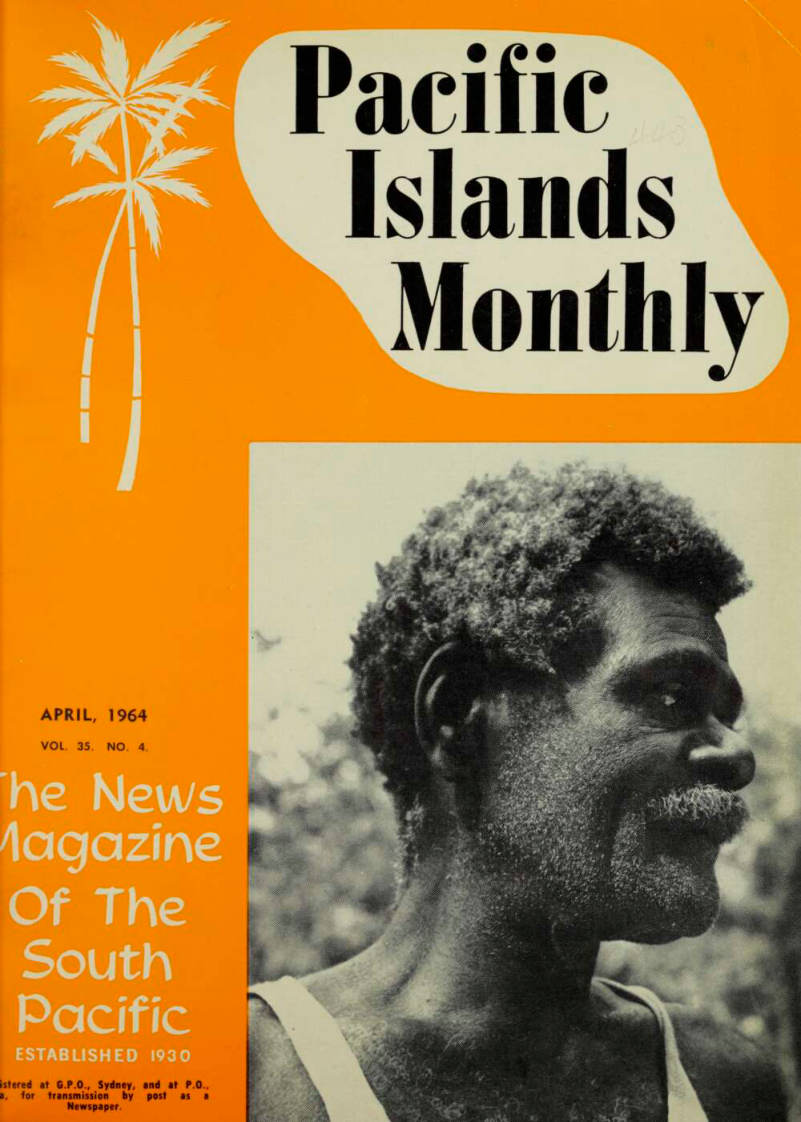 1
1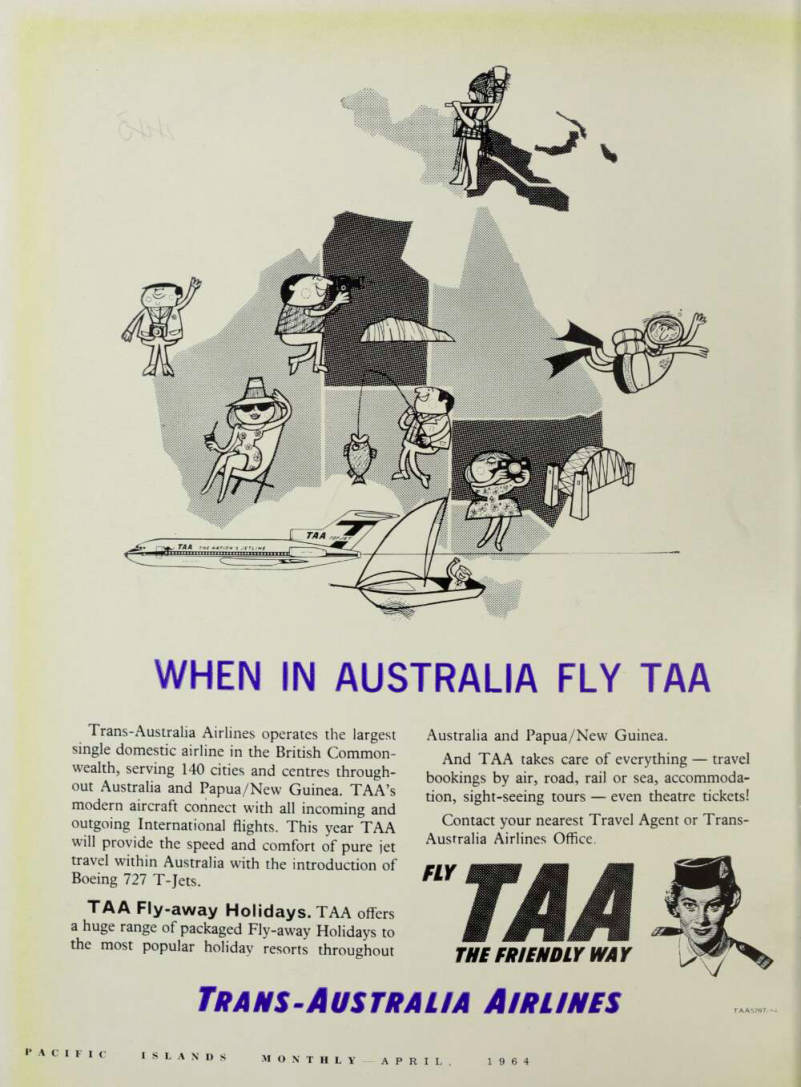 2
2 3
3 4
4 5
5 6
6 7
7 8
8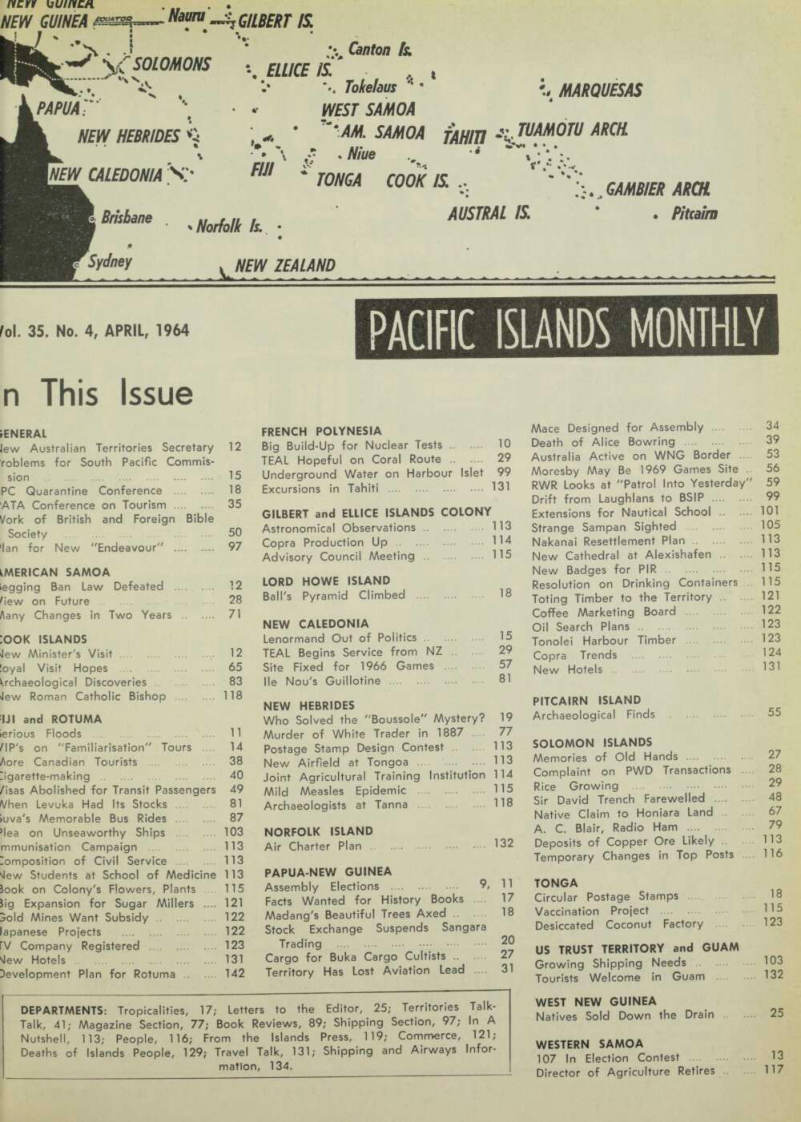 9
9 10
10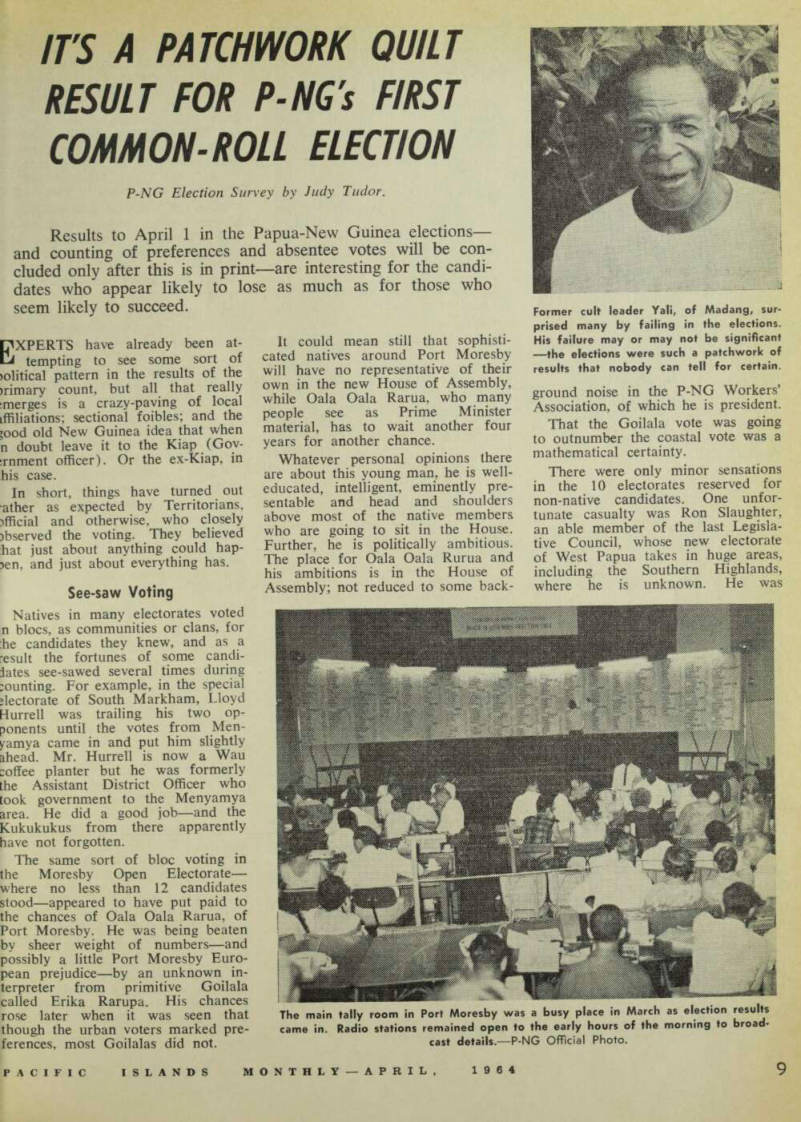 11
11 12
12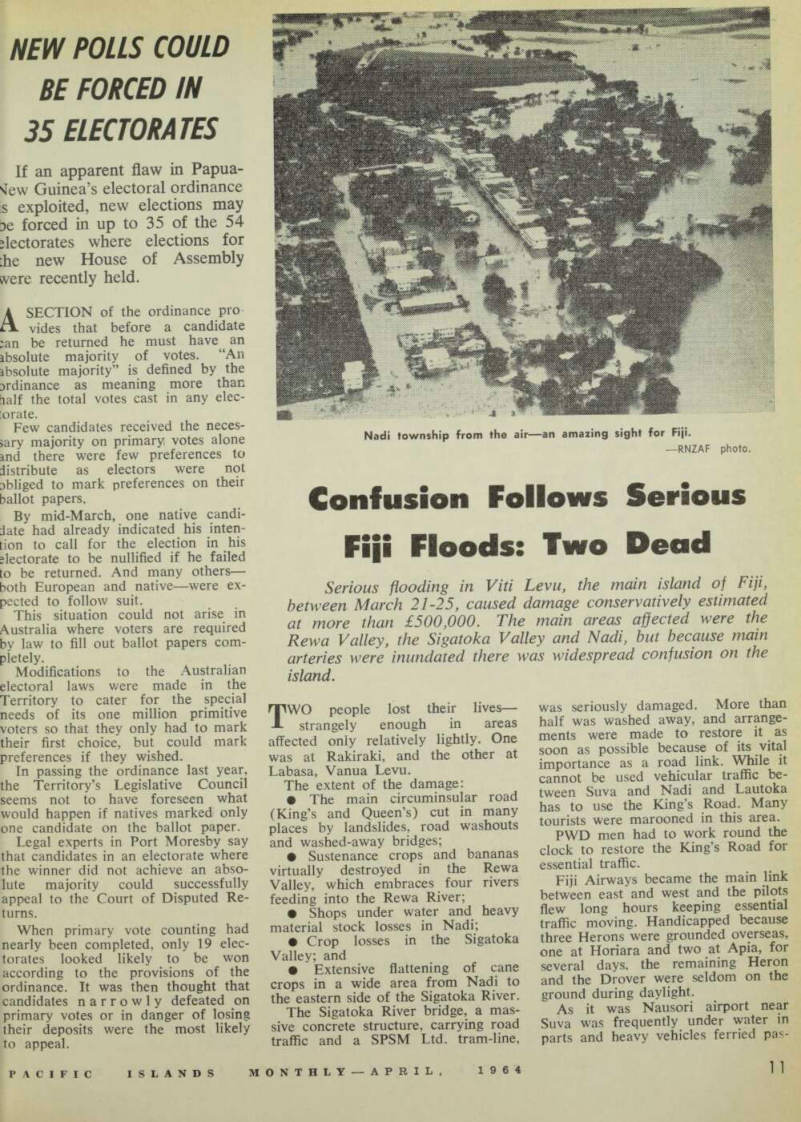 13
13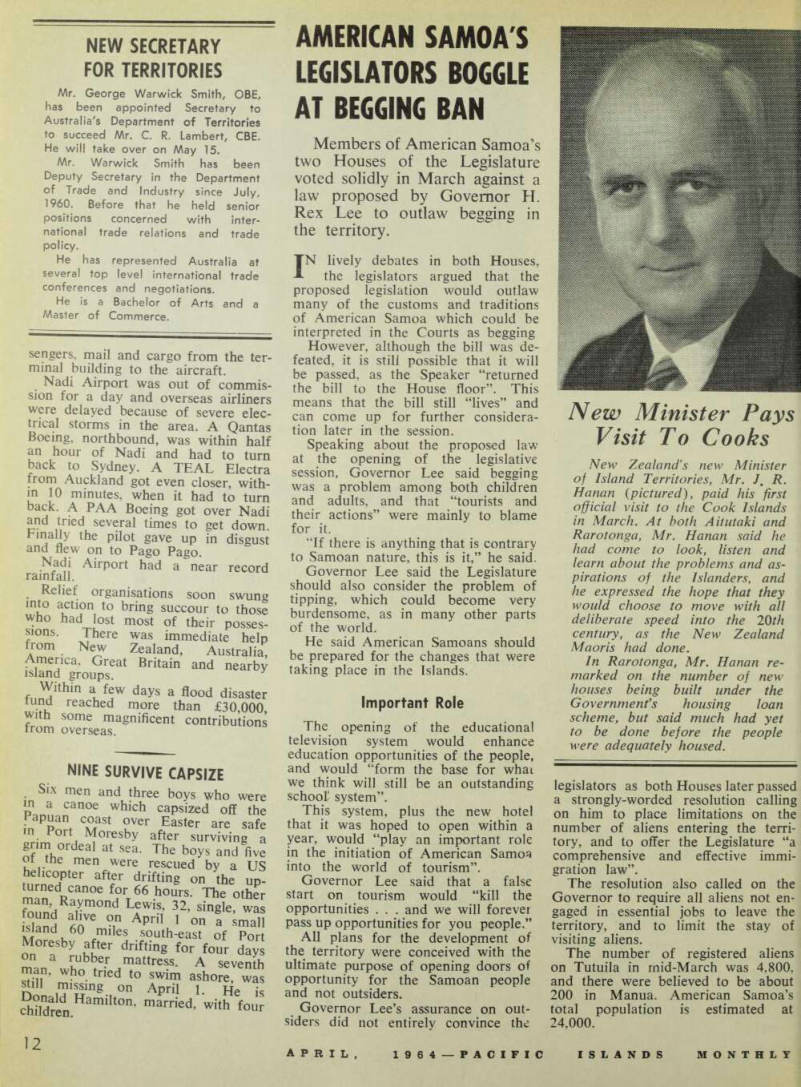 14
14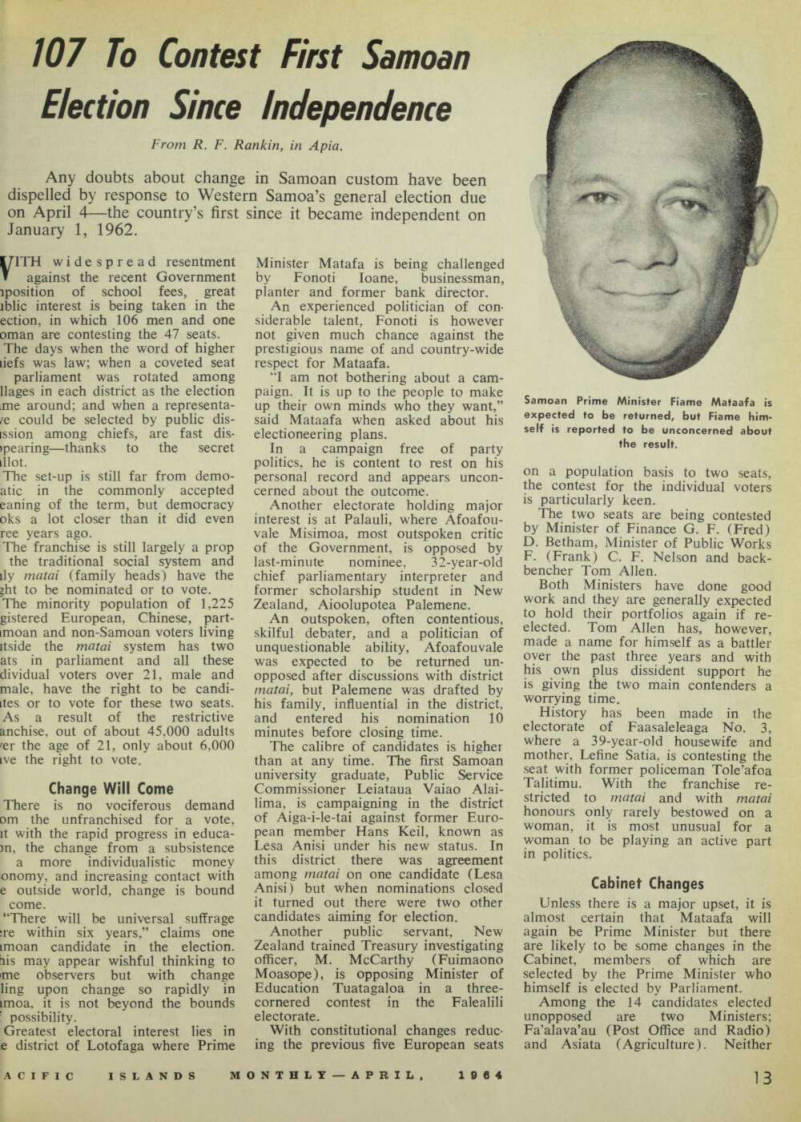 15
15 16
16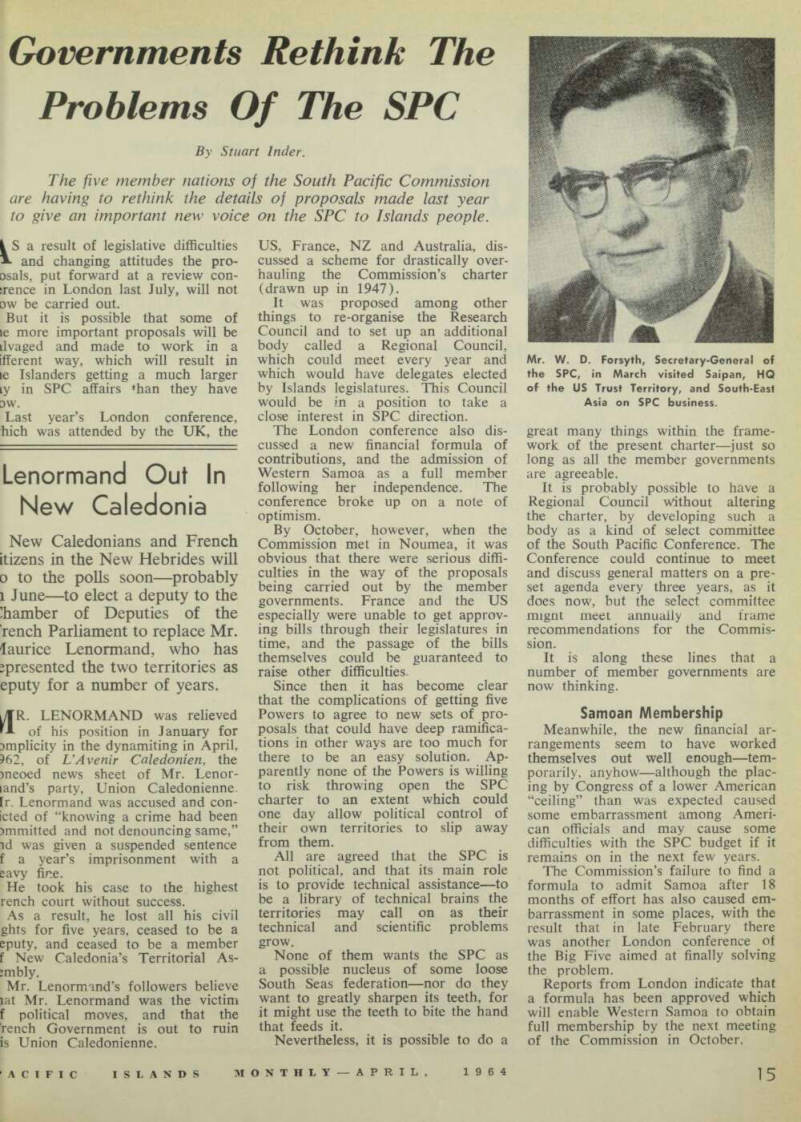 17
17 18
18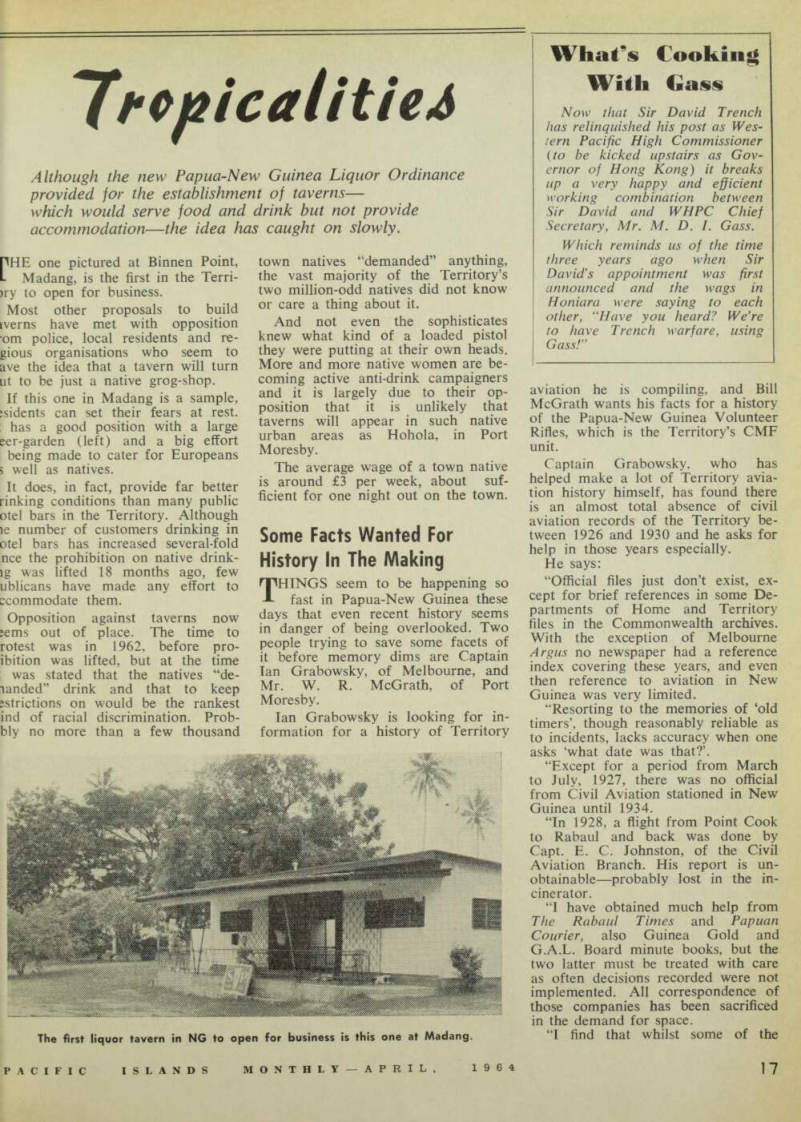 19
19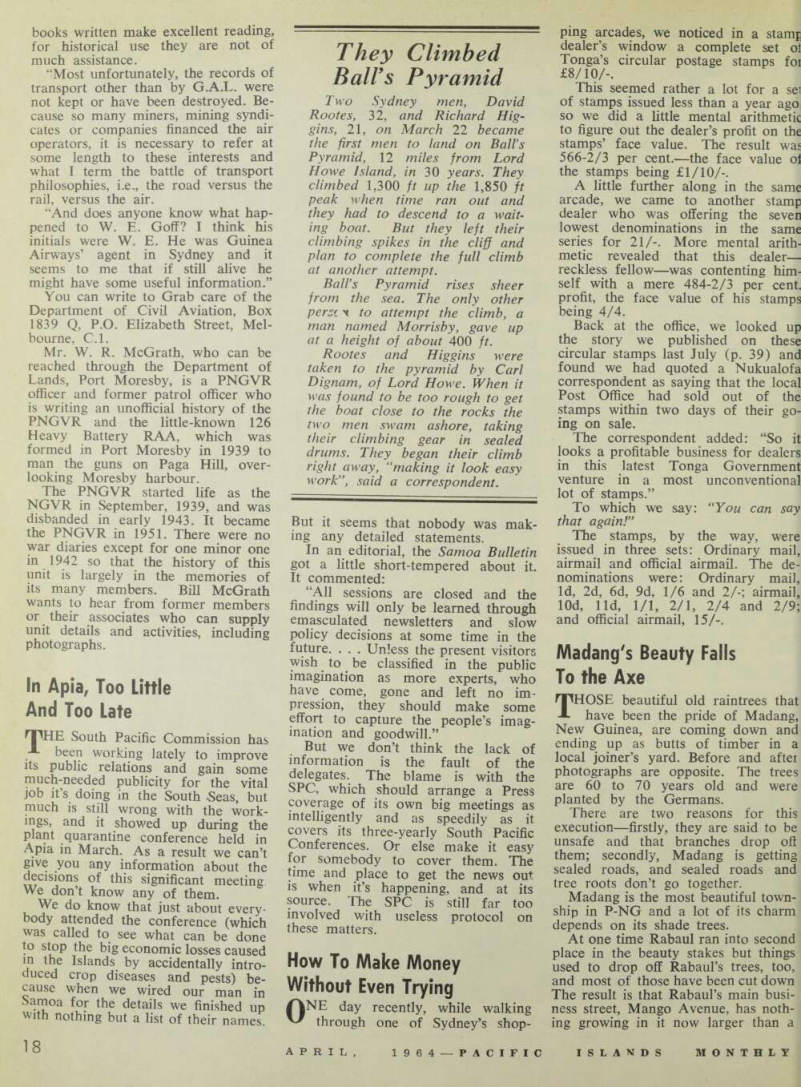 20
20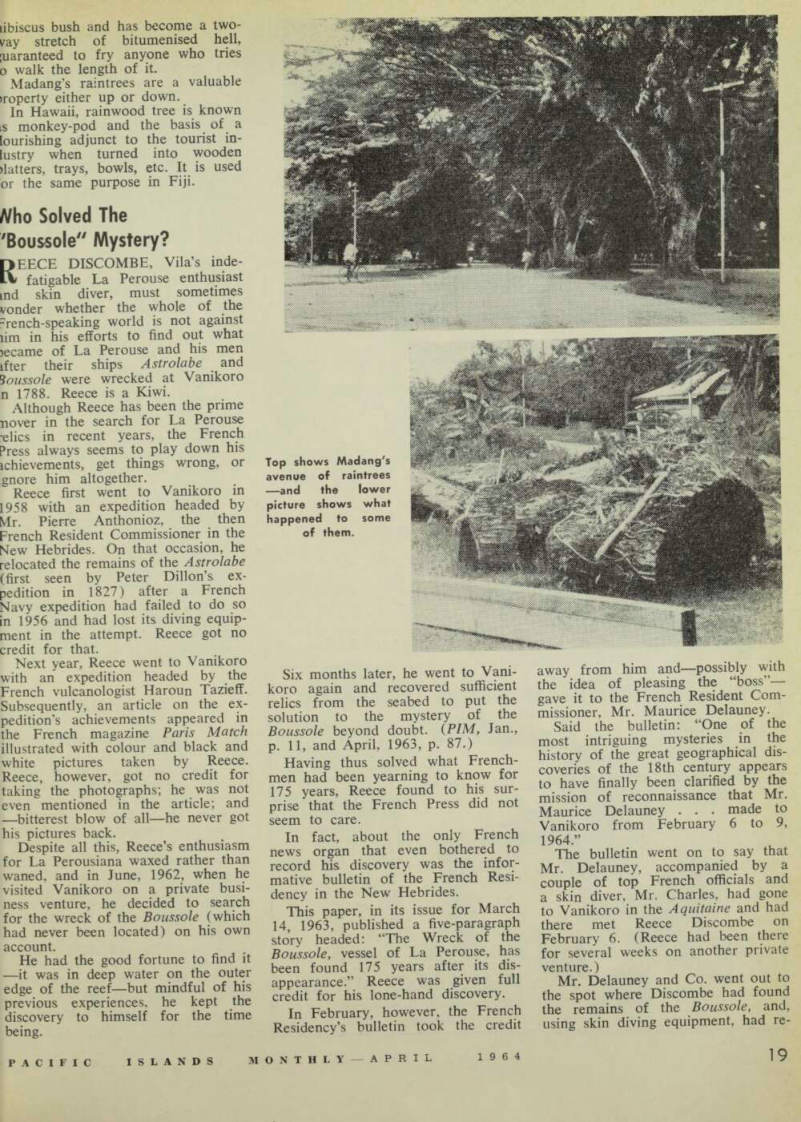 21
21 22
22 23
23 24
24 25
25 26
26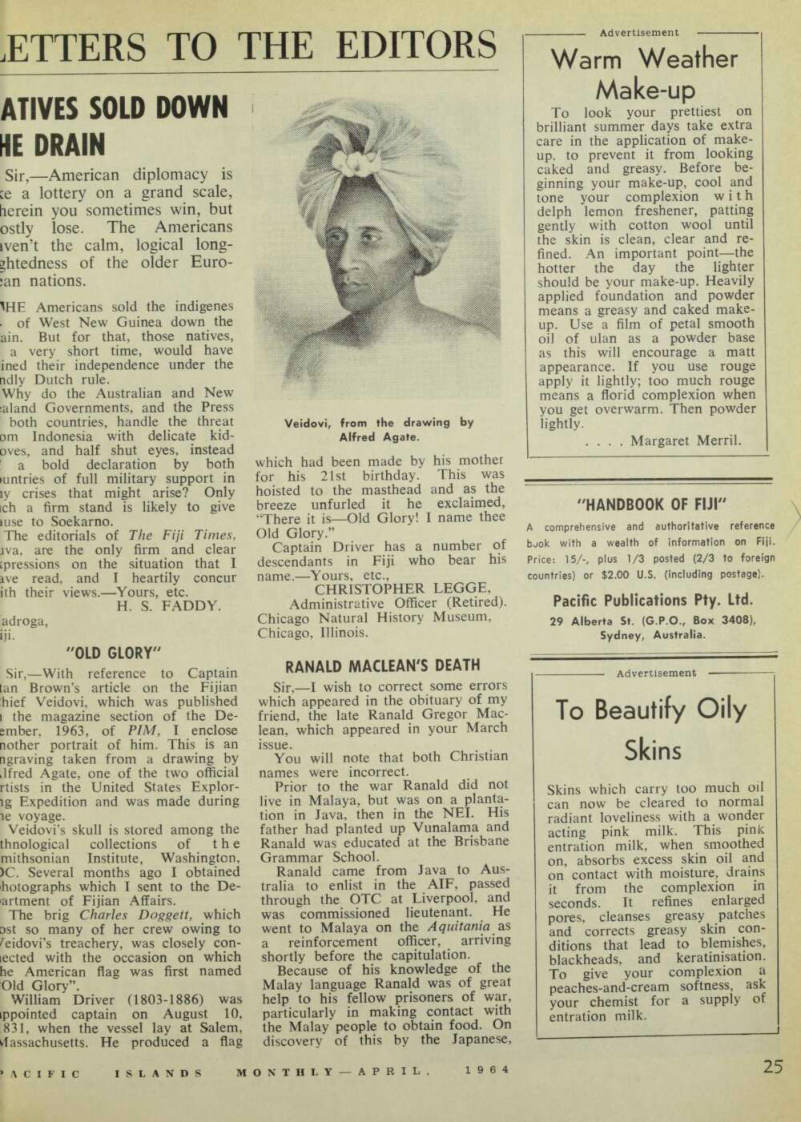 27
27 28
28 29
29 30
30 31
31 32
32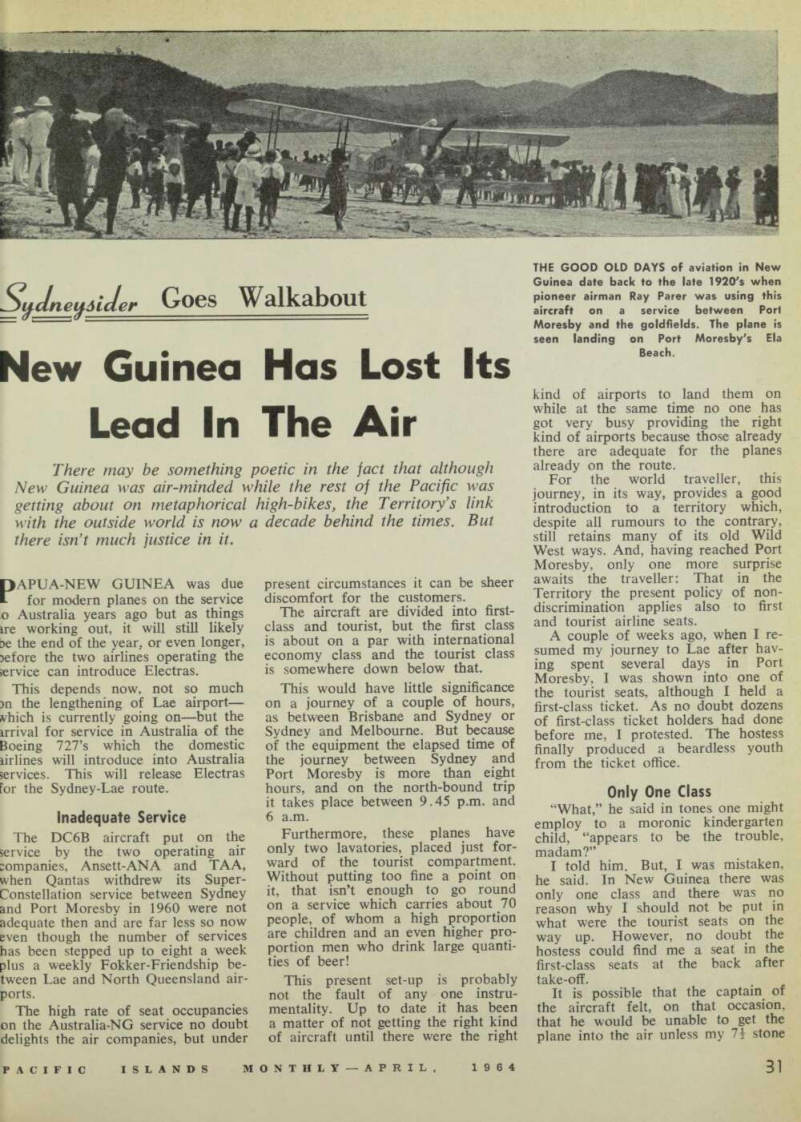 33
33 34
34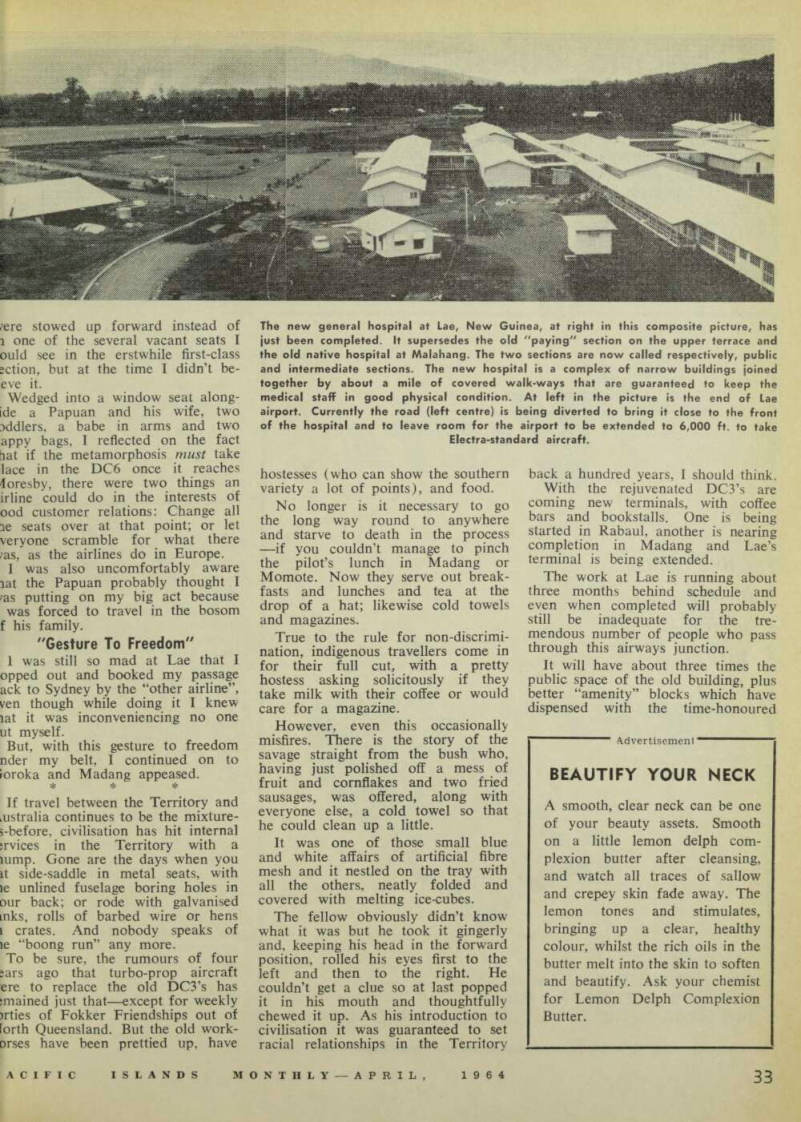 35
35 36
36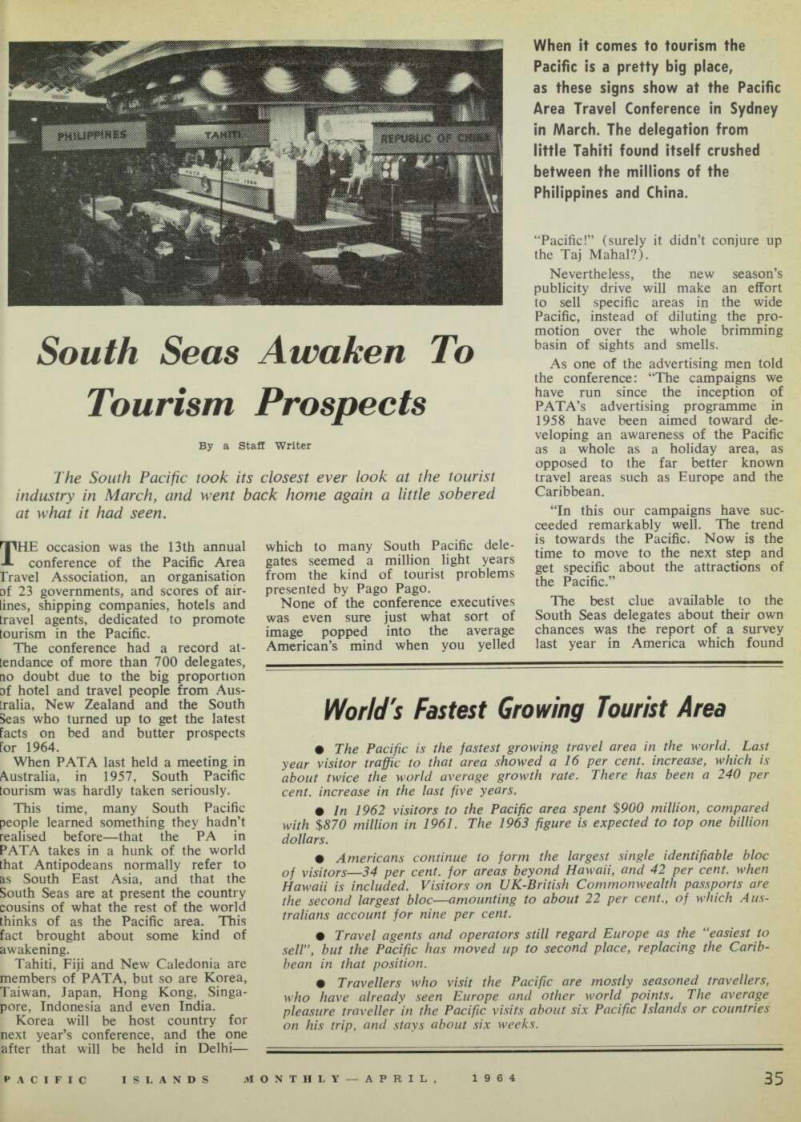 37
37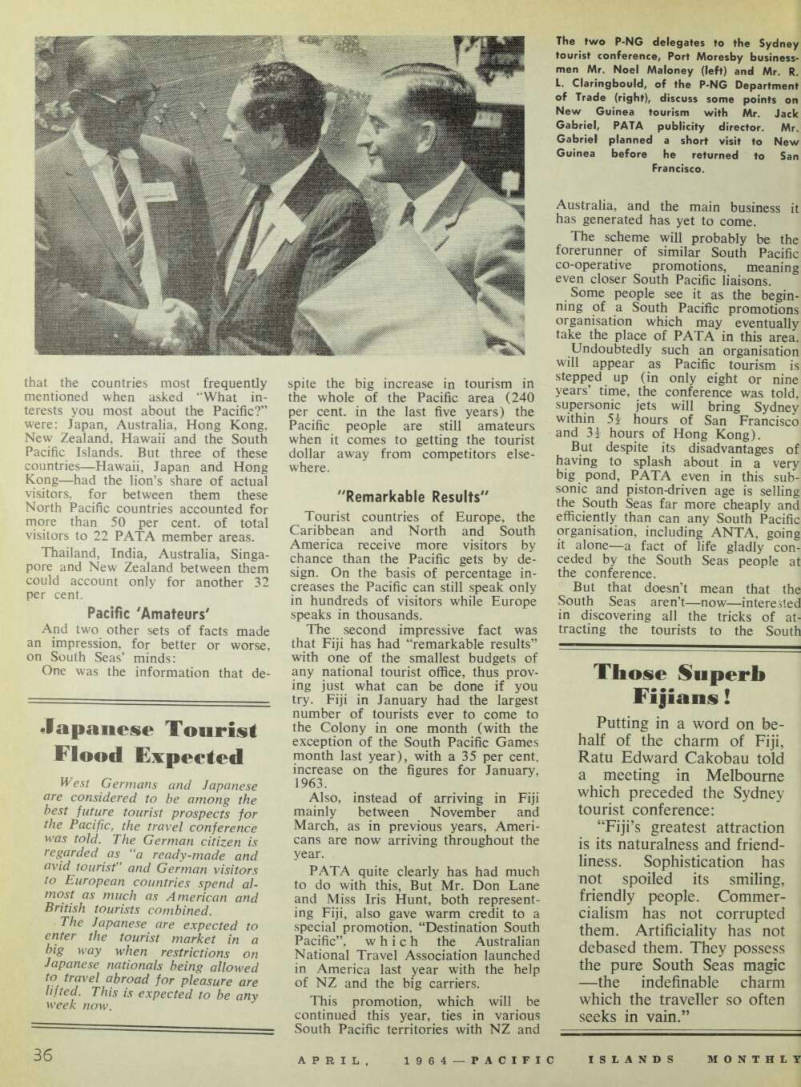 38
38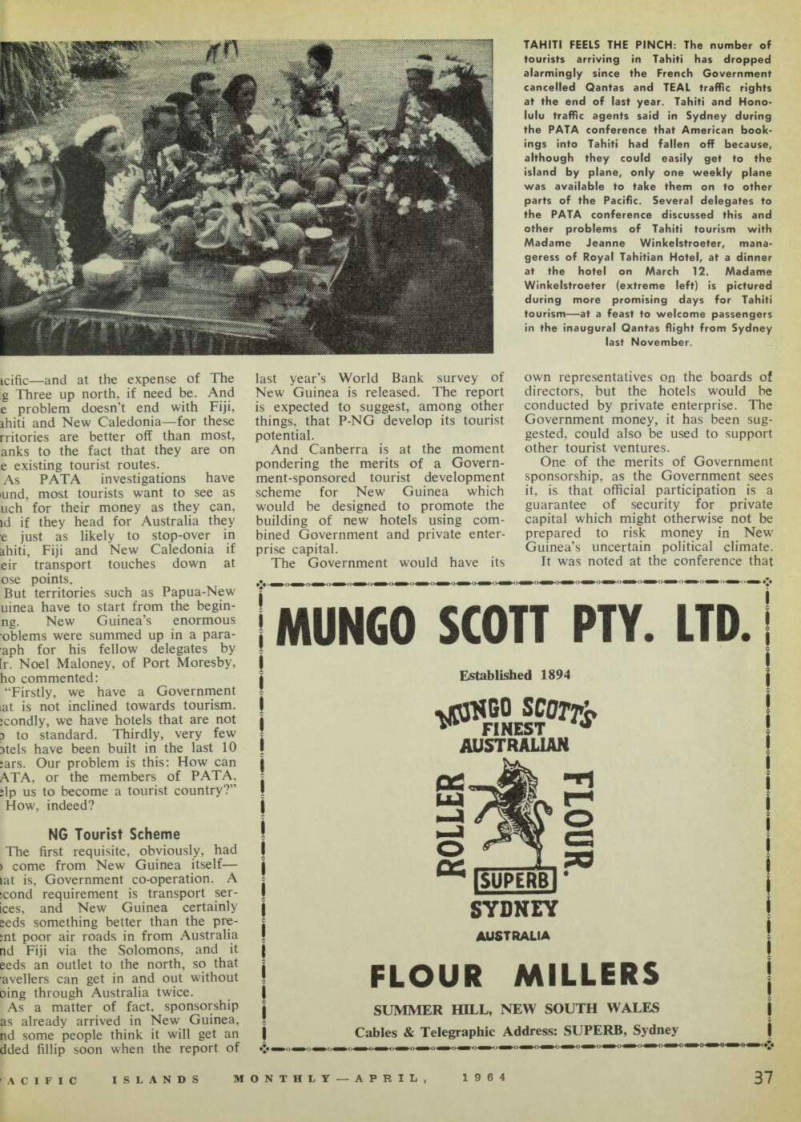 39
39 40
40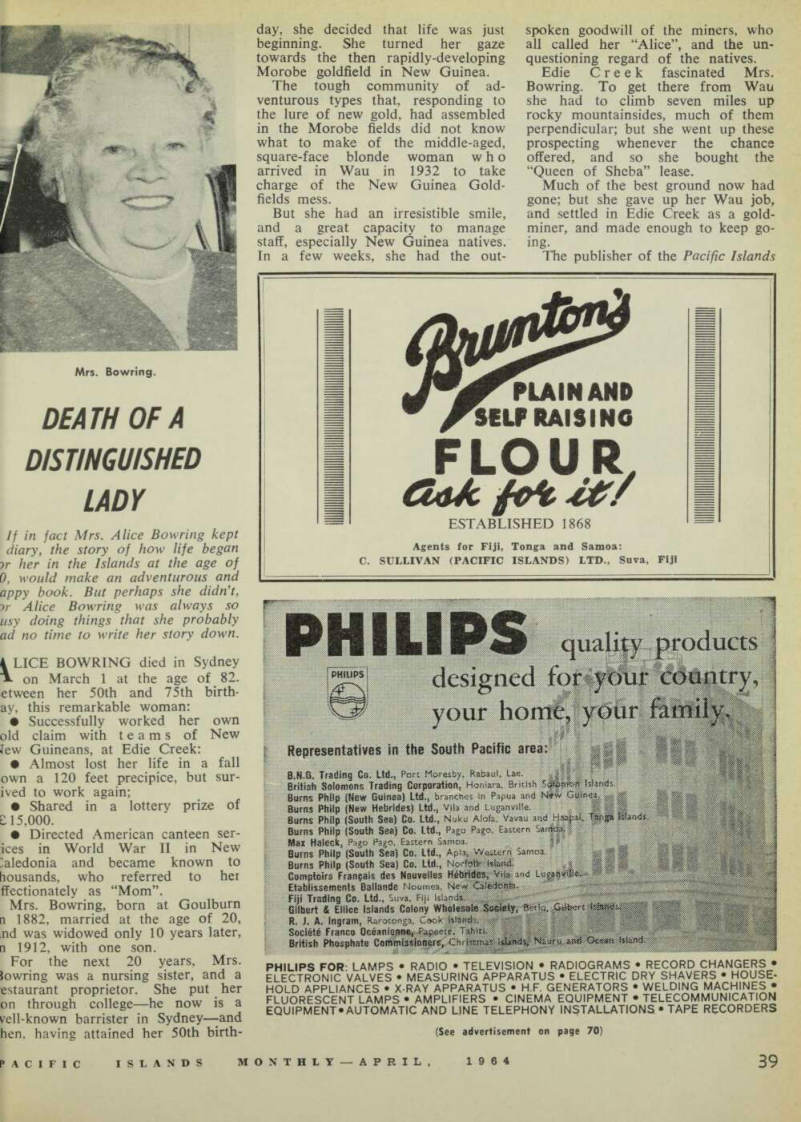 41
41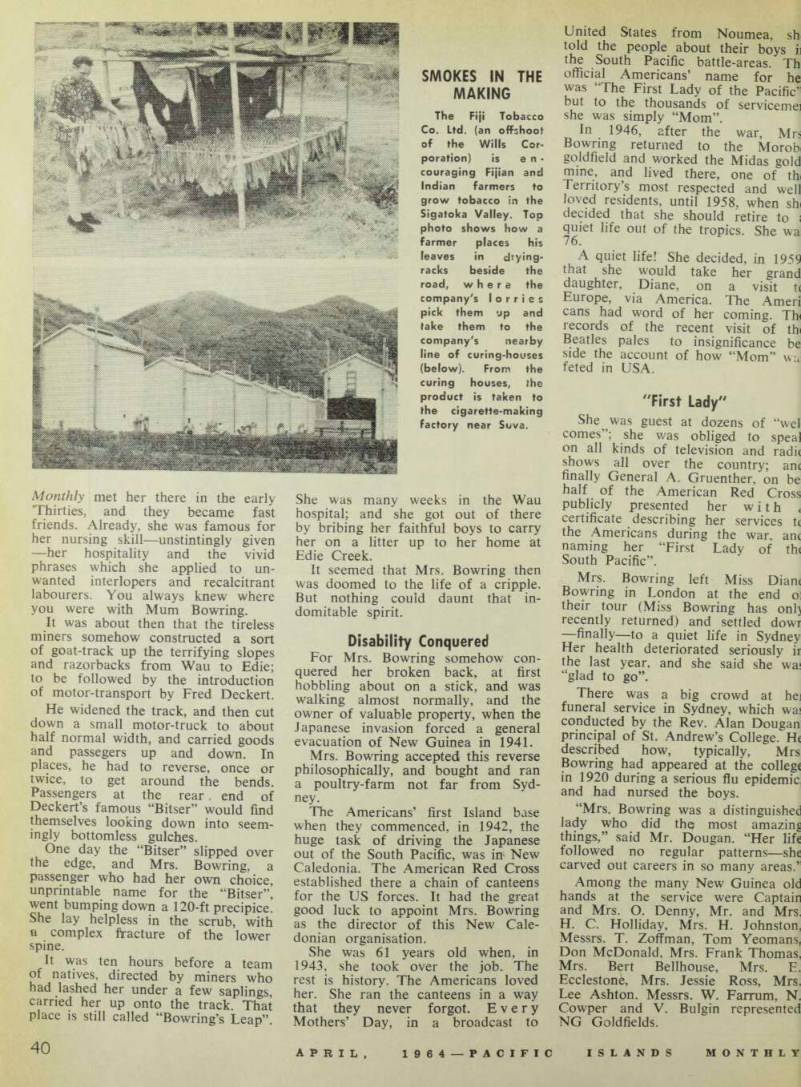 42
42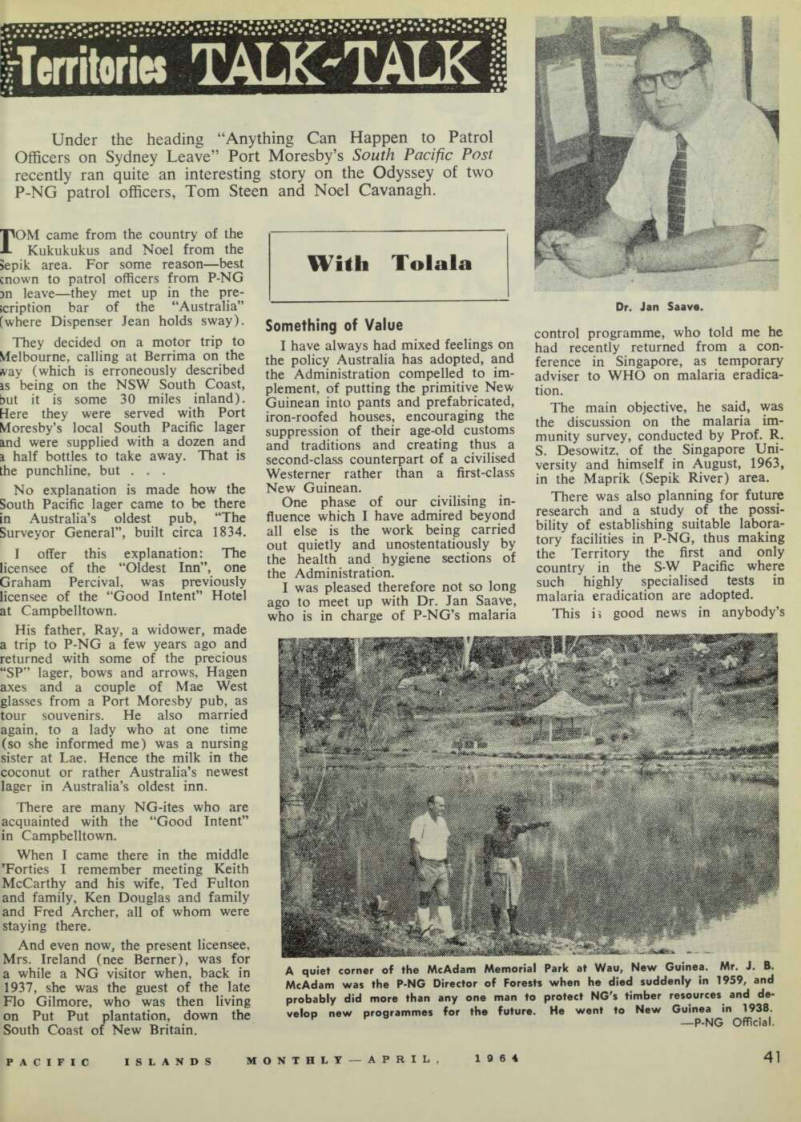 43
43 44
44 45
45 46
46 47
47 48
48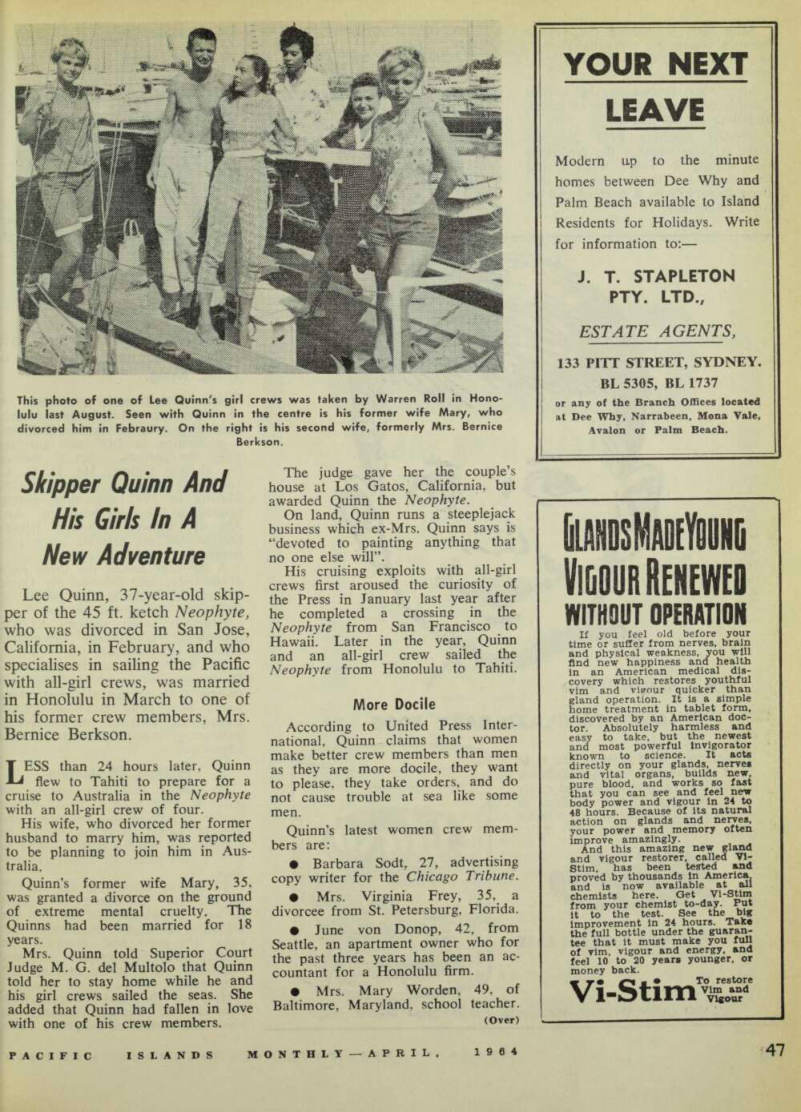 49
49 50
50 51
51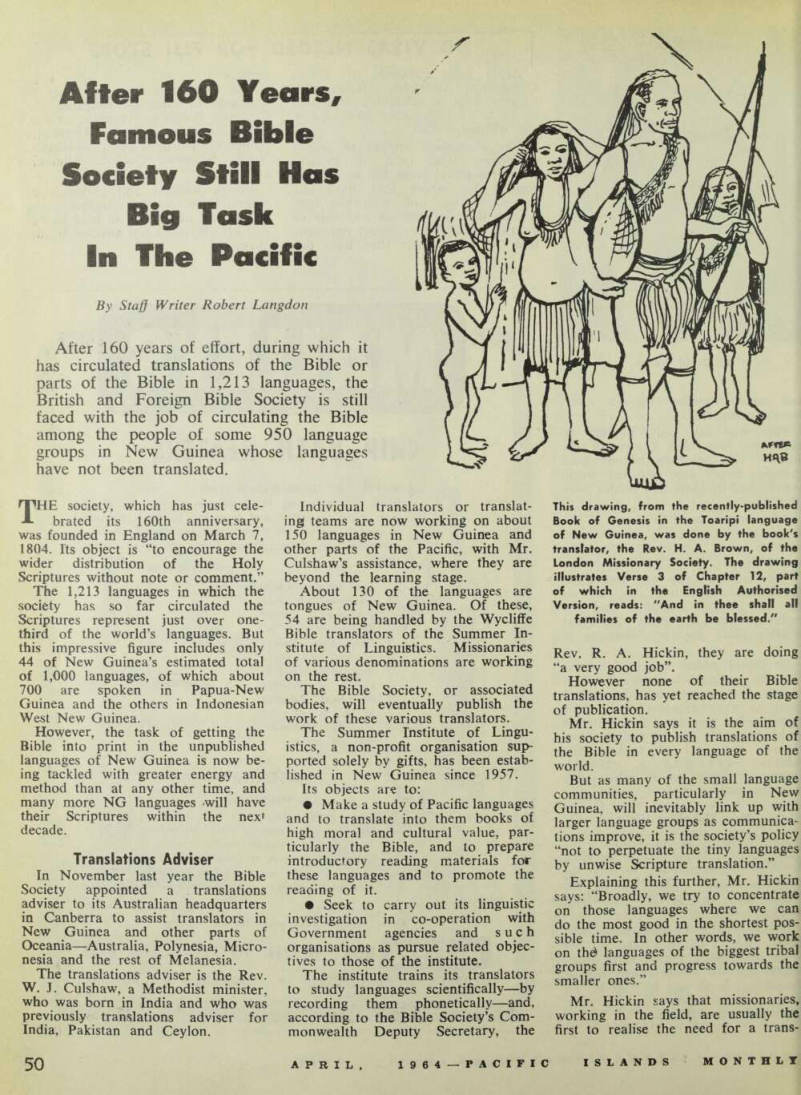 52
52 53
53 54
54 55
55 56
56 57
57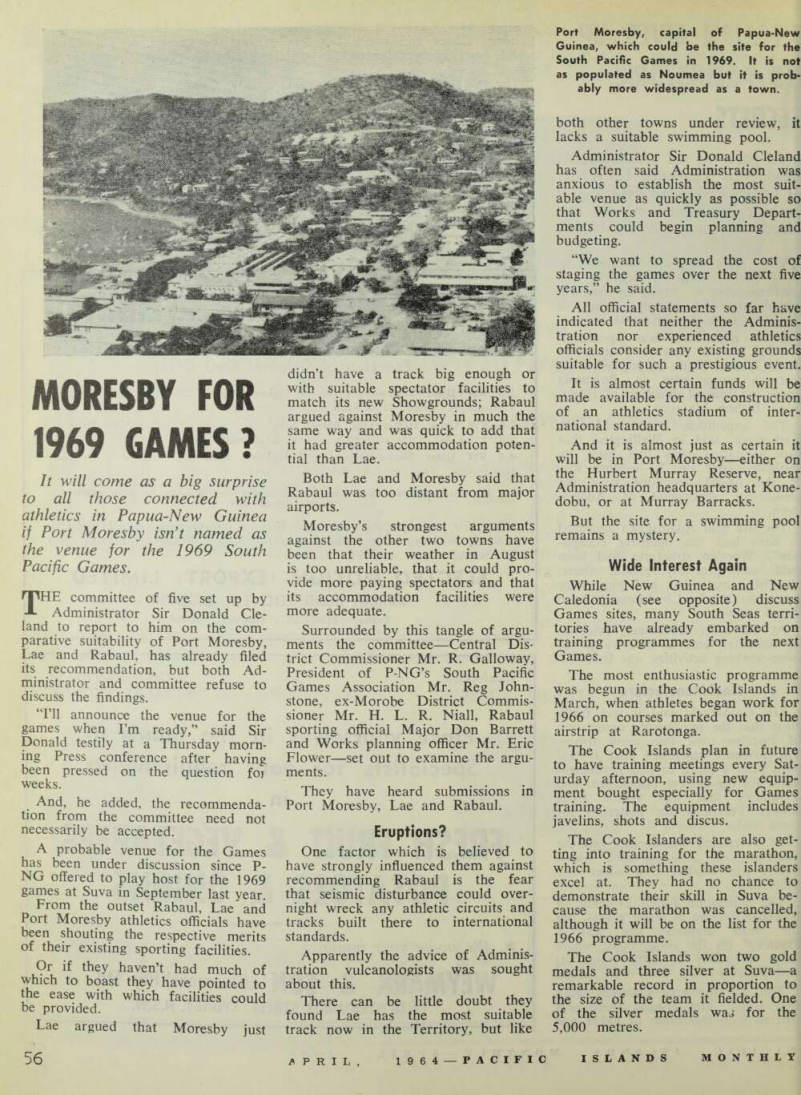 58
58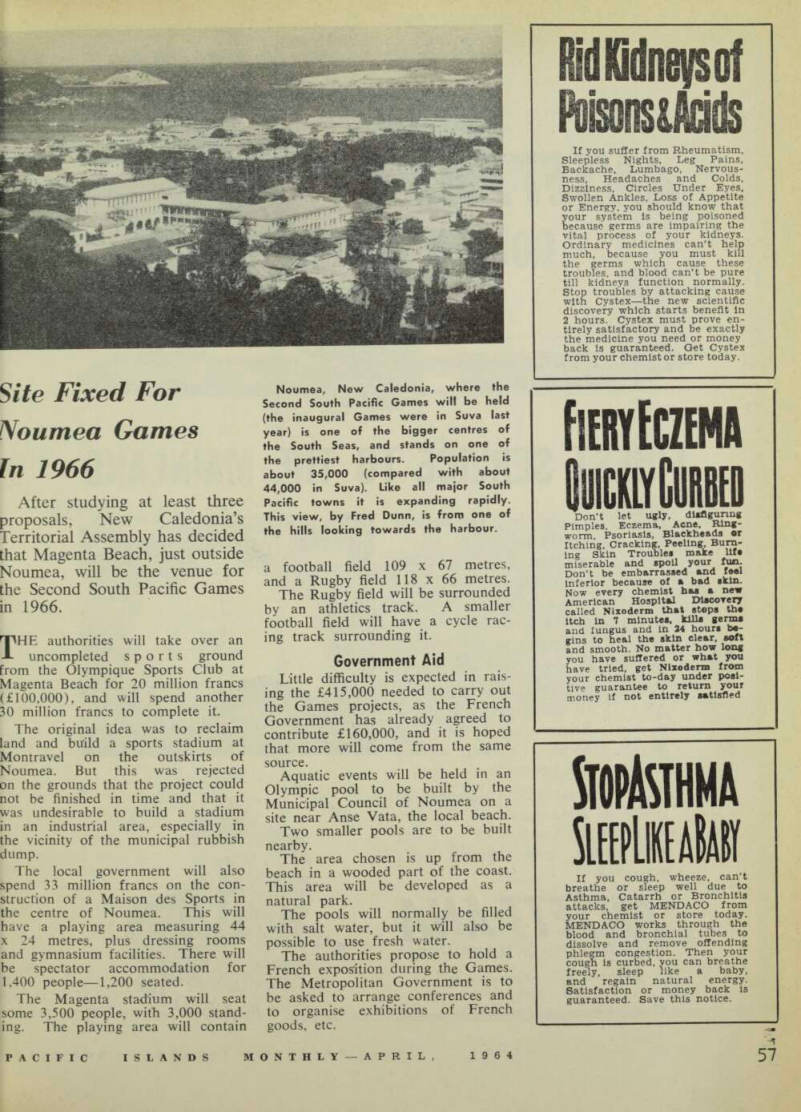 59
59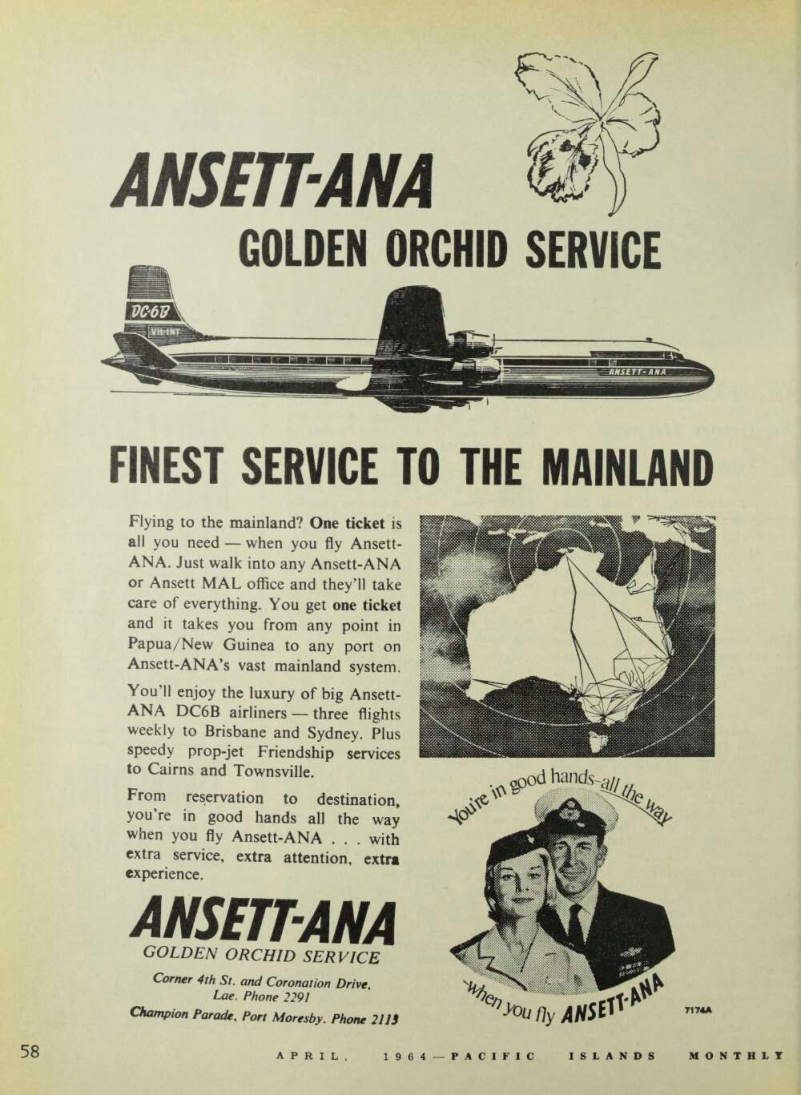 60
60 61
61 62
62 63
63 64
64 65
65 66
66 67
67 68
68 69
69 70
70 71
71 72
72 73
73 74
74 75
75 76
76 77
77 78
78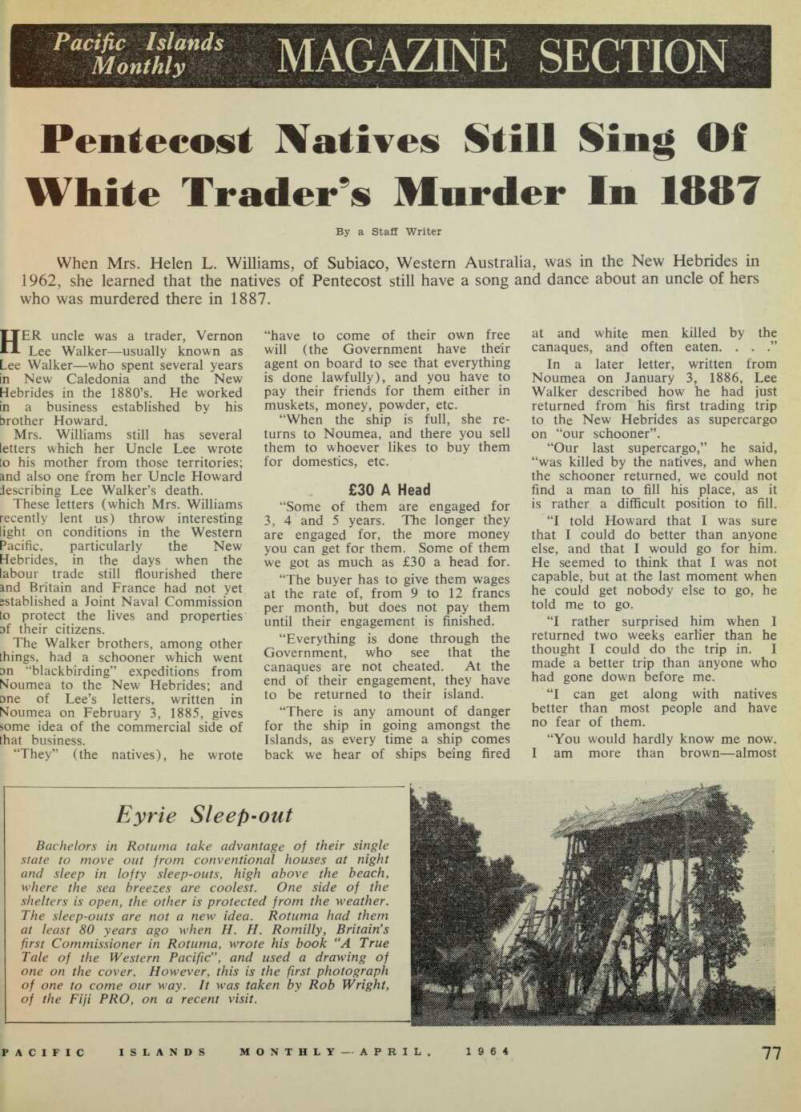 79
79 80
80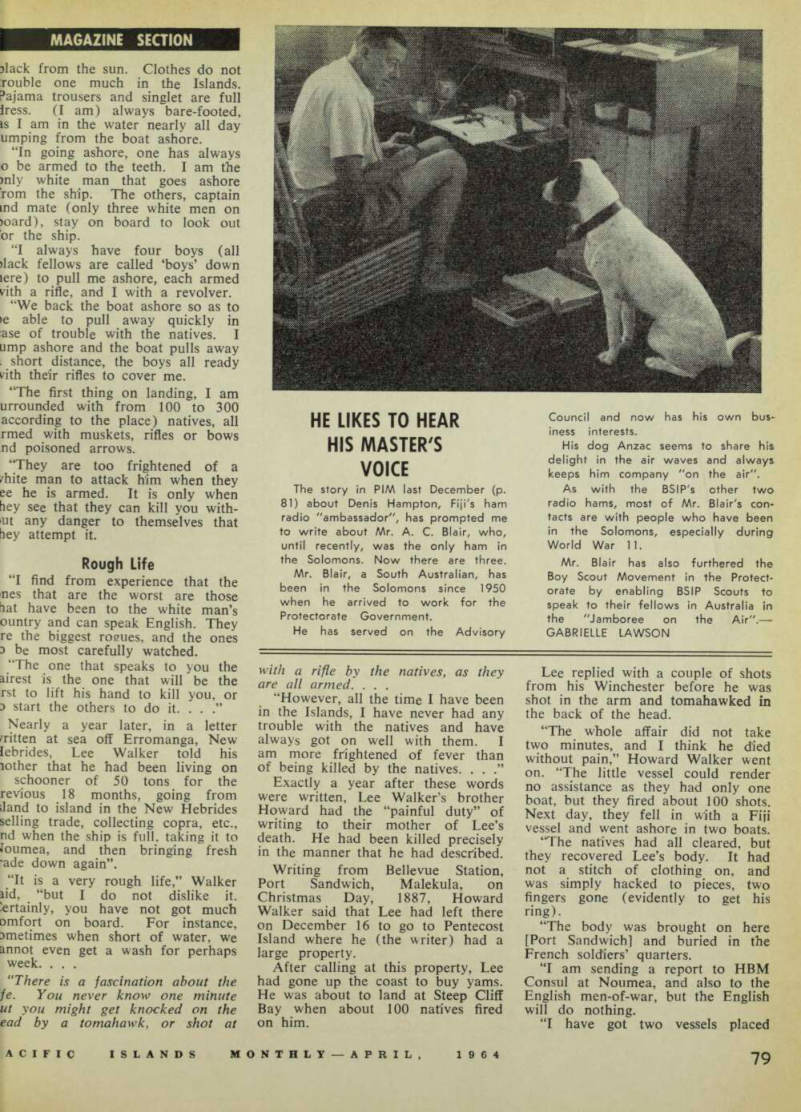 81
81 82
82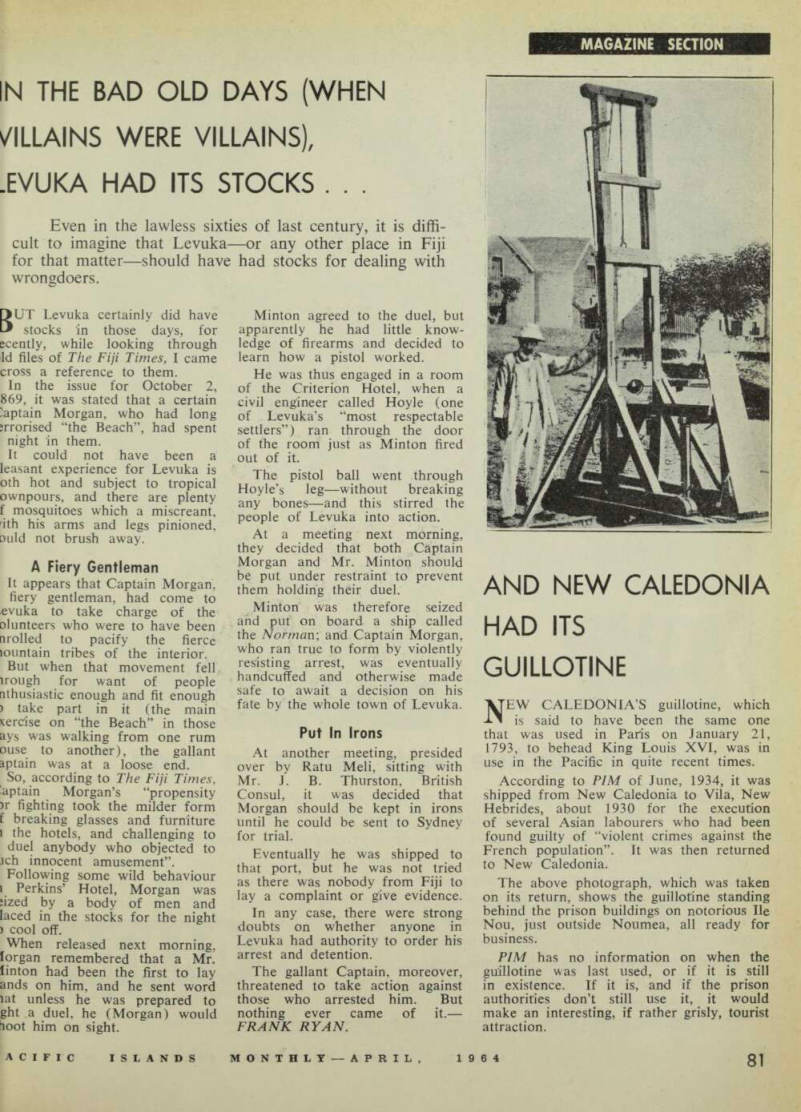 83
83 84
84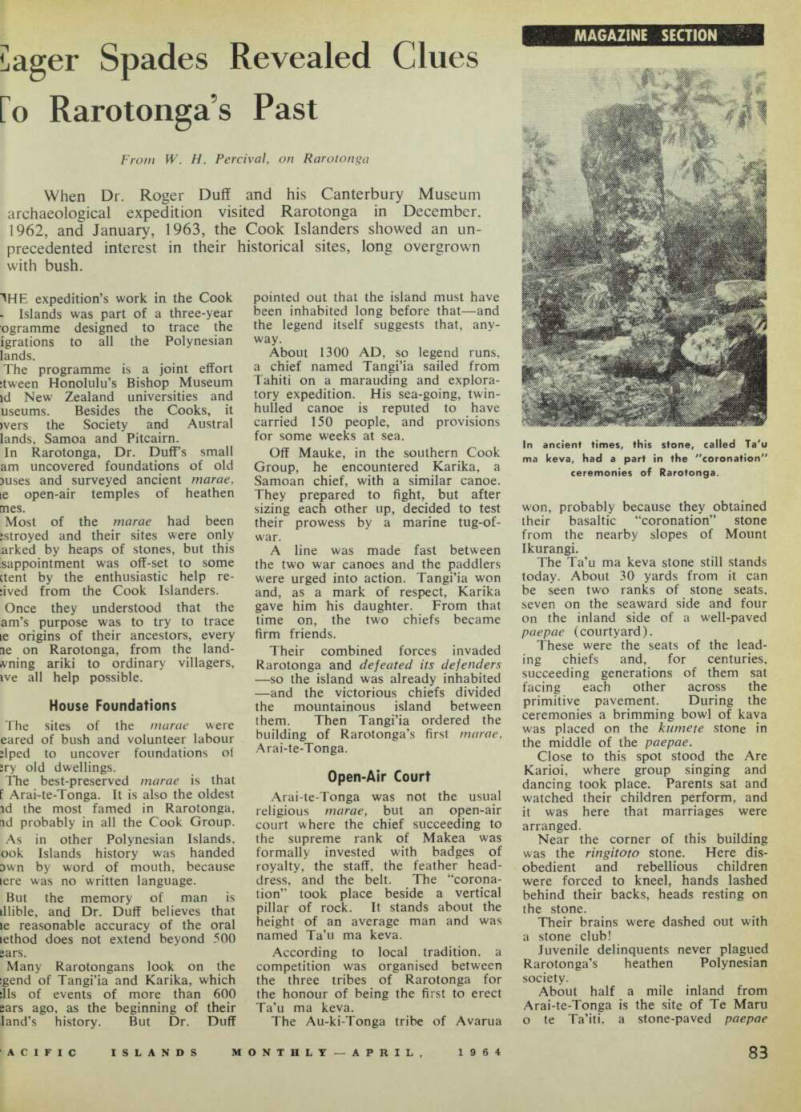 85
85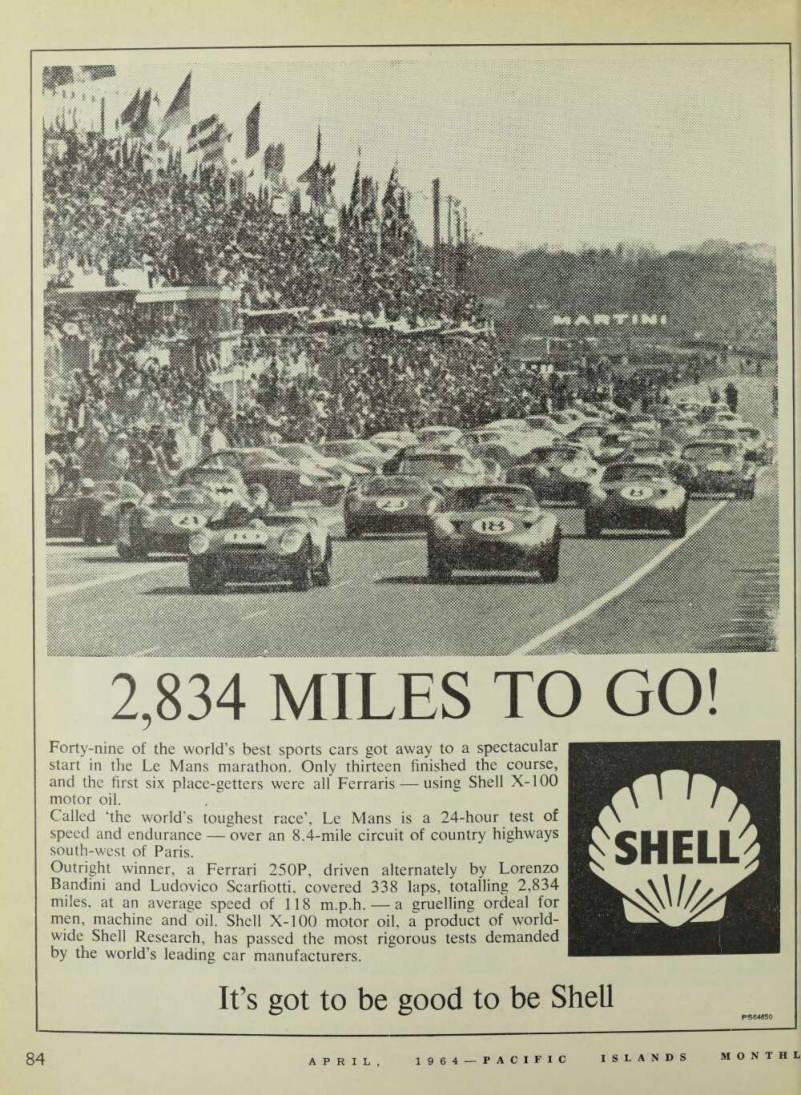 86
86 87
87 88
88 89
89 90
90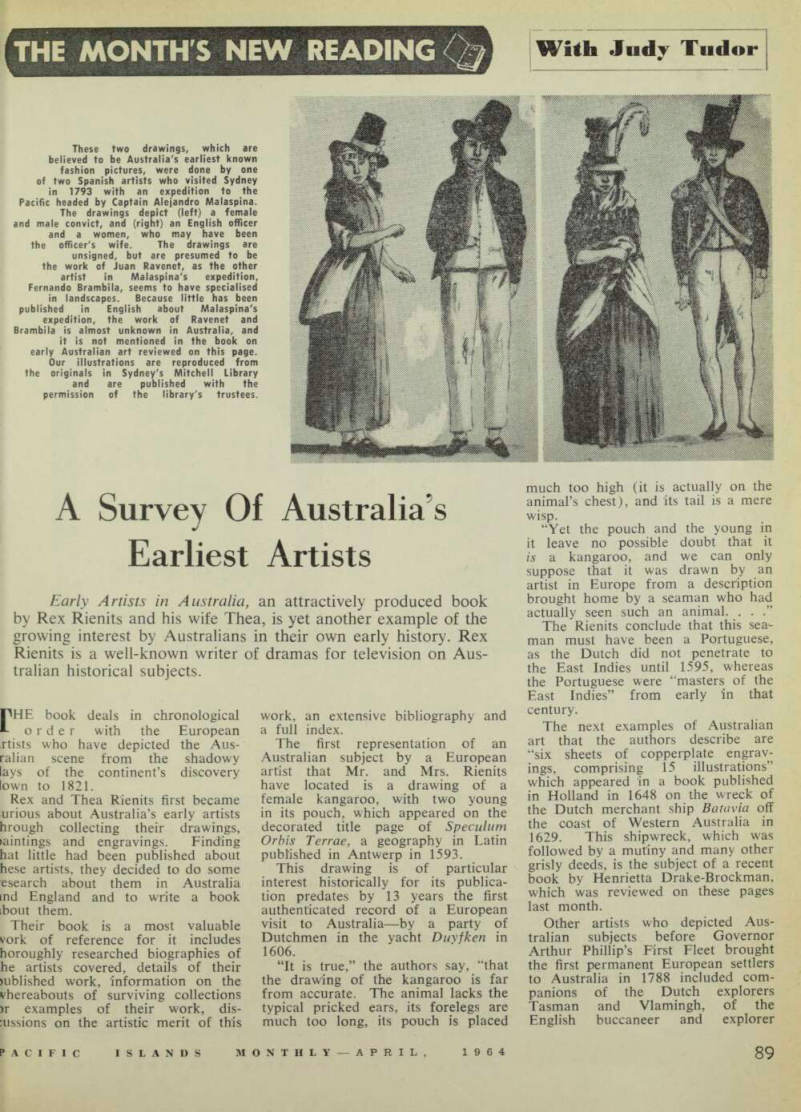 91
91 92
92 93
93 94
94 95
95 96
96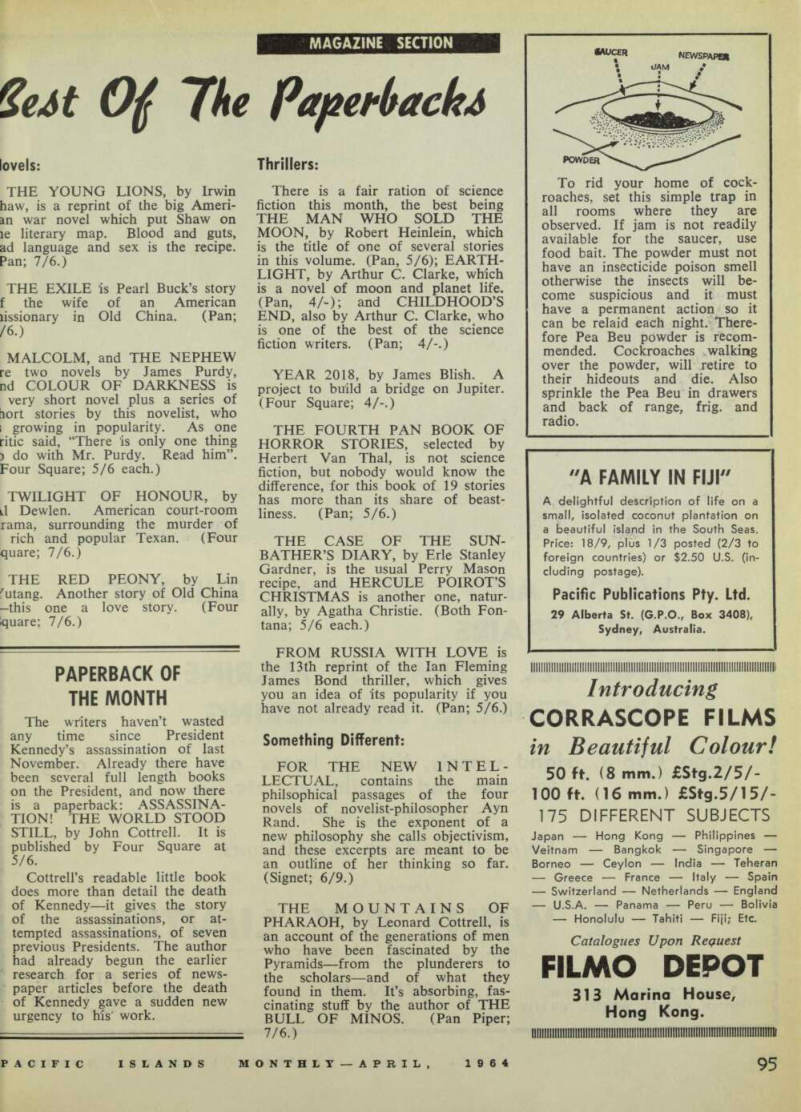 97
97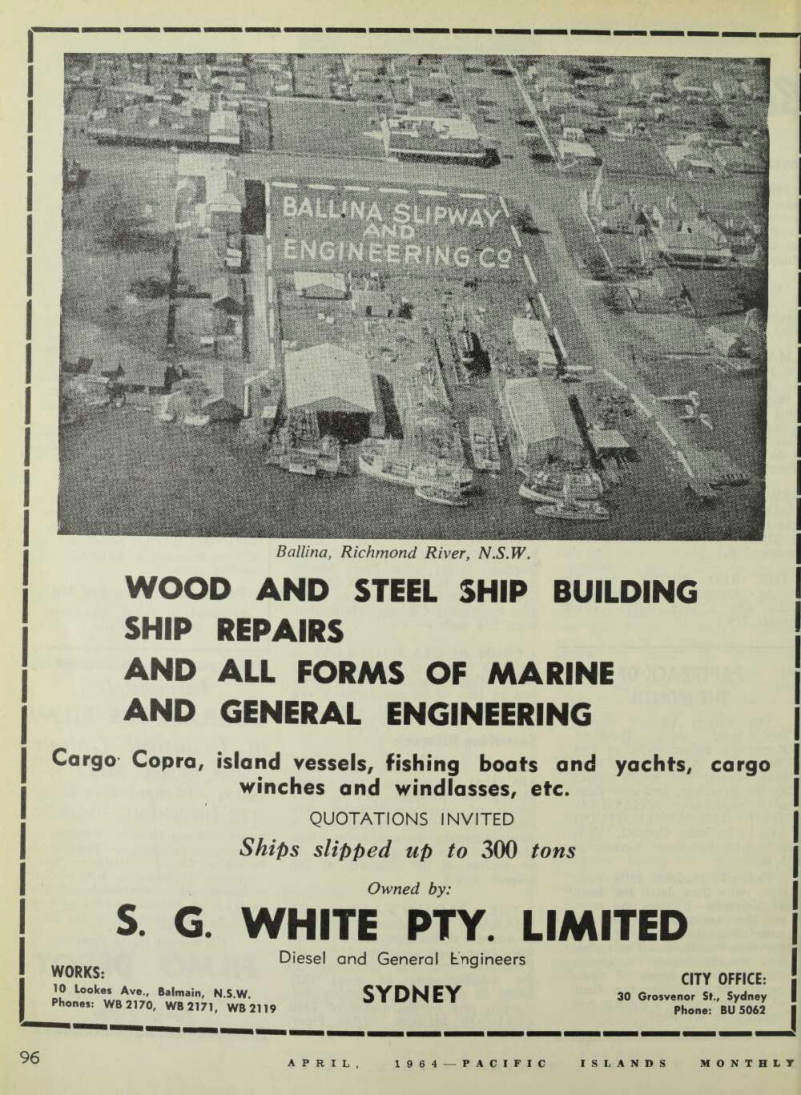 98
98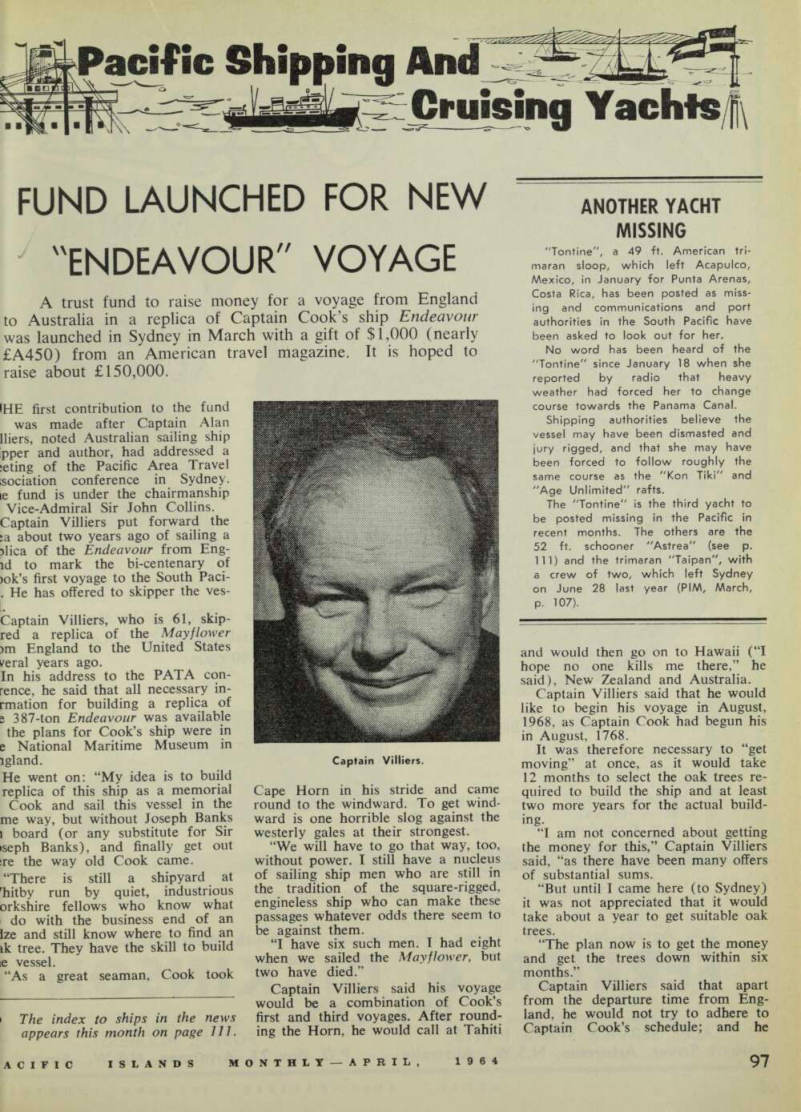 99
99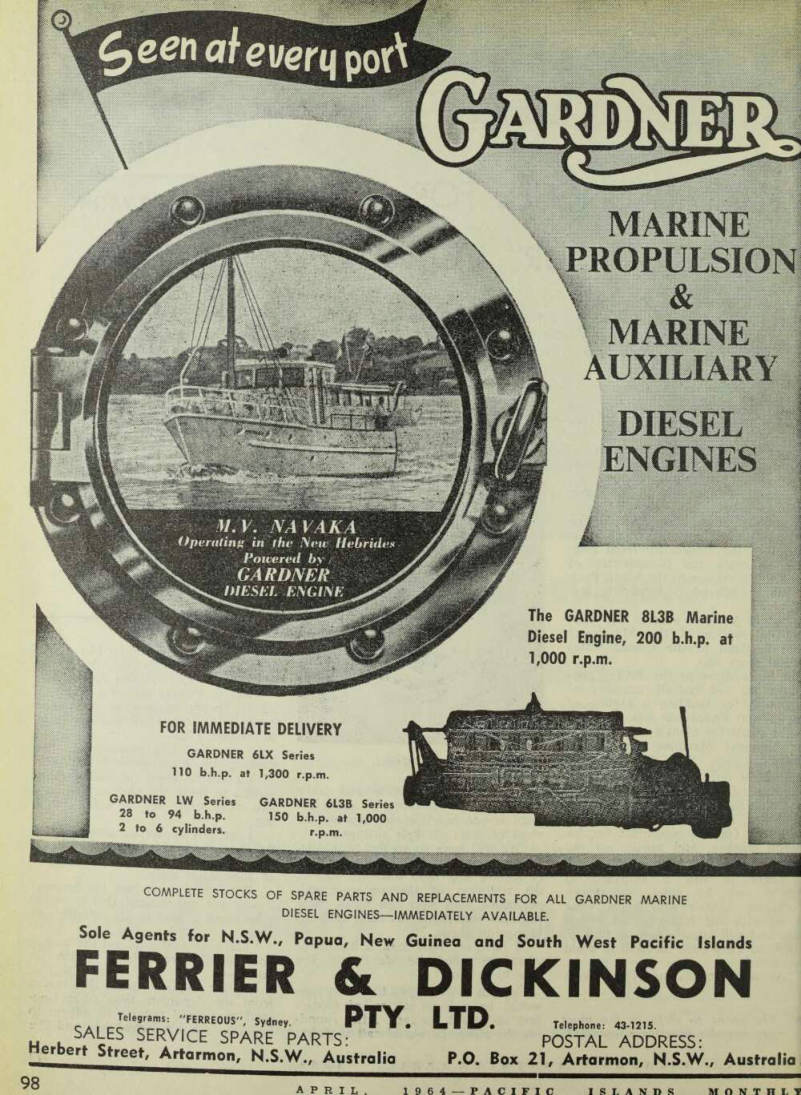 100
100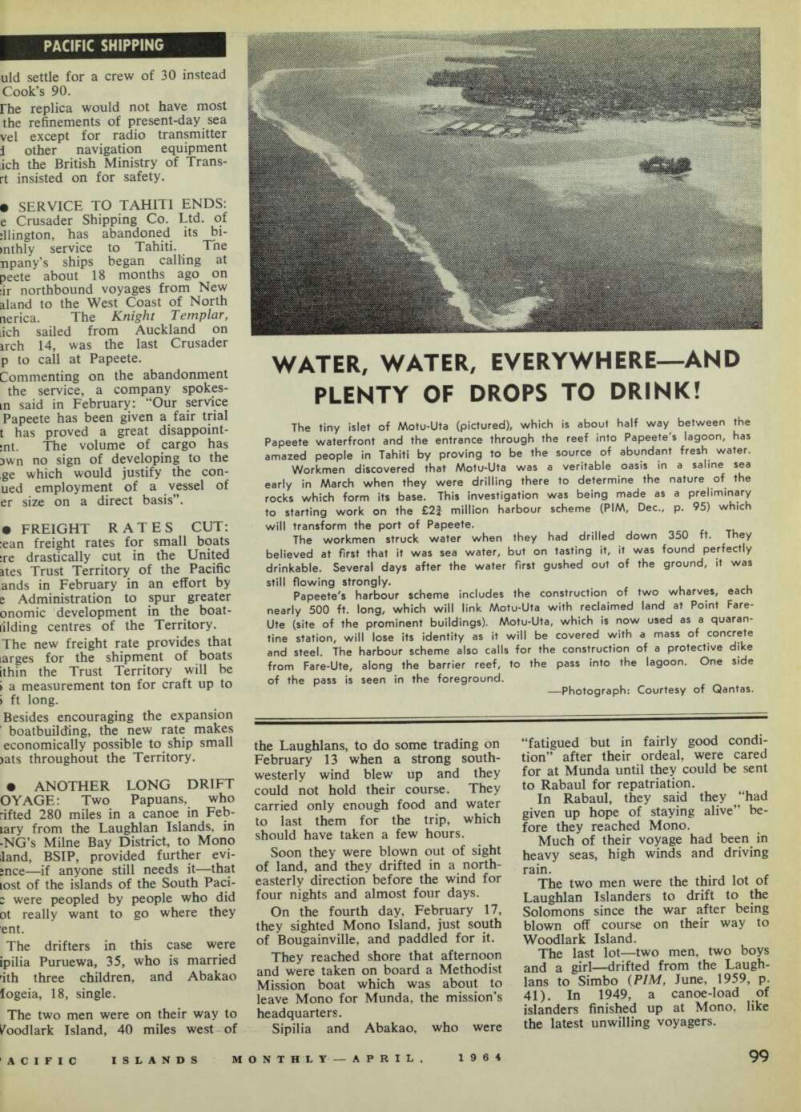 101
101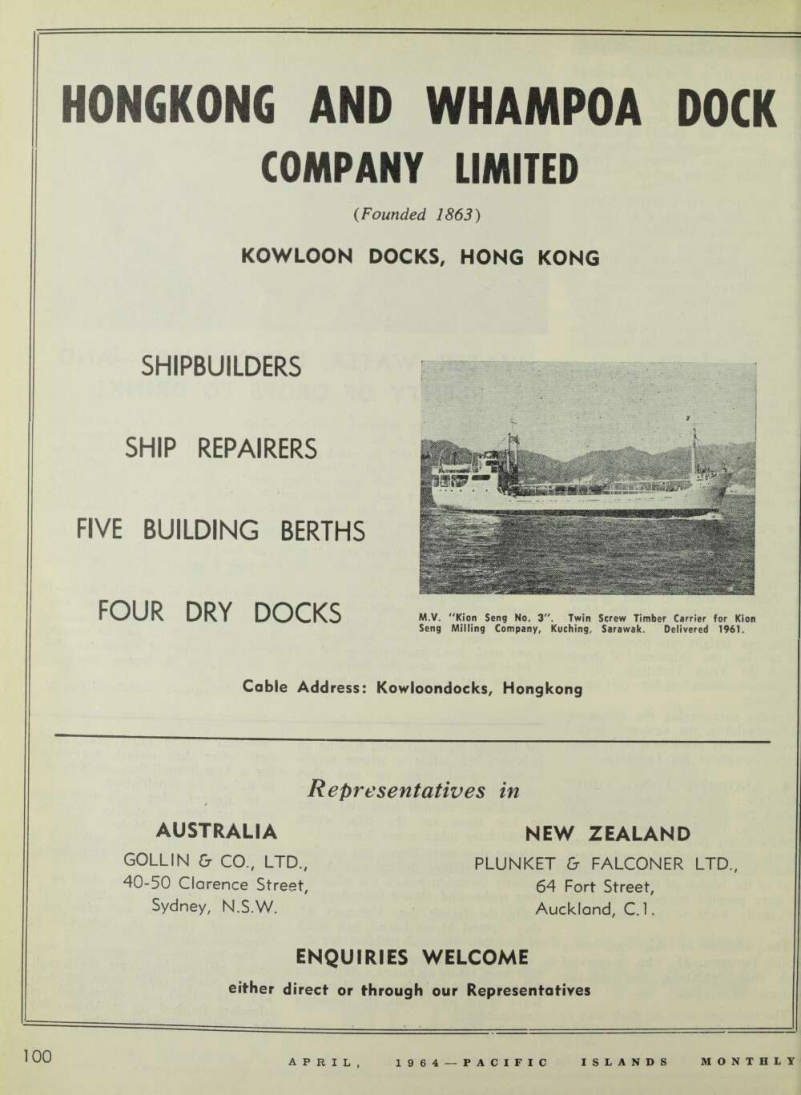 102
102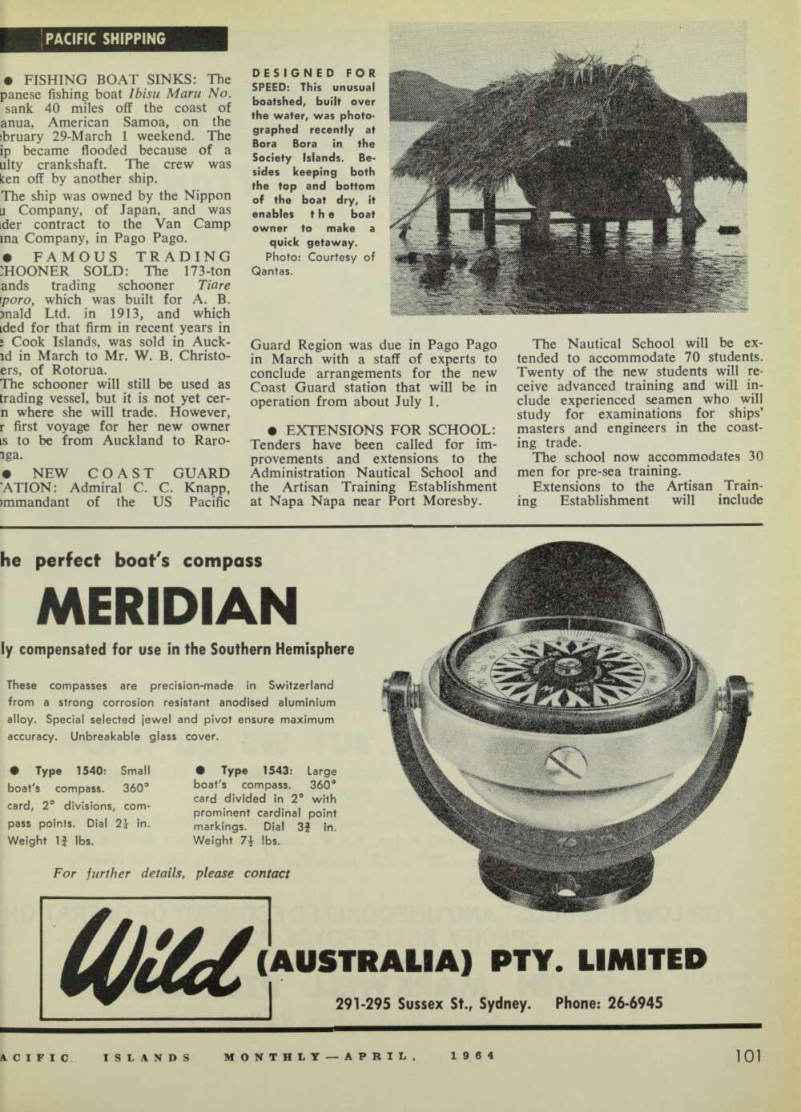 103
103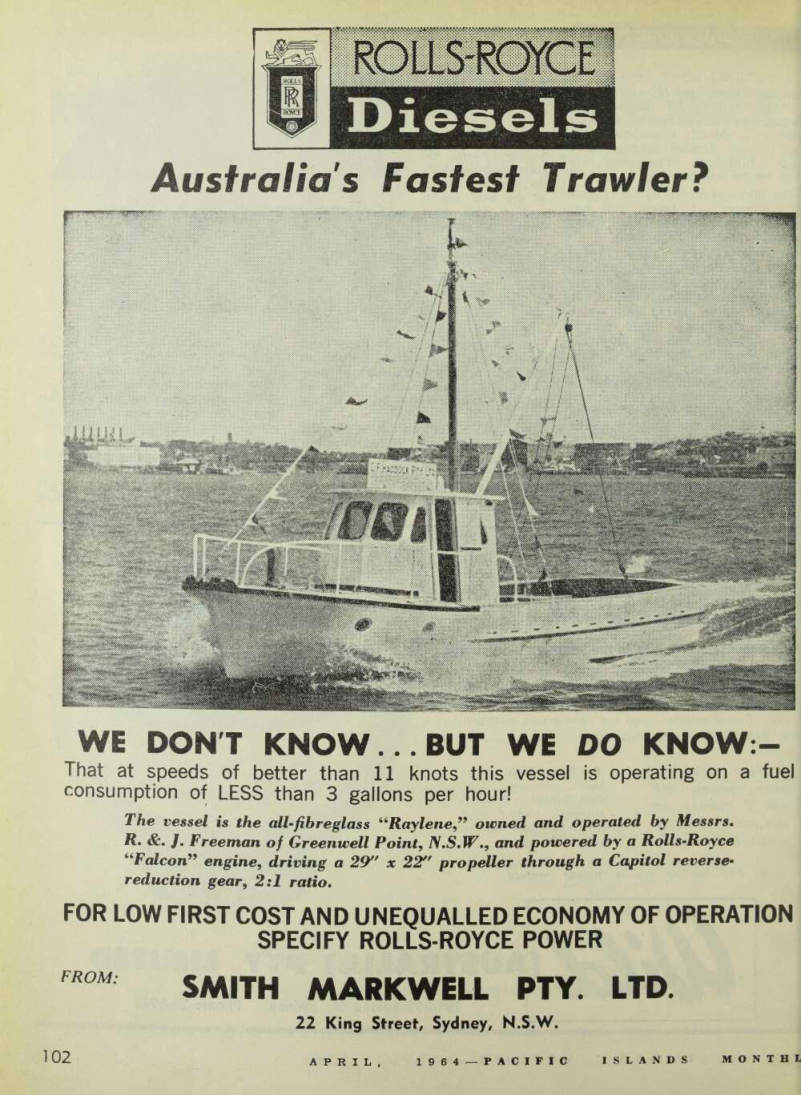 104
104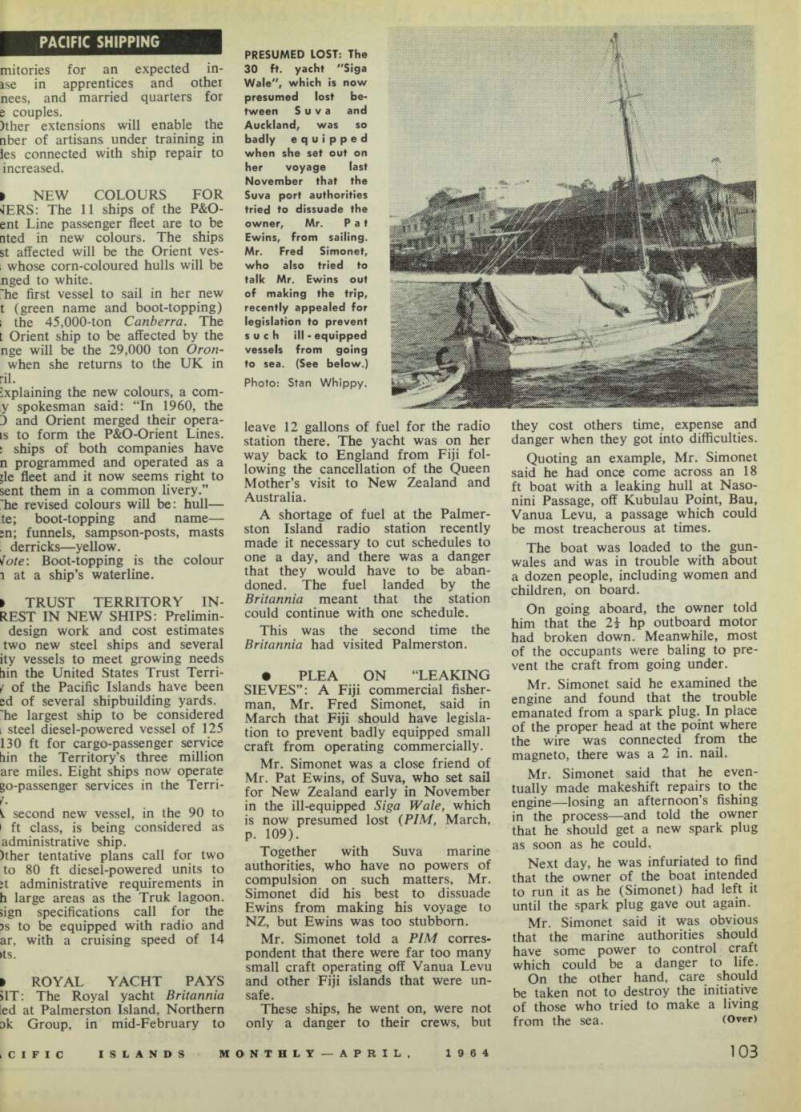 105
105 106
106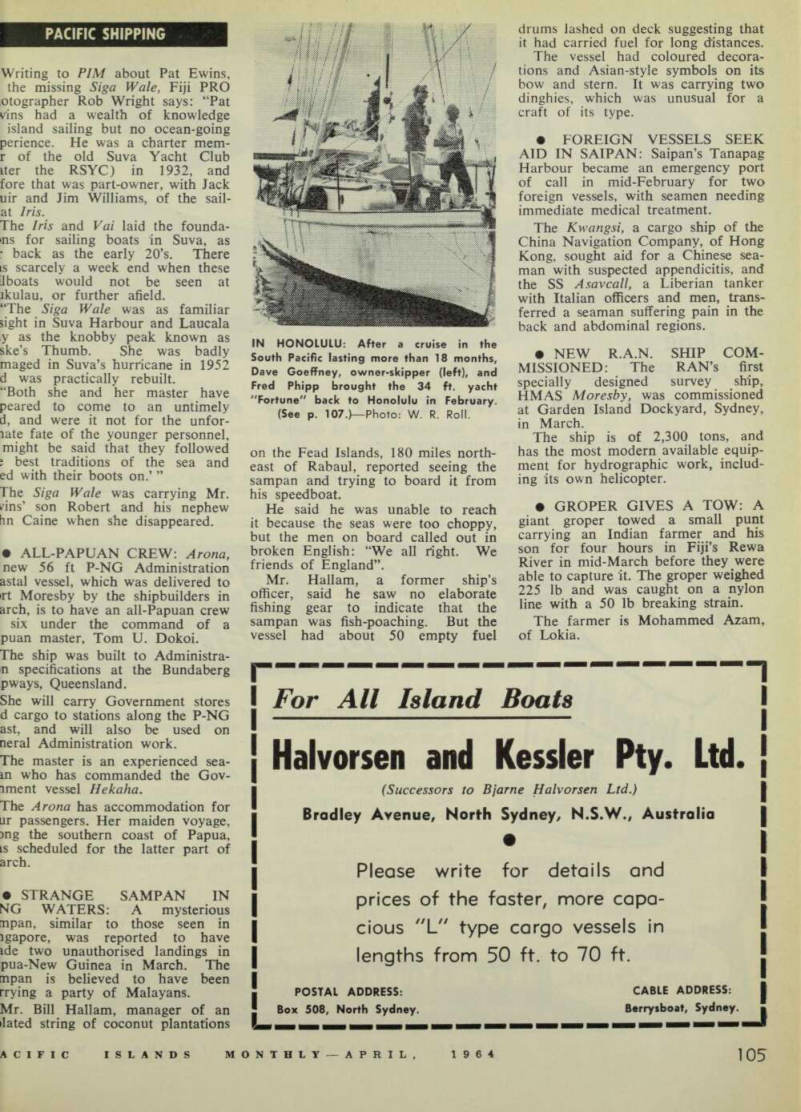 107
107 108
108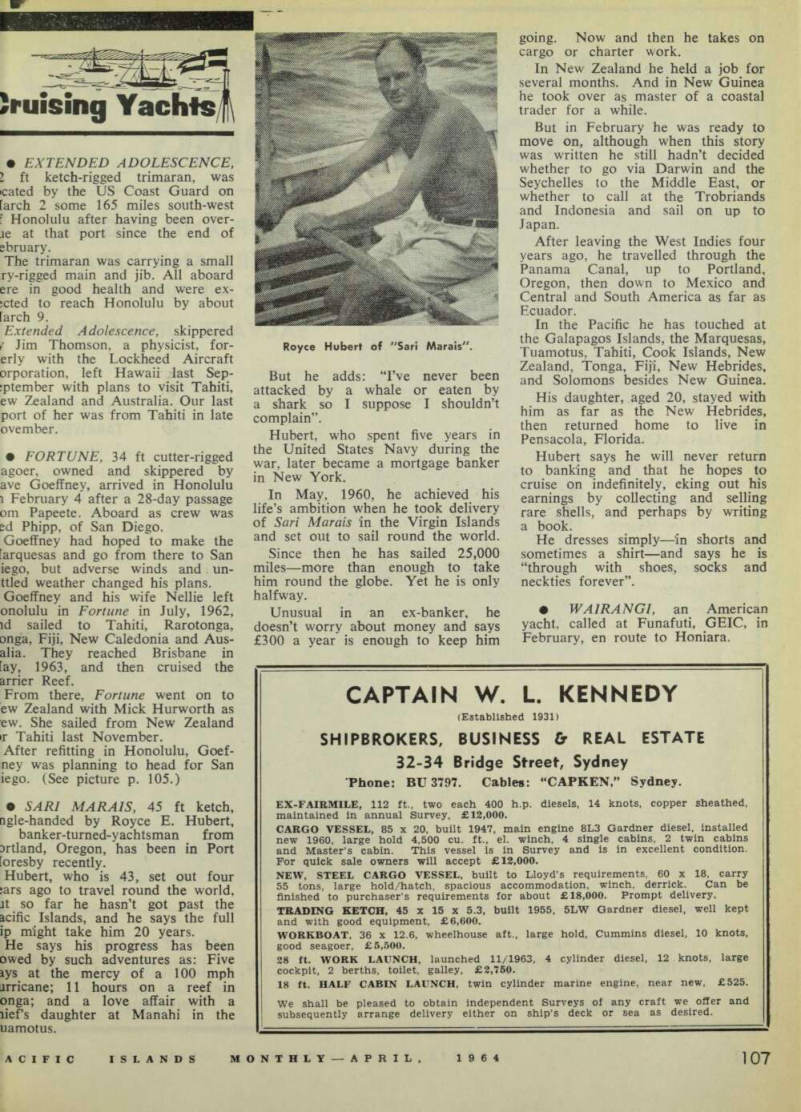 109
109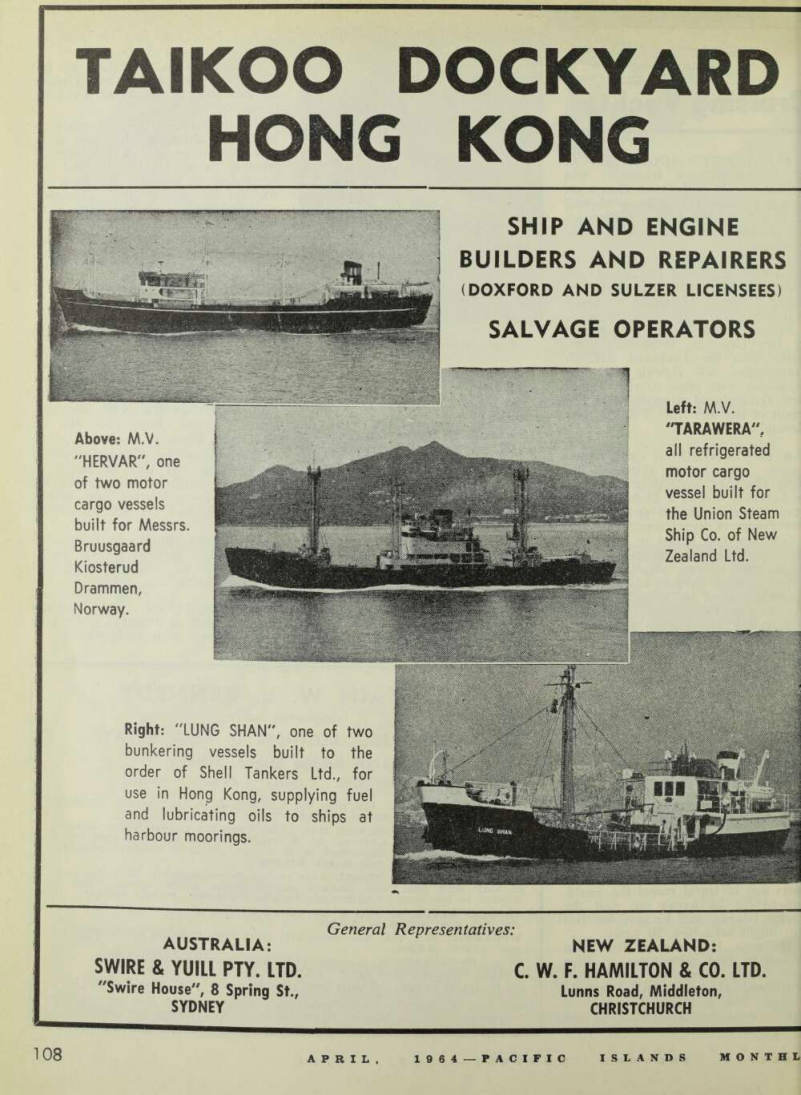 110
110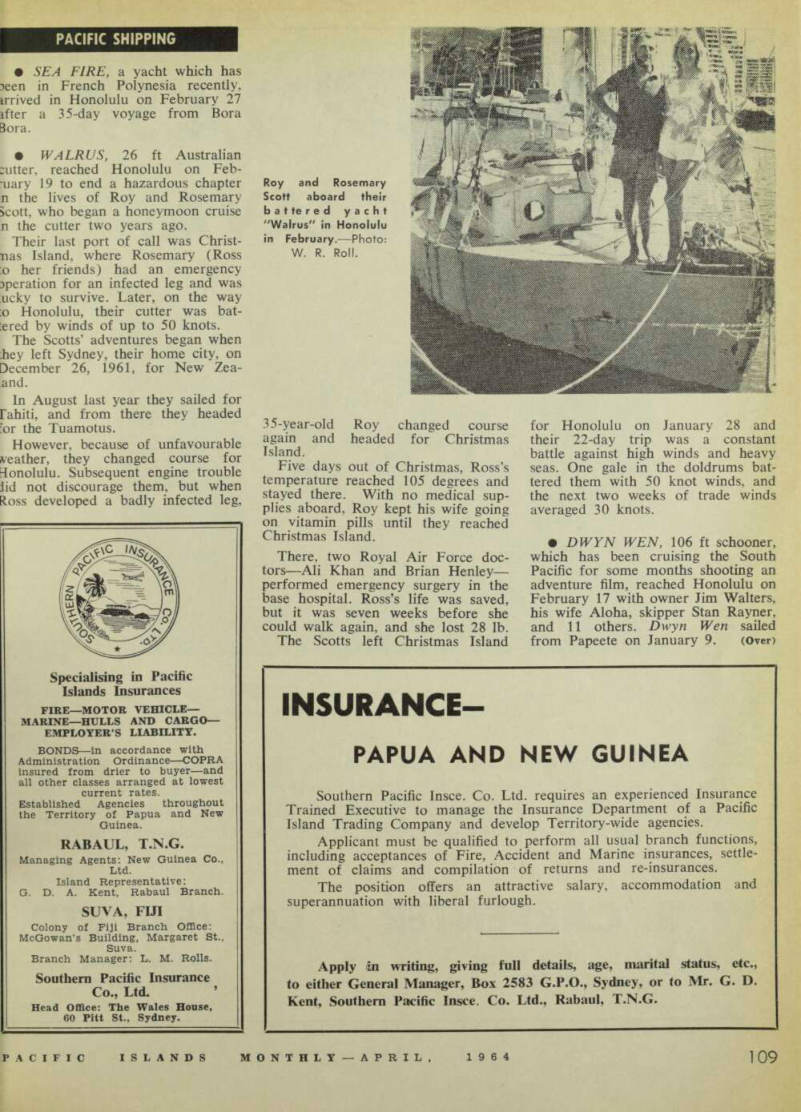 111
111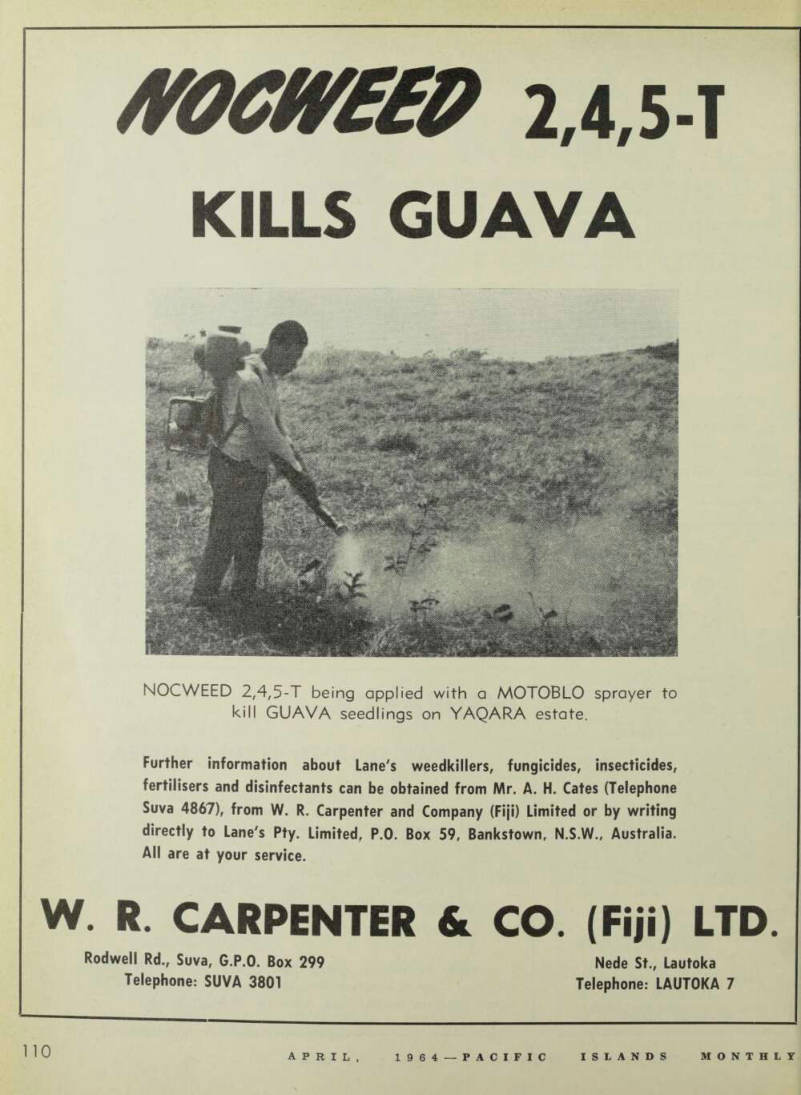 112
112 113
113 114
114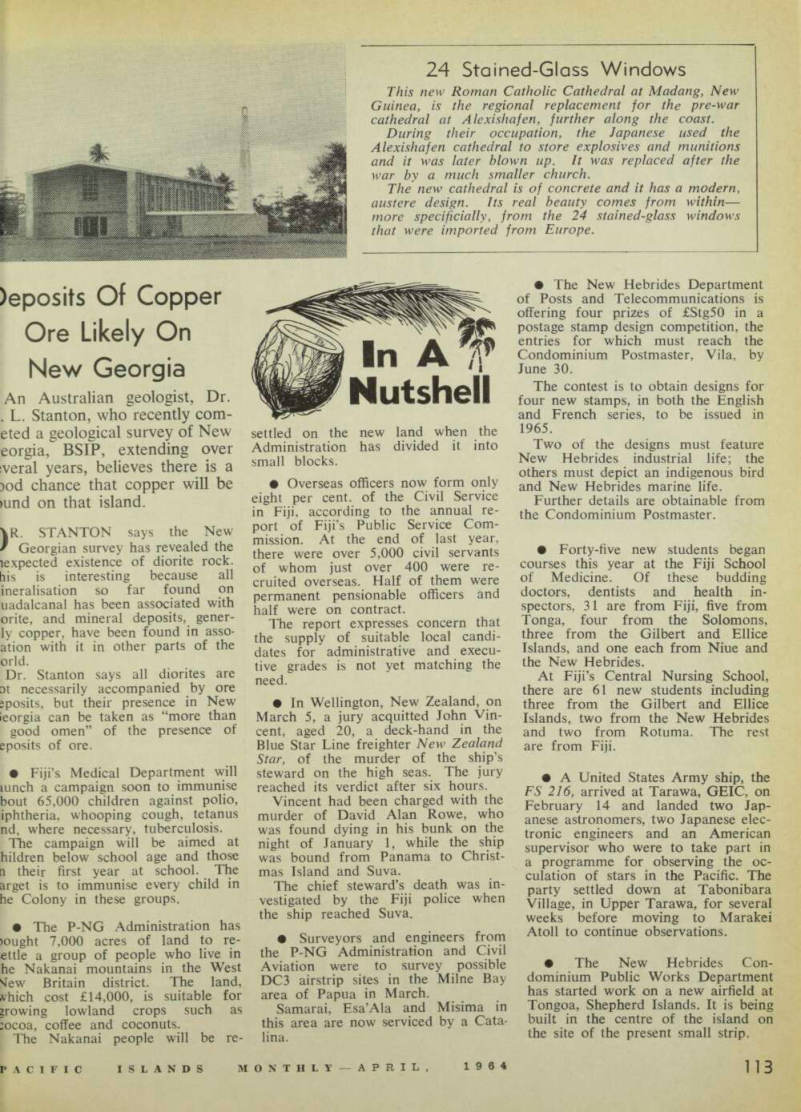 115
115 116
116 117
117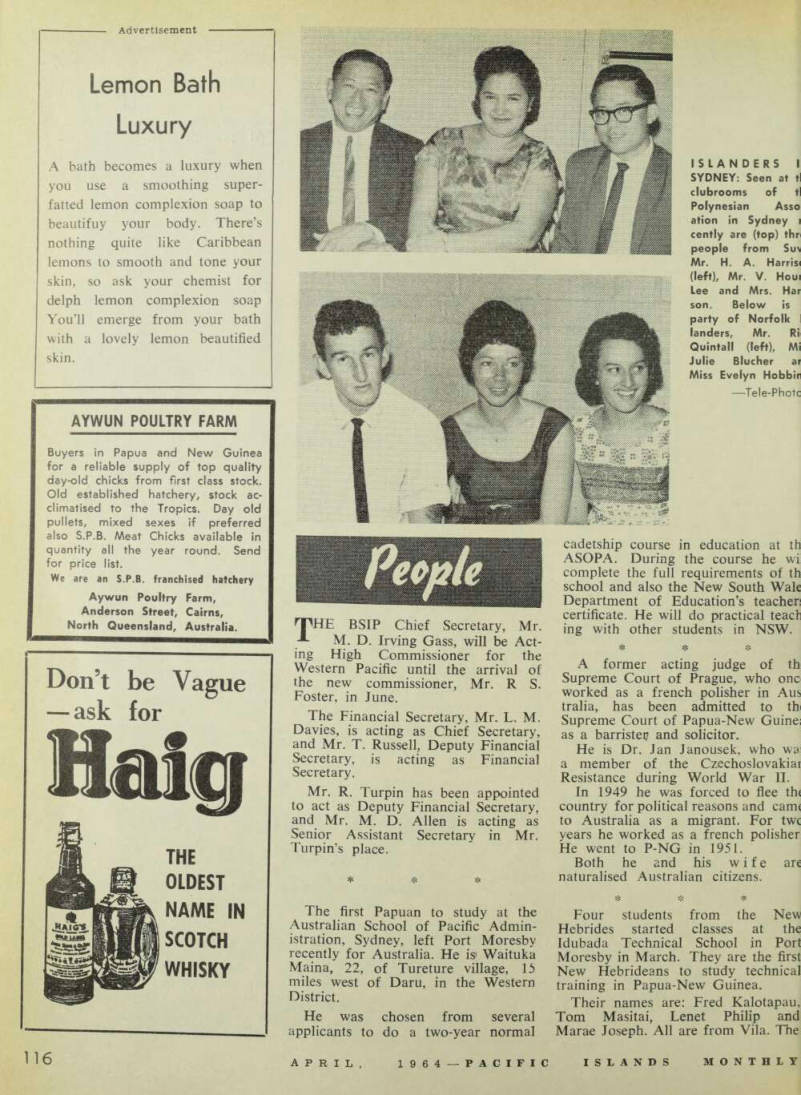 118
118 119
119 120
120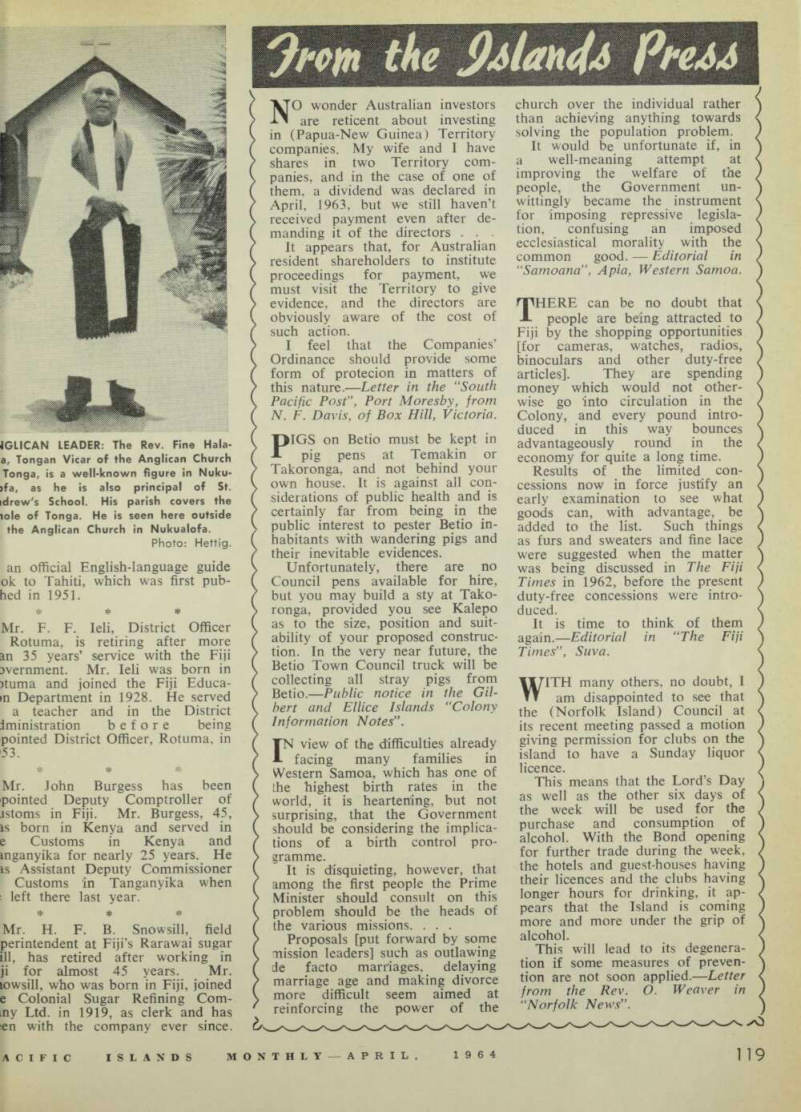 121
121 122
122 123
123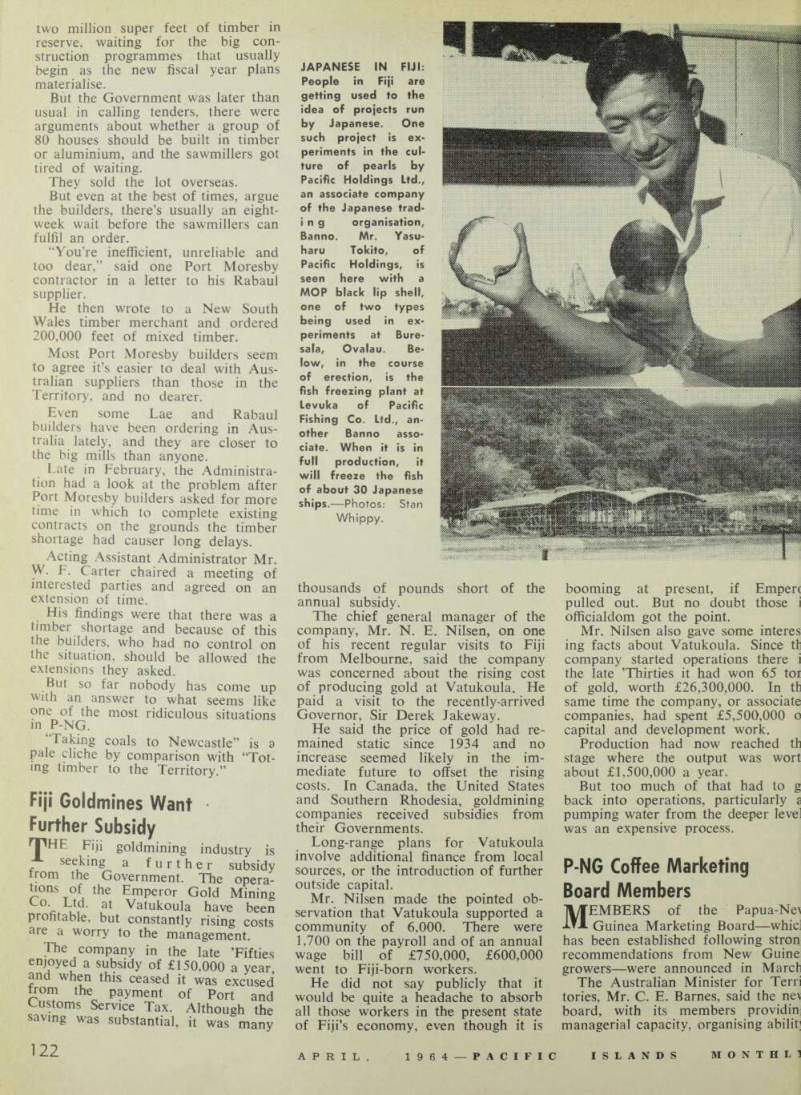 124
124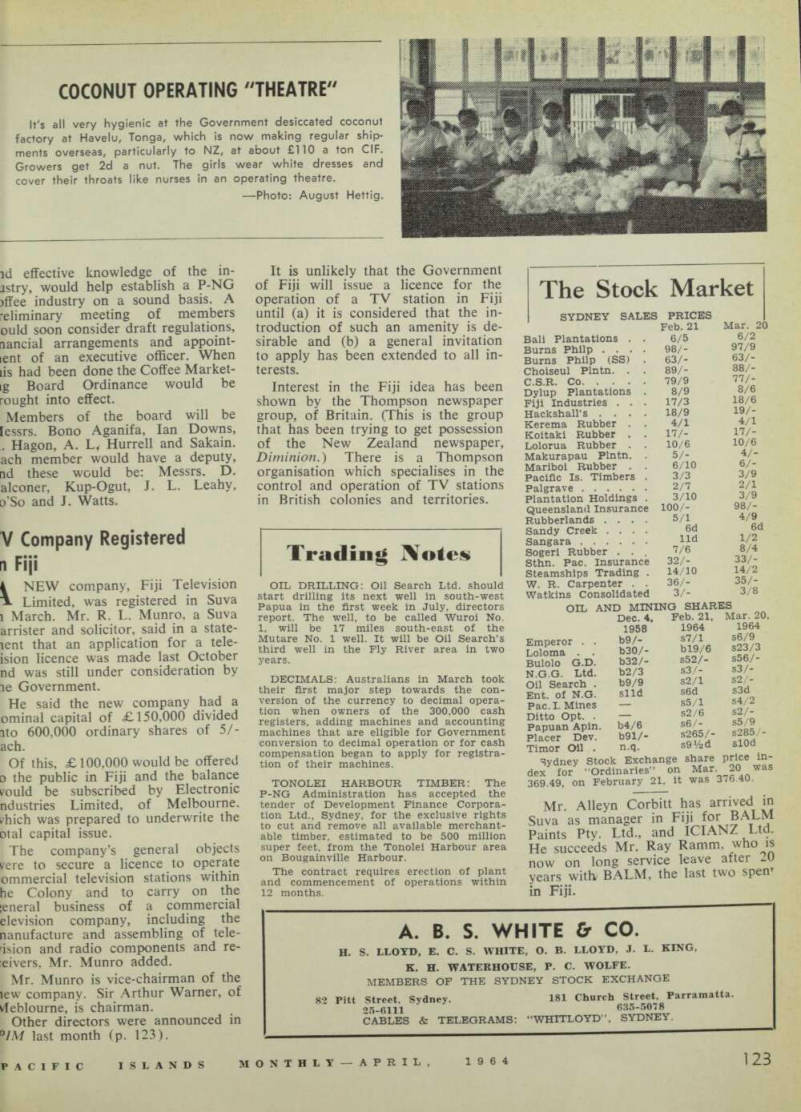 125
125 126
126 127
127 128
128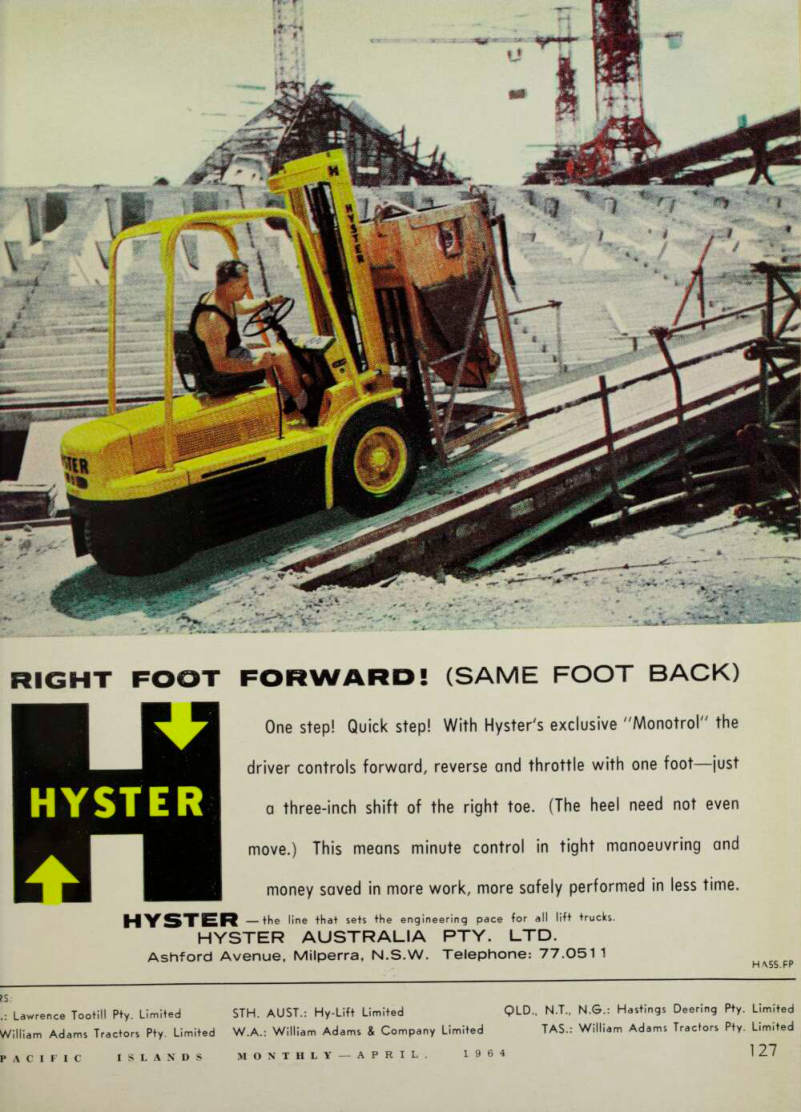 129
129 130
130 131
131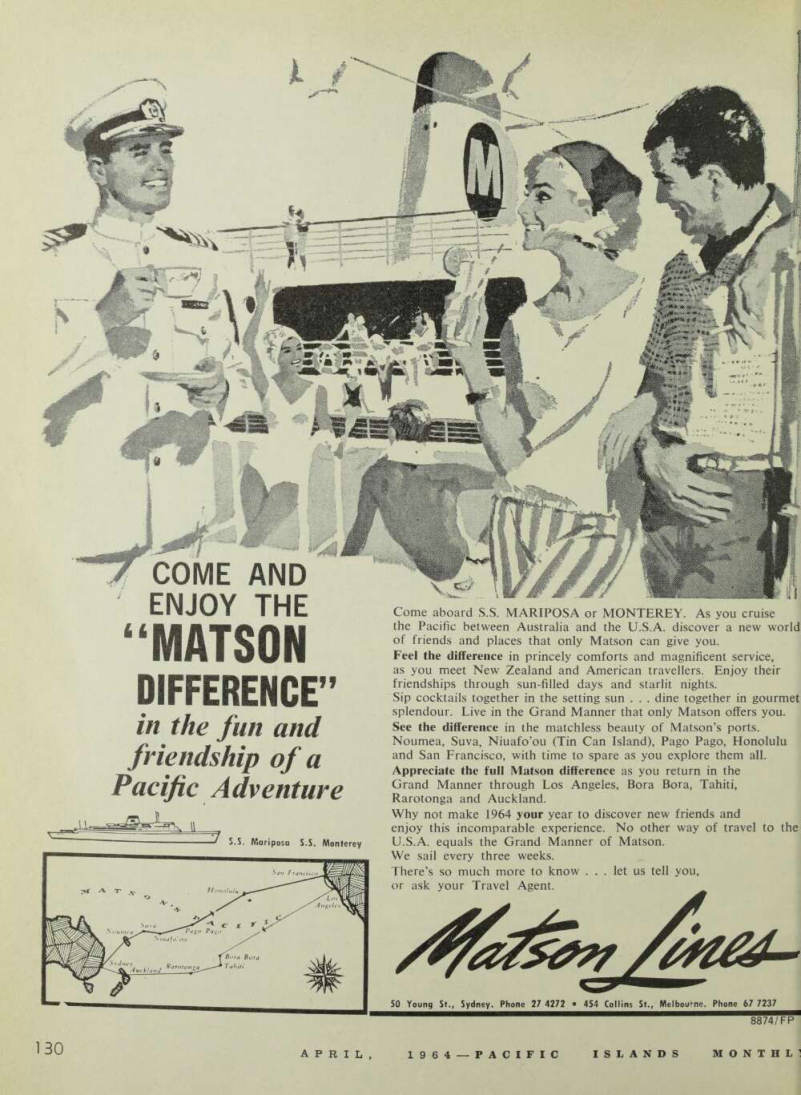 132
132 133
133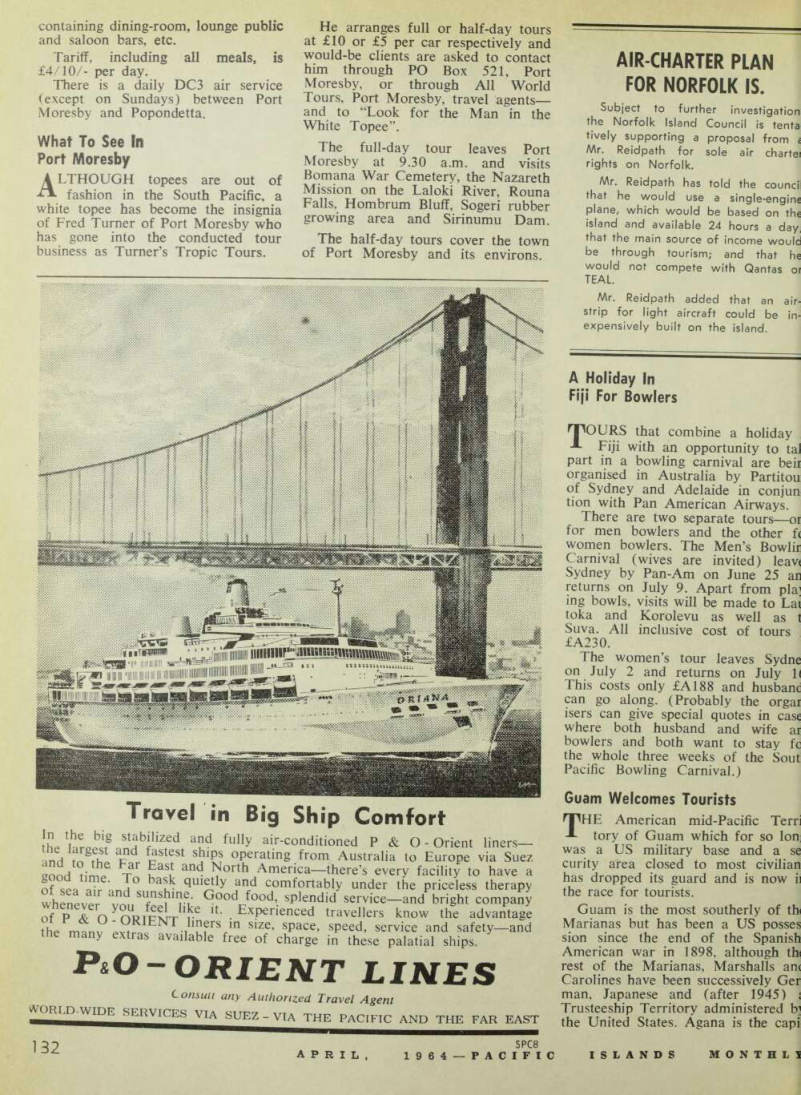 134
134 135
135 136
136 137
137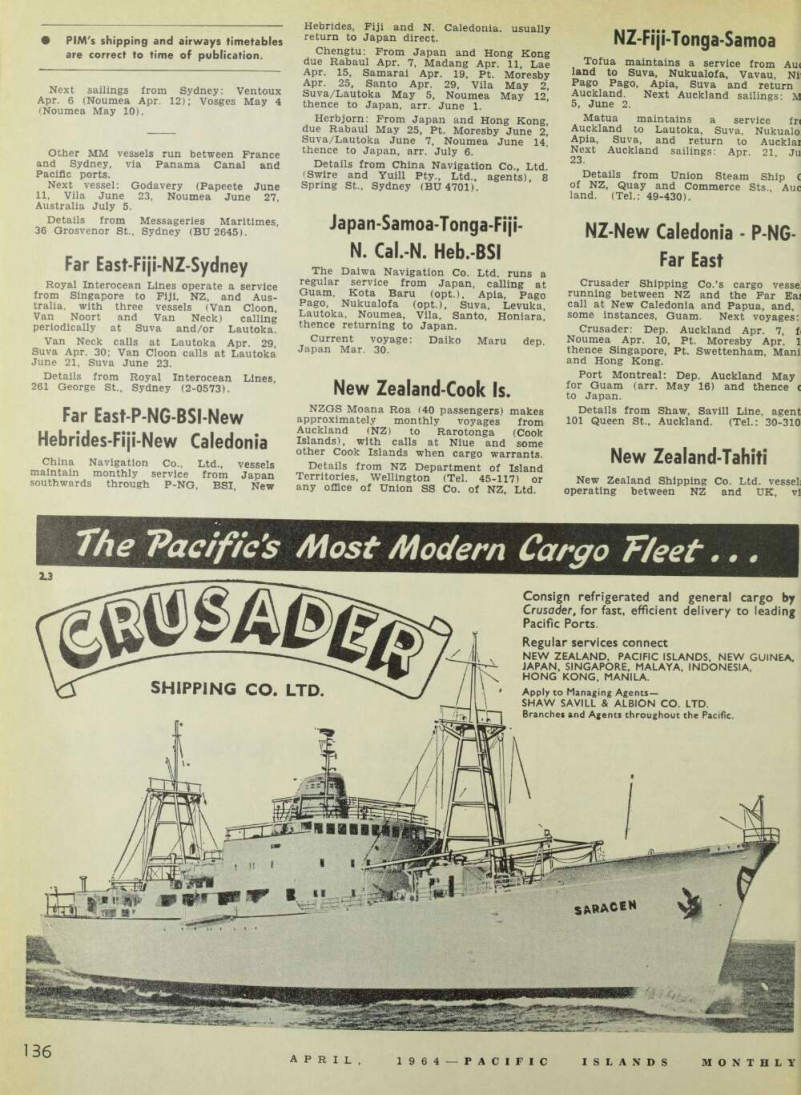 138
138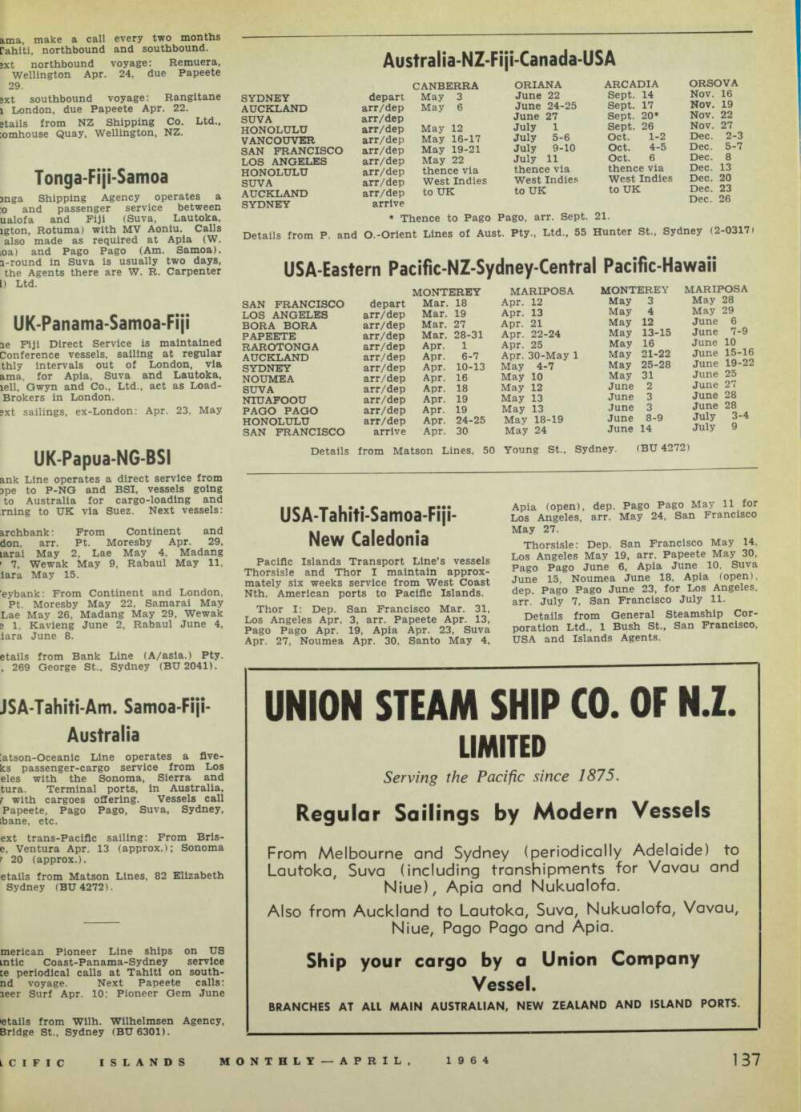 139
139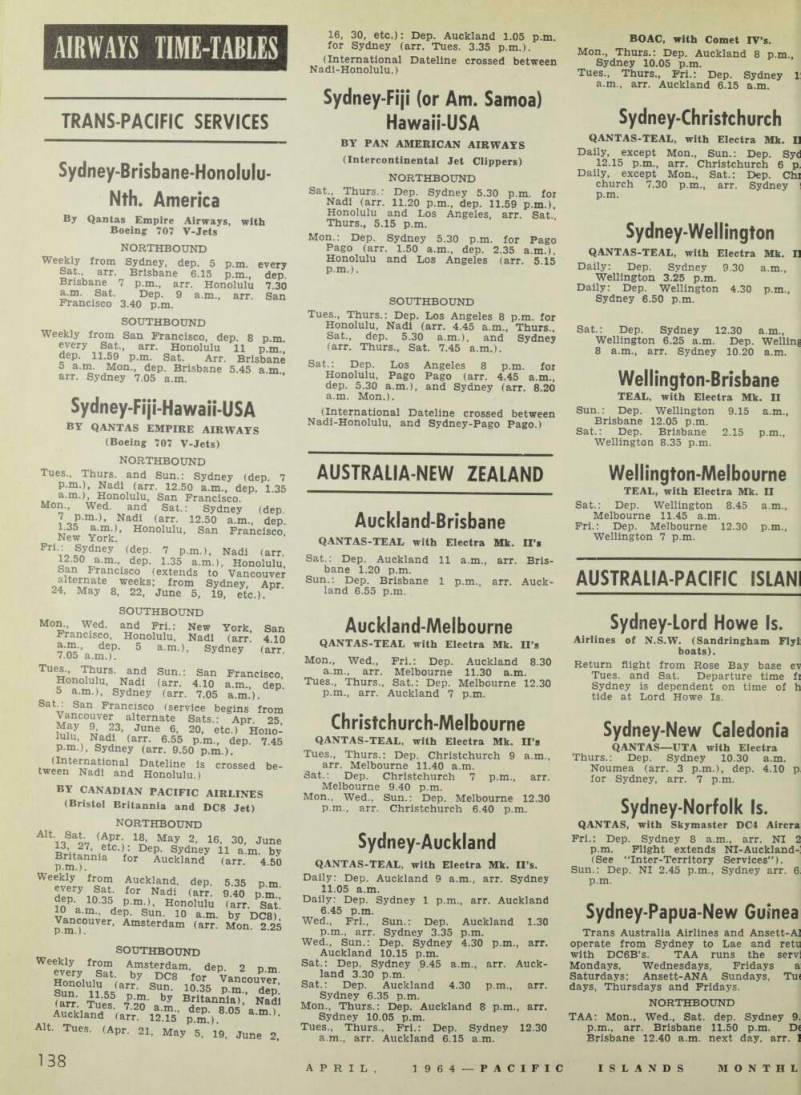 140
140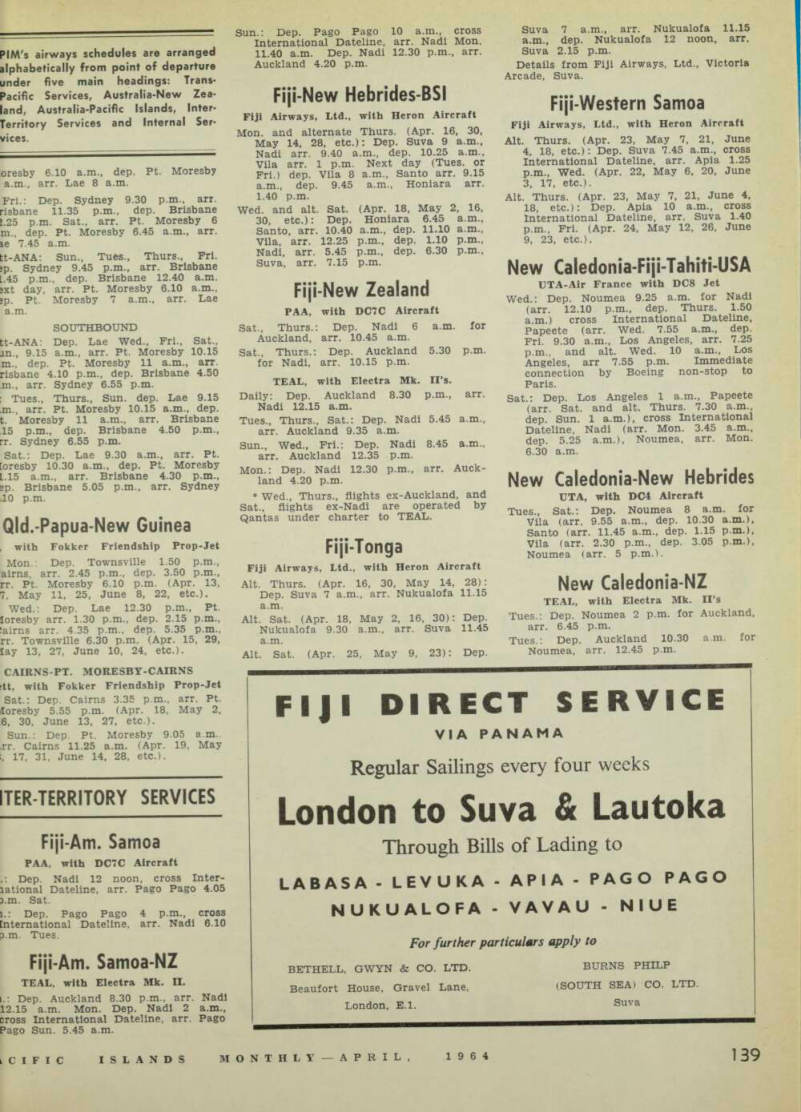 141
141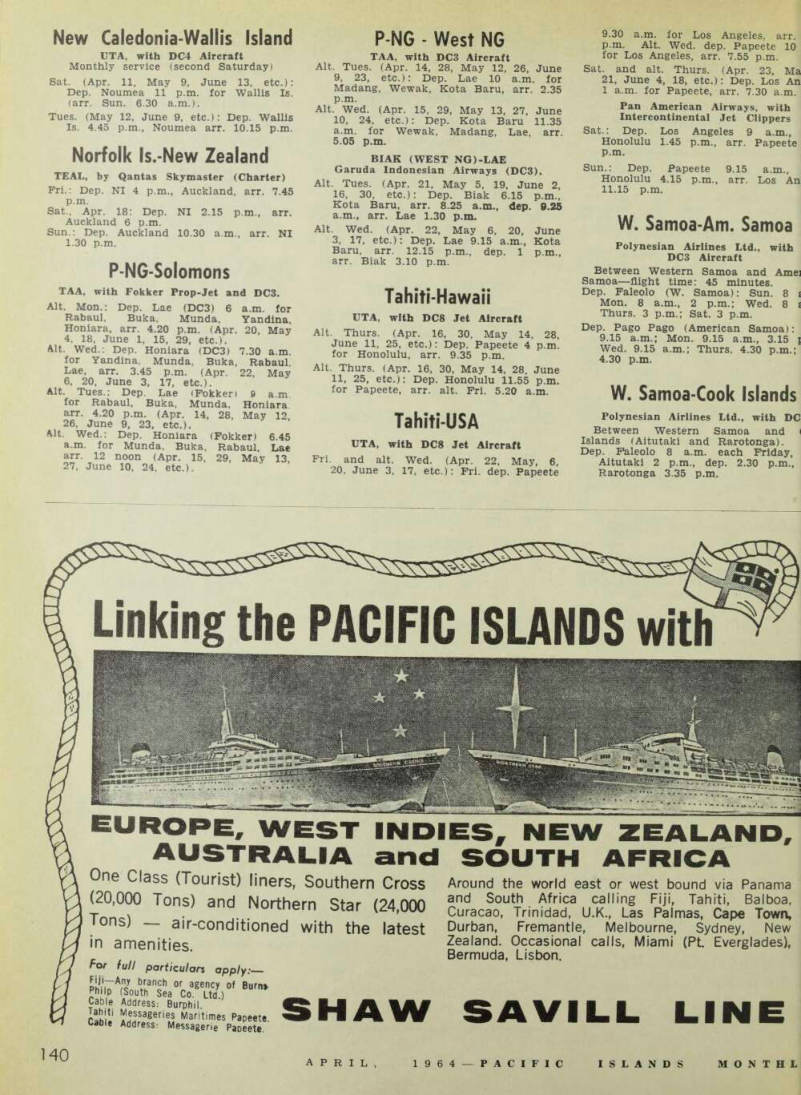 142
142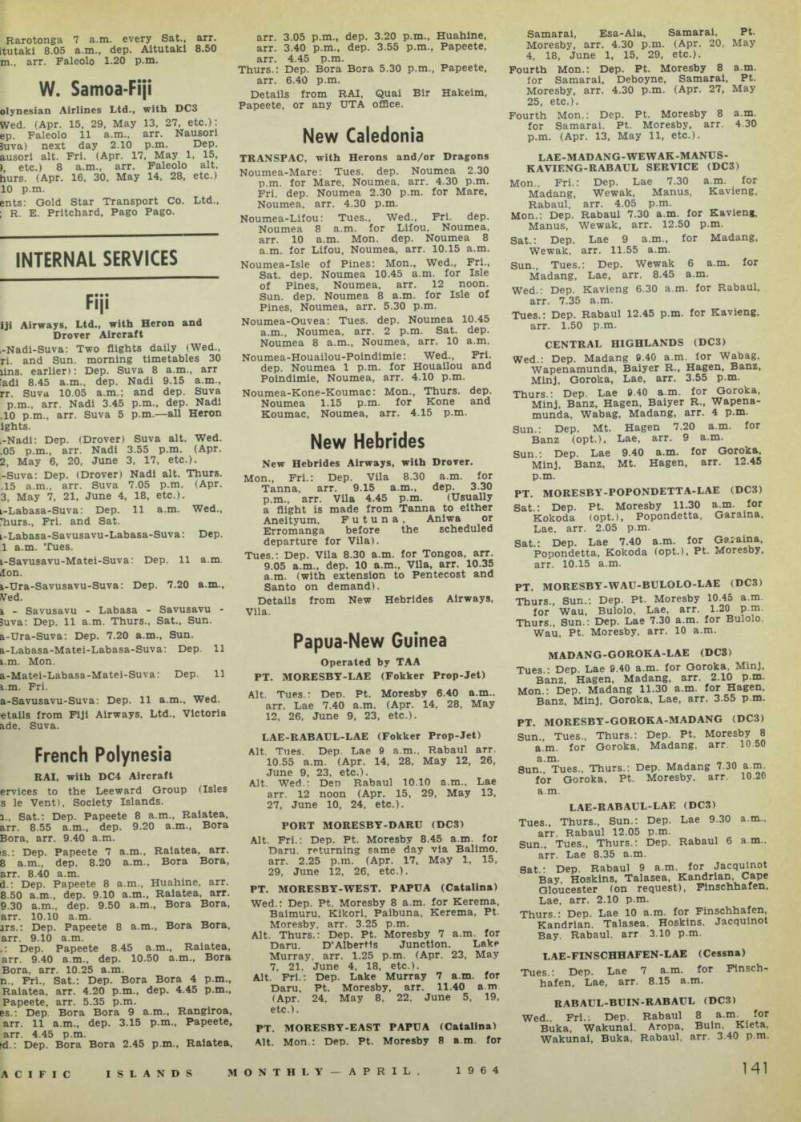 143
143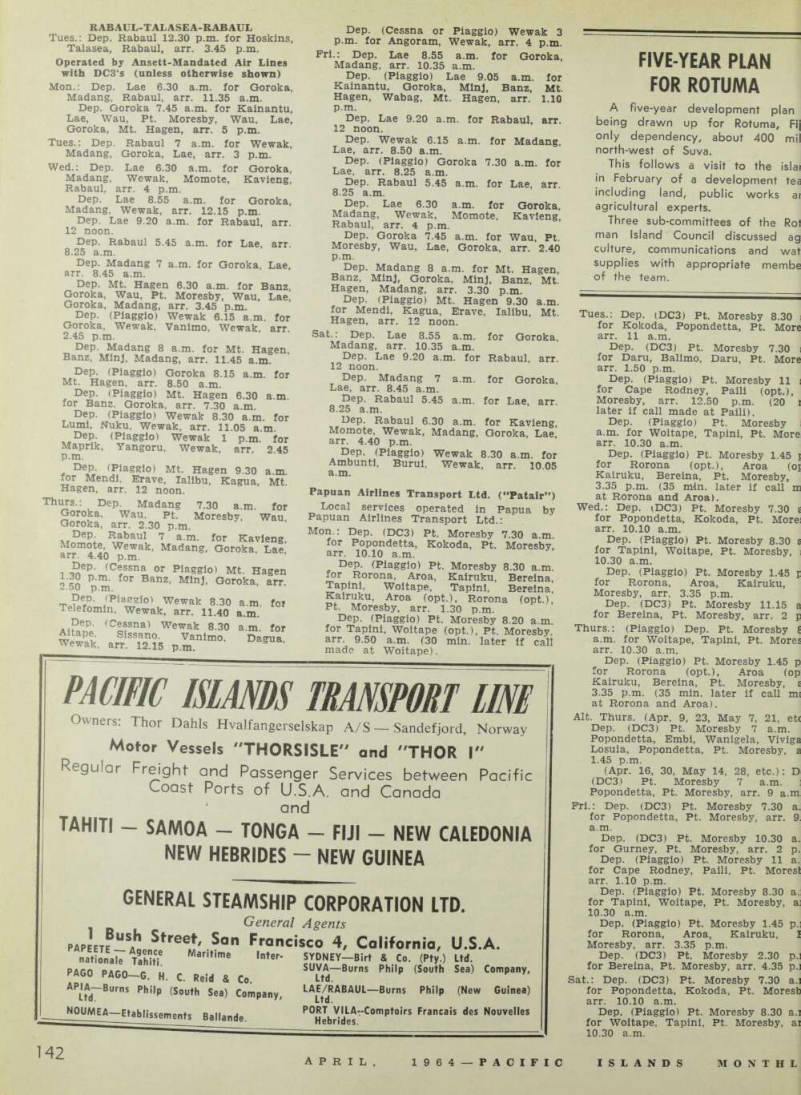 144
144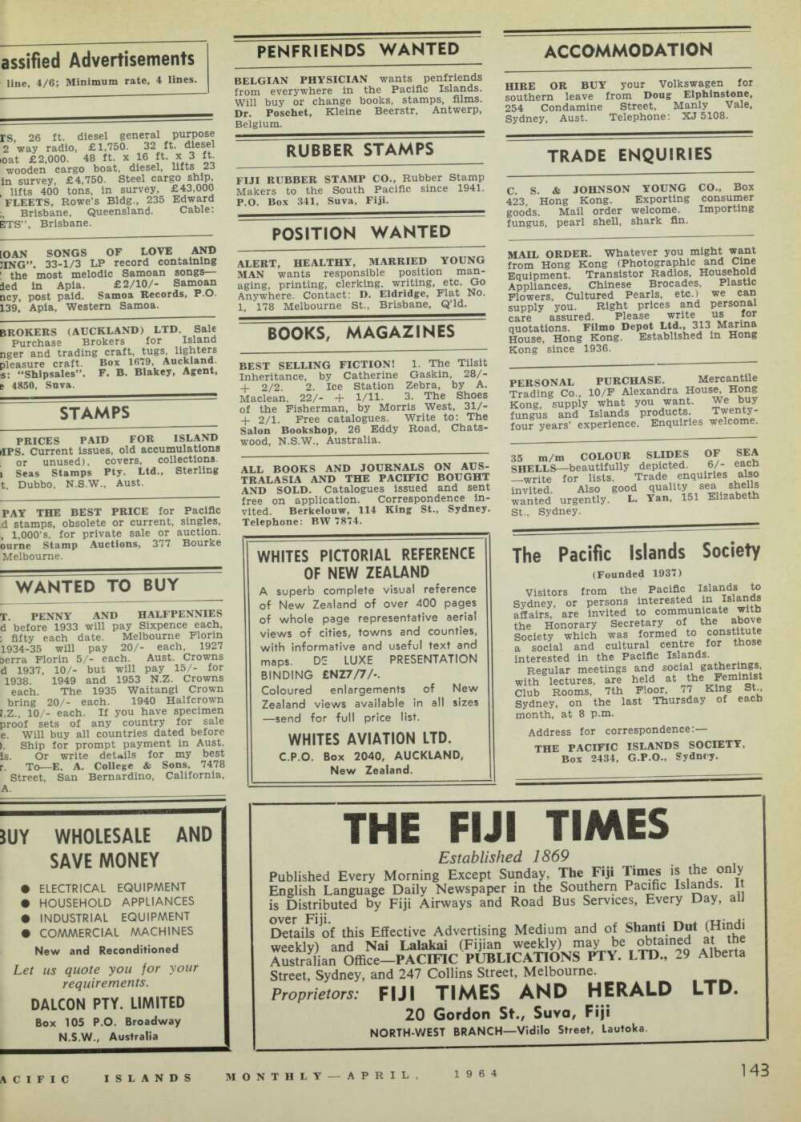 145
145 146
146 147
147 148
148 149
149 150
150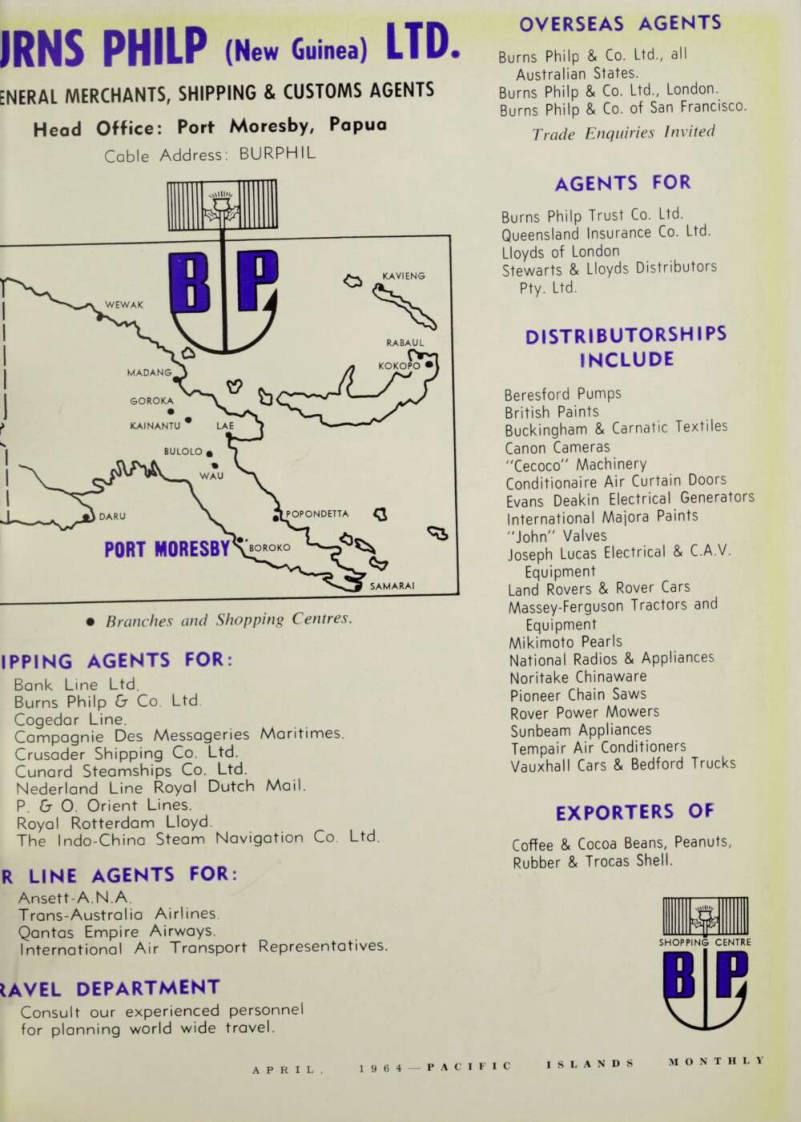 151
151 152
152