They All Say They Know
pp. 32-34 · Read in the full issue
Where They're Going
Prom PlM’s Port Moresby Correspondent Policy statements from many different parts of the Terri tory appear to show a remarkable similarity to one another ” said Central special electorate candidate Rev. Percy Chatterton in his policy speech in Port Moresby.
AND he was quite right—from the Sepik to Samarai, candidates have thumped similar tubs.
As in elections anywhere, the country’s most promising problems have provided the candidates with their platforms.
There has been little disagreement as to what these problems are, and the only real argument has arisen from the priority each should re ceive.
The great weight of opinion among European candidates is in favour of greatly accelerated economic de velopment through agriculture. To achieve this, they have said, greater attention must be given to the de velopment of communications: roads bridges, ports and airfields.
Few European candidates—or for that matter, natives—have reallv made clear their thinking on the Political development of Papua-New Guinea, but those who have spoken
at length on this vital issue have been in basic agreement.
They say the foundations for a successful multi-racial community must be well laid before independ ence overtakes their country. (And there has been an almost universal acceptance by both European and native candidates that independence is going to come before either wants it.) These then have been the two main talking points for candidates.
Defence of the Territory has been the third biggest talking point.
None of the candidates is satis fied the Territory is adequately de fended and dozens have called on Australia to make added effort here.
Kaindi open electorate candidate, Mr. J. W. Gould, described defence as P-NG’s biggest problem and many have agreed with his priority.
With few exceptions no candidates
have made rash promises on an] matter. Rather, they have beer careful to explain to both their native and European electors that they an in no position to offer anything, a; there are no Government and Opposi tion parties. The Australian Gov eminent will still control the House as it will pay the piper.
Here are some of the points made by candidates on the three mait issues:
Economic Development:
Mr. W. G. Grose, one of three candidates for the New Gurnee Islands special electorate has said “Department of Agriculture Stoak and Fisheries should be overhauled in such a way as to allow it tc function more freely in helping tc develop a viable economy.
“Export production should be en couraged by the maintenance of ar indefeasible land tenure system and by the granting of developmental loans to selected applicants withoul discrimination.”
The old question of secondary in dustries was raised in New Britain by special electorate candidate Mr.
Grainger Morris.
“There is a need to decrease the import export imbalance by actively encouraging the internal production of commodities at present being im ported from overseas,” he said.
A point Mr. Morris made that no other candidate mentioned was the
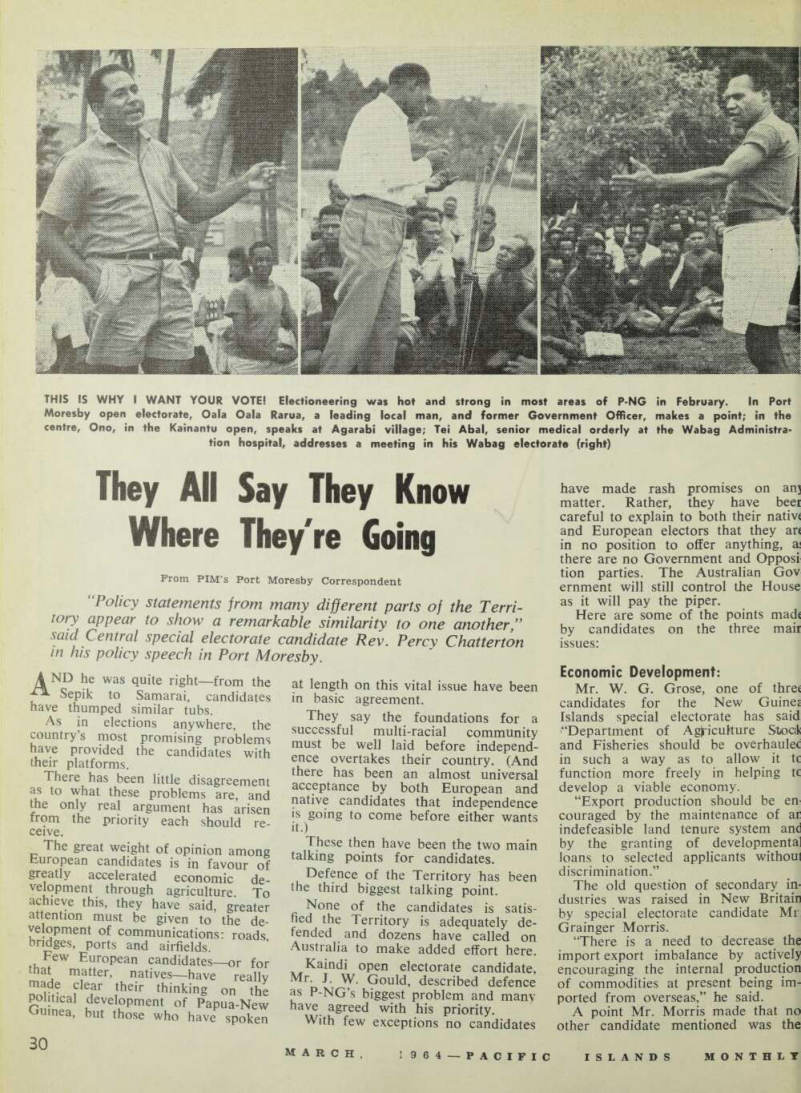
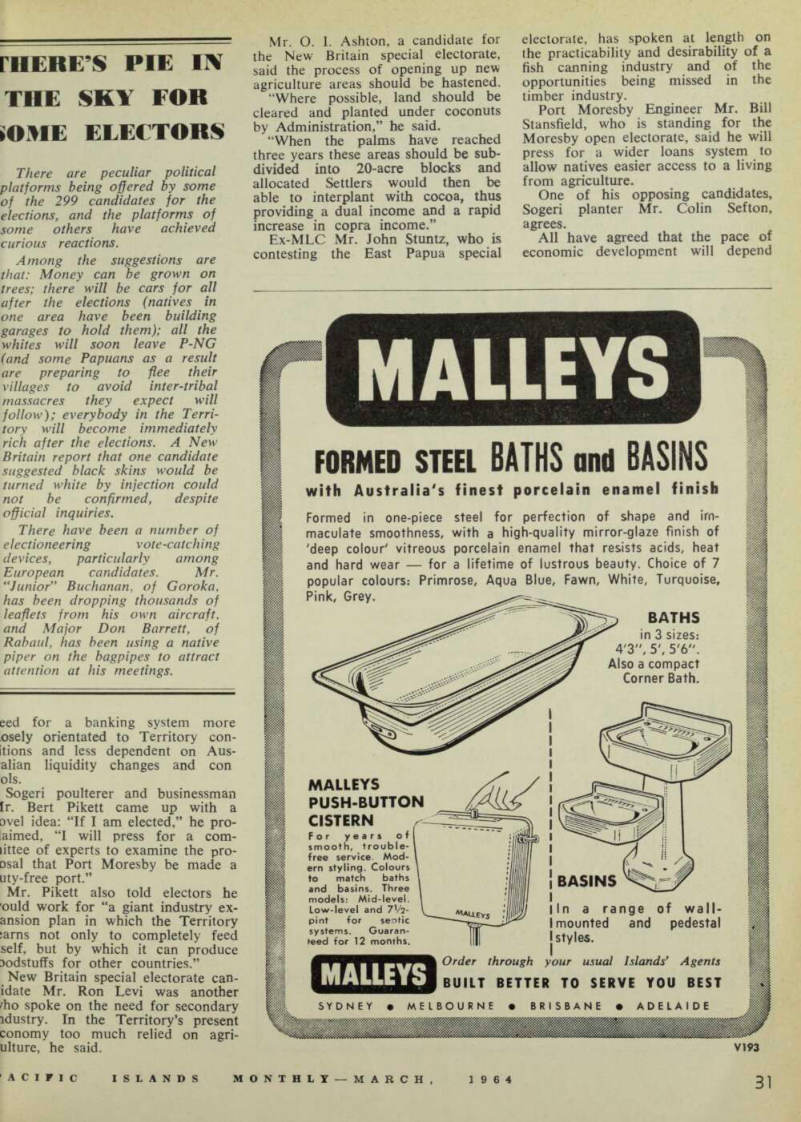
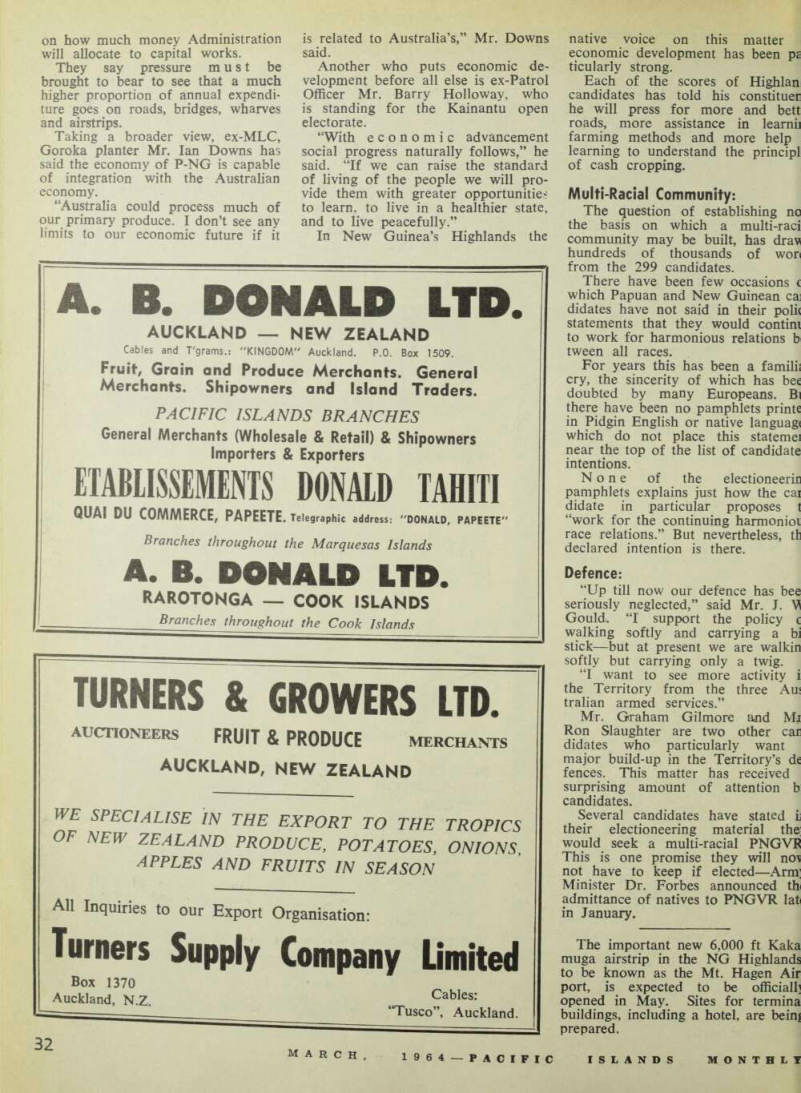
THIS IS WHY I WANT YOUR VOTE! Electioneering was hot and strong in most areas of P-NG in February. In Port Moresby open electorate, Oala Oala Rarua, a leading local man, and former Government Officer, makes a point; in the centre, Ono, in the Kainantu open, speaks at Agarabi village; Tei Abal, senior medical orderly at the Wabag Administra tion hospital, addresses a meeting in his Wabag electorate (right)
eed for a banking system more osely orientated to Territory con itions and less dependent on Aus alian liquidity changes and con ols.
Sogeri poulterer and businessman Ir. Bert Pikett came up with a Dvel idea: “If I am elected,” he pro laimed, “I will press for a com littee of experts to examine the pro osal that Port Moresby be made a uty-free port.”
Mr, Pikett also told electors he ould work for “a giant industry ex ansion plan in which the Territory ;arns not only to completely feed self, but by which it can produce Dodstuffs for other countries.”
New Britain special electorate can idate Mr. Ron Levi was another dio spoke on the need for secondary idustry. In the Territory’s present conomy too much relied on agri ulture, he said.
Mr. O. 1. Ashton, a candidate for the New Britain special electorate, said the process of opening up new agriculture areas should be hastened.
“Where possible, land should be cleared and planted under coconuts by Administration,” he said.
“When the palms have reached three years these areas should be sub divided into 20-acre blocks and allocated Settlers would then be able to interplant with cocoa, thus providing a dual income and a rapid increase in copra income.”
Ex-MLC Mr. John Stuntz, who is contesting the East Papua special
electorate, has spoken at length on the practicability and desirability of a fish canning industry and of the opportunities being missed in the timber industry, Port Moresby Engineer Mr. Bill Stansfield, who is standing for the Moresby open electorate, said he will press for a wider loans system to allow natives easier access to a living from agriculture, One of his opposing candidates, Sogeri planter Mr. Colin Sefton, agrees.
All have agreed that the pace of economic development will depend
on how much money Administration will allocate to capital works.
They say pressure must be brought to bear to see that a much higher proportion of annual expendi ture goes on roads, bridges, wharves and airstrips.
Taking a broader view, ex-MLC, Goroka planter Mr. lan Downs has said the economy of P-NG is capable of integration with the Australian economy.
“Australia could process much of our primary produce. I don’t see any limits to our economic future if it
is related to Australia’s,” Mr. Downs said.
Another who puts economic de velopment before all else is ex-Patrol Officer Mr, Barry Holloway, who is standing for the Kainantu open electorate.
“With economic advancement social progress naturally follows,” he said. “If we can raise the standard of living of the people we will pro vide them with greater opportunities to learn, to live in a healthier state, and to live peacefully.”
In New Guinea’s Highlands the
native voice on this matter economic development has been pa ticularly strong.
Each of the scores of Highlan. candidates has told his constituen he will press for more and bett: roads, more assistance in leamii farming methods and more help learning to understand the principl! of cash cropping.
Multi-Racial Community:
The question of establishing no the basis on which a multi-raci community may be built, has dra\* hundreds of thousands of won from the 299 candidates.
There have been few occasions c which Papuan and New Guinean cai didates have not said in their polk statements that they would contini to work for harmonious relations b( tween all races.
For years this has been a familk cry, the sincerity of which has bee doubted by many Europeans. Bi there have been no pamphlets printe in Pidgin English or native languag( which do not place this statemei near the top of the list of candidate intentions.
None of the electioneerin pamphlets explains just how the car didate in particular proposes t “work for the continuing harmonior race relations.” But nevertheless, th declared intention is there.
Defence: “Up till now our defence has bee seriously neglected,” said Mr. J. W Gould. “I support the policy c walking softly and carrying a bi stick—but at present we are walkin softly but carrying only a twig.
“I want to see more activity i the Territory from the three Aus tralian armed services.”
Mr. Graham Gilmore and Mi Ron Slaughter are two other can didates who particularly want major build-up in the Territory’s de fences. This matter has received surprising amount of attention b; candidates.
Several candidates have stated u their electioneering material the; would seek a multi-racial PNGVR This is one promise they will nov not have to keep if elected—Arm; Minister Dr. Forbes announced th( admittance of natives to PNGVR lab in January.
The important new 6,000 ft Kaka muga airstrip in the NG Highlands to be known as the Mt. Hagen Air port, is expected to be official!] opened in May. Sites for termina buildings, including a hotel, are beini prepared.