Jitters To The Editors
pp. 27-31 · Read in the full issue
Rench View On
Ritain In
He Pacific
Sir, —The Pacific Islands lonthly of February, 1964, has ist reached me and I have read ith interest the reply which you iserted on page 45 on the sub ct of the editorial which ap sared in Corail, of which I am
le director-proprietor. That
iitorial was entitled “P/M ccuses France”, and its title is ifficiently expressive for one to tiderstand or imagine its tenor.
MUST first do justice to an accusation of Mr. Lamberty, of into (your correspondent). I did )t publish his letter because of its accuracy and expressions used in which seemed to me to be jurious, and also because I wanted prevent my readers from judging idly of Mr. Lamberty, and, there- Te, of possibly bearing moral ejudice against him.
Having said this, I am obliged to ate that PIM does not usually igage in controversy (you never iblish extracts from the French ress in the Pacific, and I am proud : having started the chronicle). But nes are hard for empires, including at of Great Britain, and you must aw get the sword out because your fty way of looking at things is a iw thing to you.
The fact that you publish a letter om a Dutch citizen to defend your lf and the honour of the Empire roves how right the views of Corail ere.
Since your magazine has always ood in judgment of France in the acific, know, dear colleague, that om now on we will reply to the "tides that attack us unjustly.
Yours, etc.,
D. Tardieu.
Managing-director of Corail magazine oumea, ew Caledonia. • The above is a translation of fr. Tardieu’s letter, the original of hich is in French.
Another Obelisk Sir, —In reference to David Dean’s letter in September about the mystery obelisk on Kaliki Plantation, New Ireland, bearing the word “Planet”
I thought you may be interested in the following. In November, 1947, whilst master of the vessel Winbirra, I took a prospecting party to the Nakanai area of New Britain. It was a Mt Isa-New Guinea Goldfields venture, and included in the party was “Red” Nichols, who was return ing to the area for the first time since the 1926 massacre. His job was to take the party in and then I later took him to Rabaul en route to Brisbane.
Whilst anchored at Planet Bay (New Britain) we explored one of two small islands at Walo and in the dense foliage discovered an obelisk made of cement and brick, and in scribed on it in good legible printing were the words Bremerhaven 1912 Planet Bay 1912 Koln.
It was so interesting that I logged it—on November 17, 1947.
Anything that was of interest in that area was recounted by Red Nichols, who was a good talker about past events, but he could shed no light on this obelisk.—Yours etc.
Matt Fawkner
Sydney What Plane Was That?
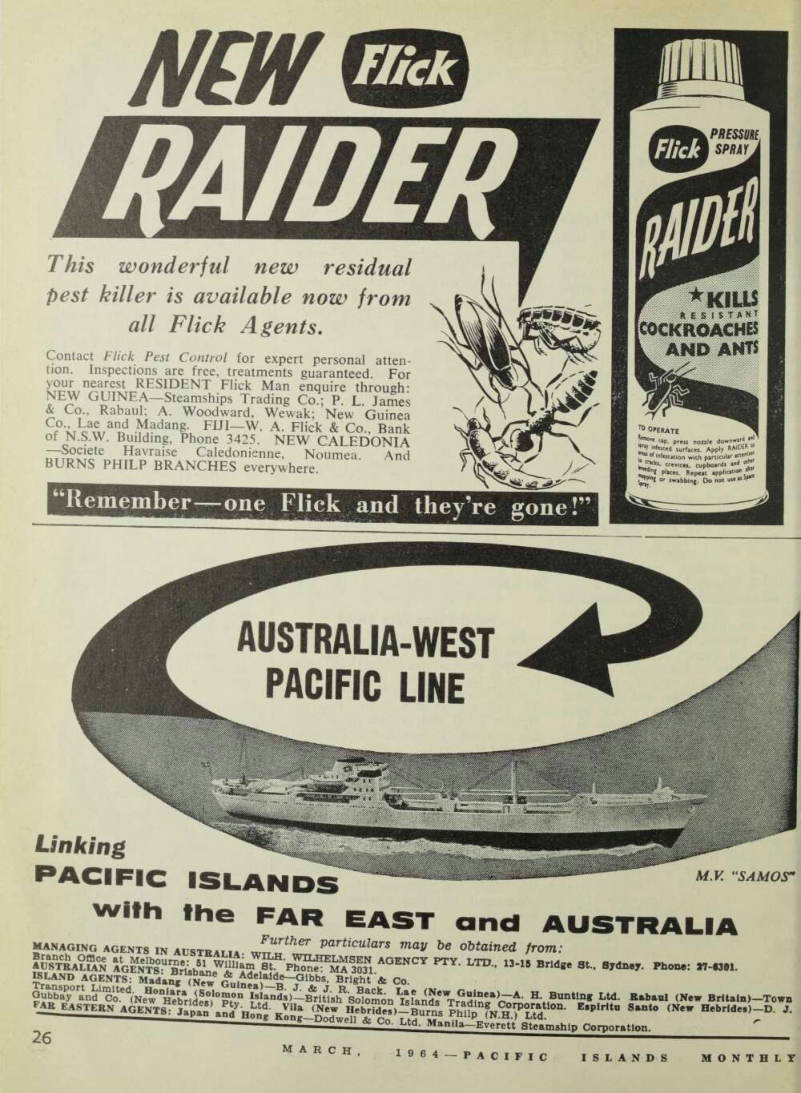
Sir, —May I correct your inter esting picture and description of one of my prewar aeroplanes in your issue of last August, p. 27.
This aeroplane is a Fairey Frame 3F military reconnaisance two-bay biplane fitted with a 600 bp Napier Lion engine. It was a metal fabric covered two-seater, which I bought from Davies, who flew it from England in the Centenary Air Race.
I used it in New Guinea on prospecting and survey work when Dick Glasson, Bob Moody and my self were opening up the Aitape and Sepik area for New Guinea Norwest Developement Company (co-directors Blakemore and General Wisdom).
We built the dromes at Maprik, Worn and But and cleared smaller ones.
The Fairey Fox which I flew in the Centenary was a single-bay mili tary biplane fitted with a Rolls Royce Kestool, 12 cylinder V type of 450 hp. I had had large tankage fitted in England for use for carrying petrol at higher rates than ordinary cargo.
Both these planes had to be landed
i the beaches at Port Douglas and bany Pass, Cape York, as the Civil /iation regulations at that time rbade any flight more than 50 iles across the sea without reless.—Yours, etc.
Ray Parer
t. Nebo, -isbane, Qld.
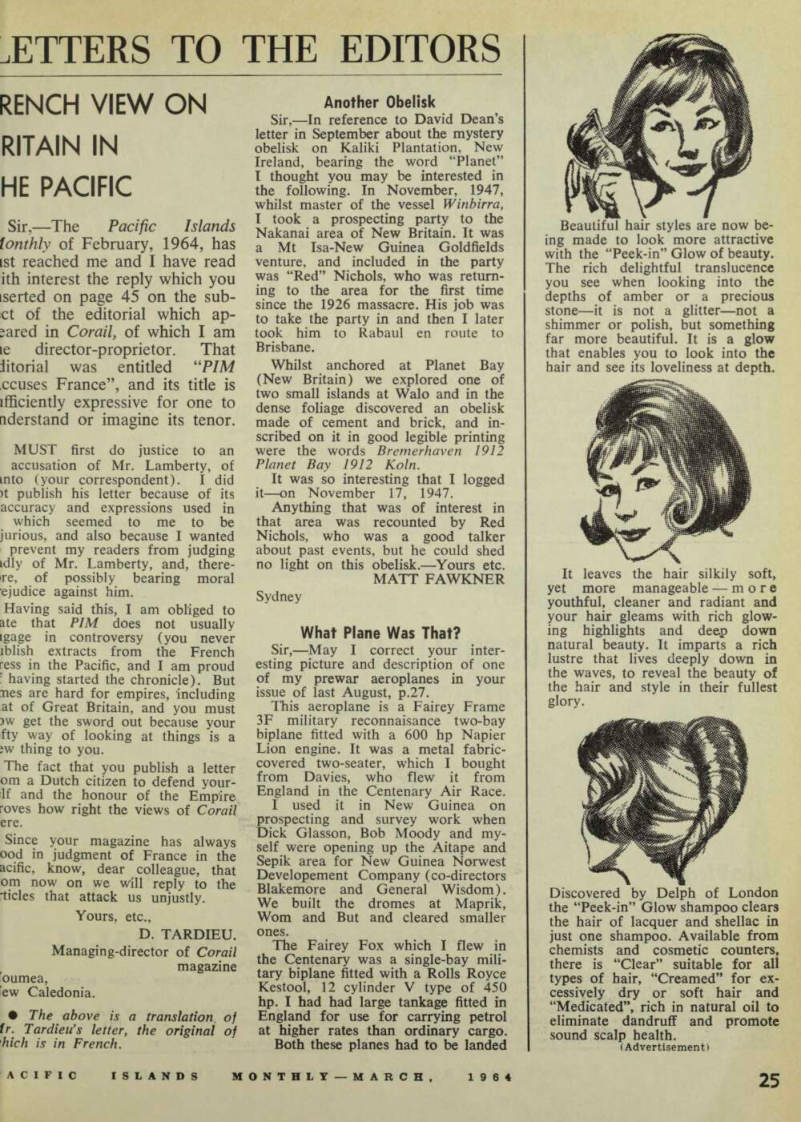
Ray Parer’s letter has touched a chord in the memory of Judy Tudor, one of PlM’s editors, who was mining in New Guinea’s Sepik before the war. In her scrapbook she located the photo of the aircraft on this page and after comparing it with the one PIM published last August (and finding the planes similar ), she asks : Which of the Parer planes is the le in my photo? I was always under ic impression that it was the Fairey ox; that a Wau syndicate had 3ught it and Ray Parer had flown it i the air race from the UK that larked the Melbourne Centenary in 934-35.
But like a lot of other things in lew Guinea it seems as though mine Duld have been the right idea at iched to the wrong information. Ac arding to what Ray says it could be le Fairey Frame 3F.
My picture was taken (by J. L. hipper) at Maprik in early 1938. m the woman looking at the amera. The plane then looked to be i the final stages of disintegration, Ithough when I had met it and Ray ar the first time a year previously it ad seemed a comparatively going oncern.
In the last months of 1936 we icard that Ray had cleared an air trip at a hitherto unknown place ailed Maprik, which was “down in he kunai”, and another at Worn, on he coast, about two hours by pin
nace, or more if you walked, from Wewak. What was more, Guinea Air ways was alleged to be running an air service between the two points.
When we went on leave in 1937 we decided that instead of walking five or six days to Wewak to catch the Macdhui we would walk one day to Maprik and catch the new plane ser vice.
As two-way radio was not then in operation and the only means of communication with Wewak was by native runner, we had no way of tell ing whether any of this was true and when we finally reached Maprik we discovered that a lot of it was not.
The plane service, for example, operated only as required, which was every six weeks, after the ship came in.
Maprik then consisted of a small strip of roughly cut grass, a thatched
house to hold cargo at one side and Ray’s plane pushed under a lean-lo on the other.
We camped in the cargo shed and one evening towards the end of the first week Ray appeared out of the kunai.
Next morning he pushed his plane out, somehow managed to load Mr.
Norman White Snr., two cockatoos, several native women and two boys into the rear cockpit and set off.
Twenty minutes later they glided silently back. The engine of this par ticular plane was cooled by water or some other liquid. The water jacket had developed some fine holes and although Ray usually carried a big wad of chewing-gum to deal with them, this time, in flight, he was un able to get at the seat of the trouble— a hole that sprayed a fine jet on to the distributor and stopped the motor.
At the time he was slightly closer to Worn but it didn’t take him long to remember that at Maprik he had a blow-lamp and other tools while at Worn he had nothing. He had already climbed to a good height so he turned the plane round and with the usual Parer skill and good luck, glided back—although not without terrifying his goggle-eyed passengers.
What happened to the plane after this photo was taken I don’t know but judging by its appearance it left its bones at Maprik.
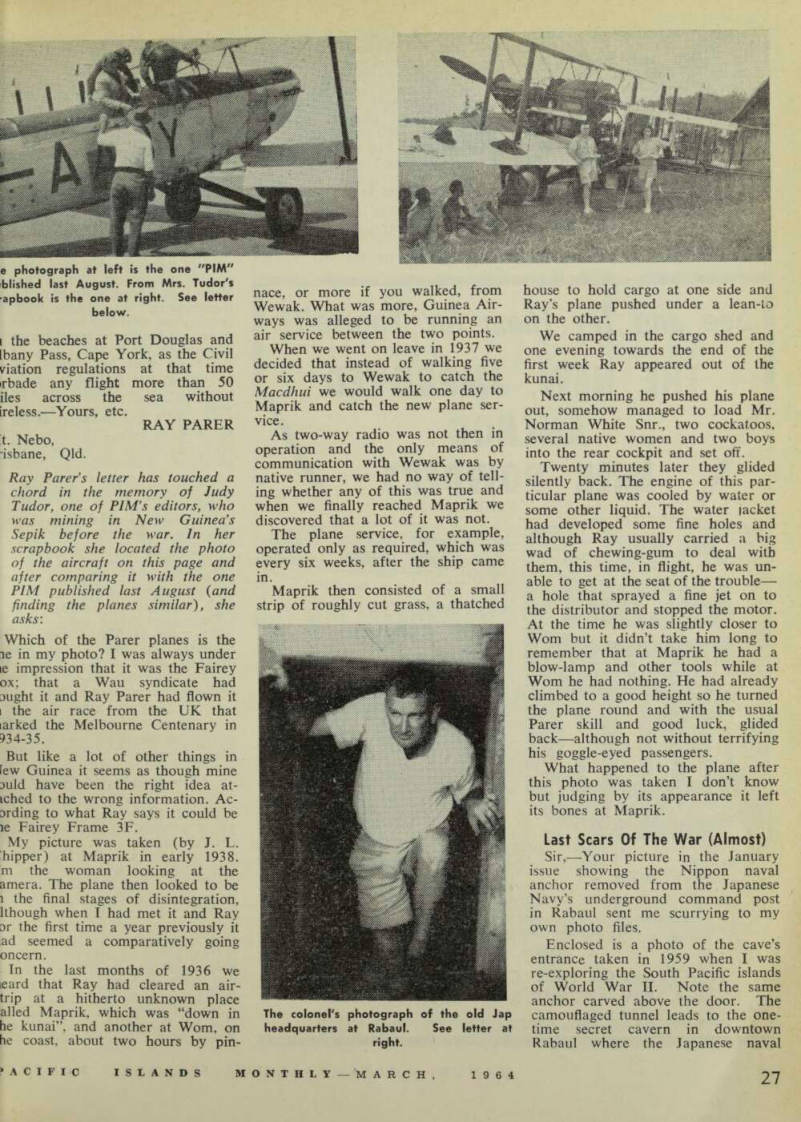
Last Scars Of The War (Almost) Sir, —Your picture in the January issue showing the Nippon naval anchor removed from the Japanese Navy’s underground command post in Rabaul sent me scurrying to my own photo files.
Enclosed is a photo of the cave’s entrance taken in 1959 when I was re-exploring the South Pacific islands of World War 11. Note the same anchor carved above the door. The camouflaged tunnel leads to the one time secret cavern in downtown Rabaul where the Japanese naval
[?]e photograph at left is the one "PIM" blished last August. From Mrs. Tudor's [?]apbook is the one at right. See letter below.
The colonel's photograph of the old Jap headquarters at Rabaul. See letter at right.
high command plotted its abortive South Pacific strategy.
This photo and many others illustrated a series of articles on “Return to the South Pacific” pub lished in the US Marines’ magazine Leatherneck. The gentleman emerg ing from the cave entrance is Mr.
Len Kent, manager of the New Guinea Club on whose property the wartime command post was located.
Yours, etc.,
Robert C. Hayes.
Lieutenant-Colonel (Retired) United States Marines Mercer Island, Washington, USA.
• Colonel Hayes will regret to hear that our January story turned out to be a little premature. The bulldozers have cleaned up a lot of things around that area but the old Jap headquarters, and anchor insignia, are still there as this issue goes to press. We don’t suppose the Marines would like to import them for their museum?
An Old Hand In St. Helena Sir, —PIM never fails to interest me, and so many items click in my memory.
The picture of the old Papuan
flag, then owned by the Re: R. E. S. Taylor, of Port Macquarii which you published in Februar 1963, recalled to me my first voya§ to the Islands, 46 years ago, when was a fellow passenger to Papua wit Mr. Taylor in the old Marsina. [M!
Taylor died in 1963]. I was the still in my ’teens, travelling to tak up tremendously important duties a junior clerk in the Bank of Ne' South Wales, Port Moresby.
How well I remember those Bi vessels, the Marsina, Morinda an Mindini. I have travelled in all c them, and was already an Islanc resident when the Matunga was fir: posted missing in World War Years later I lived in the same boarc ing house in Vavau, Tonga, with M: Norm Pyne, who had been Matunga purser on her last eventful trip whe captured by the Wolf.
I have often had Islands event recalled to my mind just by casm acquaintances in different parts of th world.
In 1950 I was travelling in the S: St. Magnus from Aberdeen to th Shetland Islands and was a fellov passenger with Captain Andersoi who was in command of the shii taking Colonel Holmes from Rabau to Nauru in 1914.
Here in St. Helena I am the onl; Australian, and there are no oh Islands residents with whom to recal the boundless pleasure of the past so you see how important I viev the safe arrival of PIM. However each morning that I shave, I use j Gillette razor which came from th< trade room of MV Mascot in th< Solomons, in which I made severa trips as supercargo in 1923, am which was wrecked on Utupua Islam in Santa Cruz in March, 1924!
Yours, etc.,
A. H. Green
St. Helena Island, South Atlantic.
The Meaning of "Busy"
Sir, —I was sorry to learn of the death of Mr. A. C. Rowland in Tahiti recently at the age of 91 {PIM, Jan., p. 129).
In the years before the war, 1 was in Rabaul with my sights set for Tahiti. At that time I wrote to your publication (yes, even then I was your reader) asking for detailed information about Tahiti.
You referred me to Mr. Rowland. [PIM’s Tahiti correspondent at that time] cautioning me not to encumber him with unnecessary correspondence for “he is a terribly busy man”.
Well, I never sent my inquiry to him, but succeeded in a few weeks in acquiring a position with a corn
;rcial firm in Papeete, and met ; gentleman in person. When I d him about PlM’s advice, his ly answer was one big chuckle th a remark that was not too ttering.
Anyway, Mr. Rowland could be :n all day and every day riding i bicycle or loitering in front of ; Banque de ITndo-Chine.
I visited Tahiti again last year d found him in almost the exact n doing the same thing (nothing) he did each day during my feral years’ stay in Tahiti, which dws you that “busy” has a ferent meaning in Sydney and in peete, and for that matter in any rt of the world—including Cali rnia. Yours, etc.,
Frank P. Kosik.
isbane, ilifornia, USA.
Press Freedom in Samoa Sir, —Should your magazine have roving reporter with some free He I suggest a visit to Western moa might be well worth his time. iere are some strange goings on re at present.
I shall tell you of the case of Tie revelation of the Elvins’ port”. For the past year Mr. arry Elvins, a United Nations ministration expert, has been here jrking out a scheme and a report i government administration. Mr. vins, an elderly Australian gentle an with a distinguished record of iblic administration, was well liked re by most people though un ipular with a few because of his ankness and direct approach.
A few weeks ago Mr. Elvins fished his report and handed it over the Prime Minister. Mr. Elvins en left Samoa for Australia.
Since then it has become common lowledge the report was hard hitting id would hurt somebody’s feelings.
It was presumed that in the normal anner here the report would be bled in the Legislative Assembly committee, would then probably 5 quietly forgotten and left to ither dust in some pigeon hole in entral Office.
This was not to be, however. The iterprising editor of Samoana news iper, Bob Rankin, got hold of a >py of the report and published in his newspaper.
Since this happy event extra •dinary goings on are reported. Mr. ankin has been questioned by the Mice, police have investigated the overnment Printing staff and staff other Government departments.
Many people agree the Govern icnt must have security and say lr. Rankin is guilty of a breach
of journalistic ethics. This is not so Old time and Samoan residents believe if the Elvins’ report had not been made partly public in this way, the public would never have seen or heard of it again. It is a question of freedom of the Press and of the public’s right to know.
The Government here is becoming increasingly secretive and because of this, high levies for school fees, etc., are becoming increasingly unpopular. A constant stream of mainly American UN personnel are
coming in to whom the Government confides its plans but the ordinary Samoan and local European resident is told nothing.
Poised, or supposedly so, on the verge of a major development plan for harbours, citizens and residents of Western Samoa are not even allowed to see a sketch plan of what their capital and harbour is to look like. Yours, etc.,
“Freedom Of The Press”
Apia, Western Samoa, • See story p. 49