Territories TALK-TALK
pp. 31-35 · Read in the full issue
There is no doubt that being a hospital inmate has its advantages, as I have found out over the past few months.
Between times of having injections and being meticulously tidied up for Matron’s’ inspections there is ample opportunity for reading and silent contemplation.
|3HE inimitable and understanding - Stuart Inder paid me a visit ound Christmas time and handed e Keith McCarthy’s new book, itrol Into Yesterday, which I was )le to browse through quietly and oroughly enjoyed, though at times thought the writer when dealing ith certain incidents was inclined have “tongue on cheek”.
I hope Keith follows his Patrol ith another volume, written when i has retired from the Establish ed, and needs not tread so warily.
However ... It is a valuable cord of conditions and events iring the pre-War II period in MG, giving a fair idea of the fflculties of administering the erritory under its own steam and ithout the generosity—to the tune : millions of pounds—of the Aus alian taxpayer.
Nobody knows better than Keith [cCarthy exactly what “working on shoe-string” entailed.
The illustrations were exceptionally >od. I was disappointed, however, at he did not include some of his vn sketches and cartoons. J. K. Me a natural-born black-and-white list with a highly-developed sense : humour and I hope in his next X)k he will include some of his own rawings and give the record a eater personal touch, for Keith is personality above all else.
I have in mind the several cartoons i sketched for the eruption issues of
The Rabaul Times back in 1937.
One in particular created much amusement at the time. It was headed “Geographical Suggestion” and depicted New Britain’s several volcanoes. The captions ran: “If we call this the Son . , . and this the Mother . . . and this the Father . . . and this the Daughter. . . .”
Then, showing the recently erupted Vulcan, “Don’t you agree this should be called the Bastard! (Nobody wanted it, you know).”
Apropos the Rabaul eruption I notice that Keith, in describing the
With Tolala
evacuation of the Rabaul population (p. 175) says: “The big Macdhui was called up by radio and was soon heading for Rabaul to lend a hand”.
Just to keep the record straight it was not the Macdhui but Montoro that was contacted somewhere around Kavieng, I think it was, and it did a wonderful job of work.
The Rabaul Eruption My authority for the correction is the first eruption issue of The Rabaul Times, which was a six-page folio roneoed issue which I arranged to run off at the Catholic Mission, Vuna pope, and dated June 4, 1937. It
contained a detailed description of the eruption and the events follow ing. I quote a portion, which is of historical importance: At approximately 1.30 p.m. (on the day following the eruption) after the Europen women and patients from the Namanula Hospital had embarked, a loud explosion, followed by dense clouds of black smoke, rising from behind Mount Mother, heralded the fact that another volcano had broken out, in the vicinity of the Matupi crater. This made the situa tion more serious as the dust from the clouds would fall directly on the township.
It was at this juncture that the “Montoro” hove in sight and the good ship was most welcome as she came along at full speed with life boats over the side and the master (Captain Mitchie) is to be congratula ted for the prompt manner in which he quickly got into action and took on board the remaining Europeans and over 5,000 natives, men, women and children (to say nothing of dogs, baskets or a couple of cockatoos)!
The original number of natives had been greatly increased by the late afternoon owing to Matupi natives evacuating their island after the crater eruption.
By sundown the last boatload was on board and “Montoro” steamed out for Kokopo. It was on this vessel that many had their first meal for the day and the ship’s staff worked with a will which was greatly
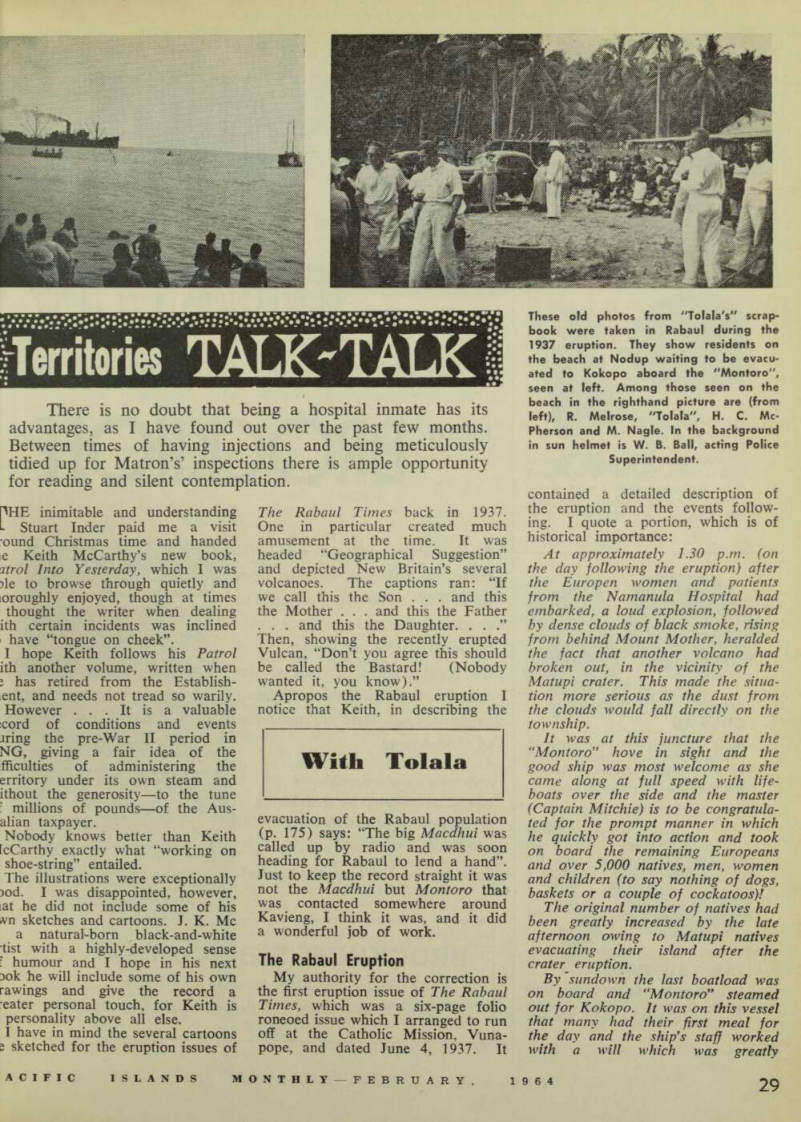
These old photos from "Tolala's" scrap book were taken in Rabaul during the 1937 eruption. They show residents on the beach at Nodup waiting to be evacu ated to Kokopo aboard the "Montoro", seen at left. Among those seen on the beach in the righthand picture are (from left), R. Melrose, "Tolala", H. C. Mc- Pherson and M. Nagle. In the background in sun helmet is W. B. Ball, acting Police
Superintendent.
7 predated by the tired, nerve cked refugees.
On Sunday evening the ‘Golden ear’ and the fleet of schooners rived off Kokopo where every ■eparation was made by the atholic Mission to receive the fugees and the patients from amanula.
The ‘Montoro’ arrived during the ening and stood off until the orning when the work of dis nbarking commenced.
Shortly after the arrival of the iontoro’ a meeting was held on lard, convened by District Officer augh and official arrangements ade for quartering, rations and the neral supervision of details. All cal stores were commandeered; ficials deputed to their various ities and some organisation brought bear on the situation which was serious one.
At 12.30 p.m. a Guinea Airways ane flew over the town, with Pilot
Turner bringing His Honour the Administrator and Mr. C. R. Field (Director of Public Works) from Lae, where they departed at 8.35 a.m.
After circling the town once a perfect landing was made on the new ’drome at Taliligap.
On his arrival His Honour decided immediately to proceed to Rabaul by the Tnduna Star’ which left at 2.20 p.m..
This was the upheaval that started the cry: “Abandon Rabaul!”
But the town lived again, only to be bombed out of existence dur ing the 1942-44 blitz, and yet . . . it rose again bigger and brighter than ever. Rabaul’s experiences during its fifty-odd years have been unique and, at times, most uncomfortable.
I know.
Let’s hope its strenuous days are over now.
For Aid Lang Syne
An old-time friend dropped me a few lines from NG during Christmas and commiserated with me over my ailment and encouragingly told me not to worry if I were unable to write my usual Talk-Talk.
“You must not forget,” he wrote, “we are now living in the future NOT the past of which you are so fond of recalling in your column.
Don’t forget but there are few now of your vintage in NG, nor are they particularly interested in what has been. They are concentrating on what is to be.”
All very true no doubt; and yet there are still some old-timers, scattered far and wide, who derive a certain pleasure in travelling back along Memory’s Trail recalling past incidents.
It does not necessarily curtail their progressive outlook, but they can obtain a more realistic conception of the present by comparisons with the past.
From England there came word
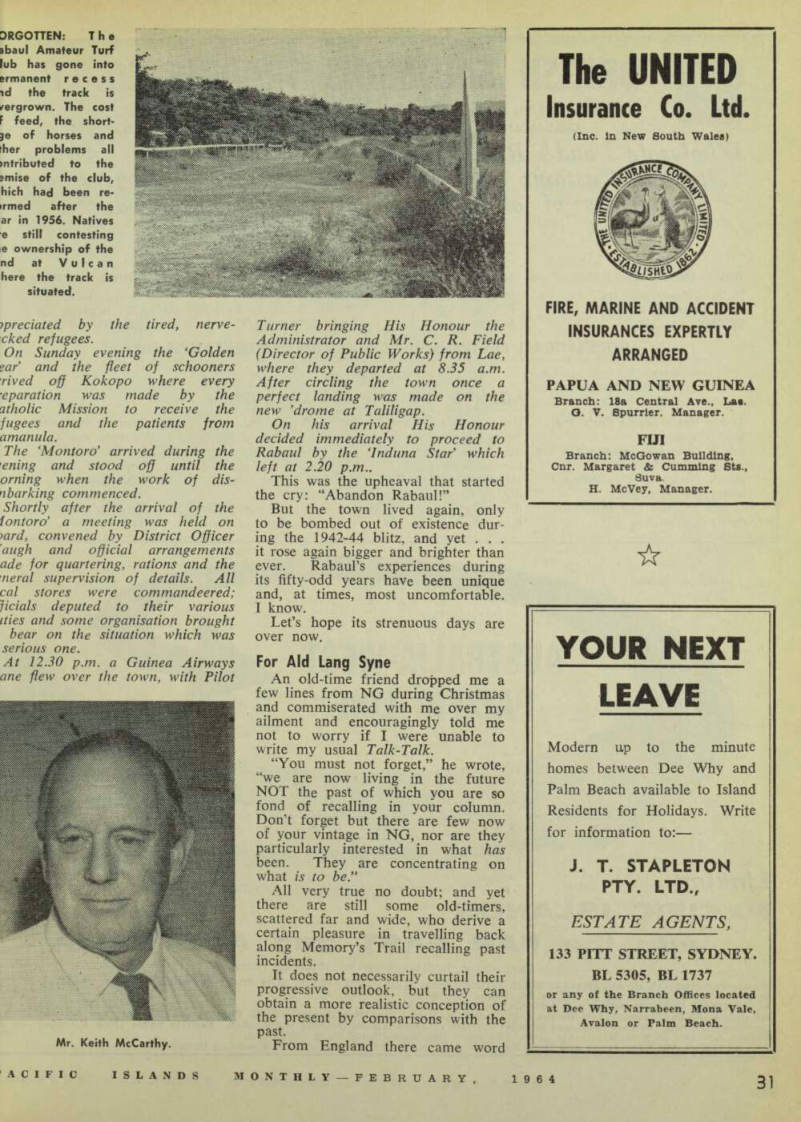
[?]Rgotten: The
[?]abaul Amateur Turf [?]lub has gone into [?]ermanent recess [?]d the track is [?]ergrown. The cost [?] feed, the short [?]e of horses and [?]her problems all [?]ntributed to the [?]mise of the club, [?]hich had been re [?]irmed after the [?]ar in 1956. Natives [?}e still contesting [?}e ownership of the [?]nd at Vulcan [?]here the track is situated.
Mr. Keith McCarthy.
>m old-time Rabaul resident, Mrs. icy Brodie, whose artistic work d been well received in Paris and London ( PIM, Dec., 1962, p. 1).
She hopes to return to Australia Drtly and will probably settle in isbane. She had been travelling tensively on the Continent and is a en worker for the Toe H organisa n. Her daughter Joan lives in ibaul, and son Ken is in the my. . . .
Another old NG link was Captain ugkist, making Christmas contacts th old acquaintances in NG whom met when he was Chief Officer
on the NDL steamer Bremerhaven back in the 1930’5.
He was writing from Port Swettenham, Malaysia, and is master of the NDL MV Ravenstein. His name, Klugkist, when translated from the German, means Wise Box, therefore, following an old German custom prevalent in NG in their time he was dubbed “Savvybox”, the pidgin version. (I remember at one time I had a German medical, assis tant down in Bougainville whose name was Meer-Katz; his friends called him “Pussy belong salt water”).
Ludwig Klugkist had an uncle, who was “Savvybox” also, and he was master of the NDL steamer Coblenz during the Pre-War I years, 1911-14.
In those days the NDL steamers on the Sydney-Japan run called at Rabaul, Madang, Maron, Yap, Angaur, Manila and Hong Kong. (Maron was not among the “Forgotten Isles” 50 years ago)!
The nephew writes that recently he has received from his uncle’s effects an album in which most of the Coblenz passengers had signed their names and he mentions E. P.
Calder, J. B. O. Mouton, Karl Hoerler, Schoenian, Julius Engle brecht, Governor Dr. Hahl, G.
Pralle, G. Taeufert, the writer Norbert Jacques and J. Mirow.
An Unmentioned Detail Much ink has been spilled in the Australian Press on speculating over the outcome of the Papua and New Guinea future House of Assembly: the manifold difficulties of the elections; the great step towards self determination and a hundred other results beneficial and otherwise have all been high-lighted.
There is, however, one little (but all-important) point which I have not seen mentioned in this publicity campaign and that is the matter of the Royal Assent, which has been known to have been disallowed on occasions even in the best of circles, and the fact that there are many more native members as against “ex patriates” won’t alter the situation.
How the illiterate member for some Highlands constituency will react in such an event remains to be seen.
Youngsters Show Their Style: Hagai
Administration Primary School, Port Moresby, is the largest primary school in Papua-New Guinea, with an enrolment of nearly 1,000 children. The school operates staggered hours so everyone can receive an education. The Headmistress, Miss E.
J. Walker, has been in the Territory since 1947, Here, some of the children at their end of the year break-up enjoy a dancing display, varying from traditional Papuan and Samoan dances to The Stomp. —P-NG Official Photo.