Advisory Council
pp. 27-29 · Read in the full issue
Slates New Hebrides Budget
The 19 6 4 Condominium iudget was withdrawn and ra ised after members of the New
[ebrides Advisory Council had
Irongly criticised it in a debate t the beginning of the seventh sssion of the council in Vila in December. The Budget was pre mted again later in the session.
ACCORDING to a local observer, there was a feeling of tension, r en of apprehension, when members ithered for the opening of the ssion. This, he says, was because ey had been staggered to see that e Budget was nearly £lOO,OOO gher than that of the preceding ;ar, when they received their copies ; the Budget the previous week.
Some members felt so strongly >out the increased figure that they ere all for rejecting the Budget ithout discussion.
However, after hearing the joint •eech of the British and French esident Commissioners, which augurated the session and outlined e Budget proposals, and after Iking the matter over at lunch nong themselves, the members :cided that the responsible thing to ) was to discuss each Budget oposal critically.
The Resident Commissioners had ade it clear in their speech that ey knew that some of their Budget oposals would not be popular, and ey did their best to convince every le that all the proposed items of :penditure really were necessary, and at the required revenue had to be iund within the Group.
The Resident Commissioners’ udget proposals not only included creases in revenue under various jads, but also new methods of isessing certain duties.
Export Duty
For example, a change was quested in the system of assessing :port duty on agricultural products i that duty should be calculated on true f.o.b. value determined as :actly as possible after the sale of ie product. proposal evoked considerable scussion. No one was really jposed to it, but it was criticised jcause the change would produce a ;venue increase of about £B,OOO,
which would mean a corresponding loss to producers.
The question of copra grading was also discussed at length. It was generally agreed that arrangements must be made and facilities provided to enable a system of grading to be introduced, and for copra of good quality to receive an adequate price. , a proposal to institute a proportional trading licence similar to that in use in New Caledonia.
While it was recognised that this would apply in the first instance to
the importing firms, it was agreed that the firms would automatically pass on the increased charges to consumers, and thereby raise the cost of living.
Discussion on the items of expenditure produced criticism against h £ F in the Public Works ti t for the running of condominium vessels, the cost of the , recently-established copra research st . a f lon at Santo > and . the leave P r ,°visions for Condominium personnel, As a result of the debate, the
iudget was withdrawn and revised, he revised Budget included several cononlies, and also provided for an icrease in the education subsidy ■om the proposed £36,000 to 38,000.
Changes in Budget
The revised Budget included the
allowing changes:
• Export duty on copra will be harged at the rate of 5£ per cent, n the weight of copra landed in le port to which it is shipped, instead f 6 per cent, on the amount shipped hich was subject to certain deduc ons. This calculation will be based n the f.o.b. value of the copra and ot on the “mercuriale” as was reviously the case.
It is expected that if 34,000 tons f copra are exported in 1964 the Condominium will collect £Stg.B,ooo lore in export duty that under the resent system. This amounts to 5/10i a ton or A4id a bag of opra. The method of collecting xport duty on coffee and cocoa will e changed in the same way. • The number of businesses and rofessions which must pay licence jes has gone up to 60. Most people ho used to pay a fee of £Stg.3o ill now have to pay £Stg.so. • Anyone who imports or exports >r the purpose of his business or rofession will need the new nporter’s/exporter’s licence. This ill cost £l2O. If the value of the cencee’s exports or imports or both Dmbined exceeds £Stg.s,ooo an dditional charge of 1.2 per cent, ill be made on the amount in excess f £Stg.s,ooo.
The additional 1.2 per cent, repre
sents an addition of under 3d in the £ on the landed cost of imports. • Import duty has been abolished on copra sacks, fencing wire, mosquito nets and netting; and the duty on tea, sugar, sawn timber, paint and other building materials has gone down from 15 to 10 per cent. • Import duty has been increased by Stg.3/4 a litre on pernod and similar drinks and by Al/9 a bottle on whisky, gin, brandy, etc.
Import duty has also been increased on the cheaper brands of cigarettes but has been reduced on the dearer brands, so that the duty on all brands is now identical.
• Import duty on textiles has been adjusted so that all cloth will carry a duty of 20 per cent. The result is that the cheapest cottons will be about a penny (Australian) a yard dearer, and the good quality ones, threepence to fourpence a yard dearer. • Port entry dues have been in creased from fourpence (Sterling) to sixpence a net registered ton. • Dog licences, which have not been collected for many years will be collected in Vila and Santo in 1964. The fee, previously Stg.lo/has been raised to Stg.£l.
Local councils will also be empowered to collect this tax outside Vila and Santo. One aim of this tax is to reduce the number of dogs in the Group. • The vehicle tax for all vehicles has been increased by £Stg.loA for 1964. • Amusement slot machines, previously free of tax, will now be taxed at the rate of £Stg.3s for poker machines and £Stg.2s for pin tables and games such as football.
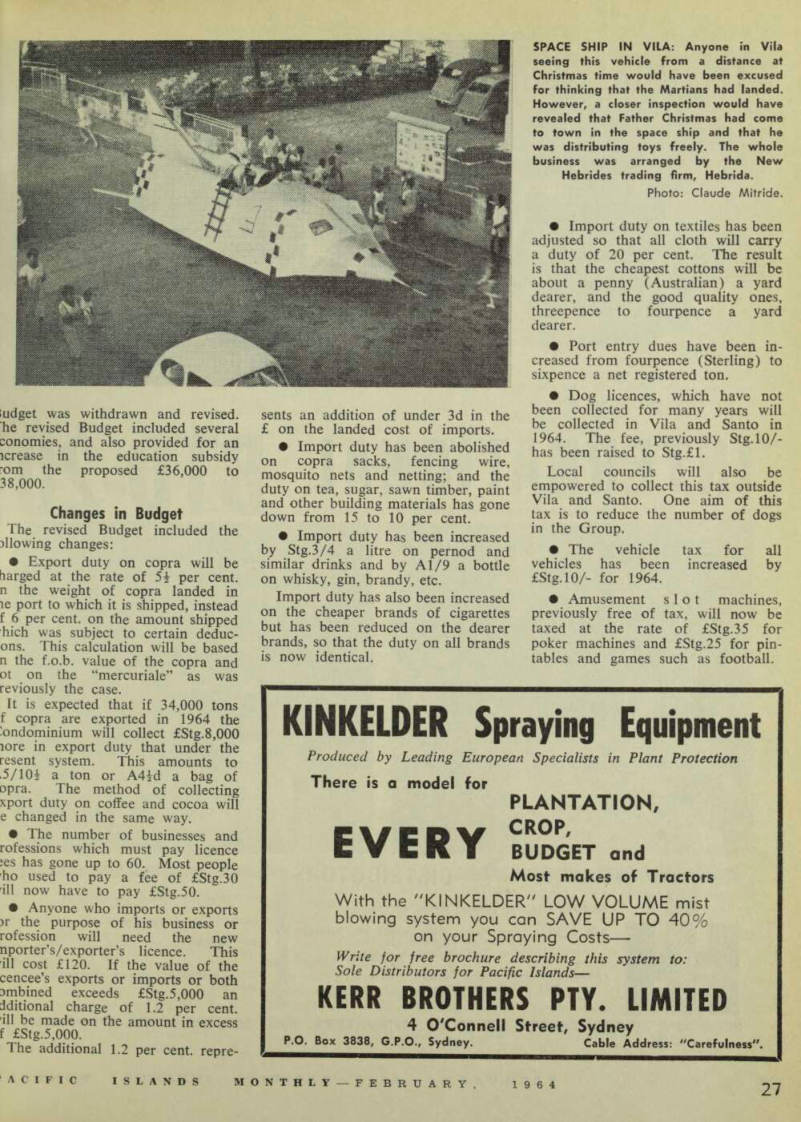
SPACE SHIP IN VILA: Anyone in Vila seeing this vehicle from a distance at Christmas time would have been excused For thinking that the Martians had landed.
However, a closer inspection would have revealed that Father Christmas had come to town in the space ship and that he was distributing toys freely. The whole business was arranged by the New Hebrides trading firm, Hebrida.
Photo: Claude Mitride.