Talks Soon On
pp. 37-38 · Read in the full issue
Political Future
Of The Cooks
The Cook Islands new Leader [ Government Business, Mr. D.
Brown, who is “Chief linister” in the Cooks’ new ladow Cabinet, will visit Well [gton early in the New Year to scuss some vital aspects of ooks-New Zealand relations ter the Cooks achieve internal If-govemment in 1965. i MONG the main points for k discussion is the recommenda >n by the constitutional advisers at Cook Islands affairs in the New aland Parliament be handled rough a Select Committee of the Z House of Representatives rather an through an elected Cook ander sitting in the House.
Under the recommendations of the nstitutional advisers, whose report s been accepted by both the Cook ands Assembly and the NZ Gov ament ( PIM, Dec., p. 33) the >oks in 1965 will have full Cabinet avernment under a Chief Minister, d the Cooks Legislative Assembly 11 have complete legislative tonomy.
Head of State The Queen will be the Head of ite in the Cooks as in NZ and : Cook Islanders will retain NZ izenship. NZ will have a Com ssioner in the Cooks, but he will rry out a role somewhat similar a Governor and will have no wer to over-rule the Assembly.
However, since NZ will continue provide most of the finances for 5 Cooks, NZ will continue to ircise control of policy simply by atrolling the purse strings.
Before the Cooks Assembly closed 1963 session on November 19, it cted Mr. Brown and three others a deputation to discuss the future sembly and NZ Parliamentary ationships in Wellington. The iers are Mr. William Estall •eputy Leader of Government siness), Mr. David Hosking and Ngatapuna Matepi.
As Deputy Leader of Government siness, Mr. Estall is also a member the Cooks new Executive Com ttee, or “shadow cabinet”, the
membership in which was announced by Mr. Brown the previous week.
Mr. Brown was appointed Leader as a result of a secret ballot by the Cooks Assembly, but he is required to make his own selection of his “cabinet”. The Assembly also elected a Speaker.
The only other nomination for the post of Leader was that of Ngatupuna Matepi. Mr. Brown received 11 votes to Matepi’s 10.
The full membership of the new Executive Committee, with their portfolios, is: Mr. D. C. Brown: Leader of Gov ernment Business.
Mr. William Estall: Deputy Leader of Government Business, and in charge of Finance, Treasury, Customs, Inland Revenue, Post Office, Radio, Shipping and Air, Labour.
Napa Tauei Napa: Agriculture, in cluding fisheries, Co-operatives, Hotel, Freezer.
Mr. Robert Julian Dashwood: Health, including dental; Social Development, including Housing; and Broadcasting, Justice, Police and Prisons.
Tangaroa Tangaroa: Public Works, Education, Printing, Power, Survey.
The new Speaker is Teariki Tuavera, He is not a member of the Executive Committee. The only other nomina tion for Speaker was that of Ngatapuna Matepi, and the matter was decided in a secret ballot.
The Cooks has had an Executive Committee since 1962, but its powers have not been as wide as those that are now given to the new Committee under Mr. Brown.
Three members of the new Com mittee were also members of the old one, whose full memebship was: D. C. Brown, T. Tangaroa, W.
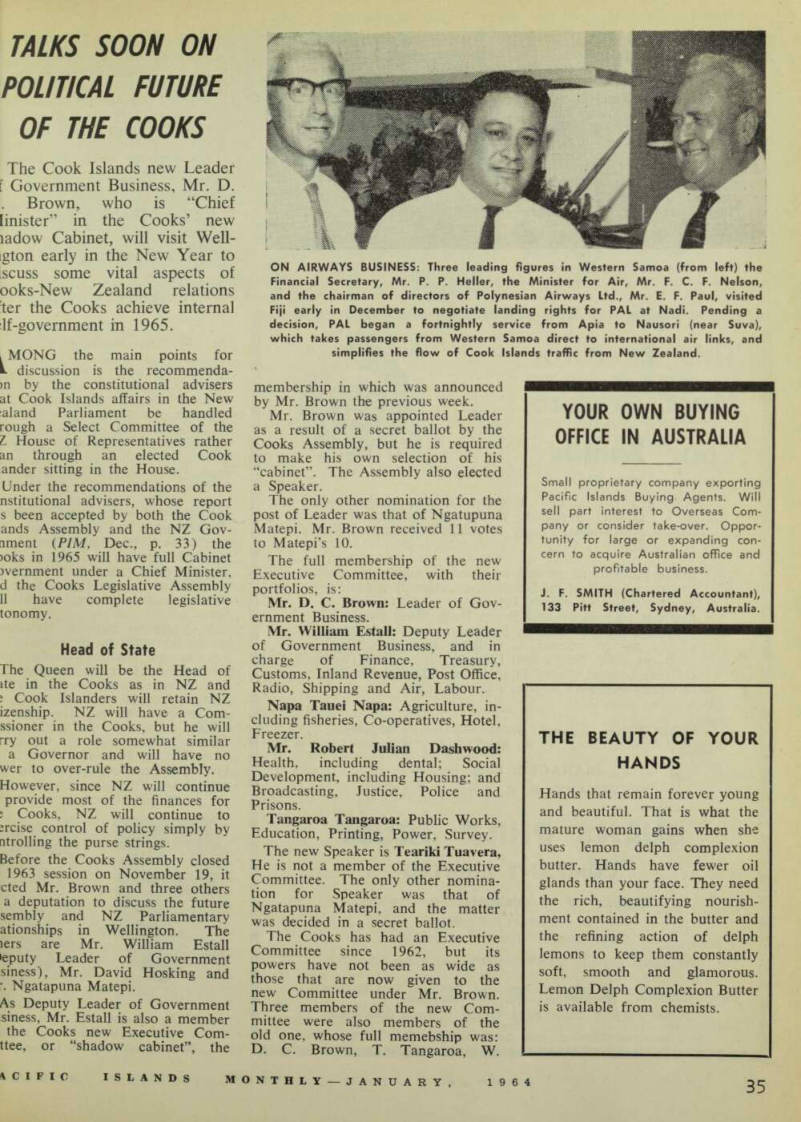
ON AIRWAYS BUSINESS: Three leading figures in Western Samoa (from left) the Financial Secretary, Mr. P. P. Heller, the Minister for Air, Mr. F. C. F. Nelson, and the chairman of directors of Polynesian Airways Ltd., Mr. E. F. Paul, visited Fiji early in December to negotiate landing rights for PAL at Nadi. Pending a decision, PAL began a fortnightly service from Apia to Nausori (near Suva), which takes passengers from Western Samoa direct to international air links, and simplifies the flow of Cook Islands traffic from New Zealand.
Estall, Napa Napa, N. Matepi, T.
Tuavera and Vaine Rere.
The old Committee was disbanded in November to make way for the new one. The Resident Com missioner, Mr. A. O. Dare, told the Assembly that the first Committee had done a very good job for the Cooks in its year of operation.
Administratively it had been ‘'excellent”, and decisions had been made on the spot. On no occasion had there been any acrimonious discussion.
He added: “If the Hon. D. C.
Brown and his new members work as well as the old Executive Com mittee then the Cook Islands are in good hands”.
The timetable for internal self government in the Cooks is now as follows: 9 The constitutional machinery to be put into operation by the NZ Parliament immediately. • The Cooks Assembly to be dissolved in February, 1965. • A 22-member Assembly to be elected by universal suffrage in March, 1965. • The new Assembly to meet in May, 1965, and elect a Speaker and Chief Minister; the Minister to name four other members of the Assembly to form a Cabinet.
For some notes on the back grounds of the new shadow cabinet, see Tropicalities, p. 15.