Ramshackle
pp. 38-39 · Read in the full issue
History In A Ramshackle Cathedral
The consecration of the Rt, Rev.
Leonard Alufurai and the Rt. Rev.
Dudley Tuti as first Solomon Islands Bishops in the Anglican communion took place in Honiara on November 30. Here, Canon Frank Coaldrake gives a colourful report of this most important event in the history of the Church in the South Pacific:
The most ramshackle cathedral the world was the scene of this A Andrew’s Day’s most significant ses vice in the world. No one preset noticed the cathedral—it did not see.* to matter that the building is an oc tunnel-shaped army hut with co> lapsed arches, sagging eaves and glasi less windows. A few did notice tk leaking roof when a sudden showt. found its way through in trickle > Nothing else was bedraggled.
THE complicated service flowr smoothly and solemnly on. TT people were spick and span. Islanj people have taken to shirts and shorn or skirt and blouses and the packu congregation seemed suddenly have brought the new world inn focus.
With several hundred “left-oven on the lawns around the cathedral tit congregation totalled nearly 2,00 For a week past every available boa and even some canoes, had beis bringing people in from islands fi and near—from the New Hebridef 1,000 miles to the south—froo Tikopia 1,000 miles to the east-t from Ontong Java 400 miles to tt north. From distant places in om and twos, from nearer places parties of 10—chosen representatiw
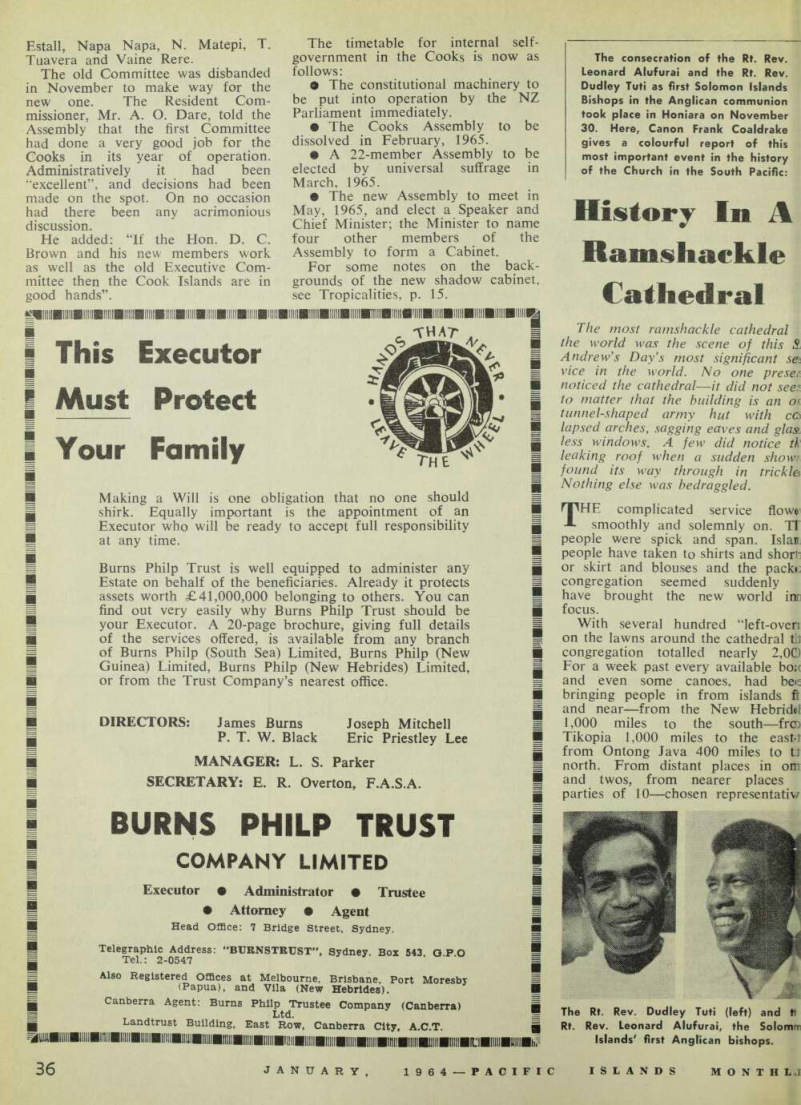
The Rt. Rev. Dudley Tuti (left) and t Rt. Rev. Leonard Alufurai, the Solemn
Islands' first Anglican bishops.
be seated in the old tin shed of cathedral and take part in this □nous act of God.
The day was declared a public )liday throughout the Protectorate.
The service was broadcast on the cal radio, this being the first day ne broadcast attempted. Pro ammes had always been recorded d replayed in the past but this rvice was brodcast live.
Sir David Trench, High Commis mer of the Western Pacific, and idy Trench were in the congrega m. Representative senior clergy im other churches were present.
The Archbishop of New Zealand, - Most Reverend Norman Lesser, nducted the service because Mela sia is in the Province of New Zea id. He was assisted in the conse ation by the Bishop of Melanesia, d Rt. Rev. Alfred Hill, the Bishops Nelson, Carpentaria, New Guinea d Polynesia; the Assistant Bishop New Guinea, the Rt. Rev. George nbo (a New Guinean), the Bishop Aoteoroa, the Rt. Rev. W. H. napa, and the Coadjutor Bishop Brisbane, the Rt. Rev. John Hud n.
The occasional sermon was cached by the Bishop of Melanesia.
He reminded the congrgeation of that God had wrought in over 100 ars in the church in Melanesia, om the initial visionary planning of shop George Augustus Selwyn, the irtyrdom of Bishop Patteson and i heroic suffering of Stephen iroaniara, the church had grown as i offering of a people to God.
The cathedral rector, Canon Edgar ood, was responsible for the or nisation and succeeded with the Ip of many clergy and wardens laying the ground for a faultless emony.
The chairman of the Australian >ard of Missions, Canon Frank •aldrake, was present on behalf of
the board. The ABM supports the diocese with budget grants and has undertaken a substantial extra re sponsibility in part of the cost of the Assistant Bishoprics.
The appointment of the two Assis tant Bishops had been made possible by the financial support of the Islands church. The people have shown their support for the consecration of two of their number by promising extra support.
This will be raised in different ways, but on one island they have given land, cleared the jungle and made five new coconut plantations for the church. In a few years the nuts will produce copra for sale and the pro ceeds will go to the Bishoprics.
Round of Duties The new bishops, the Rt. Rev.
Leonard Alufurai and the Rt. Rev.
Dudley Tuti, will serve initially as assistants in the full round of duties.
The Islands people welcomed the new bishops in their own way, first with a feast, then with a great dance.
Food for the feast had been brought in with the people—four bullocks, 43 pigs, 14 turtles, 40 fowls, two goats and 10 tons of fruit and vegetables.
Firewood for the cooking was cut by two of the church’s men serving a prison sentence and assigned to that task as their share in the festivi ties.
Another mission promised a truck load of flowers for the decorations and sent the truck all the way into town the day before to ask the mission for the petrol they would need to bring the flowers in.
The local broadcast commentator began with a 10 minute introduction in Pidgin English describing the scene at the cathedral. He finished with the words “Make im Bishop begin soon mebbe half hour mebbe 10 minit mebbe sometime,” just as
the first procession entered the cathedral.
The dancing on the sports ground was watched by about 2,000 people.
Men from several different islands danced old custom dances of welcome to a chief. The rhythms and the cos tumes stirred the blood and many times there were shieks and calls from the crowd the same as we hear from teen-age fans of a pop-singer.
The broadcast commentator said Honiara had never seen anything like it.