Big Reception
p. 35 · Read in the full issue
For Manihiki
Castaways
The three survivors of the 63f drift voyage from Manihiki,
ok Islands, to Erromanga,
w Hebrides, were welcomed
Rarotonga, by a big, en
isiastic crowd when they ar
sd by air from Apia on
vember 8. 3E three men, Teehu Makimare, Toka Tube and Tupou Papai, e blown away from Manihiki in 7 ft boat after almost completing 20-mile crossing from Rakahanga M, Nov. p. 10 and Dec. p. 63).
Tier reaching Erromanga, the i were transferred to hospital in i. They began their flight home to Cook Islands, via Fiji, American Western Samoa, on November 2.
Leg Pains
»n arrival in Rarotonga, all men e outwardly in remarkably good sical condition, but all were sui ng from leg pains, eehu Makimare was met by his i and two children, who had elled from Manihiki to Rarotonga he trading schooner Tiare Taporo. a Tube was met by his father— wife and family still being in nihiki. And Tupou Papai was ted by his wife and one child, down from Manihiki. he relatives of the three casta s had been on their way to Raro ;a from Manihiki when word received from the New Hebrides they were safe, mong the crowd at the airport to t the castaways was the Cook nds Resident Commissioner, Mr.
O. Dare, and members of the k Islands Legislative Assembly, rayers of thanksgiving were said
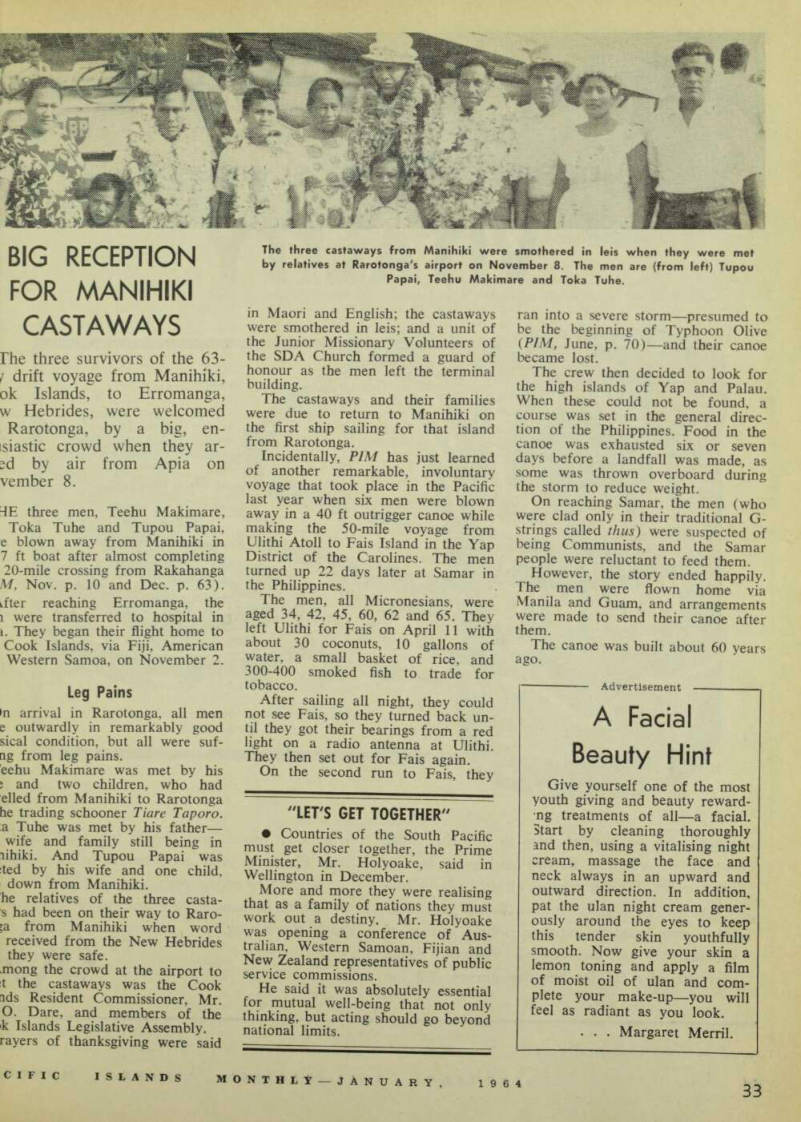
in Maori and English; the castaways were smothered in leis; and a unit of the Junior Missionary Volunteers of the SDA Church formed a guard of honour as the men left the terminal building.
The castaways and their families were due to return to Manihiki on the first ship sailing for that island from Rarotonga.
Incidentally, PIM has just learned of another remarkable, involuntary voyage that took place in the Pacific last year when six men were blown away in a 40 ft outrigger canoe while making the 50-mile voyage from Ulithi Atoll to Fais Island in the Yap District of the Carolines. The men turned up 22 days later at Samar in the Philippines.
The men, all Micronesians, were aged 34, 42, 45, 60, 62 and 65. They left Ulithi for Fais on April 11 with about 30 coconuts, 10 gallons of water, a small basket of rice, and 300-400 smoked fish to trade for tobacco.
After sailing all night, they could not see Fais, so they turned back un til they got their bearings from a red light on a radio antenna at Ulithi.
They then set out for Fais again.
On the second run to Fais, they
"Let's Get Together"
• Countries of the South Pacific must get closer together, the Prime Minister, Mr. Holyoake, said in Wellington in December.
More and more they were realising that as a family of nations they must work out a destiny. Mr. Holyoake was opening a conference of Aus tralian, Western Samoan, Fijian and New Zealand representatives of public service commissions.
He said it was absolutely essential for mutual well-being that not only thinking, but acting should go beyond national limits.
ran into a severe storm—presumed to be the beginning of Typhoon Olive ( PIM , June, p. 70) —and their canoe became lost.
The crew then decided to look for the high islands of Yap and Palau.
When these could not be found, a course was set in the general direc tion of the Philippines. Food in the canoe was exhausted six or seven days before a landfall was made, as some was thrown overboard during the storm to reduce weight.
On reaching Samar, the men (who were clad only in their traditional G strings called thus ) were suspected of being Communists, and the Samar people were reluctant to feed them.
However, the story ended happily.
The men were flown home via Manila and Guam, and arrangements were made to send their canoe after them.
The canoe was built about 60 years ago.
The three castaways from Manihiki were smothered in leis when they were met by relatives at Rarotonga's airport on November 8. The men are (from left) Tupou Papai, Teehu Makimare and Toka Tube.