New Caledonia
p. 85 · Read in the full issue
52 Died When Arms
Exploded In Wartime
By Lew Friday
It was about 2 p.m. on Sunday, November 1, 1943.
Noumea was just waking from its after-lunch siesta, and I was walking in the Rue d’Alma when the town shook as in an earthquake.
A HOT blast of air rushed through the town, and shattered glass fell from many shop windows. About half a mile across the harbour, on the far side of the Point Doniambo nickel smelters, the greatest explosion in New Caledonia’s history had occurred.
It was a major disaster, of vital importance to the Allied war effort at the height of the Solomons’ offensive. It was so important that newspapermen could not report it at the time; and I have seen no references to it in print since.
What had happened was this: Tons of ammunition and barrels of gasoline had blown up on the wharf, 52 men had been killed, and scores had been injured.
The explosion caused many fires which did much damage, but quick action by a United States ammunition platoon and a bomb disposal platoon, Army engineers, Navy construction battalions and port personnel got the fires under control within four hours, and they were put out within eight.
Repairs to the wharves began immediately and were completed within 24 hours.
Many lives were saved through the untiring efforts of Army and Navy men. One officer—a second-lieutenant, named King—was awarded a Soldier’s Medal for heroism in
evacuating a supply of ammunition, several trucks, and other equipment amid fire and flying shrapnel, thus saving much Government property from destruction, Four ships were berthed near where the explosion occurred. Three of them got clear of the docks within 27 minutes, and the fourth ship fol lowed soon afterwards, Harbour pilots from the offices of the port director were aboard these ships less than nine minutes after the explosion, lending what assistance they could. At least one Frenchman was afterwards decorated by the Americans for the part he played in getting one ship clear, As soon as practicable, debris was searched for unexploded ammunition, and all such ammunition was loaded on trucks and taken to an area to be further inspected by bomb disposal troops.
Ammunition in various dumps around the town was inspected and any that showed signs of deteriora tion was fired. ] During the rest of the day anu throughout the night, those supervis ing salvage operations and removing debris did heroic work. Crews from the Arm y’s 353rd and 362nd Engineers participated, Plans were then drawn up to re build the damaged area, a task that
was completed late the same month.
The explosion was so severe that the recently completed concrete slab of the wharf had to be reconstructed.
The scene after the explosion, on the dock and in the water, beggared the imagination. After several days of intense work by the Allied Forces and French civilians in recovering bodies from the charred debris, 35 bodies remained unidentifiable.
A mass burial service was held at the U.S. Army cemetery off the high way out of town. It was conducted by Chaplain R. D. Driscoll, of the U.S. Navy, and Chaplain John M.
Smith, of the U.S. Army. Twenty five bodies were buried on November 2, 26 on November 3, and one on November 5.
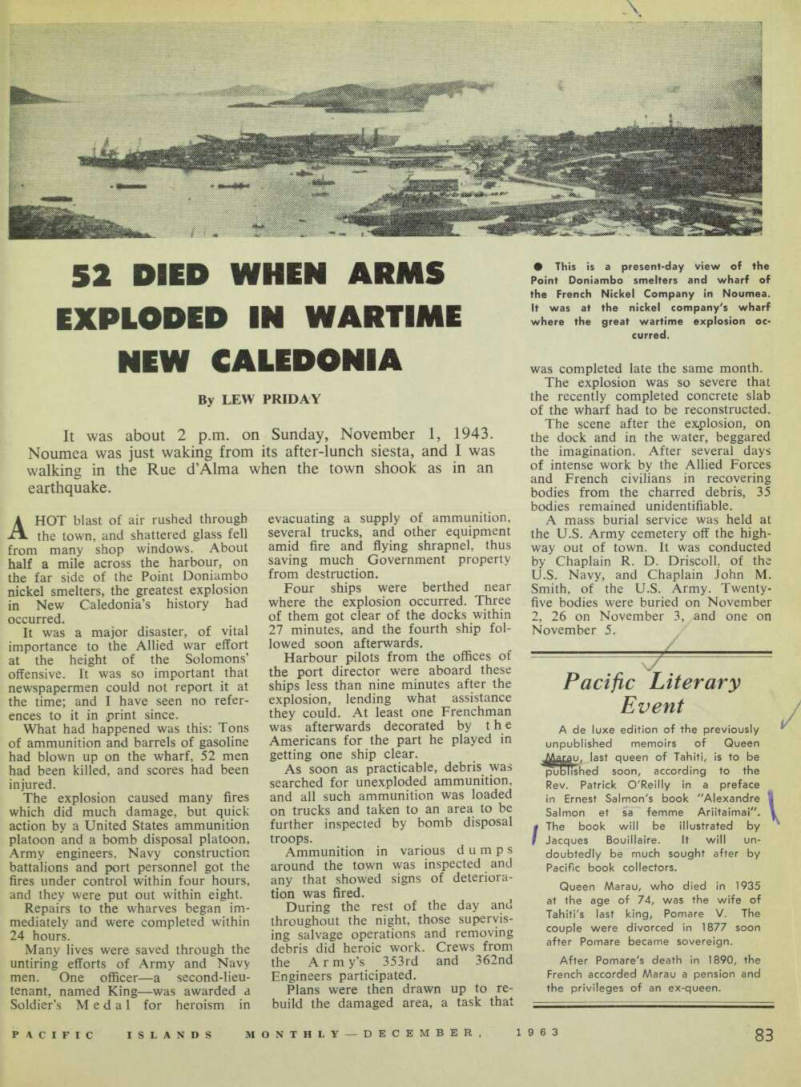
This is a present-day view of the Point Doniambo smelters and wharf of the French Nickel Company in Noumea.
It was at the nickel company's wharf where the great wartime explosion oc curred.