He Makes Friends
p. 83 · Read in the full issue
Radio "Ham" Denis Hampton Is a Busy Ambassador
He Makes Friends For Fiji On The Air Waves
From J. Adlington, in Suva A “ham” radio operator at
Laucala Bay, Fiji, was tuning
his shortwave receiver late one
night recently. Suddenly,
amongst the Morse, came a faint but distant call sign voiced in a rich Irish brogue.
HE replied, and for the brief period that followed a direct-voice radio link was established over the vast expanse of ocean and land that sep arates Fiji and Ireland, After the usual exchange of “ham” technicalities, a feature of this hobby, the talk turned to generalities. Soon a spate of questions and answers about life in sunny Fiji was flying through the ether until the voice faded in the distance.
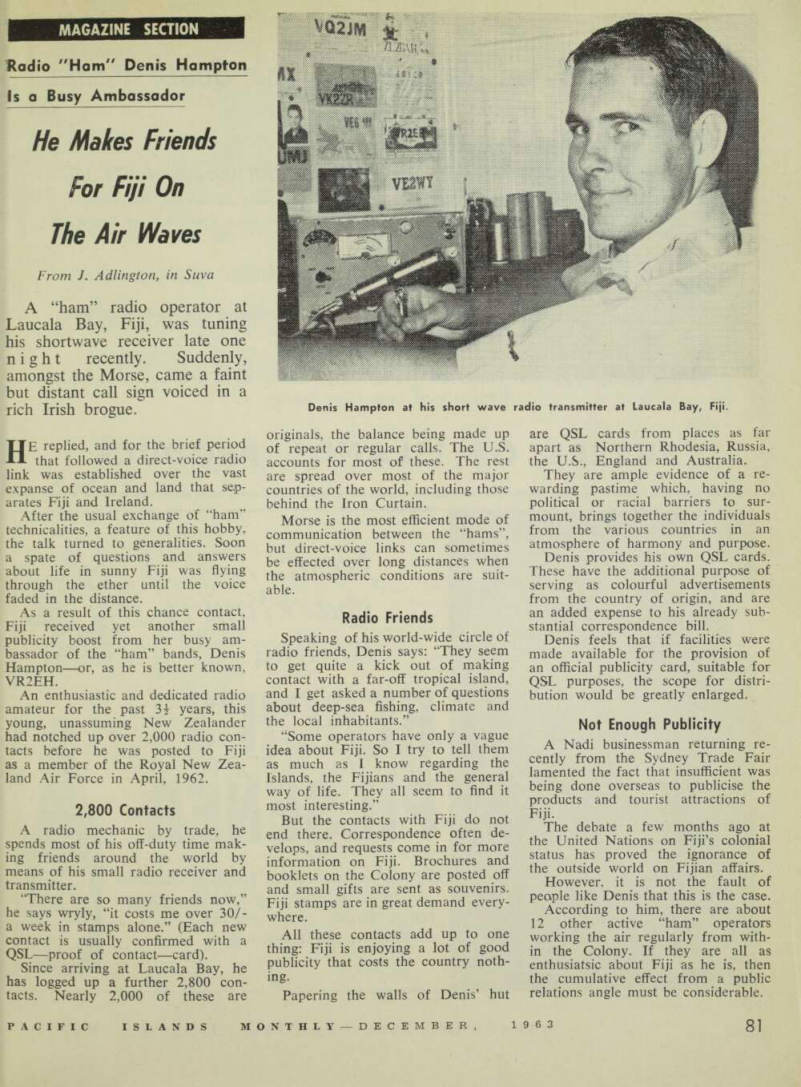
As a result of this chance contact, Fiji received yet another small publicity boost from her busy am bassador of the “ham” bands, Denis Hampton—or, as he is better known,
Vr2Eh.
An enthusiastic and dedicated radio amateur for the past 31 years, this young, unassuming New Zealander had notched up over 2,000 radio con tacts before he was posted to Fiji as a member of the Royal New Zea land Air Force in April, 1962.
2,800 Contacts
A radio mechanic by trade, he spends most of his off-duty time mak ing friends around the world by means of his small radio receiver and transmitter.
“There are so many friends now,” he says wryly, “it costs me over 30/a week in stamps alone.” (Each new contact is usually confirmed with a QSL —proof of contact —card).
Since arriving at Laucala Bay, he has logged up a further 2,800 con tacts. Nearly 2,000 of these are
originals, the balance being made up of repeat or regular calls. The U.S. accounts for most of these. The rest are spread over most of the major countries of the world, including those behind the Iron Curtain.
Morse is the most efficient mode of communication between the “hams”, but direct-voice links can sometimes be effected over long distances when the atmospheric conditions are suit able.
Radio Friends Speaking of his world-wide circle of radio friends, Denis says: “They seem to get quite a kick out of making contact with a far-off tropical island, and I get asked a number of questions about deep-sea fishing, climate and the local inhabitants.”
“Some operators have only a vague idea about Fiji. So I try to tell them as much as I know regarding the Islands, the Fijians and the general way of life. They all seem to find it most interesting.”
But the contacts with Fiji do not end there. Correspondence often de velops, and requests come in for more information on Fiji. Brochures and booklets on the Colony are posted off and small gifts are sent as souvenirs.
Fiji stamps are in great demand every where.
All these contacts add up to one thing: Fiji is enjoying a lot of good publicity that costs the country noth ing.
Papering the walls of Denis’ hut
are QSL cards from places as far apart as Northern Rhodesia, Russia, the U.S., England and Australia.
They are ample evidence of a re warding pastime which, having no political or racial barriers to sur mount, brings together the individuals from the various countries in an atmosphere of harmony and purpose.
Denis provides his own QSL cards.
These have the additional purpose of serving as colourful advertisements from the country of origin, and are an added expense to his already sub stantial correspondence bill.
Denis feels that if facilities were made available for the provision of an official publicity card, suitable for QSL purposes, the scope for distri bution would be greatly enlarged.
Not Enough Publicity
A Nadi businessman returning re cently from the Sydney Trade Fair lamented the fact that insufficient was being done overseas to publicise the products and tourist attractions of Fiji.
The debate a few months ago at the United Nations on Fiji’s colonial status has proved the ignorance of the outside world on Fijian affairs.
However, it is not the fault of people like Denis that this is the case.
According to him, there are about 12 other active “ham” operators working the air regularly from with in the Colony. If they are all as enthusiatsic about Fiji as he is, then the cumulative effect from a public relations angle must be considerable.
Denis Hampton at his short wave radio transmitter at Laucala Bay, Fiji.