Territories TALK-TALK
pp. 115-119 · Read in the full issue

With Tolala
In the July {< Talk-Talk” I sent out a query concerning the Mortlock Islands in New Guinea—after whom were they named?
NOW comes to hand a suggestion from E. L. Mauseth, of Alden, Minnesota (USA), for long years a correspondent with Islanders (and. incidentally, a keen conchologist), to the effect that a Captain Benjamin Morrell, a New England skipper, sealer and whaler, hailing from Ston ington, Connecticut, was responsible for naming both the Mortlock Islands —the one in the Carolines and the one in New Guinea.
Mr. Mauseth quotes his authority two old newspapers published in Nan tuckett, Mass., The Enquirer and Mirror, dating from 1800 to 1850.
The name was that of a First Mate or seaman, writes Mr. Mauseth. Cap tain Morrell is credited with having “discovered” the Caroline Mortlocks in 1830.
From another source, however, an expert on Pacific Islands history, comes a different tale.
He quotes Andrew Sharp’s The Discovery of the Pacific Islands in which it is stated that a Captain Mortlock, of the British vessel Young William, sailed about the Pacific in 1795 and in that year discovered some islands in the Carolines, one of which was Nomoi (south of Truk), No mention is made of our New Guinea Mortlock Islands.
So apparently, it is a toss-up be tween Morrell and Mortlock and per sonally I’d be inclined to back Mort lock; not that I doubt for one moment Reader Mauseth’s sincerity.
I find it rather strange that a “colourful personality”, such as Morrell is described, did not perpetu ate his own name on some coral isle in the Pacific.
Are there any other suggestions?
"Taken For A Ride"
A feature of the SP Post, Port Moresby, which I invariably delight in reading is “Have a look”, by J. D.
McCarthy. His comments always appear critical, constructive, rational and free from that innocuous, vague phraseology which characterises official hand-outs. Therefore I sur mise he is of the Non-Official species and (to use a modern term) an ex patriate.
I notice, however, that in the Post of September 10 he refers to a com ment of mine in August Talk-Talk anent the rise in the Administration’s “pay packets” and wonders whether I have been “taken for a ride” when I whitewash the Establishment’s ex travagance and describe it as expendi ture for “native welfare”.
J. D. McC. can rest assured I have been taken for no ride (in this re spect, at least).
For many years now Government expenditure has been broadly de scribed, in most departments, as be ing on account of “native welfare” and therefore deemed a justifiable ex pense unquestioned by the Australian tax-payer, who has footed the bill, feeling it was doing something for the less privileged people.
Perhaps the cover-up has been legitimate, for it can be argued that our very existence both in Papua and New Guinea is in the cause of native advancement towards our way of life.
The fact that we are surrounding our Government officers with all kinds of expensive amenities (in order to induce them to join and remain in the service) is beyond the point.
Incidentally, ID quotes me incor rectly when he credits me with using the word “impolite”. I am afraid politeness, when I have pen in hand, is not one of my strong points, but the word which I did use was “im politic”, and there is a considerable difference between the two.
To ID I wish all the best. May his typewriter ribbon never grow dim.
Those Pay Packets While on the subject of expendi ture it is of interest to note that Highlands Member lan Downs made some pithy comments in the last session of the Council concerning staff increases when speaking on the Appropriation Bill 1963-64.
The budget’s emphasis was “too much departmental activity and too little on capital works,” he said. And that was putting it very nicely.
Quite recently somebody in the know worked it out that Administra tion salaries for 1963-64 financial
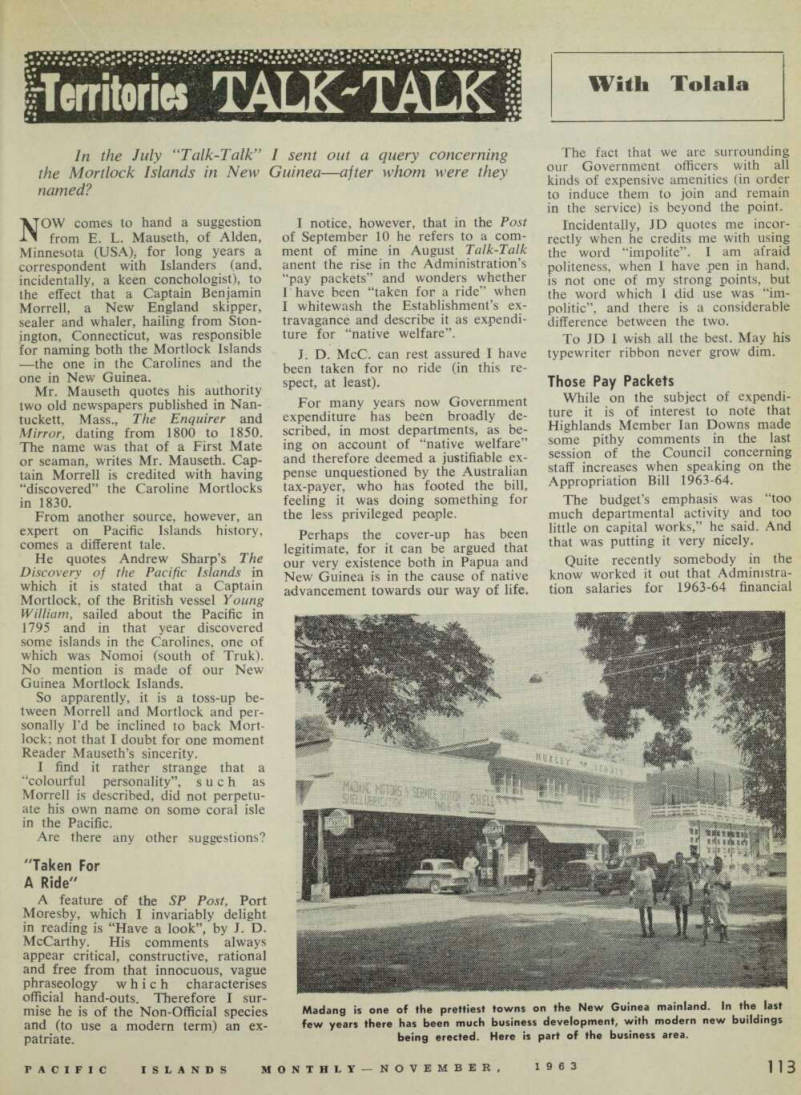
Madang is one of the prettiest towns on the New Guinea mainland. In the last few years there has been much business development, with modern new buildings being erected. Here is part of the business area.
year would be 52.47 per cent, of entire departmental expenditure.
Add to this the expense of glorify ing Port Moresby to bring it up to Capital Grandeur and what have you left for roads, bridges, wharves and airfields, which comprise the hard core of an agricultural country’s economical development?
WhaC remains in the Treasury coffers for the essential, needs of hygiene and education for places like those Fringe Islands, sometimes called “forgotten”?
Not as much as there should be by any means.
And speaking of “departmental ex penditure”, and turning back the clock a few years, just for the helluvit:— In the TNG report to the League of Nations for 1938-39 the Admin istration’s total revenue from all sources was £460,835/14/- and total expenditure £502,579/11/9.
The Public Works Department, re sponsible for roads, bridges, build ings and what-have-you, spent £11,278 on salaries, £23,524 on contingencies and £69,145 on new works. For the previous year salaries amounted to £7,511, therefore an explanatory note points out (some what apologetically, it seems) that the “increase was consequent on appoint ments of additional technical staff.”
New Works Glancing at some of the new works’ items in that period one sees “road development £34,482”, “Purchase of timber rights £2,247”, “Four new wards Kokopo Native Hospital £758.” and numerous staff bungalows, native quarters, Customs sheds and District Offices at Angoram, Bena Bena, Buin, Gasmata, Kavieng, Madang, Rabaul and many other spots.
Needless to say there were no custom-built homes, furnished with imported tubular furniture.
That was “working on a shoe string” with a vengeance, as com pared with these days. But one must not forget New Guinea was not Aus tralia’s curly-headed boy in those days but was kept within its budget by the astute Orton Townsend who handled the purse-strings; and, what is more, it showed a surplus at the end of the financial year of £17,947.
It started the year with a carry over surplus of £59,691.
Of course, in those days £1,000,000 was an astronomical figure and treated with respect, not carelessly tossed about and symbolised as £lm.
And then, not the least by any means, Australia had no pack of Afro-Asian critics climbing on its back.
Camohe Grows “Another Good Year for W. R.
Carpenter” reads the heading in a Sydney morning paper and for me it started a train of thought that went back to Rabaul in 1920 when the Ex propriation Board was starting to take over the German assets of the local companies.
Australian business firms with long vision were then carefully watching commercial events in old German New Guinea and how the post-War 1 changes might be moulded to their hearts’ desires.
In the NDL Bungalow (later known as the Walstab Bungalow) on Central Avenue and opposite the Proclama tion Square there was opened an office for W. R. Carpenter & Co., Ltd., Island produce buyers and gen eral agents, of Sydney, practically an unknown concern in NG.
A rather dour, tactiturn manager by the name of Tatham was in charge and his assistant was a pleasant cove, Bert Perriman, who, as people gradu ally got sorted in the town and found their niche in the later months of 1920, proved a good mixer and be came one of the boys.
He had a car (a Rabaul rarity at that time) even though it was only a T Ford model (I think its number was 22.) But it was quite capable of making a trip to the popular Kokopo Hotel in the evenings—and, what was more, returning.
It was Bert who was responsible for creating the goodwill spirit and the firm’s acceptance by those that really mattered. And, might I add, that characteristic remained with him down the years.
Out in the harbour, near the Hernsheim Wharf, lay anchored a
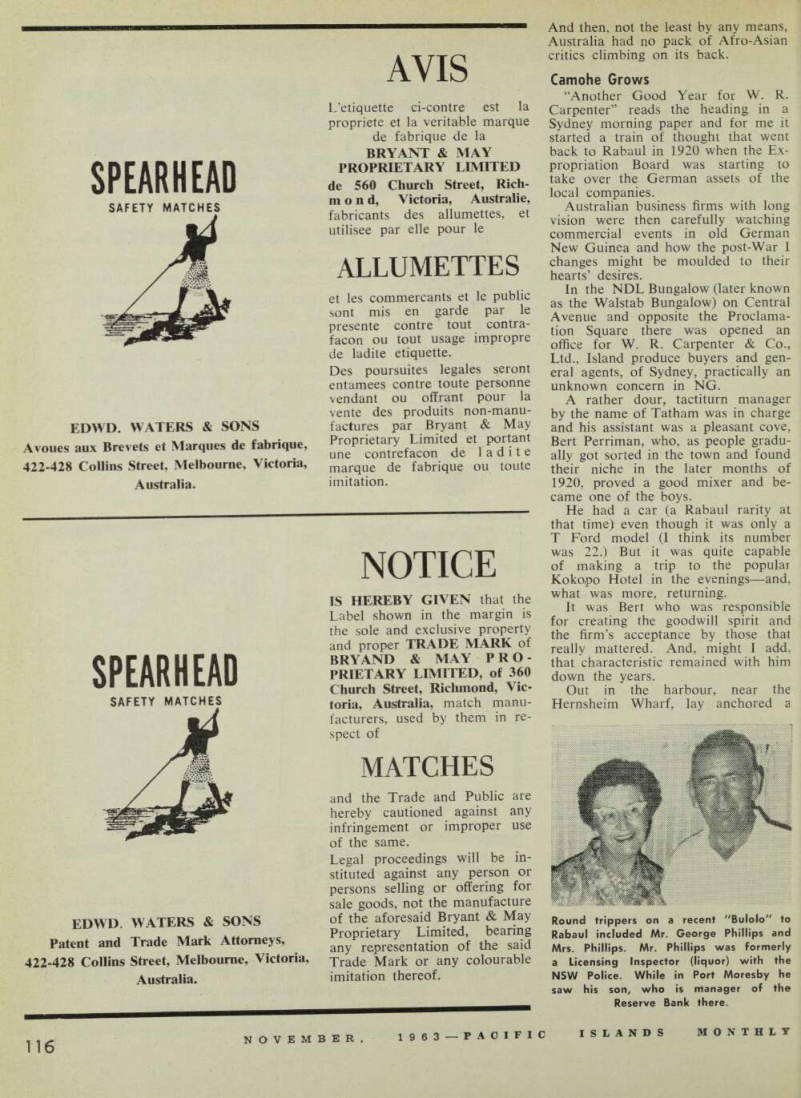
Round trippers on a recent "Bulolo" to Rabaul included Mr. George Phillips and Mrs. Phillips. Mr. Phillips was formerly a Licensing Inspector (liquor) with the NSW Police. While in Port Moresby he saw his son, who is manager of the Reserve Bank there.
not very natty-1 ook i n g schooner, Camohe.
Its master was one Captain Hope, a rather fierce-looking individual with a black tooth-brush moustache, who cruised about the islands from time to time, picking up bits and pieces of produce from clients who were not bound hand-and-foot to the Expro board.
Such was WRC in Rabaul in 1920; its headquarters, its fleet and its per sonnel.
It has gone a long way since then!
Too Much Change?
It’s all rather confusing, really. On the one hand we have the Powers That Be adjuring the people of New Guinea to go easy in their march towards territorial independ ence; yet, on the other hand we have all sorts of ideas, stemming from Western cultures, being propounded by long-haired visiting tourists and inspired native sophisticates, as for instance the adoption of the Western style of surnames and upsetting old tribal methods of naming the rising generation.
In our enthusiasm to Westernise these native people we have revolu tionised their languages, clothing, houses, foods, religions, marriages, agricultural and fishing methods, to say nothing of introducing them to the gentle art of alcohol.
One is prompted to ask whether, as trustees of a county and its people, it comes within our purview to in augurate such drastic changes?
Are such innovations wholly neces sary in bringing them to a state where they are capable of self-government?
Or, as an alternative, should we not allow these people to adjust these detailed cultural changes themselves if and when they find it necessary to do so, after having attained self government?
Are shirts and pants and socks and boots an essential qualification for self-government? Western houses? A universal knowledge of the English language? A change of nomenclature?
And a change of religion? . . . Other native countries have not found it so.
Parenthetically, I quote a heading in a Sydney morning newspaper: “A cheery Prime Minister in a mid-grey lava-lava whizzed through Sydney at the week-end carrying golf clubs.”
It was Prime Minister Mataafa, of Samoa. And note, please he wore a “lava-lava” not a “lap-lap’„ as we have insistently called it since War 11.
If, in this Age of Conformity, Samoans are determined to maintain their own individual attire, why not New Guinea?