Pacific Shipping And Cruising Yachts
pp. 97-110 · Read in the full issue
Cruising Yachts
'Cook' Badly Damaged
The Royal Navy survey ship, HMS Cook , will be out of commission for some time. She was badly damaged when she was on a coral head in reef-infested Fiji waters near the islet of Vatu-i-Ra, just off the north-east coast of Viti Levu about 5 p.m. on October 1. The Cook was refloated at 4 a.m. the next day.
J<HE limped back to Suva on 3 October 2, and a survey revealed onsiderable damage. After repairs t Suva to make her seaworthy she rill have to go into a naval dry lock for refit.
The New Zealand Naval Board sent heir construction adviser, Mr. T. I. )avies, to Suva to make an on-the pot examination, and see if it was ossible to partially slip the 1,600-ton look on the 1,000-ton Suva slipway or repairs to the foreward section.
While held on the coral patch the ’ook took a pounding from rising sas for 11 hours. The damage extensive, but was confined to tte rst 70-ft from the bows of the 307-ft ull.
This was the extent of the damage: • The asdic dome carried away; pparatus worth many thousands of ounds completely ruined; many ashes in the hull; considerable uckling of the bottom plates; many nail holes; fractured seams; and ulkheads damaged and split.
From 28 to Nil Before Mr. Davies arrived from lew Zealand skin divers from the 'ook and HMNZS Taranaki, which 'as in Fiji waters at the time, closely samined the Cook’s hull.
The captain, Commander Frank hint, said that even if repairs could e carried out at Suva, they would nly make the Cook seaworthy, and ill scale repairs would have to be lade at a regular dockyard.
The day after she arrived at Suva orkmen started to pump out about 5 per cent, of the ship’s fuel oil. rear and fittings were taken ashore ) lighten her.
Describing the grounding, Com lander Hunt said the Cook was in normal state exploring unsurveyed aters, with all her watertight doors
closed, and her anchors cleared away ready for instant action.
One of the survey boats was sound ing ahead on a zigzag course, while the Cook herself was travelling about three to four knots. There were soundings of 28 fathoms and suddenly they went from 28 to nil.
The Cook struck and her bows reared more than 2 ft before resting on the coral head, which was com pletely isolated with deepwater on every side.
The tide was full at the time and with every swell the Cook rose several feet in the water and came down with a shuddering bump which jarred her from stem to stern.
The crew, trained for such an emergency, went straight into action.
They immediately flooded one of the aft compartments to alter the trim and take her stern deeper into the water, and at the same time lift the bows. Stores and the 12-ton port cable were transferred aft, and the big fresh water tank at the forepeak was emptied to lighten the bows.
A strong SE wind threatened to swing the Cook broadside on to the coral head. The kedge and bow
anchors were put out and for 10 hours the starboard engine was run “full astern”.
All night long the Cook took a heavy pounding while the crew worked to free her. About 4 a.m., an hour before high water, the Cook gave a lurch and slid off into deep water.
The Taranaki, on her way to Fiji, was diverted to help the Cook, but she was not needed. The USS Co.’s Tofua, which was at Suva at the time, was also prepared to go to help the Cook, but she too was not needed.
Apart from the actual damage to the ship many of the stores were a write-off. The refrigerated store, holding all the stores of fresh meat and vegetables, was completely flooded, and sea water soon forced all the water out from the fresh water tanks. (Over)
"Al Sokula" Sold:
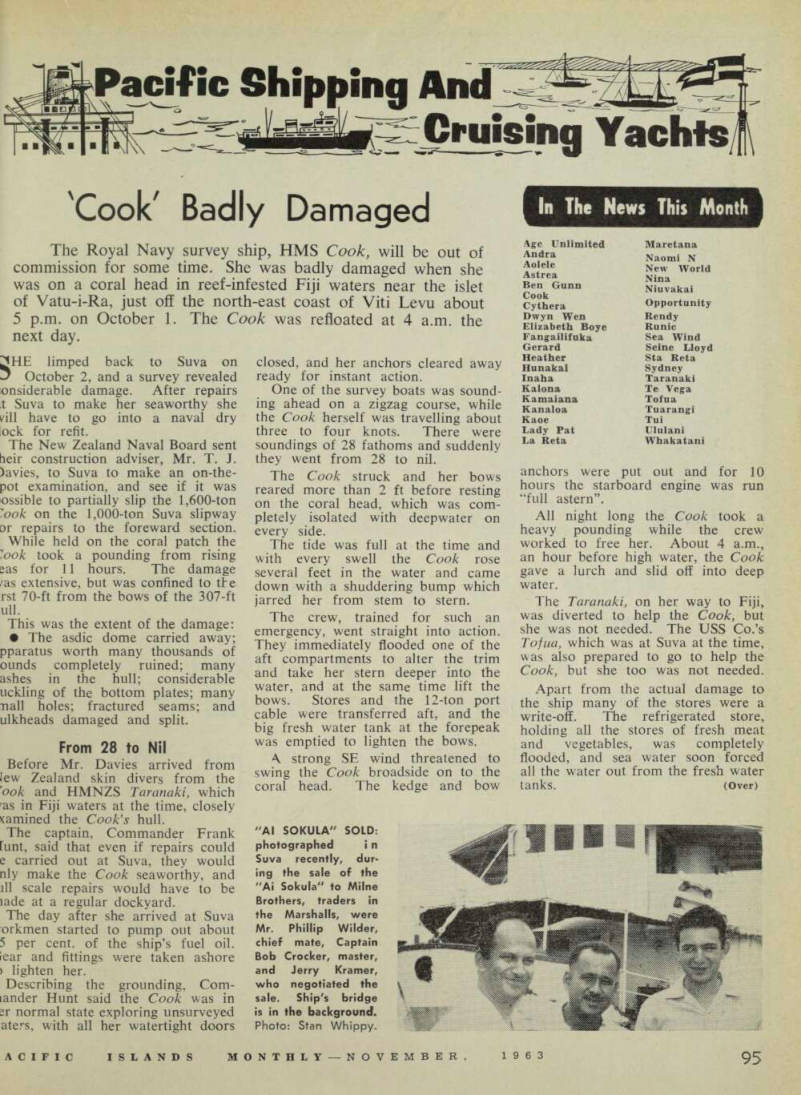
photographed in Suva recently, dur ing the sale of the "Ai Sokula" to Milne Brothers, traders in the Marshalls, were Mr. Phillip Wilder, chief mate, Captain Bob Crocker, master, and Jerry Kramer, who negotiated the sale. Ship's bridge is in the background.
Photo: Stan Whippy.
The Cook was slipped at Suva on October 13, in tricky winds, for tem porary repairs. Some of her compart ments aft were flooded to get her at the right level with the slip.
For a few days before she went on the slip men had been working hard clearing her of everything pos sible to get her on the slip. When she arrived at Suva after hitting the coral head she weighed 2,600 tons. When she went on the slip she was down to 1,600 tons.
As it is only a 1,000-ton slipway the Cook was overhanging about 60 ft.
The Fiji Public Works Department will carry out the temporary repairs.
The work was expected to take about three weeks.
A court of inquiry into the strand ing opened at Suva on October 15 with Captain B. E. Turner, OBE, DSC and bar, RNZN, as president.
The court sat in private, but was ex pected after hearing evidence to make a recommendation to the Comman der-in-Chief, Far East Naval Forces, whether a formal inquiry was neces sary. % TUI’S VISIT: In Apia in Octo ber was the New Zealand Fleet Auxiliary vessel Tui, which stayed for a few days while on a two months Pacific cruise collecting scientific in formation. She has been taking depth soundings and water samples.
• In Aha Replacement:
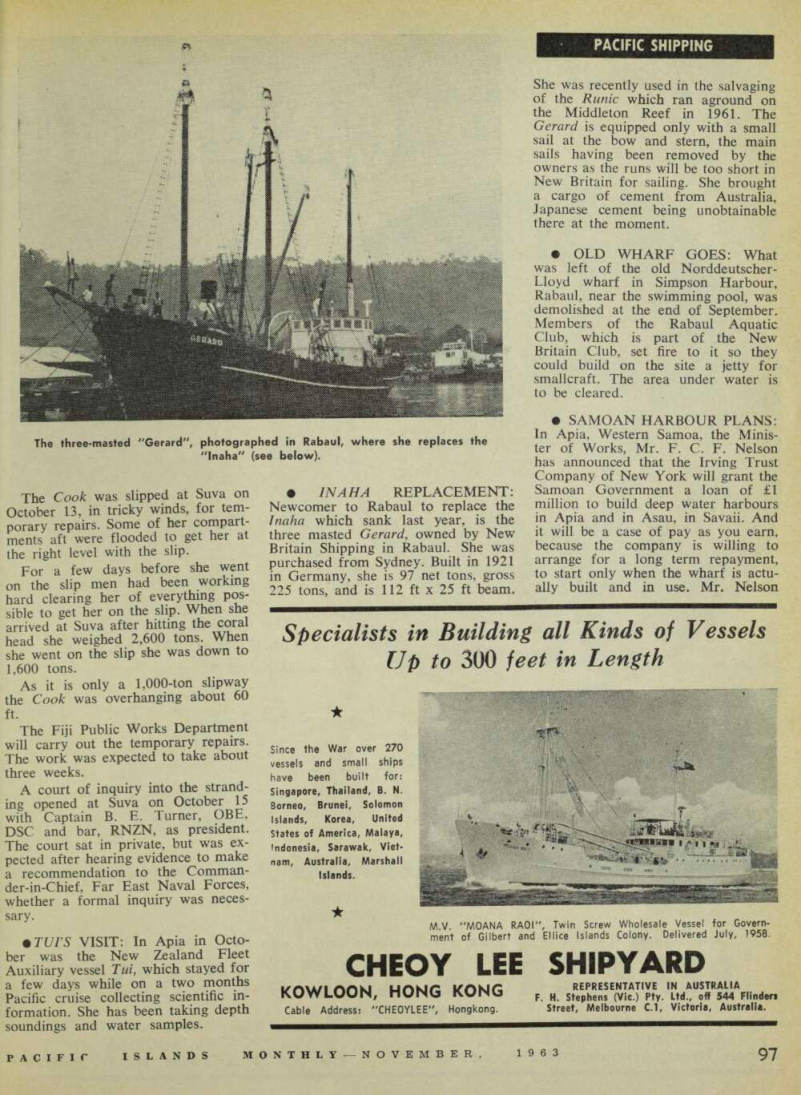
Newcomer to Rabaul to replace the Inaha which sank last year, is the three masted Gerard, owned by New Britain Shipping in Rabaul. She was purchased from Sydney. Built in 1921 in Germany, she is 97 net tons, gross 225 tons, and is 112 ft x 25 ft beam.
She was recently used in the salvaging of the Runic which ran aground on the Middleton Reef in 1961. The Gerard is equipped only with a small sail at the bow and stern, the main sails having been removed by the owners as the runs will be too short in New Britain for sailing. She brought a cargo of cement from Australia, Japanese cement being unobtainable there at the moment.
• Old Wharf Goes: What
was left of the old Norddeutscher- Lloyd wharf in Simpson Harbour, Rabaul, near the swimming pool, was demolished at the end of September.
Members of the Rabaul Aquatic Club, which is part of the New Britain Club, set fire to it so they could build on the site a jetty for smallcraft. The area under water is to be cleared.
• Samoan Harbour Plans:
In Apia, Western Samoa, the Minis ter of Works, Mr. F. C. F. Nelson has announced that the Irving Trust Company of New York will grant the Samoan Government a loan of £1 million to build deep water harbours in Apia and in Asau, in Savaii. And it will be a case of pay as you earn, because the company is willing to arrange for a long term repayment, to start only when the wharf is actu ally built and in use. Mr. Nelson
The three-masted "Gerard", photographed in Rabaul, where she replaces the "Inaha" (see below).
says that the interest required is “very reasonable”. The only proviso is that the wharf project should be started by next January. The scheme awaits Cabinet and Assembly approval.
• Hanging Crime: A Man
found guilty of having stolen a yacht would, in another age, be called a pirate and would have been hanged, said Chief Justice Herron of the Aus tralian Criminal Appeals Court on October 14.
The Court dismissed an application
by Derrick Brewin, who in May with another man was found guilty of stealing the yacht Cythera at Lord Howe Island. He is at present serving four years for the crime and had appealed against the severity of the sentence.
The Chief Justice said he could not understand how he had got off so lightly. In the Cl’s opinion he was a pirate—and piracy was a hanging matter at one time.
Brewin and another man stole the yacht valued at £17,000 belonging to Mr. and Mrs. P. Fenton at Lord Howe Island in April and it was finally recovered, damaged, near Nor folk Island.
Brewin, who was in court, said that the Fentons had not handled the yacht properly and Fenton had once threatened him with a Very pistol.
The Chief Justice said that Brewin was talking a lot of nonsense if he thought he could steal a yacht just because he thought the owner was incompetent or harsh. • BUSY TARAWA: The capital of the Gilbert and Ellice Islands Colony had a busy shipping month in September. On 23rd of the month, Tarawa had two overseas ships in port at the same time —unusual for this isolated place. One of the vessels was the MV Elizabeth Boye, operated by Karlander, which was discharging over 700 tons of general cargo. The other was MV Seine Lloyd, first of the joint Rotterdam Lloyd-Nederland Line vessels to call at Tarawa. Ves sels of this service come from Europe via Panama and call at Papeete, Noumea, Honiara, BSIP, and Papua-
New Guinea. Tarawa has now been included in the service.
• Wharf To Serve
Cameron Plateau: A Hydro
graphic survey of waters in the Milne Bay area, Eastern Papua, is planned, possibly as part of a larger survey in the same locality. In making the an nouncement, Captain G. A. Hawley, Superintendent of Marine in Papua- New Guinea, said that the survey is necessary before a site for a wharf to
THE RABAUL SCENE: The Stanford Uni versity floating marine biology classroom "Te Vega", now on a three-year cruise.
She left Rabaul for Kotabaru (formerly Hollandia). "Te Vega" has lost her sleek lines because of the addition of two deck houses (see also page 105). Lower photo shows the "Dolphin II", a barge re cently bought in Darwin by Bill Avard on behalf of Nonga Sawmills. She will trans port heavy equipment to the mills' log ging camps on New Britain and return to Rabaul with logs.
serve Cameron Plateau can be chosen, (The P-NG Administration plans to move the Milne Bay District headquarters from Samarai, which now has no room for expansion, to Cameron Plateau on the mainland of adjacent Milne Bay).
Captain Hawley didn’t know whether the RAN would make the survey or whether it would be done under contract—but he believed that it would be done before the end of this year.
• Ran Takes G-G To Nor
FOLK IS.: The Royal Australian Navy’s troop carrier Sydney, 19,500 tons, which carried the Governor- General, Lord de L’lsle, on an in formal visit to Norfolk and Lord Howe Islands in late September-early October, was about the biggest thing in Navy ships these islands had seen.
Sydney, which once carried planes, was converted earlier this year to carry troops and mechanised equip ment.
Sydney arrived at Norfolk Island on September 30 and after the Island’s Administrator, Major-General R. A. Wordsworth, and the President of the Island Council, Mr. F. J. Need ham, had paid their respects, and the Governor-General had been formally welcomed at the Administrative Building, informality became the order of the day.
In perfect weather virtually the en tire population of the island turned out to a typical NI picnic at which the Vice-Regal party and officers and men from Sydney obviously enjoyed themselves.
It was Lord Howe’s turn on Octo ber 2 when more perfect weather at another informal picnic allowed island residents and the visitors to get to know one another.
Sydney returned to Sydney on Oc tober 4 after a rough passage from Lord Howe. Thirty-knot winds and Dig seas buffeted the carrier but left the Governor-General unperturbed.
He toured the ship with Sydney’s commander, Captain W. J. Dovers.
• Automatic Lights For
P-NG: The Commonwealth Public Works Department in Papua-New Guinea has called tenders for build ng seven lighthouses in the Territory.
The lighthouses will have auto matic lights and will be built of con crete with pre-fabricated steel Tames.
• Captain Disappears:
rhere was a mystery aboard the \merican Samoan refrigerated vessel Kanaloa when the master, Captain Olsen, disappeared from her vhile at sea sometime on October 6 )r 7.
The Kanaloa was on her way to Swains Island, from Pago, to help salvage the wrecked Burns Philp ves sel Aolele, Kanaloa, was to help the MV Rendy, from Apia, tow the Aolele from the lagoon. When the Kanaloa didn’t turn up at Swains, the Rendy decided to head back to Apia, but she then received word from Pago that the Kanaloa had lost her captain and she was asked to help. Captain Ben son, of Rendy, contacted Kanaloa by radio and gave the crew instructions on how to navigate the vessel back to Pago.
Apparently Kanaloa’s crew saw the captain late in the evening of the 6th but he was not missed until about
4 a.m. on October 7. An intensive search failed to find him.
On board also were Captain Olsen’s wife and three children. Ameri can Samoa’s Attorney-General made an investigation when the Kanaloa returned to Pago Pago.
Captain Olsen was an American citizen and an experienced seaman.
He went to Pago Pago a few months ago seeking work for his refrigerated ship.
• Aolele Replacement
ARRIVES; The 60 ft Maretana arrived in Apia from Auckland in
early October as Burns Philp’s re placement for the Aolele, wrecked at Swains Island. The Maretana has a beam of 14 ft. Navigator for the uneventful voyage from Auckland was Mr. Tom Buchanan, who in 1956 won the Auckland-Suva Yacht Race.
Maretana served for nearly 20 years on the Thames-Auckland run.
She is a staunch little vessel, buill of kauri timber in 1942 at Coro mandel, on the east coast of the North Island of NZ, by Mr. S.
Strongman.
• Tonga’S Fishing Vessel
IN BUSINESS: The Tonga fishing vessel Fangailifuka brought its first load of 1,618 lbs of fish back to Nukualofa in late September. The fsh came from waters around the Ta’apai Group and consisted mainly )f schnapper and cod.
Bad weather confined fishing to wo nights and only 26 fishermen :ook part. These were mostly from Pangai and Tongoleleka, on Lifuka, vho were towed out from shore in heir own small fishing boats by fangailifuka which acted as mother hip.
Lifuka has a reef extending out to lea for about five miles and along he seaward edge of it is some of he best fishing in the Ha’apai Group, Most of the fish were taken on lines )ut skin divers also made a contri bution. Largest fish caught was a J 4 lb tafa’uli.
The fishermen were convinced that lad the weather been good they vould have had no difficulty filling fangailifuka's hold. What there was
of it arrived back in perfect con dition in the refrigerated hold and went on immediate sale at the Nukualofa market.
• Japanese In Noumea:
Thirty-two Japanese tuna trawlers are at present fishing in waters outside New Caledonian territorial limits and based in Noumea. Starting in Novem ber one trawler each day will enter Noumea to drop its catch and take on supplies. Each trawler leaves in Nou mea on an average £AISO in various purchases. This is an appreciable help to local economy.
O Raft Man Sighted: Wil
liam Willis, 74-year-old raft voyager, appears to be still going strong on his voyage between South America and Australia. Some fears for his safety were held in October, but in August he was sighted on the high seas and there was nothing to suggest he was in trouble.
Willis’ raft, Age Unlimited, was set adrift 45 miles off the Peruvian coast, after being towed out of Callao harbour, on July 4. He planned to drift north to Samoa and then south west to Sydney, a distance of about 10,000 miles, and to take three months to do it. He seems to be be hind schedule. The 10-ton raft is made of three pontoons filled with
plastic material ( PIM , August, p, 101).
Second-Officer J. McMurran of the New Zealand Shipping Company’s freiahter Whakatane described in m October how te was on watch on on August 16 when he saw the raft “At first I thought' it was a small sailing ship and after altering course toward it , I called the master, Captain r b Hood.”
Mr. McMurran said Whakatane came within 2 00 yards of the raft and made a complete circle round it.
“There was one man on it wearing a P air of blue shorts, and he waved from the raft’s rail at us.
'* and there Were , M SS stud the raft was knotS klck,n 8 U P a good bow wave.
eno"o“enable Ty conversion
with the raftsman The raft W as sighted in latitude 0 2.4 south and longitude 108.6 west.
It was running the wind on a course 280 true (about one point north of west).
The actua i position appeared to be midway between Culpepper Island in the Galanaeos Archinelaeo and Fatu
nSku in MTrqSs
(Over)
FISH STORIES: Tonga's new fishing vessel, the "Fangailifuka" had a pretty good catch in its first load, brought back to Nukualofa in September. The crew were happy. The catch on the right is a separate fish story. It is a black marlin, 10 ft. 10½ inches, weighing 350½ lb and it was caught on a cord line by the crew of the motor vessel "Govilon", just off the island of Panaetti, near Misima, Papua.
Breaking strain of the cord line was 140 lb. With the catch is "Govilon's" skipper Eli Dickson.
• Bsip’S Disappearing Vol
CANO VISITED: The highlight of the visit of the United States research vessel, Te Vega, to Solomon Islands waters (at least in the opinion of Mr. J. C. Grover, Chief Geologist there), was a brief survey in the area of the submarine volcano, south of Vangunu in the New Georgia Group.
While in Honiara, the Senior Scientist on Te Vega, Dr. Bolin, agreed to examine the volcano en route to Boungainville and Captain E. B. Olsen took a happy Mr. Grover along with him.
Three echo sounders were operated simultaneously and as the ship approached the region of the volcano :he sea bed rose from about 6,000 feet to about 1,800 feet, and 10 ninutes later to 600 feet. This was quickly followed by soundings of 162 feet, 97 feet and 32 feet. When :hat happened the captain smartly changed course and headed in the apposite direction. (Te Vega draws about 17 feet).
The Admiralty chart shows an area of breakers and shallow water extending some miles east of this aoint, but Mr. Grover said they were lot seen.
The volcano was found to be in active and there was also a second volcanic cone with an inactive crater. \s the weather was favourable, the ship made another run over the area and a patch of calm water like an lil slick was noted where the sea led rose to about 54 feet. A grab in the end of a cable was dropped iver the volcano and samples of ilack and silver-grey sand brought jp from outside the crater. The attention of scientists was then drawn ;o unusual sand grains floating on the water. These were quickly scooped jp and examined, but alas for science, they were found to be coffee grounds thrown out by the ship’s :ook.
In 1961 photographs of this area showed an island 100 feet high. Mr.
Grover said he was amazed that the volcano had sunk so rapidly. There is no part now visible above the water.
• Tongan Welcome For
NEW SHIP: The Tonga Copra Board’s new German-built ship, which Prince Tungi purchased when fie was in Holland in the middle of this year, arrived in Nukualofa at the end of her delivery voyage on October 15. She was escorted into the stream by many ships dressed overall, and amid much excitement.
The vessel was rechristened with the Tongan name Niuvakai before she left Rotterdam and sailed under the Tongan flag.
She is of 2,600 tons deadweight and will be used to carry Tongan coconuts to the new coconut process ing works in Pago Pago, American Samoa.
The day after her arrival in Nukualofa Prince Tungi presented Queen Salote with the key to the Royal suite aboard the new vessel on Vuna \yj lar f ' , . .u £ * Quen Salote was the first woman to board the ship since the ship was commissioned under the Tongan flag. This was in accordance with Tongan tradition which lays down that a woman high m rank to the owner must be the first to board a newly-acquired vessel.
• NAOMI N, 46 ft all steel yacht from Whangarei, New Zealand, ar rived in Apia, Western Samoa on Oc tober 6 from Niue. Aboard were owner-skipper D. J. Gilberd, and seven others, including Mr. Gilberd’s daughter, Naomi N has twin diesels as well as sails and is described by her owner as a “fast sailer”. Locals described her as “the best looking
yacht to enter Apia for many months”. She is built to the design of Alan Payne who designed Gretel.
Her hull is black and her masts white.
Naomi N has a beam of 13 ft 10 inches, and her normal draft of 4 ft can be increased to 7 ft by lowering a centreboard.
Mr. Gilberd is the head of a big New Zealand engineering firm, one of whose more recent contracts was the building of the foundations of the Auckland Harbour Bridge. He was visiting Niue to investigate and advise on village water supply problems. Mr. Henry M. Horn, better known to South Seas yachtsmen as plain Hank Horn of the Ben Gunn, writes us a friendly, and somewhat nostalgic, note from Massachusetts, USA, where he is with the Deep Sea Research Vehicle Group, Woods Hole Oceanographic Institution, Woods Hole. Writes Hank: For the past 4i years, my wife, 11year-old daughter and I have cruised the South Pacific in our 41 ft ketch Ben Gunn. I sold Ben Gunn in Hawaii last June, since in such a life one eventually must earn another “pot” to go again.
However, one of my many fond re collections on reaching various ports between Tahiti and New Zealand was
>icking up a copy of PIM. Now, ettled down again as an engineer for Voods Hole Oceanographic Institu ion, I would like very much to sub cribe to PIM just to keep in touch yith God’s country. Then, on Feb uary 17, 1972, my daughter will be :l years, and I’ll get another boat nd will be back again at the life I lave given up so recently.
We are a long way here from the ;ood old Pacific, but oceanography is apidly becoming the object of con iderable effort throughout the world, is you know. I am afraid the USA is farting “better-late-than-never”, but ince underway we can move.
At present WHOI is having built, inder a Government contract, a deep ea research vessel which can operate f depths of 6,000 ft.
Unlike several others which have >een built, and can go to deeper lepths, this vessel will be very
manoeuvrable and can open up to view realms of this earth which I long wondered about as I cruised the Bahamas, Caribbean, Galapagos, French Polynesia, the Cooks, Tonga, Fiji and New Zealand.
But right now I am interested in learning the whereabouts and activi ties of the many yachts out there and how our many friends Down Under are making out. • KOAE, built, owned and sailed by C. B. Taylor, a retired USN offi cer, left Suva for Auckland on Sep tember 14 and arrived on October 7.
During the three weeks passage the ketch was hove-to for one period of 30 hours and at other times was be calmed.
Captain Taylor is accompanied by Mrs. Taylor and, for the Suva-Auck land leg of the journey, by J. P.
Burgess a New Zealander. The Taylors plan a month in New Zea land before crossing to Brisbane.
Future plans include Great Barrier Reef, Ceylon, Bombay, Red Sea, Suez and the Mediterranean before heading back to the United States. • KAMAIANA, a trimaran of re volutionary construction, put in at Waipio Stream, Hawaii, in September, 38 days out of San Francisco. On board were Al Wolfsen, 52, a self styled herb doctor, and Jim Mc- Cutcheon, 34, a farmer, of Ontario.
They may just go on farther into the Pacific but in the meantime the strange craft is the nautical sensation around Hawaii.
Its main hull is a 34 ft long section
of 10-gauge sewer-pipe, with ends flattened to make a sharp bow and tapered stern. To it, attached by steel pipes, are two outriggers made of 24inch water-main. Twin keels of armour plate are welded to the out riggers and steering is by twin rud ders. The mast is made from a re jected light pole and she carries a jib and mainsail rig.
A plywood deck tops the sewer pipe hulls and on it is a cabin and wheelhouse.
Wolfsen got the idea for his strange
The trimaran "Kamaiana", in Hawaii in September. Below is Al Wolfsen, the skipper (left) and Jim McCutcheon. See story this page. — Photos: W. R. Roll.
craft when he was working as an air craft engineer during the war. He calculates that it cost him $4,000.
Apart from designing sea-going freaks he is also author of a book called God is My Doctor —a collec tion of nature cures and advice on health. Neither he nor McCutcheon had ever been to sea before this trip. 0 HUNAKAI, 36 ft Block Island ketch, which had been cruising on the high seas since her arrival in Fiji earlier this year, returned to Suva on September 6, and left on September 13 for Auckland. • ST A RET A, 40 ft twin screw motor sailer, which arrived at Suva in July on a cruise, left Suva on September 14 to return to Auckland.
Her owner, Richard King, spent some time cruising in Fiji waters. • LA RET A, Auckland-owned pleasure craft, which arrived at Suva on July 26, spent some time on cruises in Fiji. She left in September “for the high seas”. • ANDRA, 30 ft Tahiti ketch arrived Honolulu October 1 with Ronald Sewell, owner-skipper, and Jim Rassat aboard after a 36-day pas sage from Pago Pago. The pair spent a year in the Societies, Cook Islands and Samoa. During the 3 weeks trip from Rarotonga to Samoa, they never lost sight of the 34 ft yawl, Oppor tunity. During this trip they stopped at Aitutaki and Rose Island. Andra will stay in Hawaii. • LADY PAT : After two unsuc cessful attempts to leave the Hawaiian Islands for Tahiti, this 3 3-ft yawl has returned to Honolulu and cancelled plans for a South Pacific trip. © ASTREA was overdue at Hono lulu in early October and Coast Guard planes and ships had been alerted to watch for the missing 52 ft schooner with four men and a woman aboard. Astrea was on a voyage from Yalapa, Mexico, to Tahiti. The schooner left Mexico on August 27 and was due in the Mar quesas by the middle of September.
The Coast Guard identified those aboard as: Philip D. Hays, Glendale Calif, skipper; Jerry Spot, no address; James Sunseri of San Jose, Calif; and Ruth Byra and John Allen of Phoenix, Arizona. • NINA, skippered by John Sam son, arrived in Hilo, Hawaii, Sept. 30, after a 19-day passage from Tahiti. Samson, a native of Alberta, Canada, purchased the New Zealand built, Woolacott ketch in Sydney, in 1960. He cruised New Zealand waters
and left Auckland the end of May.
Aboard as crew were his wife, Pat.
Judy Cameron (of Sydney), Judy McNichol (Auckland), and Lynette Helyar (Auckland). Samson worked as a plantation assistant for Mariboi Rubber Estate, Papua, before buying the 34-foot ketch. He plans to sell the Nina in Hawaii. 9 ULULANI of Newport, Calif., arrived Honolulu September 26 after a calm-filled 16 day crossing. Aboard as sailing master is Dick Mcllvride who passed through Honolulu in June while delivering Kalona to San Pedro, Calif., his wife, Pat, daughter, Jean, and owner, Benjamin Moore, of New port, Calif. Additional crew members are David Lewis, of Bay of Islands, NZ, and Wayne Dumbleton, of Palm erston North, NZ. Moore plans to cruise the 63 ft ketch extensively in New Zealand waters. The Hand designed ketch has a 14 ft beam and 8 ft draft. She was formerly Ant ares.
Ululani departed Honolulu October 1 for Fanning Island, Samoa, Fiji and New Zealand. • SEA WIND and the Malcolm Grahams, reporting from Thursday Island in mid-September say they had great difficulty in dragging themselves away from the hospitality of Port Moresby (and the showers of the Yacht Club).
On the way to TI they cruised amongst the islands of the Torres Strait, dropping anchor at a different one every night. At Thursday Island they were having the bottom of Sea Wind scraped and getting a general clean-up for the next leg of their journey to Christmas Island and Cocos-Keeling. From Cocos they ex pect to head for the Seychelles, but otherwise plans are indefinite.
Cruising yachts New World and Heather were in TI just before they arrived; and Tuarangi left a few days after their arrival, heading to Mauri tius. • DWYN WEN, big 106 ft Ameri can schooner, added four girls to her crew in New Zealand before she left Auckland, September 30, on a 1,000mile haul to Tonga. With owners Mr. and Mrs. B. J. Walters, complement is now 19 —including Captain S. G.
Rayner, her master, two cameramen and a cook. Dwyn Wen will visit Tonga, the Cook Islands, Tahiti and the Society Group before she com pletes her cruise in Hawaii around the New Year. During the cruise 10,000 or more feet of colour film will be shot. It will be edited into a Pacific adventure film.