The Month's New Reading
pp. 87-90 · Read in the full issue
History of New Guinea Exploration Grips Like a Thriller
History that grips the imagination of the reader like a thriller owes its appeal to either unique situations or to the skill of the writer. Gavin Souter’s New Guinea: The Last Unknown has something each way and owes its excellence to both.
THIS book—except for its part four which is a political appendage slightly out of character with the rest of it—is basically the history of exploration of the mainland of New Guinea, from West New Guinea to Papua. As such, it correlates for the first time in one book, the 1,001 fragments independently known through private diaries, official reports, missionary records and the books, ancient and modern, which have already been published about the subject.
It does, of course, do more than that. New Guinea discovery is reasonably well documented—if you
With Judy Tudor
have the years to devote to the fragments in English, Dutch and German. It is Souter’s minutae that turn names we know into men and personalities. In this department he may, in some respects, have done sven better than he thought.
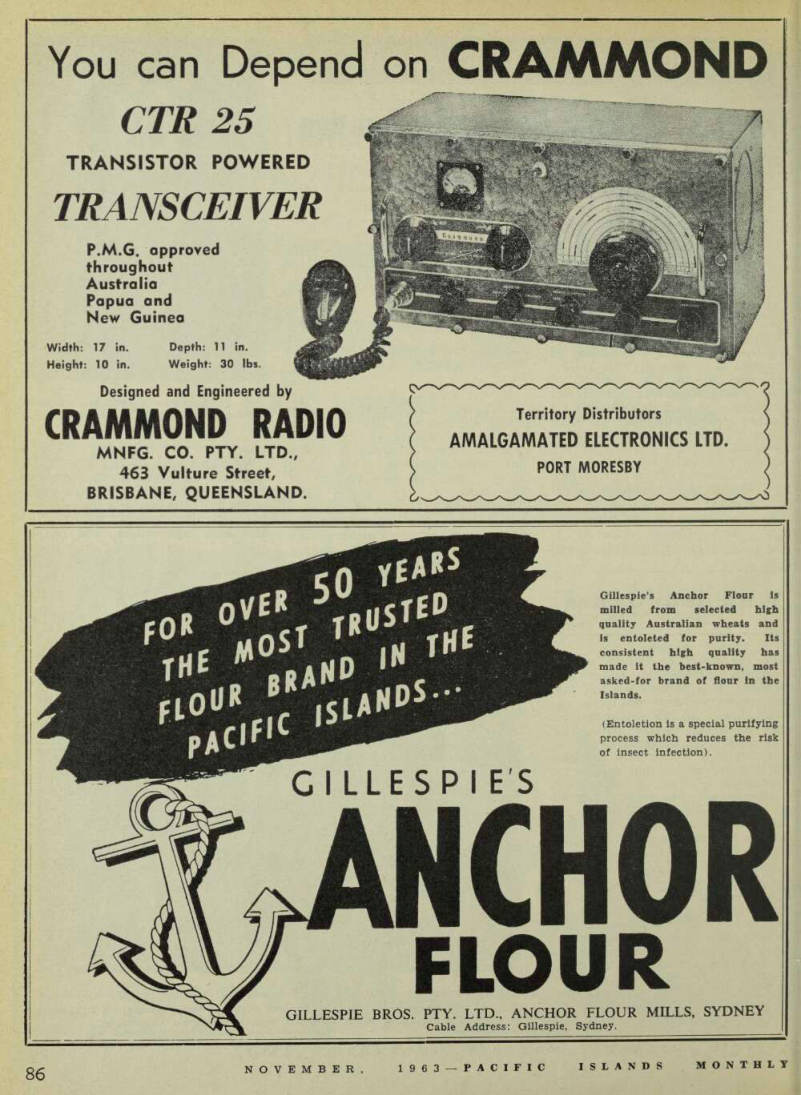
Although it is not hard to sense that the author does not approve of such antics as those of Luigi Maria D’Aibertis, who was first and furthest up the Fly River as long ago as 1876, the flamboyant, aria-singing Italian becomes almost flesh-and- Dlood reality in the author’s hands.
With a vast capacity for creating, liscovering and overcoming trouble, D’Aibertis had, also, an eye for the fight kind of female form and a labit of loosing off rockets, gun jowder, explosions and fusillades of )istol shots in native villages or for lis own pleasure. He scared many nonths’ growth out of the primitive latives of the Upper Fly who had lever seen a white man—much less i white man like this.
D’Aibertis may have shocked the purists of his time and ours. But if Souter’s is his epitaph, it would doubtless have pleased the man him self.
To the present residents of New Guinea, D’Aibertis is only a name— mostly the name of the D’Aibertis Creeper, a flowering vine of showy orange-red that at times turns the dull, green sameness of the New Guinea rain-forest into patches of fiery colour.
Again with C. A. W. Monckton— a New Zealander who became a Resident Magistrate between the reigns of MacGregor and Murray in Papua—Souter has him emerge from his narrative much more a person in the round than from the several books Monckton wrote him self.
Monckton was posted, in 1903, to Kokoda, the HQ of the North- Eastern Division of Papua and reputedly the toughest in the country.
But if the natives were wild, Monckton was wilder, and within months “. . . people who never spoke aloud the name of anyone they held in respect were referring indirectly to their new master as ‘The Man’ and were eating out of his hand”. (Over)
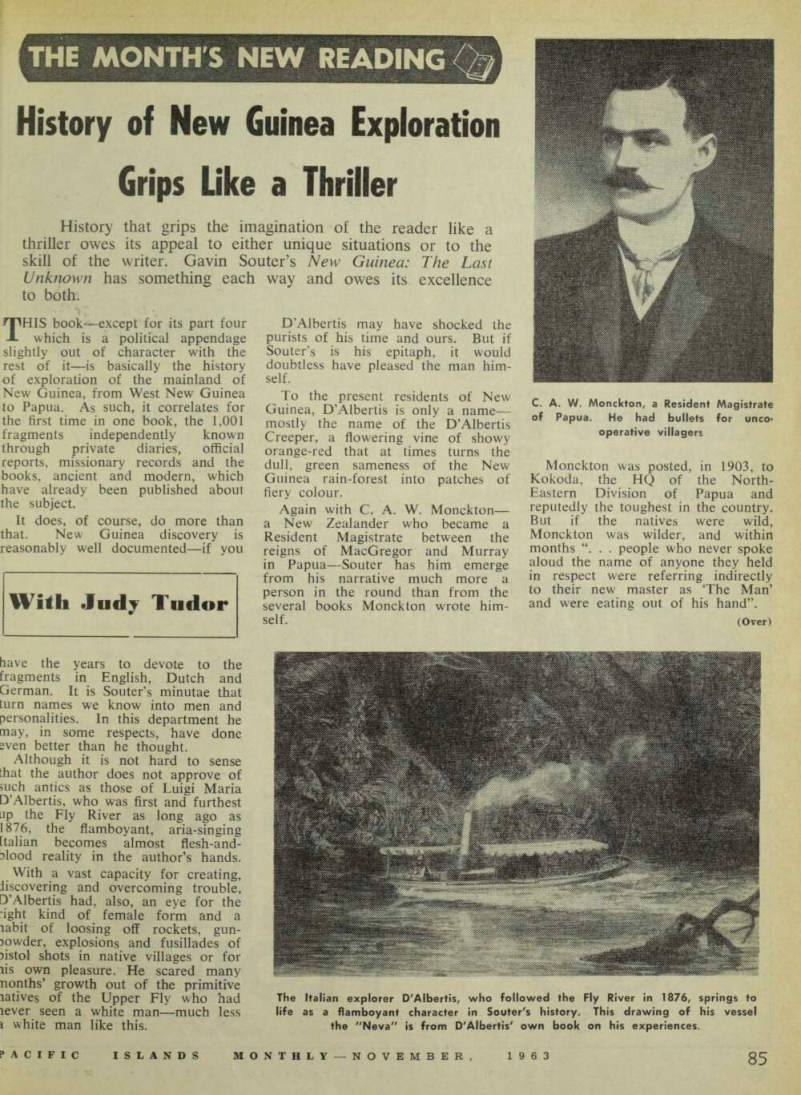
C. A. W. Monckton, a Resident Magistrate of Papua. He had bullets for unco. operative villagers
The Italian explorer D'Albertis, who followed the Fly River in 1876, springs to life as a flamboyant character in Souter's history. This drawing of his vessel the "Neva" is from D'Albertis' own book on his experiences.
Like D’Albertis, Monckton had his recipes—castor-oil and aloes for malingering; a rifle’s wire pull through on the back for reluctant carriers; and bullets for un co-operative villagers. His methods got results but they enraged both his superiors and the public con science which then, as now, was sensitive on the question of New Guinea.
As well as an administrator Monckton was an explorer—usually when he was supposed to be doing something else. He climbed Mt.
Albert Edward for no other reason than ( as one of the conquerors of Everest, half a century later, is alleged to have said) that it was there.
In 1906, with a patrol of 130 men, he set out from Kokoda to find a safe route for miners to the Upper Waria River—but having got so far west along the Waria, impulse decided him to cross the central ranges to see what was on the other side.
After incredible feats of endurance the patrol succeeded and on foot, rafts and canoes, followed the Lakekamu from its source to the coast 120 miles from Port Moresby.
Monckton’s reception in the capital was frigid; it was considered that he had “exceeded his instructions” and he was packed straight back to Kokoda across the Owen Stanleys— the only 20 fit members of the patrol carrying and dragging the rest.
It must have seemed to Monckton that the end of his era was in sight.
He cleaned up his work and resigned.
No mention of his three-months patrol across the island was made in the annual report in mid-1907.
New Guinea Exploration Because it was closest to Australia and therefore available, even before annexation, it is perhaps inevitible that exploration of what is now Papua should have taken an earlier and slightly different turn to explora tion in either the old German Terri tory or in Dutch New Guinea.
Exploration in Papua was always what the author apparently regards as “pure exploration”—that is, it was explored because someone—mission ary, administrator, scientist or just the :urious citizen—wanted to find out what was there. Exploration in New
Guinea, however, was frequently for another reason—for gold or com mercial enterprise.
The reasons for this were fairly basic—Papua was annexed to keep it from falling into the lap of another country; New Guinea was originally
administered by the German New Guinea Company, which was more interested in establishing coastal plantations and trade.
Even after New Guinea became Australian in 1920, a considerable amount of effort went into organising the new administration and in main taining the economic asset—far greater than Papua’s was or would ever become—that had fallen into Australian hands. There was no time initially for exploratory patrols for (Over)
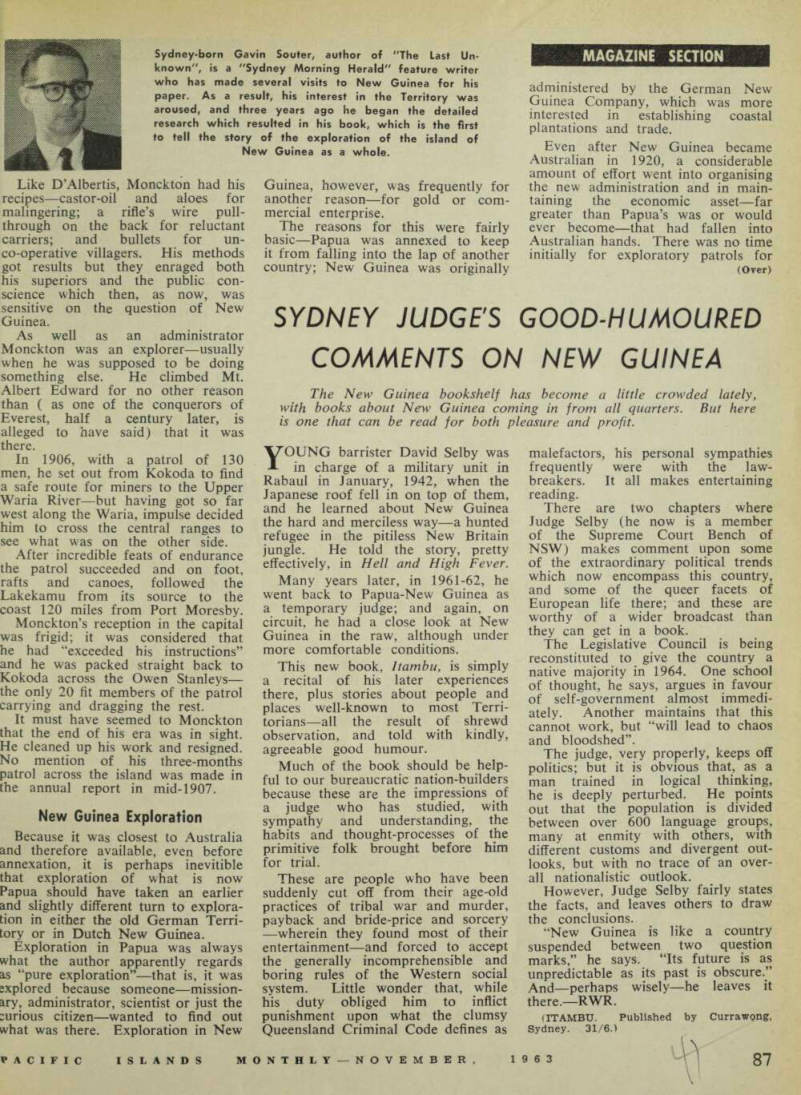
Sydney-born Gavin Souter, author of "The Last Un known", is a "Sydney Morning Herald" feature writer who has made several visits to New Guinea for his paper. As a result, his interest in the Territory was aroused, and three years ago he began the detailed research which resulted in his book, which is the first to tell the story of the exploration of the island of New Guinea as a whole.
the sake of exploratory patrols—as there had been in Papua from the very earliest times.
The most startling discoveries in New Guinea were therefore left for non-eovernment people to make. It was the early gold miners who first saw Mt. Kaindi and Edie Creek and the pine-clad sides of the Bulolo Gorge.
Private Exploration
It was similarly gold miners who found that the source of Papua’s Purari River lay deep in New Guinea mountains; and that the centre of the big island was not a vast tumbled mass of mountain peaks but a series of open grassy valleys with high populations. The results were the same; the discoverers were different— but there was no less merit in it for that.
In the Dutch half of the vast island, discovery and exploration was both earlier and later—a short-lived colony was planted on Triton Bay by the Dutch as early as 1828 while the last organised expedition of all was to the Star Mountains as late as 1959-60. The Dutch reluctance was, however, easy to explain. Until 1949 they were much more pre occupied with their East Indies.
In its ultimate analysis, however, this book is not so much a story of exploration as a story of men.
Men of many nations, inspired by many different motives; men who were administrators; or missionaries, traders, gold-miners or adventurers; men who wanted other men’s jobs or were driven by curiosity to see what was just over the mountain.
Many were men whose names are
now just a memory—the Italian D’Albertis, the German Detzner, who kept one hop ahead of the Australians in the New Guinea hinterland all through World War I; or the doughty Scot, Sir William MacGregor, who vowed that no one would sit in New Guinea higher than he (and proved it by climbing Mt. Victoria).
Many Famous Names Many are the names of men still with us—the brothers Champion, who between the wars pushed back the borders of unknown Papua (be cause their Lieut.-Governor, Sir Hubert Murray, felt it unthinkable that anyone but a member of the Papua service should); and the brothers Leahy who gave Australia a whole new primitive world on the roof of New Guinea.
Men—good, bad eccentric, self sacrificing, after glory, gold or gain— bul men. In their total they add up to the New Guinea we have today.
It is, however, the measure of the skill of the writer that these men remain as individuals, clear and
sharply defined in their place in the story, never overwhelmed, as they easily could be, by the vast back ground of the country itself.
The last short section dealing with future political development and the natives’ march towards self-govern ment —Indonesian, Dutch or Aus tralian versions—seems to have little to do with a century of Euro pean exploration of the last mysterious frontier. But it does seem to have all the hall-marks of a “publisher’s request”.
As such it is largel anti-climactic although it detracts nothing from the rest of the book, which is quite the best thing of its kind that has ever been done about New Guinea.
It is lavishly illupstrated with many historical photographs; has a detailed general index, a bibliography, chronology and various appendices.—
JT.
(New Guinea: The Last Unknown.
Angus & Robertson Ltd. 42/-.)