Yesterday
p. 85 · Read in the full issue
PIM 20 years ago this month was filled with war news, with pages of names of Islanders reported killed, wounded or missing. In the Pacific the Allies were bombing the Jap-held base of Rabaul and there was fighting in the Solomons and in the Ramu Valley of New Guinea. The Australian commander, General Sir Thomas Blarney, said that the Japs were reinforcing the SW Pacific and he believed they would put up a “stiff fight for what was left of New Guinea Extracts from that issue of November, 1943:
In Rarotonga Judge H. F.
Ayson, Resident Commissioner of the Cook Islands, announced his retirement due to ill health. Mr.
William Tailby was appointed Acting Resident Commissioner. * * * Lieutenant-General Sir Ivan Mackay said in Sydney that the New Guinea war had given the Territory facilities which would be of “immense value” after the war.
Hundreds of miles of metalled road had been built, kunai grass had been burnt off and large areas had been cleared and drained Airfields and new ports had been developed, * * * The death occurred in Noumea of the Mayor, Mr. Ernest Massoubre. He had been staunchly anti-Vichy. ♦ * * A PIM correspondent noted that the Australian territory of Papua and New Guinea had had 17 Australian Cabinet Ministers responsible for it in 17 years.
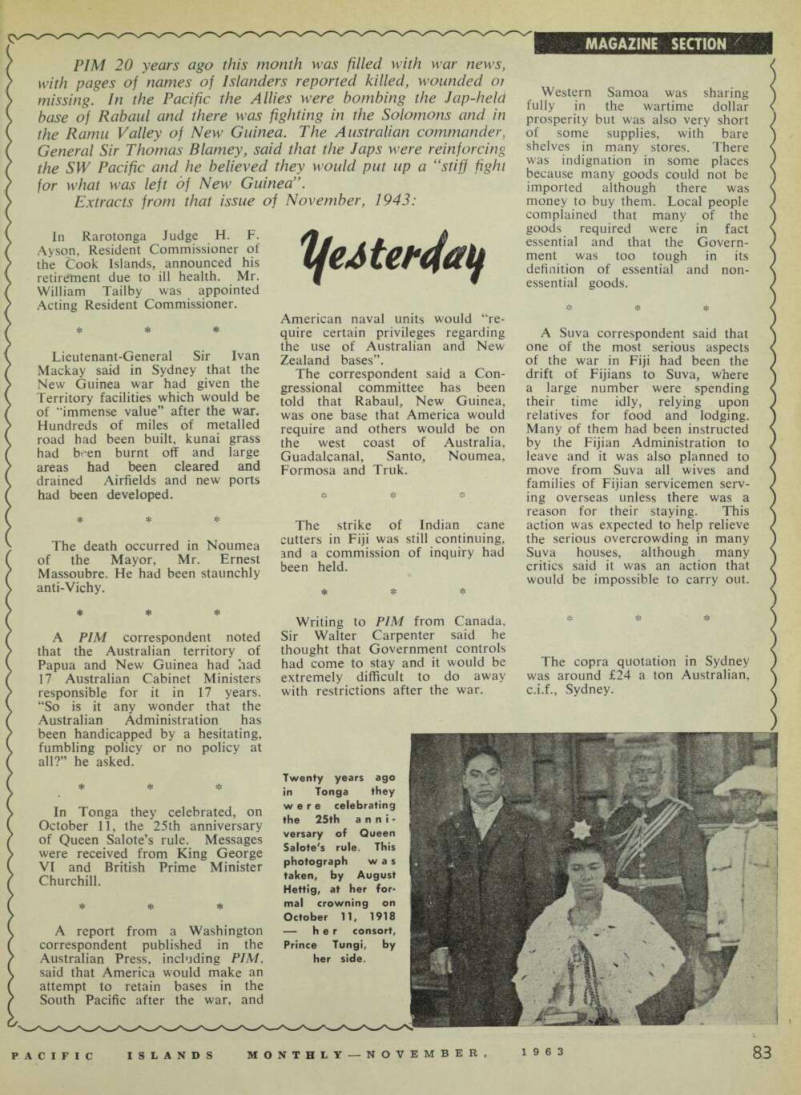
“So is it any wonder that the Australian Administration has been handicapped by a hesitating, fumbling policy or no policy at all?” he asked. ♦ * ❖ In Tonga they celebrated, on October 11, the 25th anniversary of Queen Salote’s rule. Messages were received from King George VI and British Prime Minister Churchill. ♦ * « A report from a Washington correspondent published in the Australian Press, including PIM, said that America would make an attempt to retain bases in the South Pacific after the war, and
American naval units would “re quire certain privileges regarding the use of Australian and New Zealand bases”.
The correspondent said a Con gressional committee has been told that Rabaul, New Guinea, was one base that America would require and others would be on the west coast of Australia, Guadalcanal, Santo, Noumea, Formosa and Truk. $ sj: The strike of Indian cane cutters in Fiji was still continuing, and a commission of inquiry had been held. * * * Writing to PIM from Canada, Sir Walter Carpenter said he thought that Government controls had come to stay and it would be extremely difficult to do away with restrictions after the war.
Western Samoa was sharing fully in the wartime dollar prosperity but was also very short of some supplies, with bare shelves in many stores. There was indignation in some places because many goods could not be
imported although there was
money to buy them. Local people complained that many of the goods required were in fact essential and that the Govern ment was too tough in its definition of essential and non essential goods. * * * A Suva correspondent said that one of the most serious aspects of the war in Fiji had been the drift of Fijians to Suva, where a large number were spending their time idly, relying upon relatives for food and lodging.
Many of them had been instructed by the Fijian Administration to leave and it was also planned to move from Suva all wives and families of Fijian servicemen serv ing overseas unless there was a reason for their staying. This action was expected to help relieve the serious overcrowding in many Suva houses, although many critics said it was an action that would be impossible to carry out. * * The copra quotation in Sydney was around £24 a ton Australian, c.i.f., Sydney.
Twenty years ago in Tonga they were celebrating the 25th anni versary of Queen Salote's rule. This photograph was taken, by August Hettig, at her for mal crowning on October 11, 1918 -her consort, Prince Tungi, by her side.