Three Cook Islanders Survive
pp. 12-13 · Read in the full issue
Epic Drama In Open Boat
2,200-Mile Drift To
Erromanga
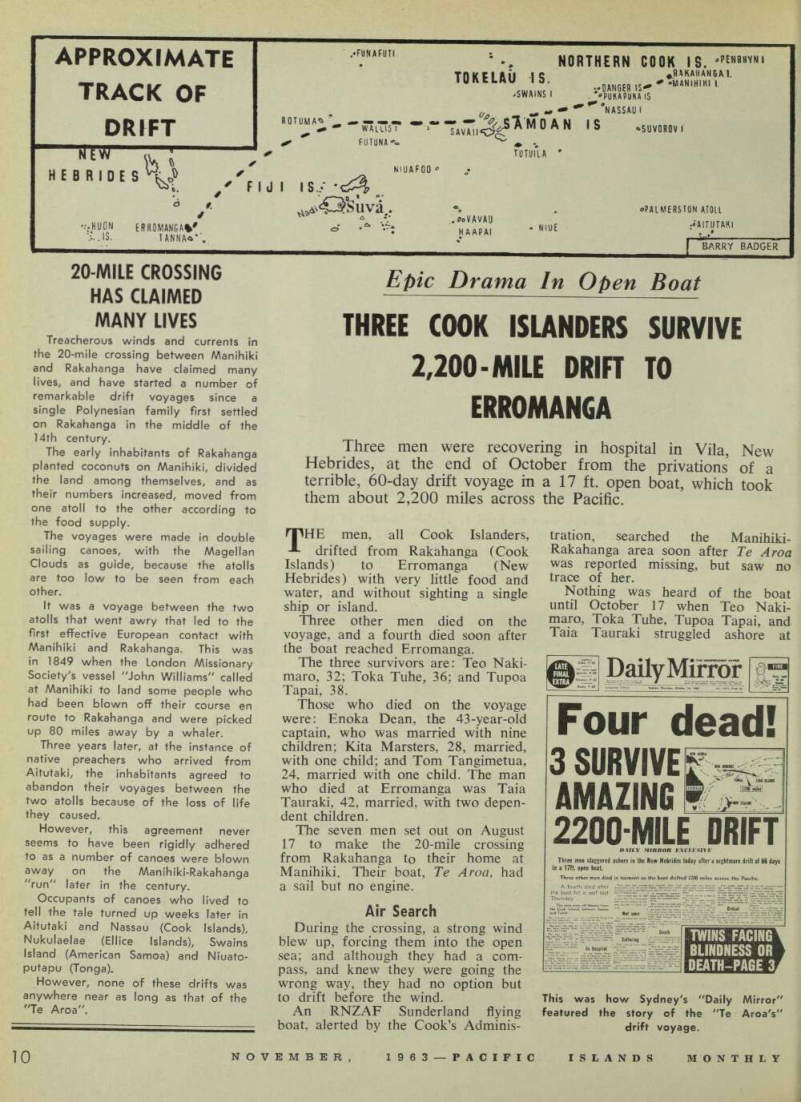
Three men were recovering in hospital in Vila, New Hebrides, at the end of October from the privations of a terrible, 60-day drift voyage in a 17 ft. open boat, which took them about 2,200 miles across the Pacific.
THE men, all Cook Islanders, drifted from Rakahanga (Cook Islands) to Erromanga (New Hebrides) with very little food and water, and without sighting a single ship or island.
Three other men died on the voyage, and a fourth died soon after the boat reached Erromanga.
The three survivors are: Teo Naki maro, 32; Toka Tube, 36; and Tupoa Tapai, 38.
Those who died on the voyage were: Enoka Dean, the 43-year-old captain, who was married with nine children; Kita Marsters, 28, married, with one child; and Tom Tangimetua, 24, married with one child. The man who died at Erromanga was Taia Tauraki, 42, married, with two depen dent children.
The seven men set out on August 17 to make the 20-mile crossing from Rakahanga to their home at Manihiki. Their boat, Te Aroa, had a sail but no engine.
Air Search During the crossing, a strong wind blew up, forcing them into the open sea; and although they had a com pass, and knew they were going the wrong way, they had no option but to drift before the wind.
An RNZAF Sunderland flying boat, alerted by the Cook’s Adminis
tration, searched the Manihiki- Rakahanga area soon after Te Aroa was reported missing, but saw no trace of her.
Nothing was heard of the boat until October 17 when Teo Naki maro, Toka Tube, Tupoa Tapai, and Taia Tauraki struggled ashore at
This was how Sydney's "Daily Mirror" featured the story of the "Te Aroa's" drift voyage.
Port Narevin, on Erromanga’s east coast, after the boat had run aground on a reef. Teo and Tupoa were then almost blind through lack of food.
The four survivors, who were virtually naked, were found by a native called Peter, who took them to a village at Dillon Bay, on the west coast of the island.
Taia Tauraki was so weak that he had to be helped by his companions; but he died soon after reaching Dillon Bay. Teo and Tupoa recovered their sight after food and rest At Dillon Bay, the village elder, Matthew, took care of the three survivors and arranged for a radio message to be sent to Vila, about 60 miles north.
It was then arranged for the Airwave, a small ship owned by Mr.
Tom Lowe, of Vila, and skippered by a visiting yachtsman, Mr. David Field, to call at Dillon Bay and bring the survivors to Vila.
Doctors On Hand .. , , , ri The Airwave reached Vila on the morning of October 24—and because the New Hebrides has neither news-
S were &eV?waf aw-
thing remarkable about her passen- Among the few who were on hand to meet the Airwave were the Senior British Medical Officer, Dr. W. H.
Rees, and Dr. R. Greenhough, who found the Cook Islanders in surprisingly good condition considering
the terrible privations they had en dured.
However, the men were im mediately transferred to the Baton Memorial Hospital.
Well-known Vila personality Reece Discombe, who is a mechanic, deep sea diver, marine salvage expert, electrician, photographer and racing car driver all rolled into one, proved that he was also a ‘red hot journalist by obtaining first news and the first interview with the Te Aroa 5 survivors and telephoning details ot their epic voyage to ”/M, which passed on the news to Sydney news papers.
Discombe told PIM that TeAr had had and water a par when she left Rakahanga for Mam hiki on August 17 and that the men had carefully rationed this dun g the first three weeks of their dntt.
Then the boat capisized m a storm, spilling the men and all the remam ing food, and water into the sea.
By this time, two of the men om and Kita—were so weak that they were unable to r . e s ain the I boat l ’, aI J!?
Enoka, the captain, was only able to aboard in with the help , . • n „ f H owever P E noka died three days {fer -d his body was cast over
oar • Aircraft Sighted
The day after Enoka s death, an aircraft passed over le Ar°a four survivors m vain waved frantic ally with clothes tied to the ends ot their oars.
From then until they were casi
ashore at Erromanga, the men in the open boat had no food apart from an occasional flying fish that fluttered aboard and two coconuts that they fished from the sea. Their only water was what they could catch in a piece of canvas.
Being strongly religious, the men took it in turns to read chapters from Bibles they had with them and to pray for their families and them selves.
All seven crew members of the Te Aroa were married and they had 22 children among them.
Several weeks after they dis appeared, the Cook Islands Legisla tive Assembly opened a fund for their wives and children, and almost £2,500 was raised.
In Vila, the recently-formed branch of the Red Cross Society supplied the three survivors with clothes.
The three men are booked to fly from Vila to Nadi by Fiji Airways on November 6 to connect with flights to Rarotonga. • A picture of the survivors appears on the front cover.
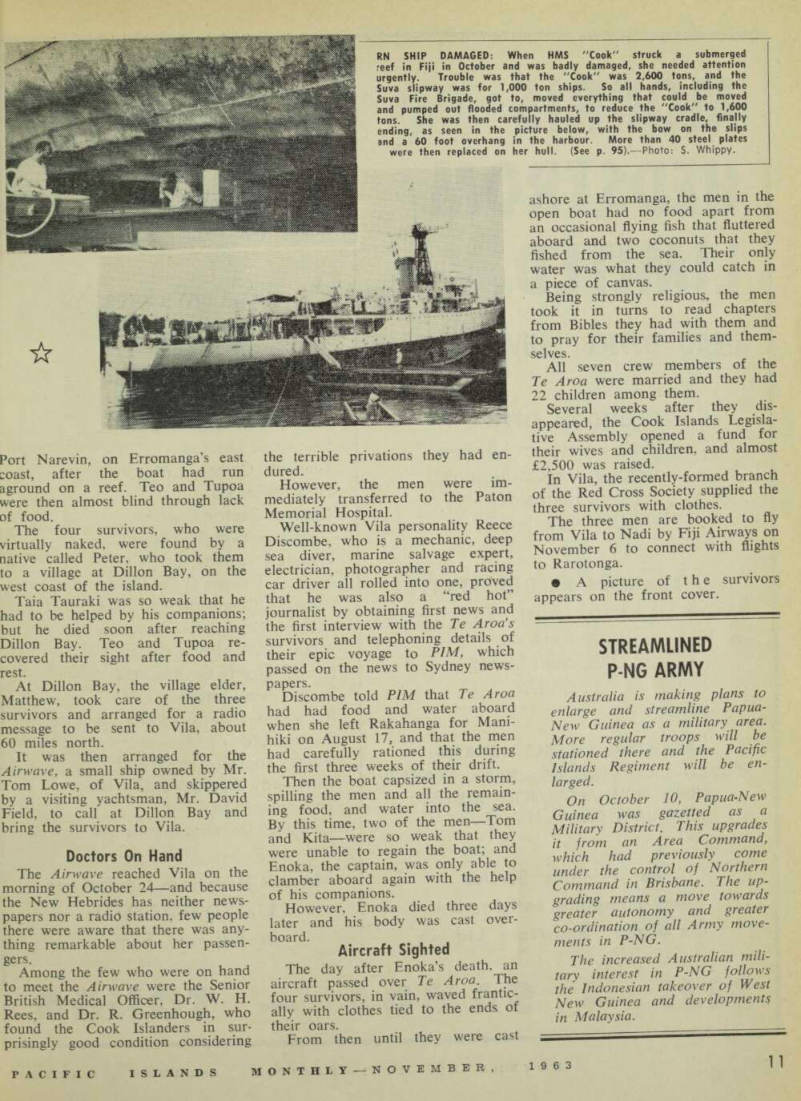
RN SHIP DAMAGED: When HMS "Cook” struck a submerged reef in Fiji in October and was badly damaged, she needed attention urgently. Trouble was that the "Cook" was 2,600 tons, and the Suva slipway was for 1,000 ton ships. So all hands, including the Suva Fire Brigade, got to, moved everything that could be moved and pumped out flooded compartments, to reduce the "Cook" to 1,600 tons. She was then carefully hauled up the slipway cradle, finally ending, as seen in the picture below, with the bow on the slips and a 60 foot overhang in the harbour. More than 40 steel plates were then replaced on her hull. (See p. 95). — Photo: S. Whippy.