20-Mile Crossing
p. 12 · Read in the full issue
Has Claimed
Many Lives
Treacherous winds and currents in the 20-mile crossing between Manihiki and Rakahanga have claimed many lives, and have started a number of remarkable drift voyages since a single Polynesian family first settled on Rakahanga in the middle of the 14th century.
The early inhabitants of Rakahanga planted coconuts on Manihiki, divided the land among themselves, and as their numbers increased, moved from one atoll to the other according to the food supply.
The voyages were made in double sailing canoes, with the Magellan Clouds as guide, because the atolls are too low to be seen from each other.
It was a voyage between the two atolls that went awry that led to the first effective European contact with Manihiki and Rakahanga. This was in 1849 when the London Missionary Society's vessel "John Williams" called at Manihiki to land some people who had been blown off their course en route to Rakahanga and were picked up 80 miles away by a whaler.
Three years later, at the instance of native preachers who arrived from Aitutaki, the inhabitants agreed to abandon their voyages between the two atolls because of the loss of life they caused.
However, this agreement never seems to have been rigidly adhered to as a number of canoes were blown away on the Manihiki-Rakahanga "run" later in the century.
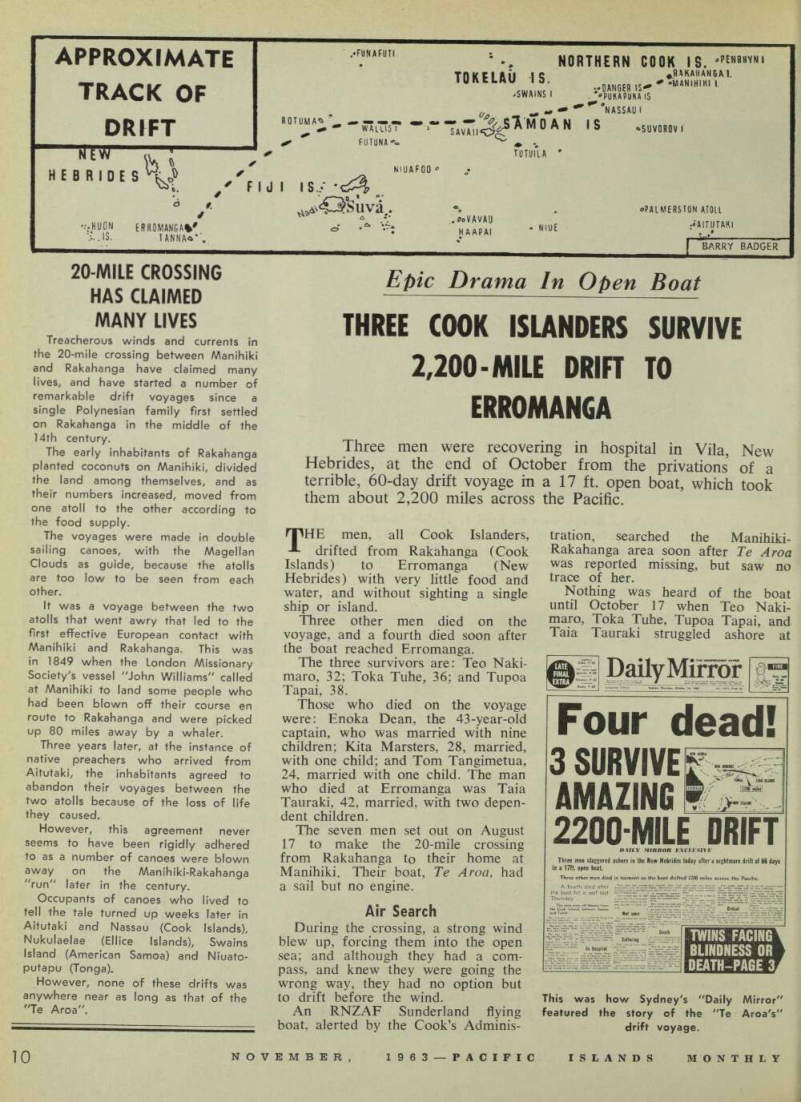
Occupants of canoes who lived to tell the tale turned up weeks later in Aitutaki and Nassau (Cook Islands), Nukulaelae (Ellice Islands), Swains Island (American Samoa) and Niuato putapu (Tonga).
However, none of these drifts was anywhere near as long as that of the "Te Aroa".