All About Pitcairn Island
p. 95 · Read in the full issue
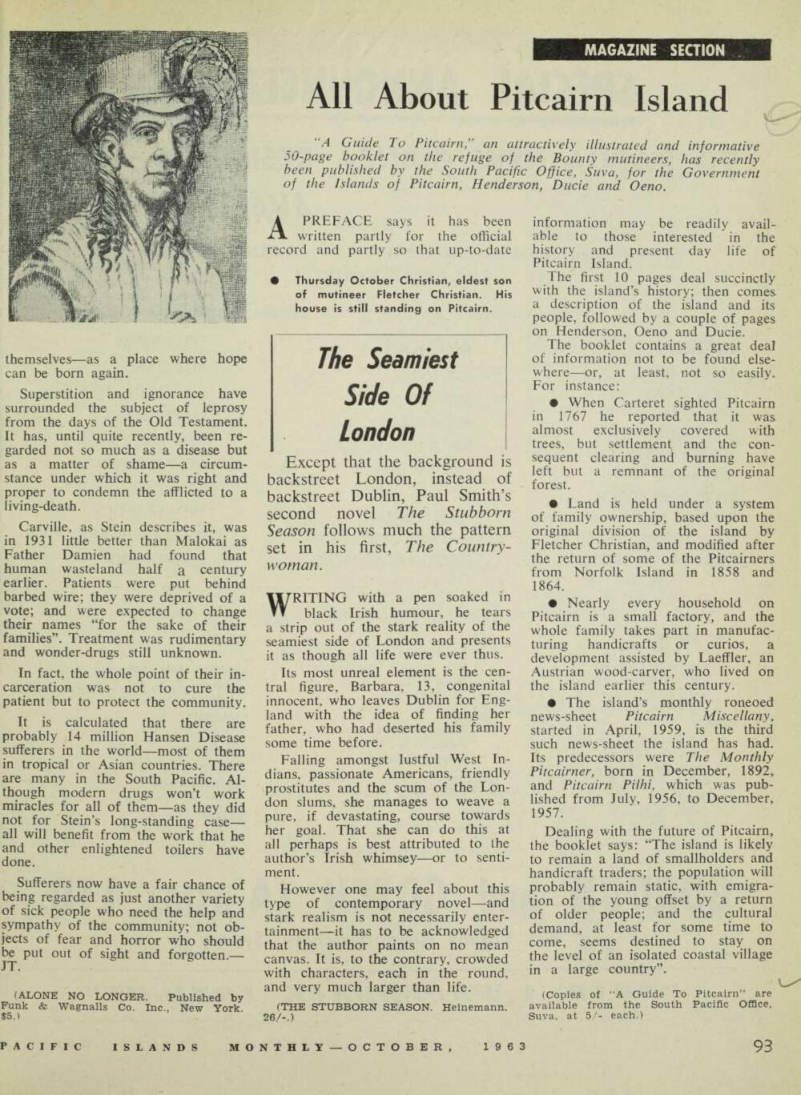
A Guide To Pitcairn,” an attractively illustrated and informative zO-page booklet on the refuge of the Bounty mutineers, has recently been published by the South Pacific Office, Suva, for the Government of the Islands of Pitcairn, Henderson, Dude and Oeno.
A PREFACE says it has been written partly for the official record and partly so that up-to-date
information may be readily avail able to those interested in the history and present day life of Pitcairn Island.
The first 10 pages deal succinctly with the island’s history; then comes a description of the island and its people, followed by a couple of pages on Henderson, Oeno and Ducie.
The booklet contains a great deal of information not to be found else where—or, at least, not so easily.
For instance: • When Carteret sighted Pitcairn in 1767 he reported that it was almost exclusively covered with trees, but settlement and the con sequent clearing and burning have left but a remnant of the original forest. • Land is held under a system of family ownership, based upon the original division of the island by Fletcher Christian, and modified after the return of some of the Pitcairners from Norfolk Island in 1858 and 1864. • Nearly every household on Pitcairn is a small factory, and the whole family takes part in manufac turing handicrafts or curios, a development assisted by Laeffler, an Austrian wood-carver, who lived on the island earlier this century. • The island’s monthly roneoed news-sheet Pitcairn Miscellany, started in April, 1959, is the third such news-sheet the island has had.
Its predecessors were The Monthly Pitcairner, born in December, 1892, and Pitcairn Pilhi, which was pub lished from July, 1956, to December, 1957.
Dealing with the future of Pitcairn, the booklet says: “The island is likely to remain a land of smallholders and handicraft traders; the population will probably remain static, with emigra tion of the young offset by a return of older people; and the cultural demand, at least for some time to come, seems destined to stay on the level of an isolated coastal village in a large country”. (Copies of “A Guide To Pitcairn” are available from the South Pacific Office, Suva, at 5/- each.)