Man Against
pp. 94-95 · Read in the full issue
Leprosy
Of the 155 million people in tht United States, only about 1,000 suffei from Hansen's Disease —the moden name for leprosy. So it is not sur prising that the 1,000 have tended tc be condemned to a limbo where the 3 can be conveniently forgotten by theii fellow men.
TWO people have shocked Ameri cans out of their complacency or the plight of the sufferers in recen years: One was Perry Burgess, witl his book Who Walks Alone, publisher in 1940; the other is Stanley Steir who, by refusing to become one ol the living-dead, has been whittlini away at the American conscience since he was confined to the Unitec States’ only leprosarium in 1931.
Stein’s voice has been the Sixty-Sh Star, the campus newspaper of Car ville institution, an ex-plantation or the swampy bend of the Mississippi, in Louisiana—officially US Marine Hospital No. 66. The newspaper be came the inmates’ pipeline to the world and was instrumental in win ning back for them the right to be considered human beings and not out casts whose only crime was that the> had, in some mysterious way, man aged to pick up Hansen’s bacillus.
Recently Stein has celebrated with a book the fact that he has spent about one-third of a century in Car ville—it’s called Alone No Longer, and it’s his own personal story. It is, as well, the story of the institution which was little better than a relic of the Dark Ages when he first went there but which has gradually emerged over the years—mostly through the efforts of the patients
themselves—as a place where hope can be born again.
Superstition and ignorance have surrounded the subject of leprosy from the days of the Old Testament.
It has, until quite recently, been re garded not so much as a disease but as a matter of shame—a circum stance under which it was right and proper to condemn the afflicted to a living-death.
Carville, as Stein describes it, was in 1931 little better than Malokai as Father Damien had found that human wasteland half a century earlier. Patients were put behind barbed wire; they were deprived of a vote; and were expected to change their names “for the sake of their families”. Treatment was rudimentary and wonder-drugs still unknown.
In fact, the whole point of their in carceration was not to cure the patient but to protect the community.
It is calculated that there are probably 14 million Hansen Disease sufferers in the world—most of them in tropical or Asian countries. There are many in the South Pacific. Al though modern drugs won’t work miracles for all of them—as they did not for Stein’s long-standing case— all will benefit from the work that he and other enlightened toilers have done.
Sufferers now have a fair chance of being regarded as just another variety of sick people who need the help and sympathy of the community; not ob jects of fear and horror who should be put out of sight and forgotten.— (ALONE NO LONGER. Published by Punk & Wagnalls Co. Inc., New York. $5.)
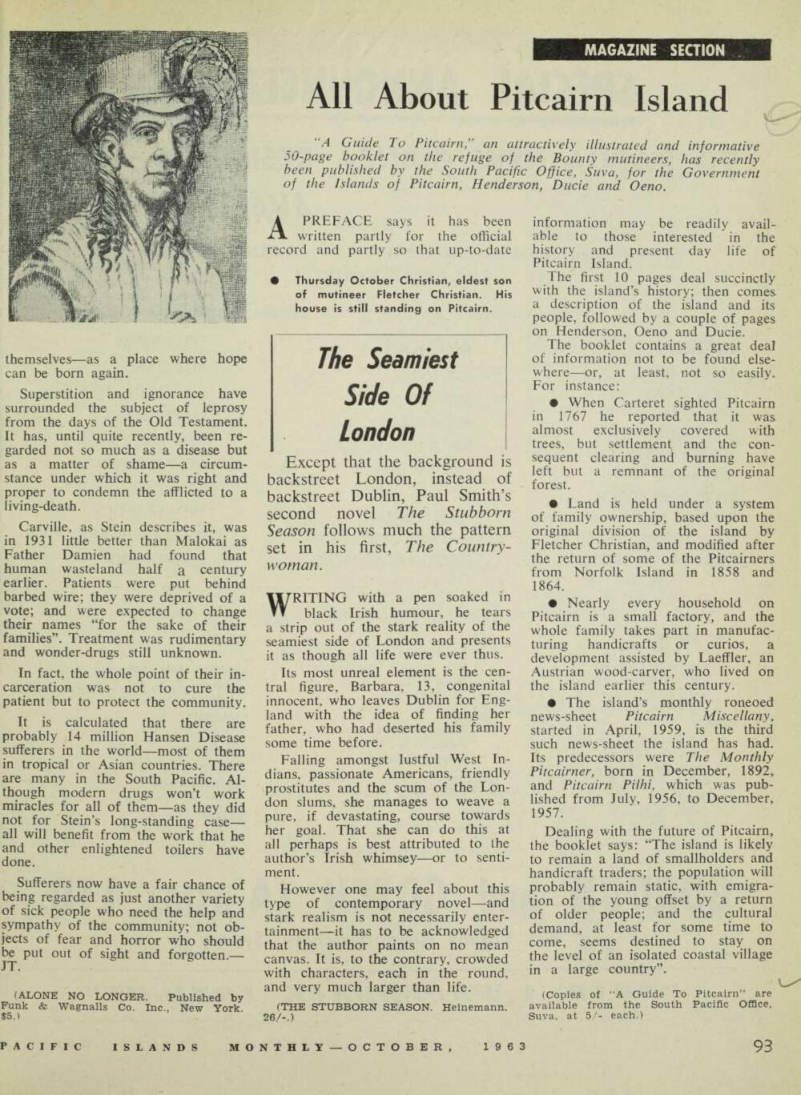
Thursday October Christian, eldest son of mutineer Fletcher Christian. His house is still standing on Pitcairn.