from the islands press
pp. 34-42 · Read in the full issue

THE First South Pacific Games . . . has been a pioneer venture in international and inter racial good fellowship, and it has been a resounding triumph.
A special fanfare should be composed and dedicated to the organisers, the controllers and the many voluntary workers—most of them behind the scenes—who created the structure on which the competitors themselves have built the Games.
Fiji provided the organisation and the setting, and 12 other territories provided representatives eager to show that in the South Pacific, international contests can be a source of friendship and not a source of bitter rivalries.— Editorial in “The Fiji Times”.
THE New Hebrides won one silver medal at the South Pacific Games. Jack Waewo, from Karwenu College, won the medal in the pole vault, vaulting 11 ft 6 in., which was equal to the winning height.
The remarkable thing about Waewo’s success was that he had never tried pole vaulting until two weeks before the Queen’s Birthday sports in June.— News item in a New Hebrides news bulletin.
THE answers for Western Samoa’s failure at the Games are easy to find. In the first place, practically all organised sport in Samoa is centred around Apia.
Secondy, the Government does little to encourage sport, and, in fact, by prohibitive duty on sport ing goods actually discourages participation in sport by young people of the low income group.
Thirdly, among sportsmen and women, too few are willing to take an active part in the or ganisation of their particular sports. Fourthly, as a result of lack of coaching, too few sports men are aware of the importance of the team before any show of individual brilliance. —Editorial in “Samoana”, Apia.
AN enormous crowd waited at Faaa Airport to welcome the Tahitian team on its return from
the Games in Fiji—a crowd such as is not often seen, impatient to greet those who had covered themselves with glory in Suva and to prove to them their attach ment and gratitude.
The first travellers to descend from the plane were received with warm applause, but when the (gold medal-winning) volleyball players came out there was delirium, music, leis and laurels of flowers. —News item in “Le Journal de Tahiti”.
WE are proud of our delega tion to the South Pacific Games in Suva. It is the truth that we are more proud of Joe Scanlan (American Samoa’s only gold medal winner) than the rest . . . but the athletes we sent were the best we had, and their per formance was no less than their best.
Had we had comparable com petition in the basketball and volleyball games, we could have walked away the winners by miles.
We showed, however, that as far as Pacific Islanders were con cerned, we have the best basket ball (men) and volleyball players. —Editorial in “Samoa News”, Pago Pago.
THE Aoniu returned today (September 10) from Suva with Prince Tu’ipelehake and Princess Melenaite, and members of the Tonga contingent to the South Pacific Games.
The scene at the wharf made a grand picture in the afternoon sunlight as the Aoniu dressed overall and her white paint gleam ing, berthed to the strains of the Police Band playing Lea-a-Fuiva, a tune composed by Queen Salote for the contingent to the Games.
The Tongan team assembled on the wharf where they were wel comed back by Prince Tungi and a number of nobles. Then, led by Prince Tu’ipelehake, and preceded by the Police Band, the team marched to the Palace for an audience with Queen Salote. — News item in Tonga Broad casting Commission radio news bulletin.
When Some Are More
Equal Than Others
SUNDAY morning at Jackson’s Airport, Port Moresby, is a good example of how, when all people are equal, some can be more equal than others.
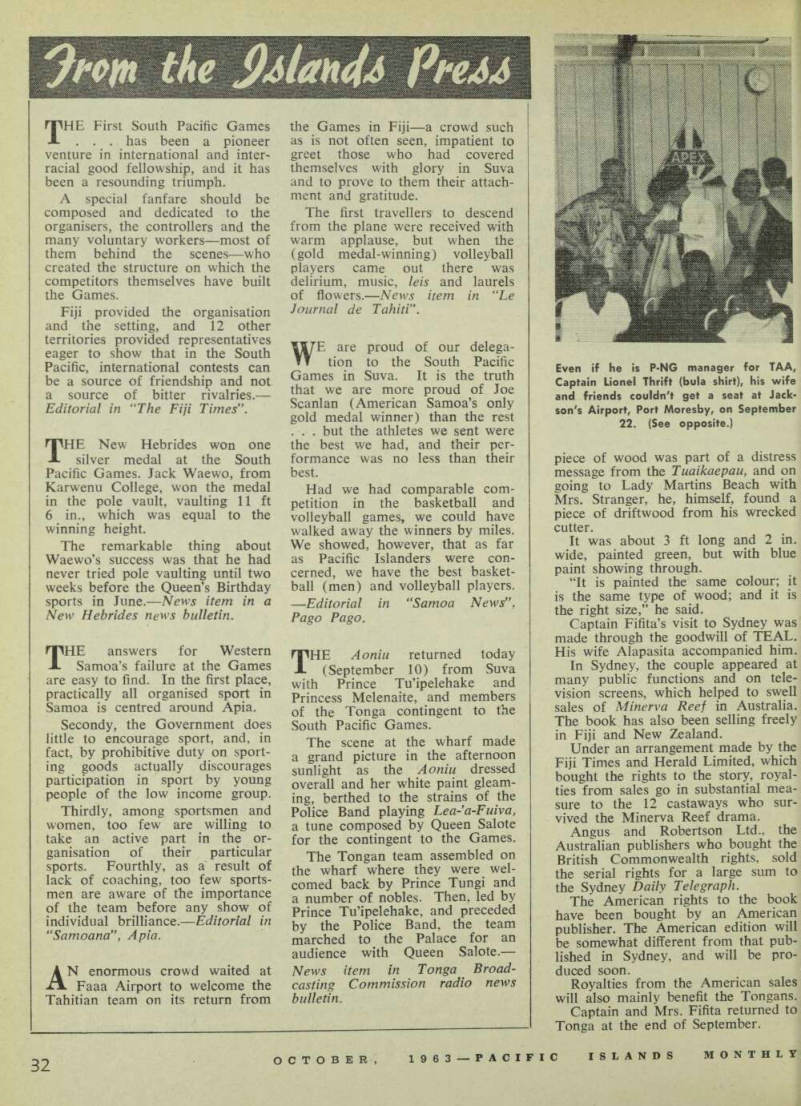
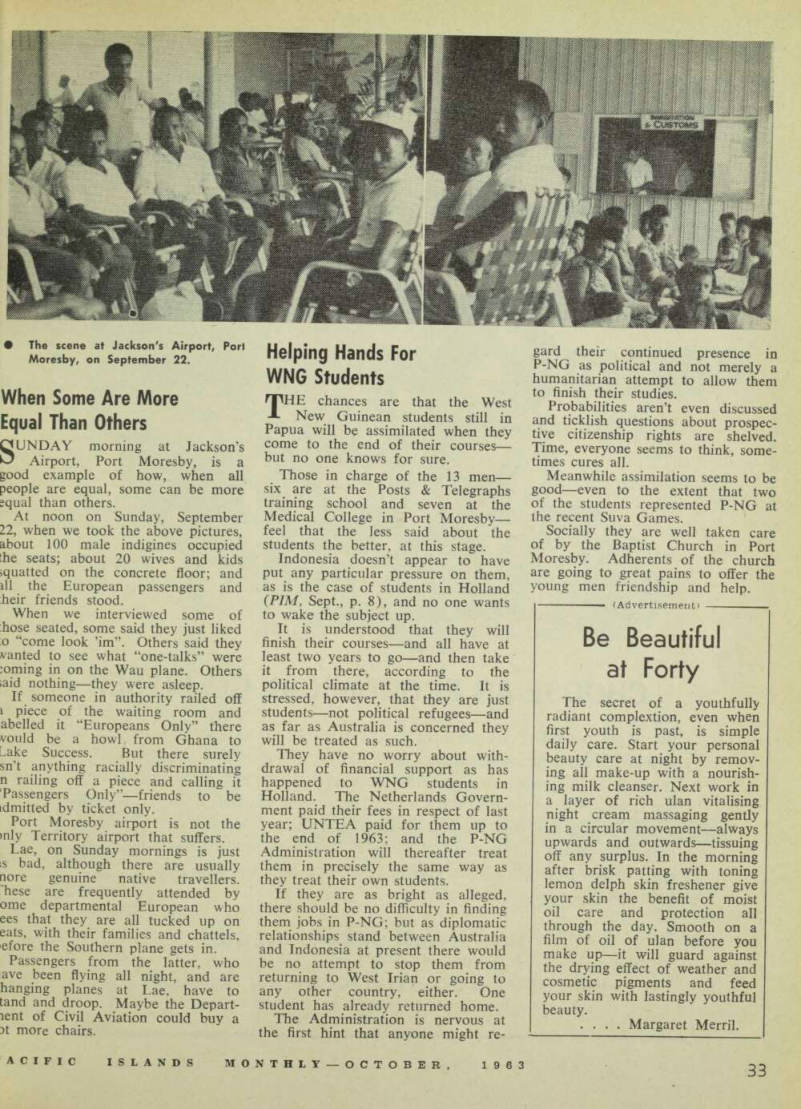
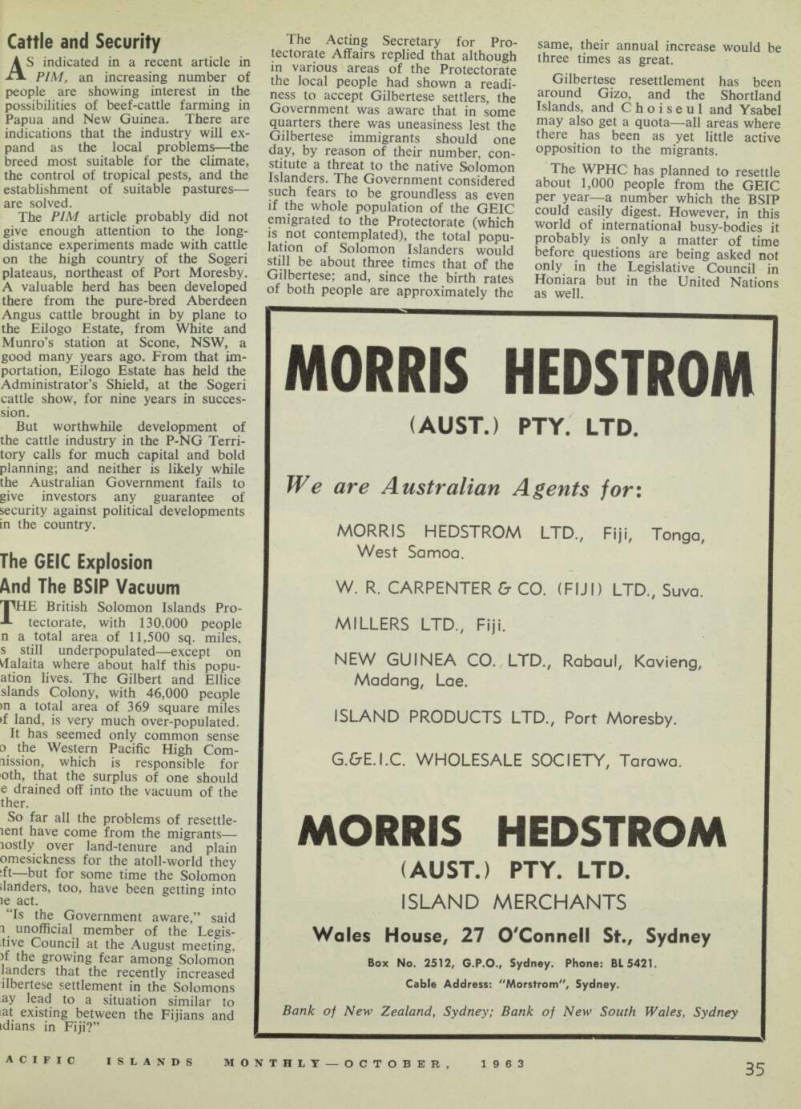
At noon on Sunday, September 22, when we took the above pictures, about 100 male indigines occupied the seats; about 20 wives and kids squatted on the concrete floor; and ill the European passengers and heir friends stood.
When we interviewed some of :hose seated, some said they just liked o “come look ’im”. Others said they vanted to see what “one-talks” were coming in on the Wau plane. Others said nothing—they were asleep.
If someone in authority railed off i piece of the waiting room and abelled it “Europeans Only” there vould be a howl from Ghana to Lake Success. But there surely sn’t anything racially discriminating n railing off a piece and calling it Passengers Only”—friends to be idmitted by ticket only.
Port Moresby airport is not the >nly Territory airport that suffers.
Lae, on Sunday mornings is just is bad, although there are usually nore genuine native travellers, 'hese are frequently attended by ome departmental European who ees that they are all tucked up on eats, with their families and chattels, efore the Southern plane gets in.
Passengers from the latter, who ave been flying all night, and are hanging planes at Lae, have to tand and droop. Maybe the Depart lent of Civil Aviation could buy a Dt more chairs.
Helping Hands For
WNG Students
THE chances are that the West New Guinean students still in Papua will be assimilated when they come to the end of their courses— but no one knows for sure.
Those in charge of the 13 men— six are at the Posts & Telegraphs training school and seven at the Medical College in Port Moresby— feel that the less said about the students the better, at this stage.
Indonesia doesn’t appear to have put any particular pressure on them, as is the case of students in Holland ( PIM, Sept., p. 8), and no one wants to wake the subject up.
It is understood that they will finish their courses—and all have at least two years to go—and then take it from there, according to the political climate at the time. It is stressed, however, that they are just students—not political refugees—and as far as Australia is concerned they will be treated as such.
They have no worry about with drawal of financial support as has happened to WNG students in Holland. The Netherlands Govern ment paid their fees in respect of last year; UNTEA paid for them up to the end of 1963; and the P-NG Administration will thereafter treat them in precisely the same way as they treat their own students.
If they are as bright as alleged, there should be no difficulty in finding them jobs in P-NG; but as diplomatic relationships stand between Australia and Indonesia at present there would be no attempt to stop them from returning to West Irian or going to any other country, either. One student has already returned home.
The Administration is nervous at the first hint that anyone might re
gard their continued presence in P-NG as political and not merely a humanitarian attempt to allow them to finish their studies.
Probabilities aren’t even discussed and ticklish questions about prospec tive citizenship rights are shelved.
Time, everyone seems to think, some times cures all.
Meanwhile assimilation seems to be good—even to the extent that two of the students represented P-NG at the recent Suva Games.
Socially they are well taken care of by the Baptist Church in Port Moresby. Adherents of the church are going to great pains to offer the young men friendship and help.
The scene at Jackson's Airport, Pori Moresby, on September 22.
Cattle and Security
AS indicated in a recent article in PIM, an increasing number of people are showing interest in the possibilities of beef-cattle farming in Papua and New Guinea. There are indications that the industry will ex pand as the local problems—the breed most suitable for the climate, the control of tropical pests, and the establishment of suitable pastures— are solved.
The PIM article probably did not give enough attention to the long distance experiments made with cattle on the high country of the Sogeri plateaus, northeast of Port Moresby.
A valuable herd has been developed there from the pure-bred Aberdeen Angus cattle brought in by plane to the Eilogo Estate, from White and Munro’s station at Scone, NSW, a good many years ago. From that im portation, Eilogo Estate has held the Administrator’s Shield, at the Sogeri cattle show, for nine years in succes sion.
But worthwhile development of the cattle industry in the P-NG Terri tory calls for much capital and bold planning; and neither is likely while the Australian Government fails to give investors any guarantee of security against political developments in the country.
The GEIC Explosion
And The BSIP Vacuum
rHE British Solomon Islands Pro tectorate, with 130,000 people n a total area of 11,500 sq. miles, s still underpopulated—except on tfalaita where about half this popu ation lives. The Gilbert and Ellice slands Colony, with 46,000 people >n a total area of 369 square miles >f land, is very much over-populated.
It has seemed only common sense o the Western Pacific High Com lission, which is responsible for oth, that the surplus of one should e drained off into the vacuum of the ther.
So far all the problems of resettle icnt have come from the migrants— lostly over land-tenure and plain omesickness for the atoll-world they —but for some time the Solomon ilanders, too, have been getting into le act.
“Is the Government aware,” said i unofficial member of the Legis tive Council at the August meeting, )f the growing fear among Solomon landers that the recently increased ilbertese settlement in the Solomons ay lead to a situation similar to at existing between the Fijians and idians in Fiji?”
The Acting Secretary for Pro tectorate Affairs replied that although in various areas of the Protectorate the local people had shown a readi ness to accept Gilbertese settlers, the Government was aware that in some quarters there was uneasiness lest the Gilbertese immigrants should one day, by reason of their number, con stitute a threat to the native Solomon Islanders. The Government considered such fears to be groundless as even if the whole population of the GEIC emigrated to the Protectorate (which is not contemplated), the total popu lation of Solomon Islanders would still be about three times that of the Gilbertese; and, since the birth rates of both people are approximately the
same, their annual increase would be three times as great.
Gilbertese resettlement has been around Gizo, and the Shortland Islands, and C h o i s e u 1 and Ysabel may also get a quota—all areas where there has been as yet little active opposition to the migrants.
The WPHC has planned to resettle about 1,000 people from the GEIC per year—-a number which the BSIP could easily digest. However, in this world of international busy-bodies it probably is only a matter of time before questions are being asked not only in the Legislative Council in Honiara but in the United Nations as well.
The Best-Kept Secret
Of The Games
MR. F. J. Coyne, Director of Organisation for the South Paci fic Games, has sent us his “greetings and congratulations” on the produc tion of our eight-page Games Record last month.
“You certainly wasted no time in its production,” he said.
Then, having presented his bou quets, Mr. Coyne belaboured us with a brickbat.
He said: “I know that, through lack of adequate funds, we’ve had to run the Games on a shoe string, but we really haven’t been quite as mean as would appear from your alloca tion of the medals.
“In point of fact, we awarded no less than 455 of them [PIM said 179] in the following categories:—
Gold 158
Silver 150
Bronze 147
“A possible explanation for the dis crepancy may be that we awarded medals to the individual members of all placed teams in the team sports.
“Perhaps you will give us credit for our generosity.”
We are certainly glad to give the Games Organisation credit for its generosity, and we have no doubt that the explanation for the discrepancy between the official medals tally and ours is the one given by Mr. Coyne.
However, in the absence on holi days of editor Stuart Inder, who covered the Games for us, we can only conclude that the presentation of medals to all members of the placed teams must have been the best-kept secret of the Games.
We say this because our medals tally corresponded with those pub lished in The Fiji Times, South Paci fic Post, New Guinea Times-Courier, Samoana and Cook Island News, all of which, as far as we know, com piled their tallies independently.
Furthermore, The Fiji Times pub lished a progressive medals tally on each day the Games were in pro gress, but Mr. Coyne’s organisation apparently never warned it that it was falling into error.
Those Fiji Bananas
Are Under Fire Again
rpHERE were some red faces among ... Australian manufacturers at the Fiji Trades and Industries Fair in Suva in September.
Just when they were having some success in pushing their lines, the
Produce Secretary of the NSW Divi sion of the Australian Primary Pro ducers’ Union, Colonel C. F. M.
Godtschalk, made a bitter attack about Fiji imperilling the Australian banana industry.
The Australians at Suva had already read quite a lot about their country not buying very much from Fiji, while Fiji imported more from Australia than anywhere else. But putting on a brave face they managed to explain that they represented sec ondary industry, and inferred that there was a wide divergence of views between Australian primary and secondary industry.
Colonel Godtschalk, like a lot of other Australian producers, has wild ideas about the cheap, black labour myth. He apparently imagines that Fiji wants to flood Australia with bananas produced by cheap labour.
In fact the bananas in Fiji are not produced by cheap labour. They are produced mainly by indigenous people on their own plantations, and are marketed through well-tried and established procedures.
At the time of the Colonel’s out burst, a Queensland Minister and member of the Country Party was in Fiji heading a small delegation from his State at the trade fair. The Minis
ter was Mr. A. R. Fletcher, the Minister for Lands. He lost no time in describing Colonel Godtschalk’s re marks as intemperate.
As a member of the Country Party, Mr. Fletcher has the interests of Queensland banana growers at heart, but he says he is prepared to be reasonable about the matter. He said that if there was any action which would have grave effects on the banana industry in Queensland he would be quick to support any oppo sition against imports from Fiji.
But those people who had spoken to him, including the Development Commissioner, Mr. W. B. Rogers, had been temperate in their sugges tions. All they wanted was the right to sell bananas to Australia for a month or two each year when Aus tralian sources could not meet the demand.
He was certain most Australian banana producers would look at the matter in that light, and that they would be reasonable—but we aren’t.
Australian producers’ protectionist phobias are ingrained, and Fiji bananas are just one of their hates—
even after a dozen years there are still periodic attempts to stop the im portation of passionfruit pulp from the New Guinea Highlands.
It's Still Segregated
Grogging in P-NG
THE PIM article on native drinking in P-NG (June issue) reminded retired Papua rubber-planter G. A.
Loudon of a recent incident: Young Tommy Rosser, of Rigo, who had not been in “civilisation” for some time, met Colin Sefton in Port Moresby. Tommy was interested in the capital city’s suburban develop ments, so they went out together to Boroko, and called at the Boroko Hotel for a drink.
At the bar door, Tommy hesitated and drew back. He had not hitherto seen the new drinking laws in opera tion. ‘What’s up?” asked Colin.
“Can’t go in there,” said Tommy.
“The bar’s full of natives.”
“Why not?” demanded Colin.
“Aren’t we as good as they are?” and forthwith led the surprised Rigo plan
ter inside, and introduced him to P-NGs new de-segregation system.
Except as an experience, however, few Europeans patronise public bars in the Territory these days—although the ingrained Australian habit of standing up at a bar, rather than sit ting down in comfort at a table, dies hard.
One result of this at the “top pub” in Port Moresby is that former Euro pean public bar patrons have invaded what used to be the lounge and cock tail bar. They stand around the latter 10 deep at peak periods and the volume of sound that comes from this part of the hotel equals anything emanating from an Australian subur ban hotel any summer Saturday afternoon. It’s all very educational for the tourists who pass that way and don’t know the background.
Putting The Boots
Into Socks
THE Fiji Customs Department has found a novel way of “protect ing the revenue”, or even increasing it. Seizing on two small pieces of rubber used in the elastic tops of men’s nylon socks, they have decided that they should be classed as “wholly or partly of foreign manufacture”.
For many years socks were impor ted under the British Imperial pre ference tariff of 25 per cent, as they were classed as goods which were of 25 per cent. British manufacture.
But a zealous Customs officer un ravelled a sock and found two minute strands of rubber running round the top. So the Customs Department invoked another section of the regu lations which defined the socks as “goods wholly or partly made of rubber”. That ruling put them under the foreign tariff of 50 per cent.
Carrying the matter to its logical conclusion, Customs immediately wrote to a firm demanding a further 25 per cent, on hose imported the previous year, and to prove their case added that the hose were partly made of rubber.
Even though the hose may be labelled “Made in England,” the 50 per cent, will be charged, with a consequent increase in price to the consumer if the two strips of rubber run through the top of the hose.
That is not much encouragement to “Buy British” when cheaper foreign-made lines are on offer, the merchants say.
So far the Customs Department has not stated how it knows that the rubber used is not of British origin.