tropicalities
pp. 33-34 · Read in the full issue
The circumlocutions, polite and sensitive, that people use these days to escape coming out with dirty colonial words like native, or European or boy, would fill a dictionary and Papua-New Guinea is affected by the disease more than most.
POLICE-BOYS have become police men; Europeans have become expatriates; natives are indigenes and some of them Mr, and more re cently Esq.* According to the captions on the photographs of native members of the Legislative Council, that hang around the Chamber’s vestibule in Port Moresby, we now have Somo Sigob, Esq., and Kondom Agaundo, Esq., and Yin Tobaining, Esq.—although we have been in formed that the latter, freely trans lated, means Yin Mr. Baining Esq.— “To”, in Blanche Bay, being a prefix denoting the male.
P-NG will no doubt get over its handle problems in due time—as has the Eastern Pacific, where there aren’t any, by mutual consent. But if they have to havq them in the interim, something with more local colour would have been appropriate.
The Motuan words “Taubada” and “Sinabada”, meaning the equivalent of New Guinea Pidgin’s Masta and Missus, may also be way out in this context, but at least they are no more ridiculous than Mr. and Mrs., which are only contractions of the English words for Master and Mistress.
In the meantime, P-NG is sensitive to a fault, short on common-sense and sometimes on a sense of humour.
The once oft-bawled “Boy” is now seldom heard in the land, although we are told that it is quite OK if you say “My Boy” (paternally); or Old Boy” (all club-mates together).
Most expatriates get over the trouble
when trying to attract the attention of an indigenous male by simply yelling “Hi”.
And the story probably apocryphal—is told of a Madang planter, who, some years ago when the fiat had gone forth that the term boss-boy was no longer to be used, but “foreman” substituted for it, met unexpected obstacles.
The planter called his slave to him and said that from then on he was no longer a boss-boy. The recipient of new honours looked somewhat downcast, but said bravely: “Yes, masta”.
His boss went on: “Now you fore man “Four man!” said the native in alarm. “No got! Me no four man— me one fella tha’s all”.
Native elected member for Eastern Papua, John Guise, has recently tossed another teaser into the ring.
Before the new House of Assembly meets next year, he wants someone to come up with a single term that will replace Papuan and New Guinean. He thinks it will make for unity.
No prizes are offered and the best suggestion so far is the very weak “West Melanesian”.
A Piece Of His Own
Ship—2,ooo Miles Away
CASTAWAY skipper, Captain David Fifita, found a piece of driftwood from the wreckage of his cutter Tuaikaepau while he was in Sydney in September to promote the sale of Olaf Ruhen’s book Minerva Reef.
The driftwood had apparently floated the 2,000 miles from Minerva Reef, where the Tuaikaepau, with Captain Fifita and 16 other Tongans, was wrecked in July, 1962.
Olaf Ruhen’s book tells of the 102-day drama that followed the shipwreck.
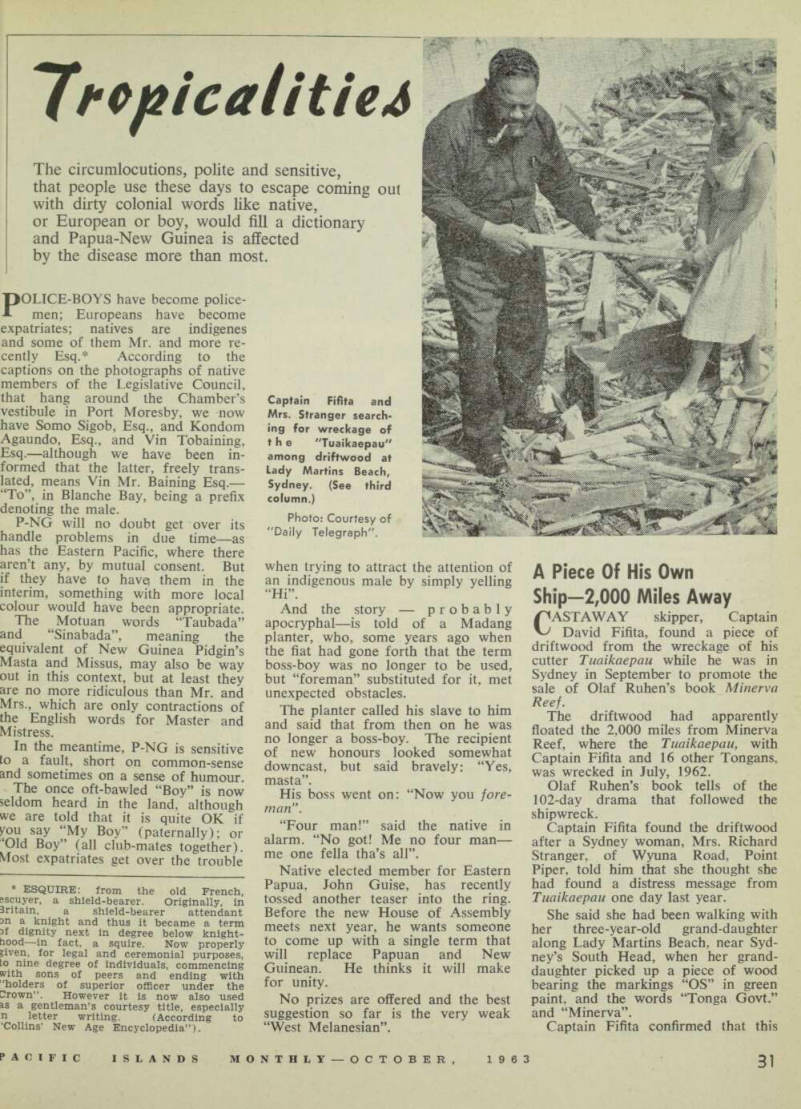
Captain Fifita found the driftwood after a Sydney woman, Mrs. Richard Stranger, of Wyuna Road, Point Piper, told him that she thought she had found a distress message from Tuaikaepau one day last year.
She said she had been walking with her three-year-old grand-daughter along Lady Martins Beach, near Syd ney’s South Head, when her grand daughter picked up a piece of wood bearing the markings “OS” in green paint, and the words “Tonga Govt.” and “Minerva”.
Captain Fifita confirmed that this
* ESQUIRE: from the old French, sscuyer, a shield-bearer. Originally, in Britain, a shield-bearer attendant an a knight and thus it became a term af dignity next in degree below knight hood —in fact, a squire. Now properly ?iven, for legal and ceremonial purposes, to nine degree of individuals, commencing with sons of peers and ending with “holders of superior officer under the Srown”. However it is now also used is a gentleman’s courtesy title, especially n letter writing. (According to ‘Collins’ New Age Encyclopedia”).
Captain Fifita and Mrs. Stranger search ing for wreckage of the "Tuaikaepau" among driftwood at Lady Martins Beach, Sydney. (See third column.) Photo: Courtesy of "Daily Telegraph".
piece of wood was part of a distress message from the Tuaikaepau, and on going to Lady Martins Beach with Mrs. Stranger, he, himself, found a piece of driftwood from his wrecked cutter.
It was about 3 ft long and 2 in. wide, painted green, but with blue paint showing through.
“It is painted the same colour; it is the same type of wood; and it is the right size,” he said.
Captain Fifita’s visit to Sydney was made through the goodwill of TEAL.
His wife Alapasita accompanied him.
In Sydney, the couple appeared at many public functions and on tele vision screens, which helped to swell sales of Minerva Reef in Australia.
The book has also been selling freely in Fiji and New Zealand.
Under an arrangement made by the Fiji Times and Herald Limited, which bought the rights to the story, royal ties from sales go in substantial mea sure to the 12 castaways who sur vived the Minerva Reef drama.
Angus and Robertson Ltd., the Australian publishers who bought the British Commonwealth rights, sold the serial rights for a large sum to the Sydney Daily Telegraph.
The American rights to the book have been bought by an American publisher. The American edition will be somewhat different from that pub lished in Sydney, and will be pro duced soon.
Royalties from the American sales will also mainly benefit the Tongans.
Captain and Mrs. Fifita returned to Tonga at the end of September.
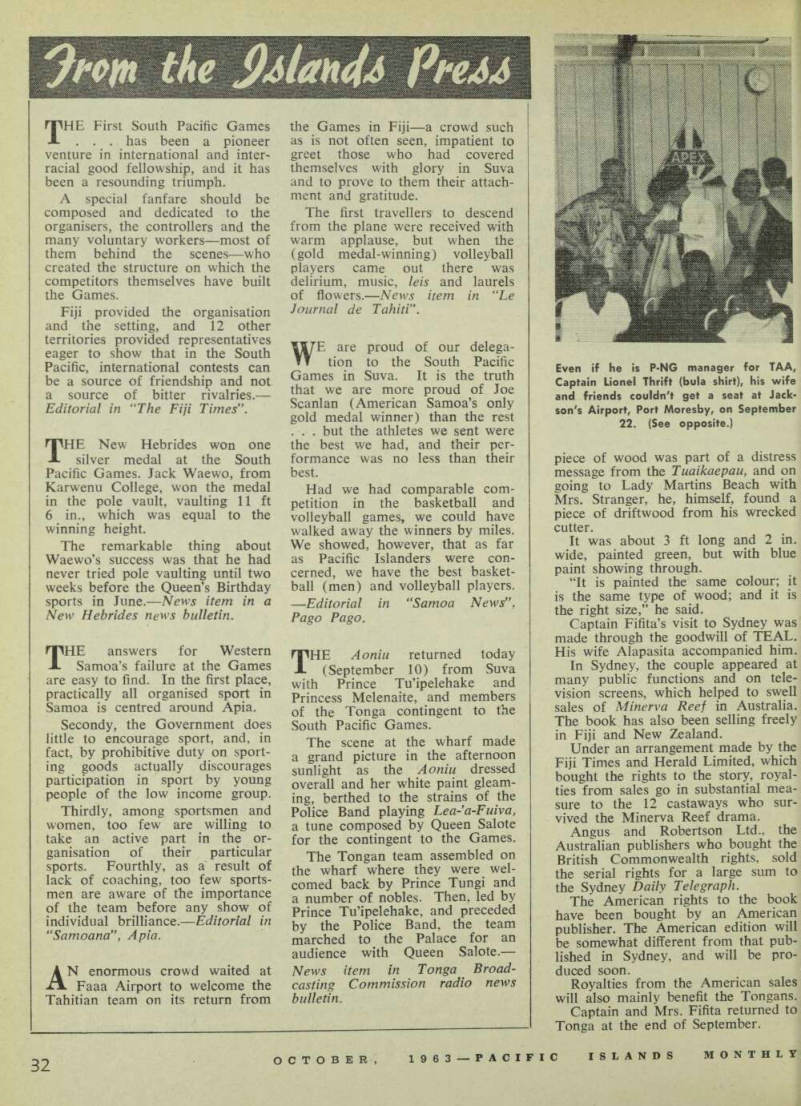
Even if he is P-NG manager for TAA, Captain Lionel Thrift (bula shirt), his wife and friends couldn't get a seat at Jack son's Airport, Port Moresby, on September 22. (See opposite.)