yesterday
p. 87 · Read in the full issue
The question of what would happen after the war to the League of Nations mandated territories particularly the three in the Pacific was exercising PlM’s attention in September, 1943. PIM thought the Samoans would be
capable of governing them
selves after the war, but it said “territories like New
Guinea, incapable of self
government, must be taken care of in some way”. Other items in PIM of 20 years ago were: All schools and assembly places in Tahiti had been closed because of an epidemic of influenza which attacked the throat, intestines and kidneys. The disease had ap parently been brought from the United States. An average of three or four deaths daily had occurred in July. * * * Fijian and Tongan troops, who had been in the thick of the fight ing on New Georgia, Solomon Islands, had won the praise of the Americans who declared there were no better fighters anywhere.
The Americans were particularly impressed by the Islanders’ ability to make gruelling, day-long patrols and then sleep as peacefully under shellfire as if they were in their own villages. * * ♦ Mr. Owen Cyril Noel, a District Officer in Uganda, had been ap pointed Resident Commissioner in the BSIP. He succeeded Lieut.- Colonel W. S. Marchant. * * * Fiji’s Governor, Sir Philip Mitchell, received a deputation of Indian cane-growers from Lau toka who claimed that sugar was not worth growing at the existing price. They asked that the price be increased, and intimated that they would probably not cut their cane under existing conditions. * * * Since the American Army’s arrival in New Caledonia in
March, 1942, that territory had been enjoying the greatest boom in its history. Post Office Savings Bank deposits had risen from 24 million francs in March, 1942, to 51 million francs in August, 1943. * * * Mr. H. W. Champion had re tired from the post of Government Secretary of Papua and Commis sioner for Native Affairs. “Next to Sir Hubert Murray,” PIM said, “he was Australia’s most distin guished officer in the field of Paci fic administration.” * * * New Guinea aviation pioneer Ray Parer, whose whereabouts and activities since the beginning of the war had been a mystery, had been located in Edgecliffe, Sydney, running a grocery shop.
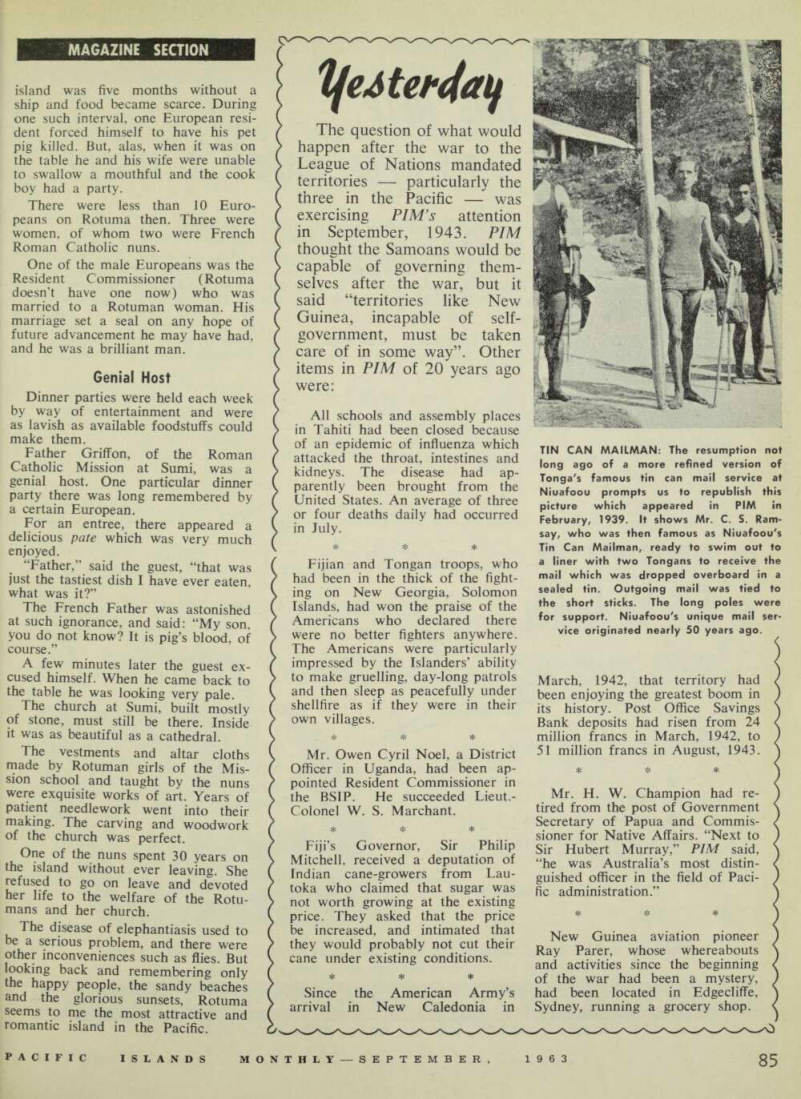
TIN CAN MAILMAN: The resumption not long ago of a more refined version of Tonga's famous tin can mail service at Niuafoou prompts us to republish this picture which appeared in PIM in February, 1939. It shows Mr. C. S. Ram say, who was then famous as Niuafoou's Tin Can Mailman, ready to swim out to a liner with two Tongans to receive the mail which was dropped overboard in a sealed tin. Outgoing mail was tied to the short sticks. The long poles were for support. Niuafoou's unique mail ser vice originated nearly 50 years ago.