Bigger Than Anywhere
pp. 85-87 · Read in the full issue
Rotuma: "The Gem Of The Pacific"
It May Be Neglected, But The Oranges Grow Bigger Than Anywhere
From Gabrielle Lawson in Honiara Judging by the letters on Rotuma that have appeared in PIM in recent months, I gather that things haven’t changed much on that “gem of the Pacific”—as an enthusiastic journalist once called it—since I was there some 30 years ago.
ROTUMA is situated midway be tween Fiji and the Ellice Islands, and also about midway between Samoa and the Santa Cruz Group of the Solomon Islands, about 12 de grees south of the Equator.
Thirty years ago it was well off the main shipping routes and it still is today, although communication is perhaps better now than it was then when only three or four ships called there in a year.
The trip in Burns Philp’s old Malake, which took eight days from Fiji, was certainly no luxury cruise.
The ship anchored outside the reef at Rotuma, about a mile off shore, and in rough weather passengers who were too timid to climb down the gangway and make the perilous leap into the waiting launch were lowered into a work boat by the ship’s sling, an equally frightening al ternative.
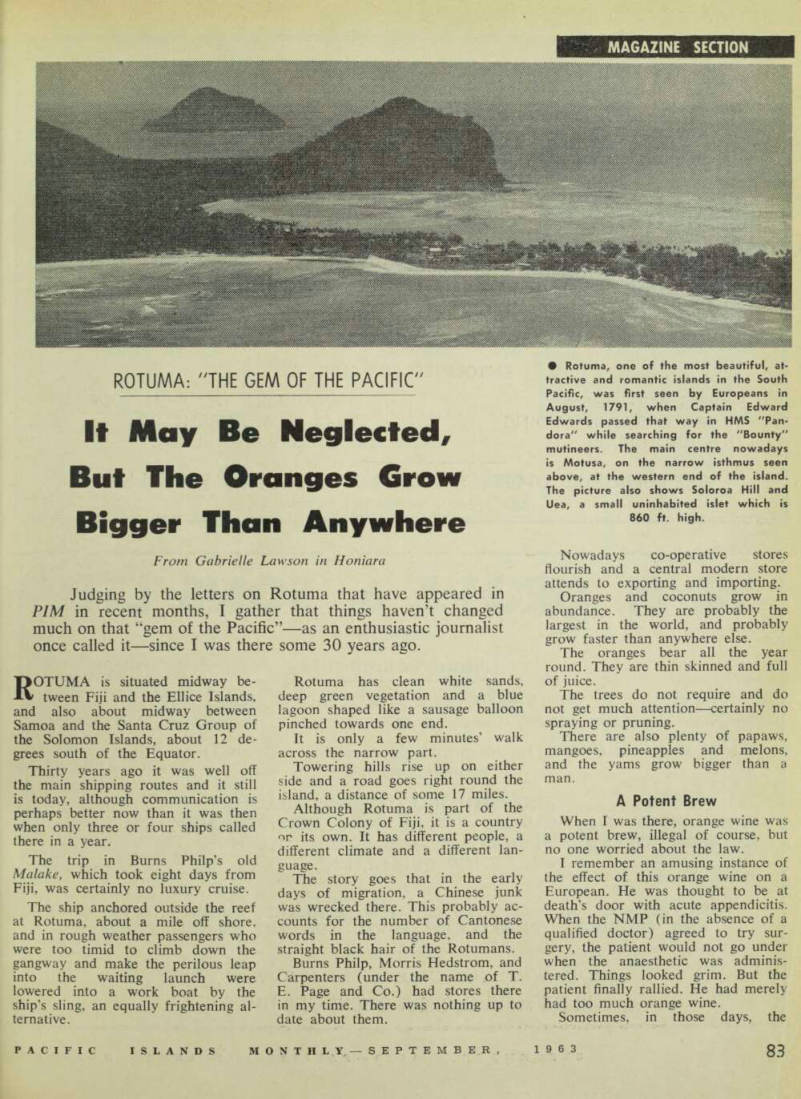
Rotuma has clean white sands, deep green vegetation and a blue lagoon shaped like a sausage balloon pinched towards one end.
It is only a few minutes’ walk across the narrow part.
Towering hills rise up on either side and a road goes right round the island, a distance of some 17 miles.
Although Rotuma is part of the Crown Colony of Fiji, it is a country or its own. It has different people, a different climate and a different lan guage.
The story goes that in the early days of migration, a Chinese junk was wrecked there. This probably ac counts for the number of Cantonese words in the language, and the straight black hair of the Rotumans.
Burns Philp, Morris Hedstrom, and Carpenters (under the name of T.
E. Page and Co.) had stores there in my time. There was nothing up to date about them.
Nowadays co-operative stores flourish and a central modern store attends to exporting and importing.
Oranges and coconuts grow in abundance. They are probably the largest in the world, and probably grow faster than anywhere else.
The oranges bear all the year round. They are thin skinned and full of juice.
The trees do not require and do not get much attention —certainly no spraying or pruning.
There are also plenty of papaws, mangoes, pineapples and melons, and the yams grow bigger than a man.
A Potent Brew When I was there, orange wine was a potent brew, illegal of course, but no one worried about the law.
I remember an amusing instance of the effect of this orange wine on a European. He was thought to be at death’s door with acute appendicitis.
When the NMP (in the absence of a qualified doctor) agreed to try sur gery, the patient would not go under when the anaesthetic was adminis tered. Things looked grim. But the patient finally rallied. He had merely had too much orange wine.
Sometimes, in those days, the
• Rotuma, one of the most beautiful, at tractive and romantic islands in the South Pacific, was first seen by Europeans in August, 1791, when Captain Edward Edwards passed that way in HMS "Pan dora" while searching for the "Bounty" mutineers. The main centre nowadays is Motusa, on the narrow isthmus seen above, at the western end of the island.
The picture also shows Soloroa Hill and Uea, a small uninhabited islet which is 860 ft. high.
island was five months without a ship and food became scarce. During one such interval, one European resi dent forced himself to have his pet pig killed. But, alas, when it was on the table he and his wife were unable to swallow a mouthful and the cook boy had a party.
There were less than 10 Euro peans on Rotuma then. Three were women, of whom two were French Roman Catholic nuns.
One of the male Europeans was the Resident Commissioner (Rotuma doesn’t have one now) who was married to a Rotuman woman. His marriage set a seal on any hope of future advancement he may have had, and he was a brilliant man.
Genial Host Dinner parties were held each week by way of entertainment and were as lavish as available foodstuffs could make them.
Father Griffon, of the Roman Catholic Mission at Sumi, was a genial host. One particular dinner party there was long remembered by a certain European.
For an entree, there appeared a delicious pate which was very much enjoyed.
“Father,” said the guest, “that was just the tastiest dish I have ever eaten, what was it?”
The French Father was astonished at such ignorance, and said: “My son, you do not know? It is pig’s blood, of course.”
A few minutes later the guest ex cused himself. When he came back to the table he was looking very pale.
The church at Sumi, built mostly of stone, must still be there. Inside it was as beautiful as a cathedral.
The vestments and altar cloths made by Rotuman girls of the Mis sion school and taught by the nuns were exquisite works of art. Years of patient needlework went into their making. The carving and woodwork of the church was perfect.
One of the nuns spent 30 years on the island without ever leaving. She refused to go on leave and devoted her life to the welfare of the Rotu mans and her church.
The disease of elephantiasis used to be a serious problem, and there were other inconveniences such as flies. But looking back and remembering only the happy people, the sandy beaches and the glorious sunsets, Rotuma seems to me the most attractive and romantic island in the Pacific.