American Voyage Through
p. 83 · Read in the full issue
The Solomons Blazed A New Trail To China
by C. Jack-Hinton
People in the Solomons have heard plenty about the ex ploits of the American forces in those islands during the war, but none of them, probably, has ever heard that the Yanks were there as far back as 1787.
THE Americans in question were the crew of the frigate Alliance, which passed to the west of the New Georgia Group and Bougainville in November, 1787, en route to Canton for a cargo of tea. She was one of the first American ships to open up the tea trade with China.
Historians are familiar with the voyages through the Solomons of Carteret in 1767, Bougainville in 1768, Surville in 1769 and Shortland in 1788. But the voyage of the Al liance, under Captain Thomas Reed, has remained virtually unknown.
The only known account of it is contained in the logbook of the mate, Richard Dale. This was brought to my attention recently by Mr. J. For syth, of Avalon Beach, New South Wales.
The Alliance was an ex-US naval frigate of 900 tons.
Her master, Thomas Read, had served with distinction in the revo lutionary war, rising to the rank of commodore. Dale, the mate, had served in both the Royal Navy and the revolutionary navy.
In the Solomons The Alliance cleared Philadelphia for Canton in June, 1787. She called at the Cape Verde Islands, doubled the Cape of Good Hope, sighted Am sterdam Island on September 24, and reached Tasmania in October. From there, she headed northwards, keep ing about 200 miles off the coast of New South Wales.
After narrowly avoiding disaster on the reefs off New Caledonia, land in the Solomons was sighted dead ahead at 5 a.m. on November 9.
From the navigational record of Dale’s log-book and his description of the coastline sighted, the Alliance’s route can be reconstructed with reasonable accuracy.
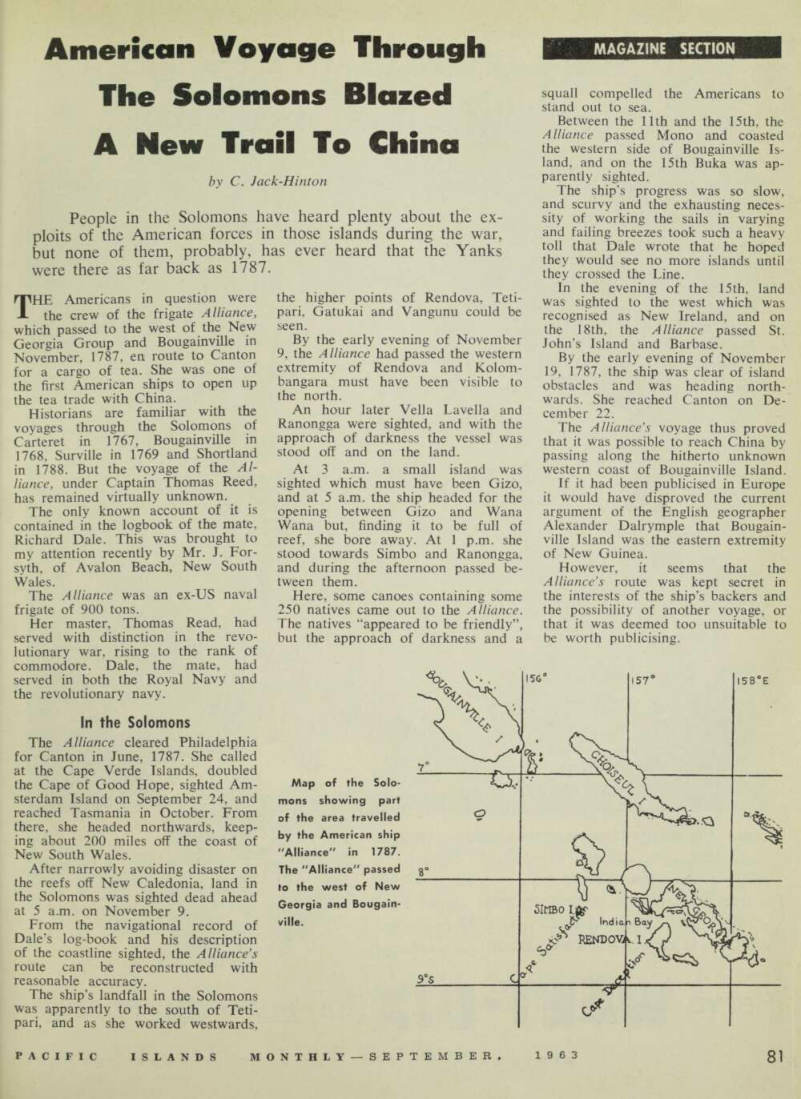
The ship’s landfall in the Solomons was apparently to the south of Teti pari, and as she worked westwards,
the higher points of Rendova, Teti pari, Gatukai and Vangunu could be seen.
By the early evening of November 9, the Alliance had passed the western extremity of Rendova and Kolom bangara must have been visible to the north.
An hour later Vella Lavella and Ranongga were sighted, and with the approach of darkness the vessel was stood off and on the land.
At 3 a.m. a small island was sighted which must have been Gizo, and at 5 a.m. the ship headed for the opening between Gizo and Wana Wana but, finding it to be full of reef, she bore away. At 1 p.m. she stood towards Simbo and Ranongga, and during the afternoon passed be tween them.
Here, some canoes containing some 250 natives came out to the Alliance.
The natives “appeared to be friendly”, but the approach of darkness and a
squall compelled the Americans to stand out to sea.
Between the 11th and the 15th, the Alliance passed Mono and coasted the western side of Bougainville Is land, and on the 15th Buka was ap parently sighted.
The ship’s progress was so slow, and scurvy and the exhausting neces sity of working the sails in varying and failing breezes took such a heavy toll that Dale wrote that he hoped they would see no more islands until they crossed the Line.
In the evening of the 15th, land was sighted to the west which was recognised as New Ireland, and on the 18th, the Alliance passed St.
John’s Island and Barbase.
By the early evening of November 19, 1787, the ship was clear of island obstacles and was heading north wards. She reached Canton on De cember 22.
The Alliance’s voyage thus proved that it was possible to reach China by passing along the hitherto unknown western coast of Bougainville Island.
If it had been publicised in Europe it would have disproved the current argument of the English geographer Alexander Dalrymple that Bougain ville Island was the eastern extremity of New Guinea.
However, it seems that the Alliance’s route was kept secret in the interests of the ship’s backers and the possibility of another voyage, or that it was deemed too unsuitable to be worth publicising.
Map of the Solo mons showing part of the area travelled by the American ship "Alliance" in 1787.
The "Alliance" passed to the west of New Georgia and Bougain ville.