Malaysia: The Implications
pp. 89-90 · Read in the full issue
The Month's New Reading
Malaysia: The Implications For The South Seas
With Judy Tudor
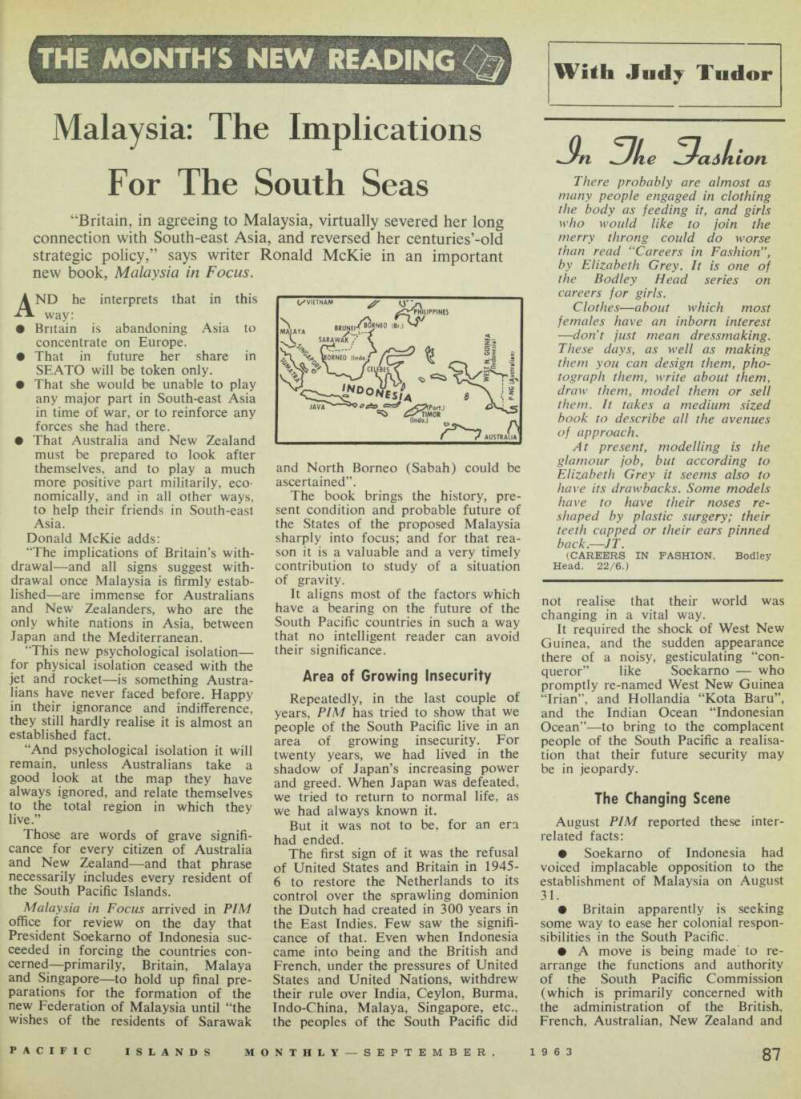
“Britain, in agreeing to Malaysia, virtually severed her long connection with South-east Asia, and reversed her centuries’-old strategic policy,” says writer Ronald McKie in an important new book, Malaysia in Focus.
AND he interprets that in this way; • Britain is abandoning Asia to concentrate on Europe. • That in future her share in SEATO will be token only. • That she would be unable to play any major part in South-east Asia in time of war, or to reinforce any forces she had there. • That Australia and New Zealand must be prepared to look after themselves, and to play a much more positive part militarily, eco nomically, and in all other ways, to help their friends in South-east Asia.
Donald McKie adds: “The implications of Britain’s with drawal—and all signs suggest with drawal once Malaysia is firmly estab lished—are immense for Australians and New Zealanders, who are the only white nations in Asia, between Japan and the Mediterranean.
“This new psychological isolation— for physical isolation ceased with the jet and rocket—is something Austra lians have never faced before. Happy in their ignorance and indifference, they still hardly realise it is almost an established fact.
“And psychological isolation it will remain, unless Australians take a good look at the map they have always ignored, and relate themselves to the total region in which they live,”
Those are words of grave signifi cance for every citizen of Australia and New Zealand—and that phrase necessarily includes every resident of the South Pacific Islands.
Malaysia in Focus arrived in PIM office for review on the day that President Soekarno of Indonesia suc ceeded in forcing the countries con cerned—primarily, Britain, Malaya and Singapore— to hold up final pre parations for the formation of the new Federation of Malaysia until “the wishes of the residents of Sarawak
and North Borneo (Sabah) could be ascertained”.
The book brings the history, pre sent condition and probable future of the States of the proposed Malaysia sharply into focus; and for that rea son it is a valuable and a very timely contribution to study of a situation of gravity.
It aligns most of the factors which have a bearing on the future of the South Pacific countries in such a way that no intelligent reader can avoid their significance.
Area of Growing Insecurity
Repeatedly, in the last couple of years, PIM has tried to show that we people of the South Pacific live in an area of growing insecurity. For twenty years, we had lived in the shadow of Japan’s increasing power and greed. When Japan was defeated, we tried to return to normal life, as we had always known it.
But it was not to be, for an era had ended.
The first sign of it was the refusal of United States and Britain in 1945- 6 to restore the Netherlands to its control over the sprawling dominion the Dutch had created in 300 years in the East Indies. Few saw the signifi cance of that. Even when Indonesia came into being and the British and French, under the pressures of United States and United Nations, withdrew their rule over India, Ceylon, Burma, Indo-China, Malaya, Singapore, etc., the peoples of the South Pacific did
not realise that their world was changing in a vital way.
It required the shock of West New Guinea, and the sudden appearance there of a noisy, gesticulating “con queror” like Soekarno who promptly re-named West New Guinea “Irian”, and Hollandia “Kota Baru”, and the Indian Ocean “Indonesian Ocean”—to bring to the complacent people of the South Pacific a realisa tion that their future security may be in jeopardy.
The Changing Scene August PIM reported these inter related facts: • Soekarno of Indonesia had voiced implacable opposition to the establishment of Malaysia on August 31. • Britain apparently is seeking some way to ease her colonial respon sibilities in the South Pacific. • A move is being made to re arrange the functions and authority of the South Pacific Commission (which is primarily concerned with the administration of the British, French, Australian, New Zealand and
United States Territories in the South Pacific). • The creation of Malaysia seems to be part of a strategic plan to inter pose at least a political barrier be tween the southwards-thrusting Red Chinese, and the unprotected Euro pean nations in the Pacific.
This review is written in mid- August, after the Premier of Malaya had accepted Soekarno’s demand that public opinion in Sarawak and North Borneo be consulted prior to the es tablishment of Malaysia.
Britain has said that she will allow a United Nations team to consult public opinion in North Borneo; and a UN authority says that the consul tation will require four weeks.
There is significance in a formal announcement by Britain, on August 10, that, whatever may come out of the Manila talks—an obvious refer ence to the possibility of Malaysia being postponed—Britain will retain her defence bases in Singapore.
For the South Pacific peoples, these daily changes in the South-East Asia scene could mean much. Naturally we wish to know where we are going, from here. We therefore may not ig nore Mr. McKie’s review and sum mary. His assessment of the situation is given in plain words.
Just to flavour the foregoing, dis agreeable mixture, here are some further facts from Mr. McKie’s book.
There would be 11 million people h the proposed Malaysia—9so,ooo
contributed by Sarawak, 450,000 by N. Borneo (Sabah). Half of the 1,300,000 in the North Borneo States are Muslim. Of that total of 1.300,000, only 200,000 are Malay; there are 350,000 Chinese, and the remainder are a bewildering variety of races.
There now are more people (about 100 million) in Indonesia than there were in Japan when the latter at tacked the West. But Japan had a strong economy and was heavily in dustrialised. Indonesia is neither.
The Cobbold Report (issued Au gust, 1962) showed that, in Sarawak
and Sabah, one-third of the people favoured union with Malaysia uncon ditionally; one-third favoured the union, with conditions; and one-third (the hard core of which was Com munist) held a variety of views, mostly opposed.
The Singapore base probably now is of decreasing value to Britain, be cause it is next-door to a potentially hostile Indonesia; it costs £1 million a year to maintain; and it depends on Malaya for its water supply.—
Rwr.
(MALAYSIA IN FOCUS. Published by Angus and Robertson Ltd. 32/6.)