Coconut "Revolution"
p. 38 · Read in the full issue
Building Boom And Coconut "Revolution"
In American Samoa
American Samoa is currently
enjoying the greatest building
boom in its history, and it will soon be showing the world some thing new in the deshelling of co conuts.
AT Tafuna airport, two new terminal buildings are going up alongside a large, well-made Samoan fale that was completed some time ago. When completed, the new buildings will provide ample facilities lor all air travellers at Tafuna.
Within a mile of the terminal buildings, many new houses are be ing built for contract personnel.
A Government housing plan in the Nuuuli Lagoon area on the western half of Tutuila envisages the con struction of 120 houses of either one, two or three bedrooms. Each house will have a sea and mountain view.
The houses will be arranged in pinwheel groups of four around semi private park and play areas. Playing equipment for children will be in stalled.
It is also planned to have a re creational area and sports facilities nearby for adults and children, plus a small boat marina and a club restaurant. Sites are also being re served for a public school and a service and shopping centre.
Out near the western tip of Tutuila, the Atauloma Girls’ School is being converted into quarters for married teaching couples and temporary teachers.
Meanwhile, work is progressing well on a road to Mount Alava where
the transmitting studios of the first TV station in the South Pacific islands will be built.
On September 1, the foundations will be put down for the processing plant of the Pacific Coconut Process ing Corporation, in which the Tonga Copra Board has a 40 per cent, in terest.
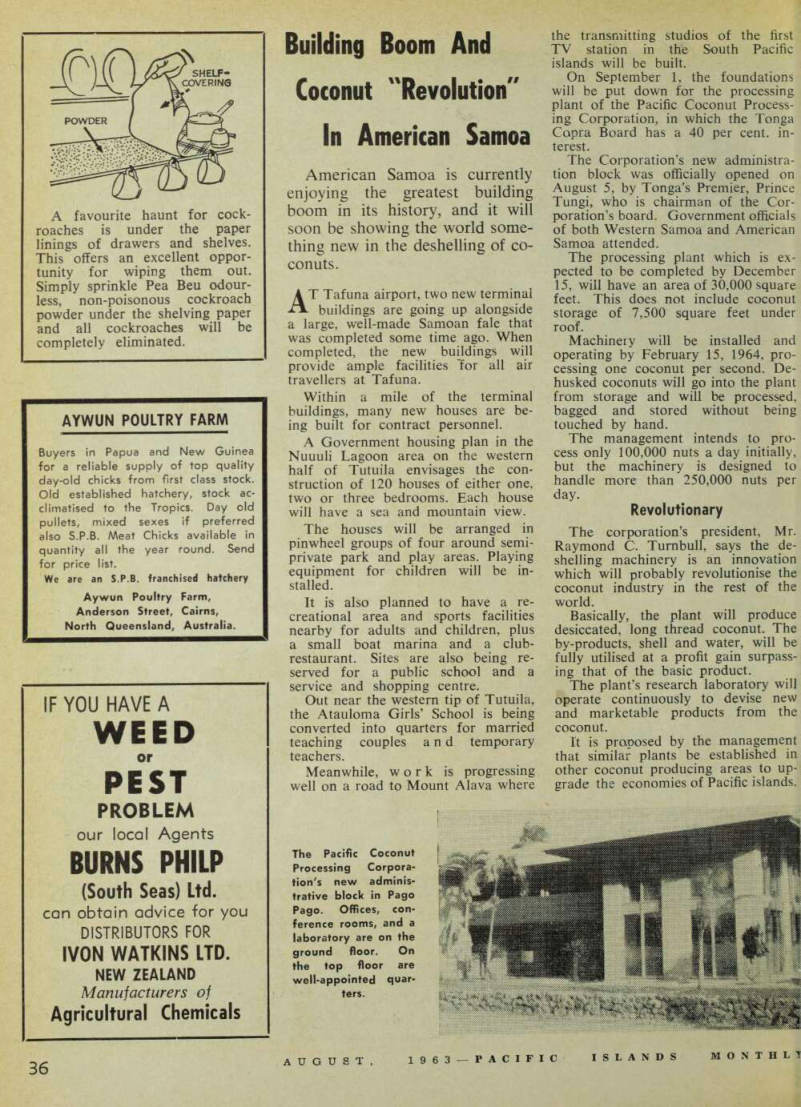
The Corporation’s new administra tion block was officially opened on August 5, by Tonga’s Premier, Prince Tungi, who is chairman of the Cor poration’s board. Government officials of both Western Samoa and American Samoa attended.
The processing plant which is ex pected to be completed by December 15, will have an area of 30,000 square feet. This does not include coconut storage of 7,500 square feet under roof.
Machinery will be installed and operating by February 15, 1964, pro cessing one coconut per second. De husked coconuts will go into the plant from storage and will be processed, bagged and stored without being touched by hand.
The management intends to pro cess only 100,000 nuts a day initially, but the machinery is designed to handle more than 250,000 nuts per day.
Revolutionary
The corporation’s president, Mr.
Raymond C. Turnbull, says the de shelling machinery is an innovation which will probably revolutionise the coconut industry in the rest of the world.
Basically, the plant will produce desiccated, long thread coconut. The by-products, shell and water, will be fully utilised at a profit gain surpass ing that of the basic product.
The plant’s research laboratory will operate continuously to devise new and marketable products from the coconut.
It is proposed by the management that similar plants be established in other coconut producing areas to up grade the economies of Pacific islands.
The Pacific Coconut Processing Corpora tion's new adminis trative block in Pago Pago. Offices, con ference rooms, and a laboratory are on the ground floor. On the top floor are
well-appointed quar
ters.