The Greeks Had A Word For It
p. 33 · Read in the full issue
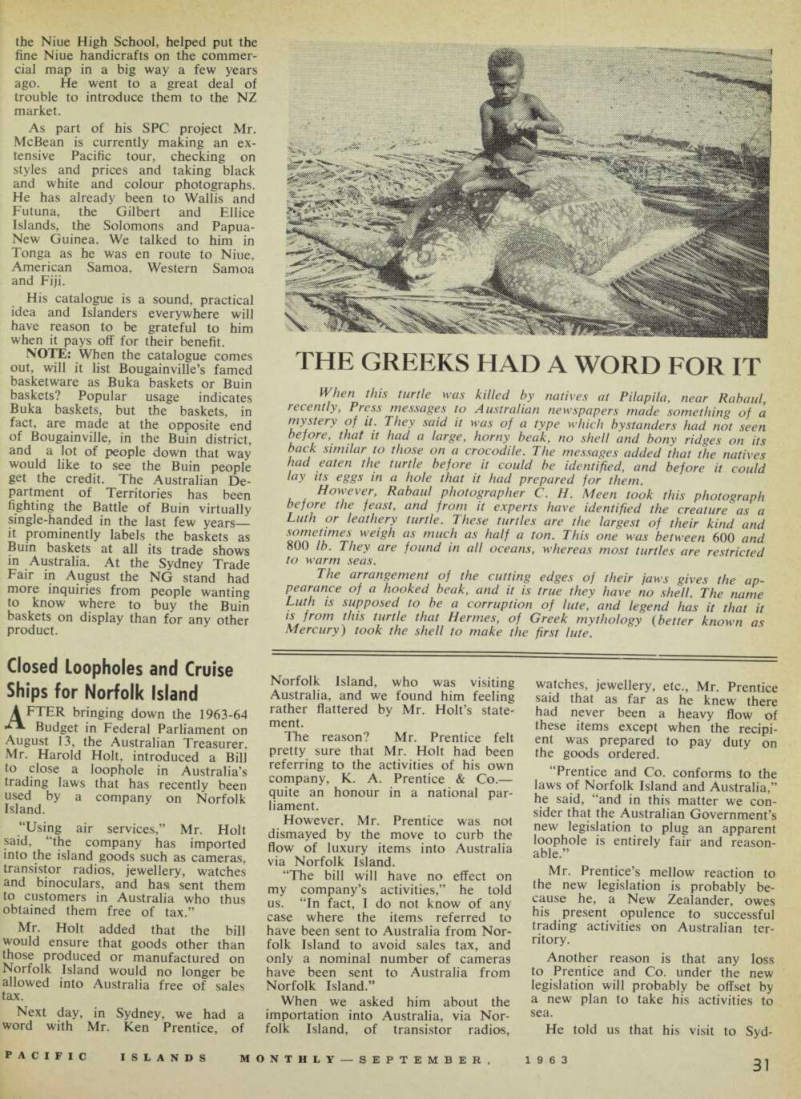
When this turtle was killed by natives at Pilapila, near Rabaul, recently, Press messages to Australian newspapers made something of a mystery of it. They said it was of a type which bystanders had not seen before, that it had a large, horny beak, no shell and bony ridges on its back similar to those on a crocodile. The messages added that the natives had eaten the turtle before it could be identified, and before it could lay its eggs in a hole that it had prepared for them.
However, Rabaul photographer C. H. Meen took this photograph before the feast, and from it experts have identified the creature as a Luth or leathery turtle. These turtles are the largest of their kind and sometimes weigh as much as half a ton. This one was between 600 and oOO lb. They are found in all oceans, whereas most turtles are restricted to warm seas.
The arrangement of the cutting edges of their jaws gives the ap pearance of a hooked beak, and it is true they have no shell. The name Luth is supposed to be a corruption of lute, and legend has it that it rom t , urt^e t^iat Hermes, of Greek mythology (better known as Mercury ) took the shell to make the first lute.