Tropicalities
pp. 31-37 · Read in the full issue

An Australian financial knight, Sir Arthur Warner, who is reputed to have made millions out of television enterprises in Victoria recently, was in Fiji in August, threatening this quiet Colony with TV. He is head of a big concern called Electronics Industries Ltd.
SIR ARTHUR is a famous yachtsman, and he went to Fiji to meet his son Peter, who was returning to Australia in the 73-ft, schoonerrigged yacht Astor. He was met in Fiji by his company’s projects manager, Mr. C. C. Zahara.
Sir Arthur said a little about TV, but enough to startle Fiji. Mr. Zahara said a good deal.
Electronics Industries, it appears, proposes to operate two commercial TV stations in Fiji—one at Suva and one at Lautoka. The stations would function in English, Fijian and Hindi. They would have access to big film libraries overseas, and they would assist the Education Department with education programmes.
They would train local technicians and supply the Islands with sets at about £7O each.
The company has made “a complete technical and business survey” of Fiji, and is about to lay a plan before the Government. In return for
its enterprise, it wants a franchise for manufacture of television and radio sets in Fiji.
This really caught local attention, Fiji has gone into duty-free goods in a big way for the tourist trade. Jap anse manufacturers have been pour ing radio and television sets into Fiji; and tourists from overseas have been buying them at a tithe of what they c ? st * n coun tries with Customs charges.
Mr. Zahara did not say so, but after he had finished talking, some Fiji folk had visions of lines of tourists leaving there armed with Fiji made TV sets bought at prices very much less than the £l5O-£2OO charge made in Australia or New Zealand.
They thought that that might have political repercussions, The visitors’ policy of publicising their plans at this early stage did not make a good impression. There is no indication that either the Fiji Gov ernment or Fiji public want a tie-up
with any TV corporation as powerful as Electronics Industries; and there are indications that, if Fiji is to have TV, it is the wish of both Govern ment and public that the service should be supplied by a local organ isation.
He's Working on a
Handicrafts Catalogue
WE heard in Nukualofa the other day that Mr, Angus McBean, of the South Pacific Commission, is compiling a booklet designed to give the native handicrafts of the South Seas a big commercial boost. Copies /6f the booklet, to be published later this year by the SPC, will be sent to business firms around the world to show just what is available for sale.
It will describe such things as bas kets, mats, hats, wood carvings, tor toise-shell ware, trays, masi, prints— everything turned out by the various island groups—and we should ima gine it to be a fascinating social docu ment as well as a valuable commer cial catalogue.
We remember when the enthusias tic Mr. McBean, as Headmaster of
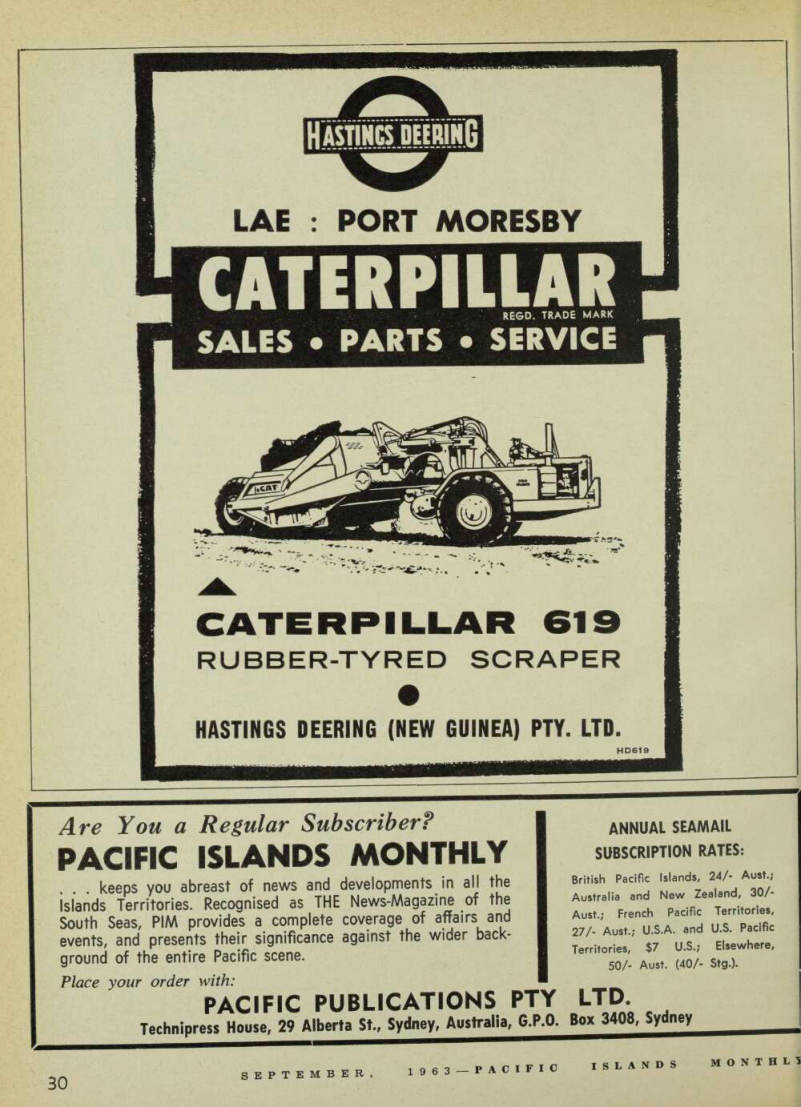
TONGA'S BIG DAY: Nukualofa's annual Vaiola Hospital Week, during which funds are raised from the public, was a big success this year—and most popular of all was the day when the procession came to town. Local schools competed for the best float. This one was sponsored by the Government Primary School at Ngeleia.— Photo: Hettig.
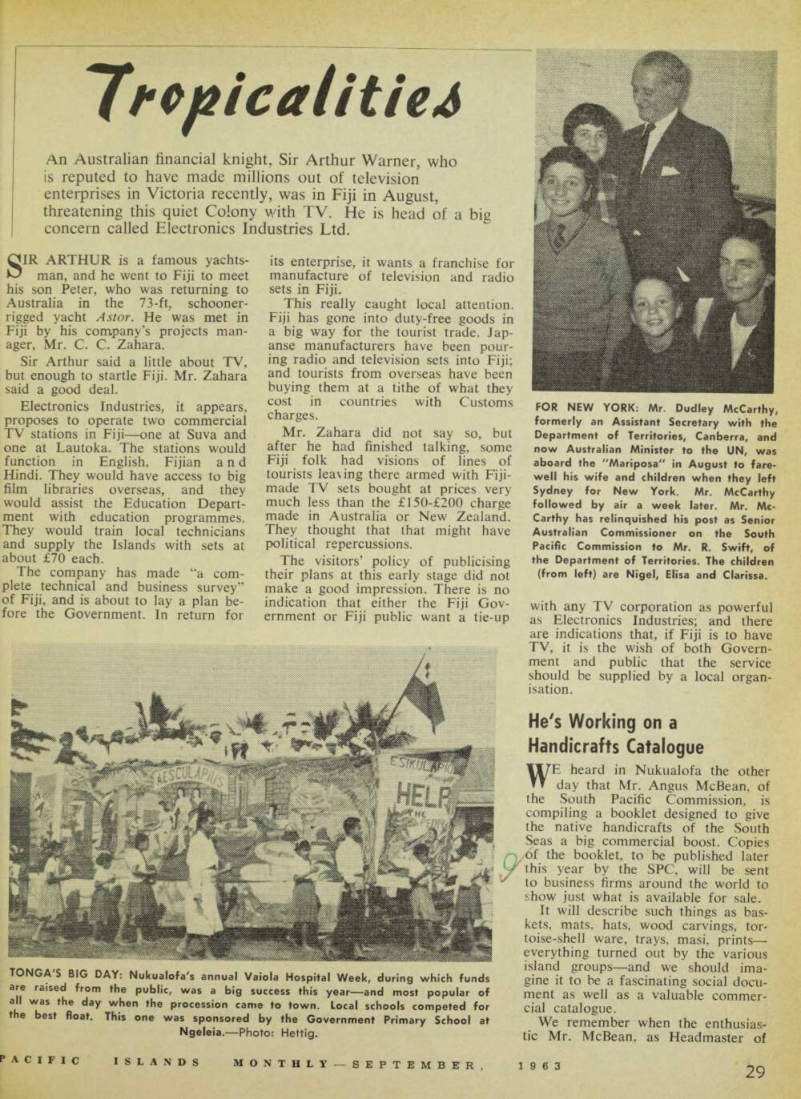
FOR NEW YORK: Mr. Dudley McCarthy, formerly an Assistant Secretary with the Department of Territories, Canberra, and now Australian Minister to the UN, was aboard the "Mariposa" in August to fare well his wife and children when they left Sydney for New York. Mr. McCarthy followed by air a week later. Mr. Mc- Carthy has relinquished his post as Senior Australian Commissioner on the South Pacific Commission to Mr. R. Swift, of the Department of Territories. The children (from left) are Nigel, Elisa and Clarissa.
the Niue High School, helped put the fine Niue handicrafts on the commer cial map in a big way a few years ago. He went to a great deal of trouble to introduce them to the NZ market.
As part of his SPC project Mr.
McBean is currently making an ex tensive Pacific tour, checking on styles and prices and taking black and white and colour photographs.
He has already been to Wallis and Futuna, the Gilbert and Ellice Islands, the Solomons and Papua- New Guinea. We talked to him in Tonga as he was en route to Niue, American Samoa, Western Samoa and Fiji.
His catalogue is a sound, practical idea and Islanders everywhere will have reason to be grateful to him when it pays off for their benefit.
NOTE; When the catalogue comes out, will it list Bougainville’s famed basketware as Buka baskets or Buin baskets? Popular usage indicates Buka baskets, but the baskets, in fact, are made at the opposite end of Bougainville, in the Buin district, and a lot of people down that way would like to see the Buin people get the credit. The Australian De partment of Territories has been fighting the Battle of Buin virtually single-handed in the last few years— it prominently labels the baskets as Buin baskets at all its trade shows in Australia. At the Sydney Trade Fair in August the NG stand had more inquiries from people wanting to know where to buy the Buin baskets on display than for any other product.
Closed Loopholes and Cruise
Ships for Norfolk Island
A FTER bringing down the 1963-64 Budget in Federal Parliament on August 13, the Australian Treasurer, Mr. Harold Holt, introduced a Bill to close a loophole in Australia’s trading laws that has recently been used by a company on Norfolk Island.
“Using air services,” Mr. Holt said, “the company has imported into the island goods such as cameras, transistor radios, jewellery, watches and binoculars, and has sent them to customers in Australia who thus obtained them free of tax.”
Mr. Holt added that the bill would ensure that goods other than those produced or manufactured on Norfolk Island would no longer be allowed into Australia free of sales tax.
Next day, in Sydney, we had a word with Mr. Ken Prentice, of
Norfolk Island, who was visiting Australia, and we found him feeling rather flattered by Mr. Holt’s state ment.
The reason? Mr. Prentice felt pretty sure that Mr. Holt had been referring to the activities of his own company, K. A. Prentice & Co.— quite an honour in a national par liament.
However, Mr. Prentice was not dismayed by the move to curb the flow of luxury items into Australia via Norfolk Island.
“The bill will have no effect on my company’s activities,” he told us. “In fact, I do not know of any case where the items referred to have been sent to Australia from Nor folk Island to avoid sales tax, and only a nominal number of cameras have been sent to Australia from Norfolk Island.”
When we asked him about the importation into Australia, via Nor folk Island, of transistor radios,
watches, jewellery, etc., Mr. Prentice said that as far as he knew there had never been a heavy flow of these items except when the recipi ent was prepared to pay duty on the goods ordered.
“Prentice and Cos. conforms to the laws of Norfolk Island and Australia,” he said, “and in this matter we con sider that the Australian Government’s new legislation to plug an apparent loophole is entirely fair and reason able.”
Mr. Prentice’s mellow reaction to the new legislation is probably be cause he, a New Zealander, owes his present opulence to successful trading activities on Australian ter ritory.
Another reason is that any loss to Prentice and Cos. under the new legislation will probably be offset by anew plan to take his activities to sea.
He told us that his visit to Syd
ney was to complete arrangements to operate a duty-free shop in the cruise ship Oriental Queen.
This vessel is the former inter state ship Kanimbla, recently refitted in Japan and soon to cruise the Pacific area for an organisation called the “See The World Club”.
Oriental Queen will visit the Pacific Islands, Hong Kong and New Zealand and will go to Japan for the 1964 Olympic Games. At all ports of call she will be used as a floating hotel.
The first call at Norfolk Island is scheduled for January, 1964, when the ship will make a two-day stop on a 14-day cruise to New Zealand.
Prentice and Cos. hopes to do lively business on all cruises, using staff now engaged in the Prentice operations at Norfolk Island—and, of course, Prentice and Cos. will con tinue to do very well there while tourists keep on flocking to Norfolk on every plane from Sydney or Auckland. These people supply most of Mr. Prentice’s business.
A brochure issued by the “See The World Club” says the “sleek white Oriental Queen has spacious, air-conditioned public rooms.”
Ailing passengers will be attended by a European physician and nurse, while robust travellers will consume first class meals served by “courteous Chinese stewards, who will also at tend personal requirements.”
On the entertainment side, passen gers will be able to dance to the ship’s Filipino orchestra.
Mixed-Marriages Are
No Good, Say Tolais
NON-NATIVE members of the New Britain Advisory Council refused to stick their necks out on August 22 when a native Tolai mem ber proposed that the Administration be asked to discourage mixed marriages.
Proposer of the motion was Stanis Boramilat, who said that although it was fine for Australians and native people to run the country together, when the natives were in their own homes they liked to be themselves.
Inter-racial marriages, he said, didn’t work.
The five Tolai members of the DAC voted for the motion; three non-natives voted against it; and four others didn’t say yea and they didn’t say nay, but sat on the fence and abstained.
The resolution is expected to be forwarded to the Administrator in due course —as are all the other re solutions passed by TAC’s and DAC’s.
But it’s not expected that the Ad ministrator will do much about whal
could be regarded as “interfering with the freedom of the individual.”
No one could have been more sur prised at the whole incident than Pastor A. G. Stewart, of the SDA Church, now living in retirement in Sydney but for long years a missionary in the Islands. He rang up to say that he takes his hat off to Boramilat but deplores the attitude of the Europeans who gave him no support at all.
In his life-time of work among Islanders, he has made scores of mixed-race friends but still believes that intermarriage cuts right across :ultural, social and family life and nflicts on succeeding generations em barrassments that they will suffer all heir lives.
There is much in what he says. \gainst the background of today’s hanging values, any marriage is i hazardous operation without add ng culture clash, but Administrative iction against it is unlikely to be the mswer in places like New Guinea, vhere, up to now, there have been bnly rare instances of inter-racial narriage, the climate is now favour ible and these unions will tend to jrow rather than decrease.
Only a very few years ago, a young European typist who walked along a nain street holding hands with her s apuan boy-friend would have been
told smartly to take the next boat South. These days it is common-place and although there might be mutter ings in private among European elders, none of them would dare to say anything in public for fear of being thought a fuddy-duddy or worse, a reactionary or a racial-dis criminator.
In today’s New Guinea, no one but a native Territorian could have put up Boramilat’s resolution; and although European abstention on the issue may have astounded Pastor Stewart it came as no surprise to anyone else.
Unusual Election
Sequel in Fiji
A unusual election situation has arisen in Fiji over the Northern European seat in the Legislative Council.
In the Legco elections in April, the seat was won by Mr. F. G.
Archibald, a member of a well known Fiji family.
By the small margin of 17 votes, he defeated Mr. H. B. Gibson, who had held the seat for a very long time. (Over)
Stanis Boramilat.
After the elections, the pro-Gibson party discovered a law which pre vented “a person certified to be in sane or otherwise of unsound mind” from becoming a member of Legco.
An elector thereupon submitted a petition to the authority concerned, asking that the election of Mr.
Archibald be declared null and void.
This was dismissed in June on a technicality—the petition was not lodged within the specified time. The Governor then certified that Mr.
Archibald had been duly elected.
It appears that Mr. Archibald had suffered a good deal from a nervous disorder and, to get suitable treat ment, he was certified on January 28, 1959, to be of unsound mind, and placed in an institution. He responded quickly to treatment and resumed normal life.
The certificate (of unsound mind) should have been cancelled, of course; but it was ignored until the challenge was made on Mr.
Archibald’s election in May. It was withdrawn formerly on June 11, 1963.
The challengers, however, argued that Mr. Archibald was legally “a per son of unsound mind” when he was elected in April; and, early in August, Fiji’s Attorney-General, presumably as a result of representations made to him, filed a petition in the Supreme Court asking that the Northern Euro pean seat be declared vacant.
Meanwhile, the Council met on August 22 and Mr. Archibald took his seat there. He made a very good showing in the Council proceedings.
On August 26, the Acting Chief Justice, Mr. Justice Hammett, granted the petition, and declared the seat vacant. A by-election will be held soon.
End to the Transistor
Price War in Fiji
THE fierce price-cutting war in the sale of transistor radios in Fiji seems to have come to an end—and more’s the pity as far as tourists and
local buyers are concerned, despite what the traders might think.
The price of the Japanese National brand transistor has in fact risen sharply in the last month or two in Fiji, selling now at a price fairly close to what it was before January 1, when radios were allowed in duty free as tourist bait.
The story goes back two or three years, when the Mayor of Suva (Cr.
C. A. Stinson) complained at a meeting of the Suva Chamber of Commerce that because of price cutting, some traders were barely able to make a profit.
He sought the Chamber’s assistance on the ground of business ethics in an effort to have cut-throat compe tition eliminated.
He complained that several traders were seeking the distribution agency for the National radio and, in an effort to impress the Japanese manu facturers, were paring prices to a minimum to induce sales.
The Chamber did nothing, presum ably not thinking of the implied sug gestion that it should fix a minimum price.
There were good grounds for Mr.
Stinson’s complaint.
Some people even suggested that Japanese policy was to come in and sell cheaply, swamp the market and achieve a turnover which rapidly es tablishes the product, but whether it is or not, some of the Fiji traders certainly went in boots and all on a selling spree. They bought the radios heavily and, when pressed by credi tors, they had to sell low, often below landed cost, to get money to pay their debts—apart from impressing manufacturers with their turnover.
The price war eventually reached such a stage that the manufacturers sent a top-ranking executive to Fiji to look at the position on the spot.
The Japanese promptly fixed a re tail price and told traders that any infringement would mean that sup plies would be cut off. They also restricted the number of outlets, which meant that many traders who had handled the radio for two or three years had to try to find some other quick-selling product.
OPEN DAY: Parents and relatives of the 166 pupils at the Norfolk Island Cen tral School, Middle gate, were able to see their children at work during a recent open day at the school. The school has five teachers, and classes range from kindergarten to Intermediate. — Photo M. Hoare.