New Hebrides
pp. 43-50 · Read in the full issue

France Goes All Out To Win Influence In The New Hebrides
By a Staff Writer
Day after day, these days, Australia’s newspapers are filled with ominous stories about Indonesia’s battle for power in South- East Asia. But nothing is ever published about a similar battle for power (or perhaps “influence” is a better word) in another area equally close to Australia.
THE battle that no one hears about is taking place in the New Heb rides. The two protagonists are Britain and France, which have jointly administered the Group as a Condominium since 1906.
For years, French interests and in fluence in the New Hebrides have been increasing while Britain’s have waned—mainly because France’s policy has always been one of ag grandisement while Britain’s, gener ally, has been trusteeship.
But the French have never made such an all-out effort to outdo the British and win influence over the natives as they are making now.
Warships' Visits
The French weapons in this battle for influence are frequent visits by flag-waving warships; medals, honours and trips to France for leading natives; a rapidly accelerating pro gramme of public school-building; increased medical services; increasing interest in the southern islands of the Group; and a general policy of tough ness in business matters.
From the beginning of this year, to the end of July, five French warships spent a total of 54 days in the Group, compared with no visits by British warships.
Of the five warships, four could definitely be said to have been on flag-waving missions, or what a cor
respondent in the New Hebrides calls imposing the “presence de la France”.
The first visitor, the Dtinkerquoise, was in the Group from January 8 to 19. Its visit took in all the anchorages on the west coast of the large island of Espiritu Santo; 11 native villages in St. Phillip and St, James Bay; the island of Malo, where there are a number of European plantations; Lamap, Malekula; the circuit of Epi; and several points on Pentecost and Ambryn.
Less than three weeks later, the Dunkerquoise was back again on a less spectacular cruise—her mission being to enable three French officials to study the erection or improvement of navigational aids between Vila and Santo, Six weeks after this came the visit of the Commandant Riviere, bringing Mr. Marc Biros, the new French High Commissioner in the Pacific, on his first visit to the New Hebrides. The Commandant Riviere’s visit lasted from March 21 to 27, and took in Vila, Santo, several places on Male kula, Tongoa and Tanna.
During this tour, Mr. Biros de corated eight leading natives with the medals of French overseas orders.
Three of the recipients were members of the New Hebrides Advisory Coun cil—the highest consultative body in the Group. (Over)
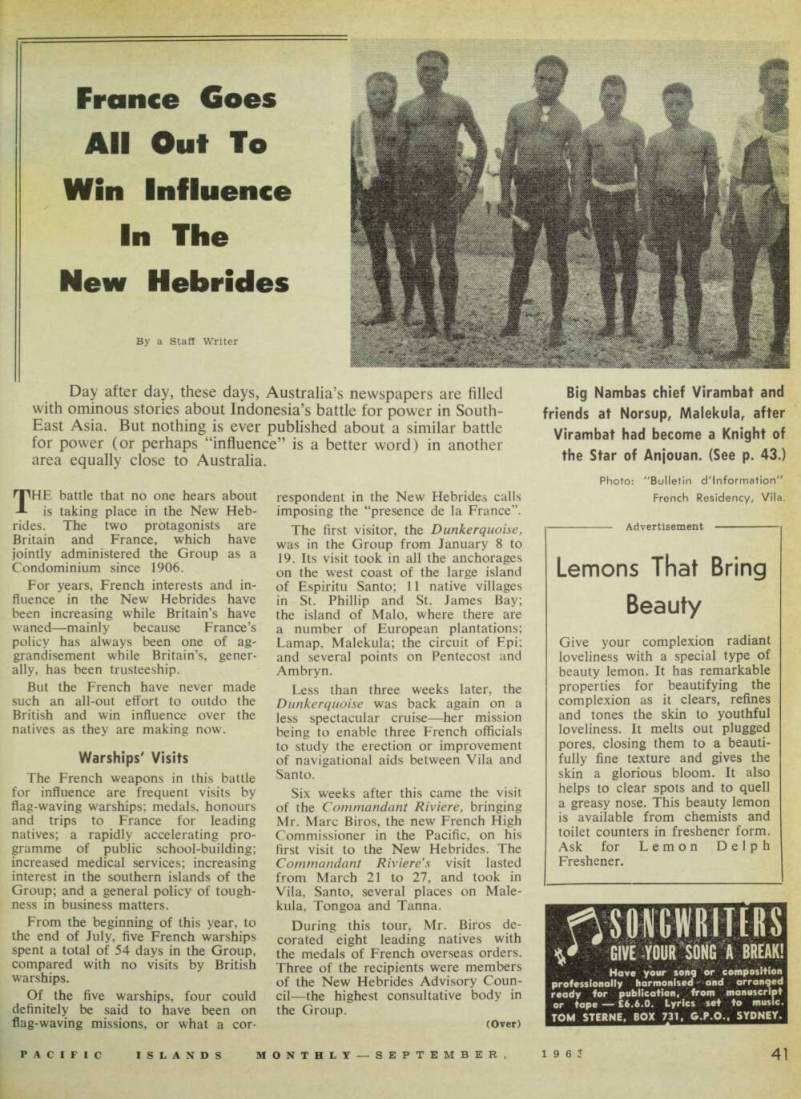
Big Nambas chief Virambat and friends at Norsup, Malekula, after Virambat had become a Knight of the Star of Anjouan. (See p. 43.) Photo: "Bulletin d'lnformation"
French Residency, Vila.
Four of the eight honoured natives became Chevaliers (Knights) of the Order of the Star of Nichan El- Anouar; three became Knights of the Star of Anjouan; and one became a Knight of the Black Star.
One of the newly-created Knights of the Star of Anjouan is Big Nambas chief Virambat, who descended from the mountains to attend his investiture at Norsup, Malekula, virtually stark naked. The insignia therefore had to be hung around his neck.
In a territory where, according to the Protocol by which it is goyerned, no native may become a subject or citizen of either Britain or France, and neither Power may exercise a separate authority, the particular awards which Mr. Biros made seem decidedly out of place.
According to an official French publication, the Order of Nichan El- Anouar was created in 1887 by Hamed ben Mohamed, Sultan of Tad jourah (French Somaliland), “with a view to perpetuating the memory of the happy moment when he and his people placed themselves under the protectorate of the glorious France”.
The other two orders have similar histories. The Order of the Black Star originated in Dahomey, which be came a French protectorate in 1863; and the Order of the Star of Anjouan is connected with the establishment of a French protectorate in the Comoro Islands (between Mozambique and Madagascar).
Bastille Day
The same reason that makes the award of these orders to New Heb rideans seem out of place applies equally to the visits of the last two French warships to the New Heb rides.
These warships were the Capriceuse and D linker quoise, which arrived from Noumea on July 19 to help the New Hebrides celebrate Bastille Day, France’s national day.
Until quite recently, the 2,000-odd Frenchmen and French citizens in the New Hebrides have managed quite well to celebrate Bastille Day on Bastille Day.
But this year, with the help of the Capriceuse and Dunkerquoise, Bas tille Day lasted for fully a fort night—from July 19 to August 2.
During this time, the warships visited Vila, Tongoa, Epi, Lopevi, Lamap, Norsup, Vao, Aoba, Santo, Tanna and Aneityum. (On the last-named is land, there are no French citizens).
Investitures, football matches with native teams, fireworks, cocktail par ties, grand balls lasting until dawn, military and naval parades, band con
certs, free picture shows, the singing of the Marseillaise, and the ceremonial raising of the Tricolor followed each other in heady profusion.
The natives, from all accounts, lapped up every moment of it. At Vilakalakala, Aoba, for example, they came from the mountains for miles around to join in the fun—and, needless to say, another leading native became a Knight of the Order of the Star of Anjouan. Four other natives in the northern islands received awards during the Bastille Day fortnight.
Yet another Knight of the Star of
Anjouan was created when the French Resident Commissioner, Mr.
M. Delauney, met the Capriceuse and Dlinkerquoise at Aneityum on the last day of their stay in the Group, The honoured native on this occasion was Jean Marie Leyhe, another rep resentative on the Advisory Council, Meanwhile, yet another native member of the Advisory Council was in Paris for the Bastille Day celebra tions as guest of the French Govern ment.
This man, Philip 110, an Assistant Medical Officer in the British service on Pentecost, is one of only two New
Hebrideans to receive a British award tes year—he was made an honorary member of the Order of the British Empire in the New Year’s Honours List, But, curiously, he had scarcely received the insignia of his award from the British Resident Commissioner, Mr. A. M. Wilkie, when the French invited him to Paris. Maybe, the French were actuated by the thought that a trip to Paris would make a greater impression on Ilo’s mind than the award of the MBE.
But the French are not only interested in winning the minds of the most influential natives. In the last few years, they have been going all out to win the minds of the children, too, by building public schools all over the place.
School-Building
Back in 1959, there were only five French public schools in the Group.
By the end of 1960, the number had grown to eight, with a total enrolment of 765. And by the end of 1962, the number had jumped to 15 with a total enrolment of 1,060.
The French education programme seems to be accelerating all the time.
Plans are now in hand to build a teacher-training college, similar to (or probably better than) the one opened by the British outside Vila last year, and more schools are going up or are planned One of the latest French schoolbuilding projects is at Aneityum, the southernmost island in the Group.
Aneityum is one of the most fertile and pleasant islands in the New Hebrides It was the first island in the Group to be Christianised, and a
century or so ago, when its popula tion was about 4,000, it was the centre from which British Presby terian missionaries spread the Gospel to many other islands.
But decimating diseases long ago reduced the population to fewer than 200, and the missionaries have been gone from the island for many years, Apart from a French Marist mis s{on that worked on the island briefly m t h e 1840’s, the French have never previously taken the slightest interest i n Aneityum. So the building of a public school there is a significant move.
The move is in keeping with grow ing French interest in all the southern islands of the Group (i.e. the islands south of Vila).
Until 1945, these islands were re garded by the British, at least, as a sort of British preserve—there being only one French citizen in the whole area.
In 1945, however, the French ap pointed their first District Agent to the Southern District, and more and more Frenchmen have since moved in. By the end of 1962, the French had two public schools and a hospital on Tanna and one public school on Erromanga. There were also four French Catholic mission schools on Tanna.
Meanwhile, in business matters, the French display a toughness and shrewdness which enables them con tinually to expand and consolidate their interests to the detriment of British interests.
Here is an example, In 1948, representatives from Aus tralia’s Commonwealth Bank went to Vila to investigate the possibility of
Aneityum Island, New Hebrides, where the French Administration is planning to build a public school. The view, looking inland, is taken from the works of the now-defunct Australian Sawmill Co., which exploited the island's kauri some years ago.
opening a branch of the bank in Vila. ( PIM, Mar. 1948, p. 77.) In August last year, two more representatives of the bank went to Vila on a similar mision. {PIM, Sept. 1962, p. 148.) So far, there is still no branch of the bank in Vila, although it is ob vious that the bank is eager to estab lish one and it is known that the British Administration would like to see one there.
Why, then, doesn’t the bank simply go ahead and open a branch? For the simple reason, one suspects, that the French don’t want any opposition to their own Bank of Indo-China, which now has a monopoly on banking faci lities in the Group.
The French, of course, cannot pre vent the Comonwealth Bank from moving in. But there are other ways —they can refuse to agree to the con vertibility of any New Hebrides francs that the bank might accumu late.
New Hebrides francs, which are is sued by the Bank of Indo-China, cir culate in the New Hebrides side by side with Australian currency. But, unlike Australian currency, they are useless outside the Group. So if the Comonwealth Bank established a branch in Vila without first getting an agreement on convertibility, it could soon find itself with a mint of useless money on its hands.
Land Claims Another example of French tough ness in business matters is their ap proach to land claims before the Joint Court. This court was set up under the Condominium Protocol mainly to resolve claims to land that was bought from the natives before the Condominium was established.
Recently, when a lawyer for the estate of a pioneer British settler at Malekula appeared before the court to hear the court resolve the estate’s
claims to four small islands off the coast of Malekula, he found himself opposed in every case by both the French Government and the largest French company in the Group.
Unlike the estate the lawyer rep resented, neither the French Govern ment nor the French company had any claims to the islands by way of occupation, yet they suggested that if the estate withdrew its claims to the islands in favour of the natives, they would do the same.
Except in one instance, the estate refused —and the Court finally re solved the claims to the other three islands in favour of the estate. In the other instance, the land went to the
natives, with recognition of ownership of the Presbyterian mission.
This, incidentally, was one of the rare cases in recent years in which British interests have been legally rep resented in a claim to land before the Joint Court.
Usually, the Joint Court cases are one-sided affairs with only a French lawyer present. So the French in terests gain titles to large tracts of land that they would probably not get if they were opposed.
A final example of the way in which French interests are expanding and consolidating is provided by a glance at the membership of the re
VISITORS TO SYDNEY: Visiting the Poly nesian Association, Sydney, recently were Nick Pakau, of Niue, and Miss Audrey Moroney, a Maori friend of Auckland.
It is not often that anyone from Niue pays the association a call.
cently-inaugurated New Hebrides Chamber of Commerce, Industry and Agriculture. Native members aside, the Chamber is predominantly French —eight French members to four British.
As the Chamber will advise the French and British Resident Com missioners on the economic develop ment of the Group and will be con sulted by the Administration before any economic measure affecting the territory is adopted, it stands to reason that with a preponderance of French members the Chamber’s ad
vice will be predominantly in favour of French interests.
British interests, small enough already, are therefore more likely to get smaller rather than bigger.
And if the French keep up their general policy of imposing the “pre sence de la France”, the day might come in the not too distant future when the French will demand an end to the Condominium system, in favour of undivided French control.
If this day should ever come, it certainly won’t be for the want of trying on the French side.