And Debunked
p. 94 · Read in the full issue
New Guinea Described And Debunked
Have you ever wondered why we are trying to make a united nation out of Papua and New Guinea?
WHAT kind of planner decided that this huge area, with its vast diversification of peoples and conditions—it has anywhere from 500 to 700 separate languages—could with advantage be brought under one control and one flag?
Some answer to the puzzle may be found in Olaf Ruhen’s new book, Mountains in the Clouds.
In an easy narrative style, he tells the story of Papua and New Guinea, from the first recorded appearance of European voyagers, through the periods of trader penetration, mis sionary contacts, “black-birding”, annexation, colonisation, exploration, planting, two World Wars, Japanese invasion, goldfields exploitation, administrative experiments, native religious frenzies, to the final absurdity of trying to turn this great hotch-potch of primitive peoples into a united self-governing nation inside a decade.
The boundaries of the Territory were never laid down in accordance with ethnic, climatic and economic considerations: they were formed,
catch-as-catch can, by the Powers in last century’s jealous land grabbing, and given their present shape by European exploitation of the islands’ natural resources.
Some day New Guinea may be a united nation—it has the people and the resources—but, as Ruhen says in his last paragraph: “The greatest need of New Guinea is time: time to teach the young, time to stabilise the legend, time for the young to grow old, time to cement the scattered fabric of its evolutionary thoughts . . . time to build an ideal and a con stitution ... ”, And, under the present crazy pro cesses of decolonisation, there just isn’t time.
Ruhen has wandered far and wide through the Territory, and browsed through a thousand records; and, with his infallible nose for the un usual, the picturesque and the bizarre, he has gathered material which he has strung together in a fascinating narrative, to give us a connected picture of New Guinea—especially the New Guinea that preceded World War 11.
Famous and legendary characters pop up on almost every page—Nick the Greek; William MacGregor and Hubert Murray, administrators; Jack Hides and Mick Leahy, explorers; Queen Emma, pioneer planter; Cecil Levien, goldfields developer; “Pard”
Mustar and Ray Parer, the first of the airmen—they and a score of others take their place in a fascinating story.
This book, while a useful history, is an example of forthright de bunking, Ruhen argues that much of the “murderous treachery” ascribed to the natives in last century was directly
the result of “black-birding” and cheating and rapine by the lowest class of whites.
He has something scathing to say about the way in which the Aus tralians “expropriated” the German property in New Guinea.
He rips away a veil which hid the manner of the establishment of certain industries in the Morobe gold fields.
He tells again the story of the bumbling and stupid Canberra bureaucrats who left many hundreds of Australian men in Rabaul in early 1942, to be destroyed by the Japs.
And he says this of Australian operations in New Guinea in 1944, after the Americans had “leap frogged” on northwards beyond New Guinea: “Allied mopping-up operations on the New Guinea mainland . . . seemed and still seem to have had no other purpose than to establish, or to bolster, the reputations of some high Australian officers, and to keep them in active commands. In some instances these mopping-up operations were conducted in areas the Americans had already by-passed.
We can regret the lives wasted in these operations, and moralise that the price paid for certain small ribbons was far too high.”
Many older Australians will endorse that comment.
Why did the publishers of this book not provide an index! That way, it would have had much value as a reference book. But, withal, it is a
lively, fascinating story.-
Rwr.
(Mountains In The Clouds. Pub
lished by Rigby Ltd., Adelaide. 30/-.)
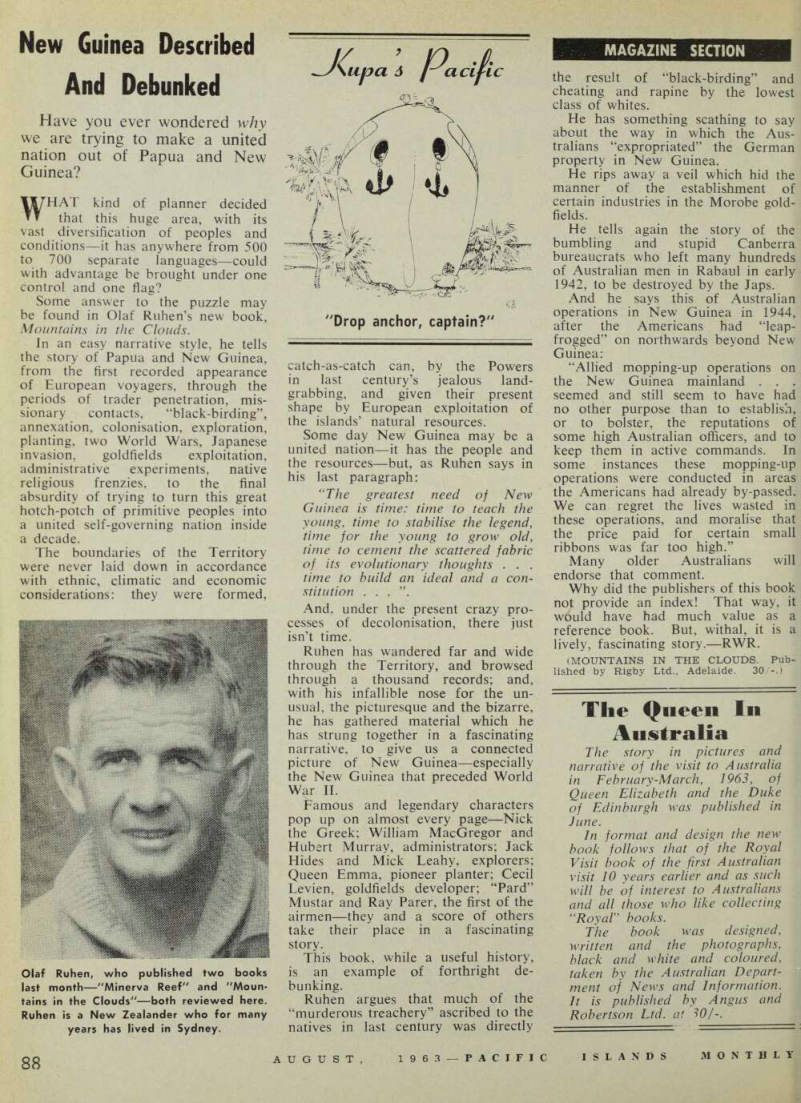
Olaf Ruhen, who published two books last month—" Minerva Reef" and "Moun tains in the Clouds"—both reviewed here.
Ruhen is a New Zealander who for many years has lived in Sydney.