The Month's New Reading
p. 93 · Read in the full issue
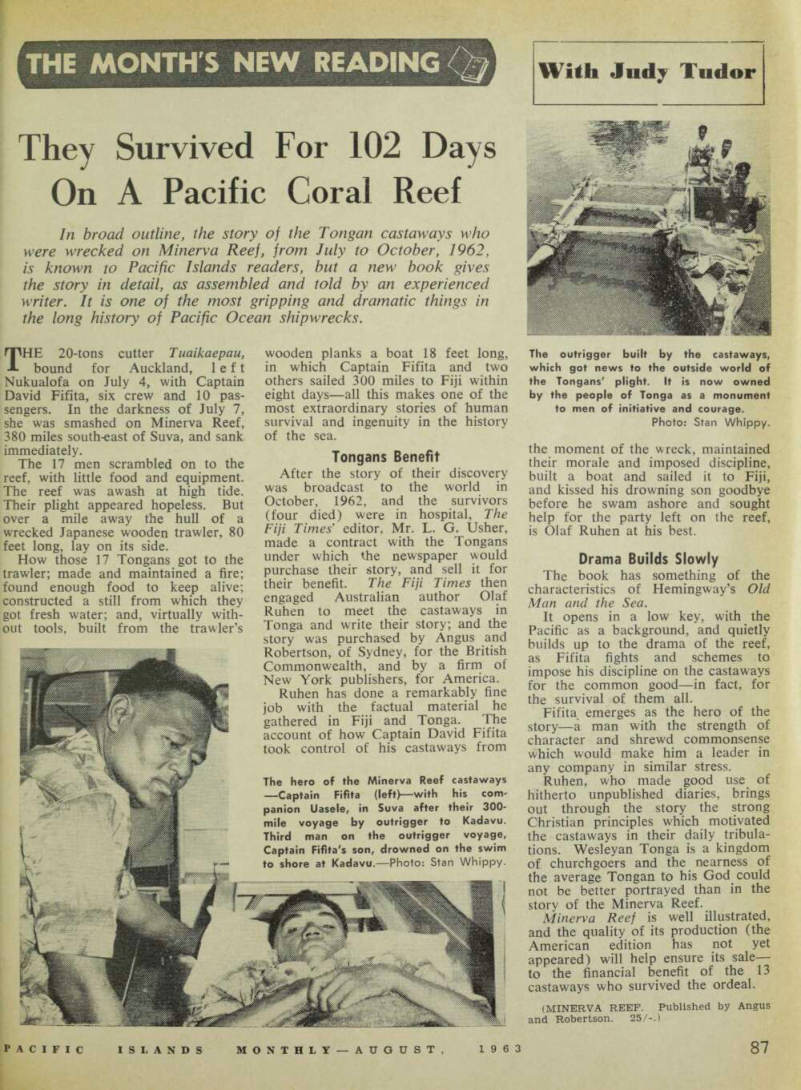
They Survived For 102 Days On A Pacific Coral Reef
With Judy Tudor
In broad outline, the story of the Tongan castaways who were wrecked on Minerva Reef, from July to October, 1962, is known to Pacific Islands readers, but a new book gives the story in detail, as assembled and told by an experienced writer. It is one of the most gripping and dramatic things in the long history of Pacific Ocean shipwrecks.
THE 20-tons cutter Tuaikaepau, bound for Auckland, left Nukualofa on July 4, with Captain David Fifita, six crew and 10 pas sengers. In the darkness of July 7, she was smashed on Minerva Reef, 380 miles south-east of Suva, and sank immediately.
The 17 men scrambled on to the reef, with little food and equipment.
The reef was awash at high tide.
Their plight appeared hopeless. But over a mile away the hull of a wrecked Japanese wooden trawler, 80 feet long, lay on its side.
How those 17 Tongans got to the trawler; made and maintained a fire; found enough food to keep alive; constructed a still from which they got fresh water; and, virtually with out tools, built from the trawler’s
wooden planks a boat 18 feet long, in which Captain Fifita and two others sailed 300 miles to Fiji within eight days—all this makes one of the most extraordinary stories of human survival and ingenuity in the history of the sea.
Tongans Benefit
After the story of their discovery was broadcast to the world in October, 1962, and the survivors (four died) were in hospital, The Fiji Times' editor, Mr. L. G. Usher, made a contract with the Tongans under which the newspaper would purchase their story, and sell it for their benefit. The Fiji Times then engaged Australian author Olaf Ruhen to meet the castaways in Tonga and write their story; and the story was purchased by Angus and Robertson, of Sydney, for the British Commonwealth, and by a firm of New York publishers, for America.
Ruhen has done a remarkably fine job with the factual material he gathered in Fiji and Tonga. The account of how Captain David Fifita took control of his castaways from
the moment of the wreck, maintained their morale and imposed discipline, built a boat and sailed it to Fiji, and kissed his drowning son goodbye before he swam ashore and sought help for the party left on the reef, is Olaf Ruhen at his best.
Drama Builds Slowly The book has something of the characteristics of Hemingway’s Old Man and the Sea.
It opens in a low key, with the Pacific as a background, and quietly builds up to the drama of the reef, as Fifita fights and schemes to impose his discipline on the castaways for the common good—in fact, for the survival of them all.
Fifita emerges as the hero of the story—a man with the strength of character and shrewd commonsense which would make him a leader in any company in similar stress, Ruhen, who made good use of hitherto unpublished diaries, brings out through the story the strong Christian principles which motivated the castaways in their daily tribula tions. Wesleyan Tonga is a kingdom of churchgoers and the nearness of the average Tongan to his God could not be better portrayed than in the story of the Minerva Reef.
Minerva Reef is well illustrated, and the quality of its production (the American edition has not yet appeared) will help ensure its sale— to the financial benefit of the 13 castaways who survived the ordeal. (MINERVA REEF. Published by Angus and Robertson. 25/-.)
The hero of the Minerva Reef castaways —Captain Fifita (left)—with his com panion Uasele, in Suva after their 300mile voyage by outrigger to Kadavu.
Third man on the outrigger voyage, Captain Fifita's son, drowned on the swim to shore at Kadavu. — Photo: Stan Whippy.
The outrigger built by the castaways, which got news to the outside world of the Tongans' plight. It is now owned by the people of Tonga as a monument to men of initiative and courage.
Photo: Stan Whippy.