Tropicalities
pp. 29-35 · Read in the full issue

Although New Zealand’s Minister for Territories, Sir Leon Gotz, has stated that it would be a waste of of public money to send a Parliamentary fact-finding committee to the Cook Islands (see p. 59), a man we know in Rarotonga claims such a committee will soon be hot-footing it in that direction to find out “just what has gone wrong with the Cooks”.
WHETHER this is the case or not, our man has definite views that the Cooks’ first Legislative Assembly is largely to blame for the mess things are in.
He says this body has earned a reputation among the people for “ig noring the electors, and being utterly incompetent, dominated by three offi cial members—the Resident Commis sioner, Treasurer and Secretary—and a grinder of private axes”.
Gripes!
“Putting matters briefy,” he says, “during the past two years the Legis lative Assembly has spent the better part of £2 million (£750,000 annual subsidy from NZ plus local revenue).
This sum has largely gone on entirely unproductive capital expenditure.
“For instance, £B,OOO (estimated) has been spent on erecting a power station in the Ngatangiia district of Rarotonga. It has now been discov
ered that insufficient subscribers are available to make it worth while operating this station. Anyone could have told the LA that before the pro ject was ever begun.
“The Cook Islands’ biggest and proudest white elephant, the notori ous cooler, which cost £250,000 to build, again lost £16,000 last year without arousing comment by the members. The cool store attached to the cooler lost £12,000 ditto without comment.
“Some £30,000 has been voted to build a laundry in Rarotonga. This will replace the present laiundresses who cope satisfactorily with the washing of the hospital.
“The emporium will also be oblig ing enough to launder the clothes of the junior clerks ensconced in the boarding house called Rarotonga Hotel, and ditto the linen of the Moana Roa.
“I believe it is hoped that from all over the great wide Pacific Ocean hurrying liners and fast cargo boats will turn aside from their courses to get their laundering done by Raro tonga. (I visualise advertising posters of Rarotonga in the near future dis playing soap suds instead of surf on the reef, and lines of washing flut tering in picturesque manner between the jagged peaks of the skyline.) “The vast octopus of the Public Works Department, growing in healthy manner if not productive strength, was last year voted a gen erous £332,630, or almost half of the total NZ subsidy for the Cook Islands for the year.
“At a time when NZ is announcing the gradual reduction of European official staff in the Cook Islands* two or three new houses at some £4,000 each were erected in Rarotonga for European officials.
“Schools, springing up everywhere, still cost £l,OOO per room or perhaps a cool £lO,OOO per school. They must, of course, be built up to NZ stan dards; nothing cool and cheap could possibly be used in the Cook Islands!”
Our man hasn’t finished his out burst yet. He takes his second breath and continues: “The LA in its wisdom, never got round to talking about subsidies for the wretched and utterly bankrupt
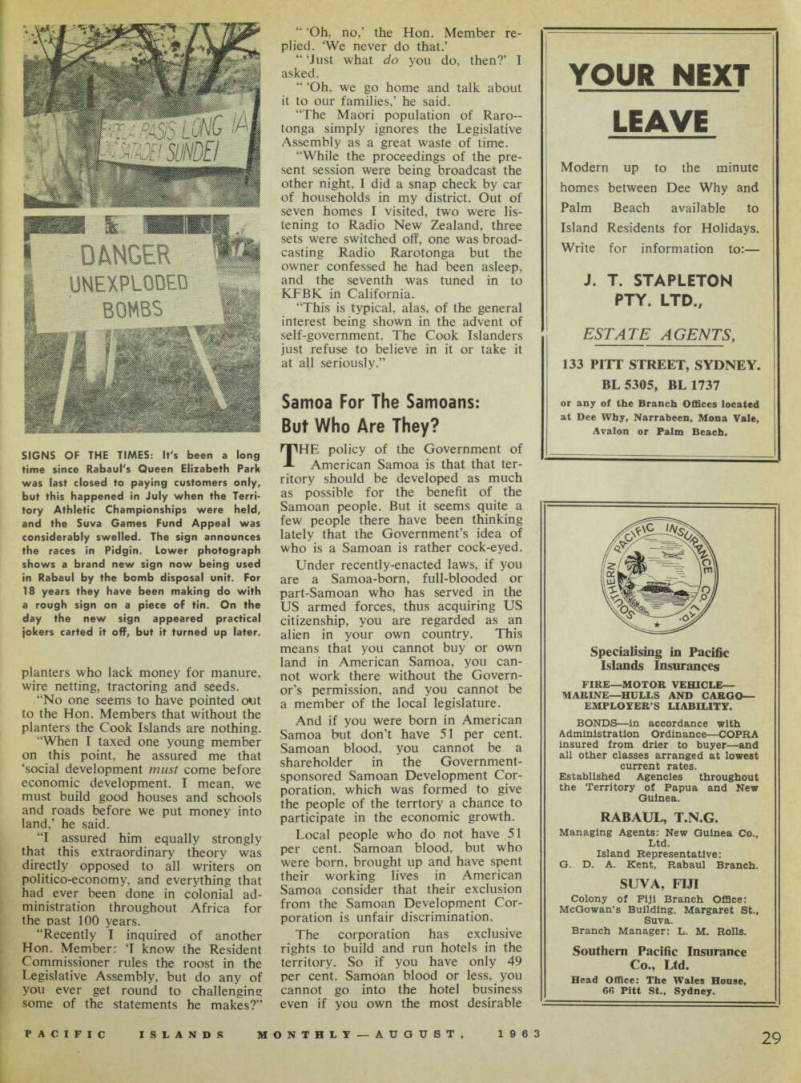
Old And
New
Yet not so widely apart are these two New Guinea aircraft —the top one is a Fairy Fox which made the first direct flight to New Guinea in 1935, and the bottom one the latest arrival a TAA Piper Aztec which recently be gan charter services on New Britain.
Piper pilot is a for mer Rabaul police man, Noel Von Hoff.
In the Fox, taken at Wau, are Mr. J. C.
Thomson, looking at the camera, and Ray Parer, with his back to the camera. See p. 33 for details of this.
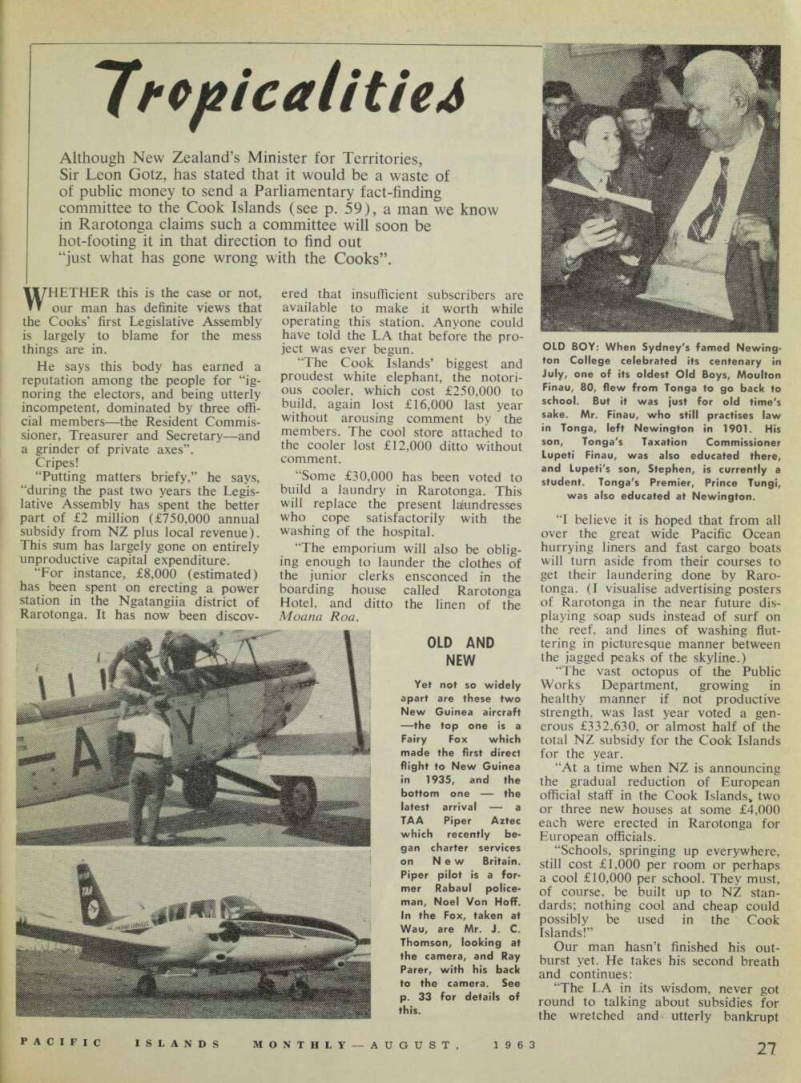
OLD BOY: When Sydney's famed Newing ton College celebrated its centenary in July, one of its oldest Old Boys, Moulton Finau, 80, flew from Tonga to go back to school. But it was just for old time's sake. Mr. Finau, who still practises law in Tonga, left Newington in 1901. His son, Tonga's Taxation Commissioner Lupeti Finau, was also educated there, and Lupeti's son, Stephen, is currently a student. Tonga's Premier, Prince Tungi, was also educated at Newington.
planters who lack money for manure, wire netting, tractoring and seeds.
“No one seems to have pointed out to the Hon. Members that without the planters the Cook Islands are nothing, “When I taxed one young member on this point, he assured me that ‘social development must come before economic development. I mean, we must build good houses and schools and roads before we put money into land,’ he said.
“I assured him equally strongly that this extraordinary theory was directly opposed to all writers on politico-economy, and everything that had ever been done in colonial ad ministration throughout Africa for the past 100 years.
“Recently I inquired of another Hon. Member; ‘I know the Resident Commissioner rules the roost in the Legislative Assembly, but do any of you ever get round to challenging some of the statements he makes?”
“ ‘Oh. no,’ the Hon. Member re plied. ‘We never do that.’
“ ‘Just what do you do, then?’ T asked.
“ ‘Oh, we go home and talk about it to our families,’ he said.
“The Maori population of Raro tonga simply ignores the Legislative Assembly as a great waste of time.
“While the proceedings of the pre sent session were being broadcast the other night, I did a snap check by car of households in my district. Out of seven homes I visited, two were lis tening to Radio New Zealand, three sets were switched off, one was broad casting Radio Rarotonga but the owner confessed he had been asleep, and the seventh was tuned in to KFBK in California.
“This is typical, alas, of the general interest being shown in the advent of self-government. The Cook Islanders just refuse to believe in it or take it at all seriously.”
Samoa For The Samoans:
But Who Are They?
THE policy of the Government of American Samoa is that that ter ritory should be developed as much as possible for the benefit of the Samoan people. But it seems quite a few people there have been thinking lately that the Government’s idea of who is a Samoan is rather cock-eyed.
Under recently-enacted laws, if you are a Samoa-bom, full-blooded or part-Samoan who has served in the US armed forces, thus acquiring US citizenship, you are regarded as an alien in your own country. This means that you cannot buy or own land in American Samoa, you can not work there without the Govern or’s permission, and you cannot be a member of the local legislature.
And if you were born in American Samoa but don’t have 51 per cent.
Samoan blood, you cannot be a shareholder in the Government sponsored Samoan Development Cor poration, which was formed to give the people of the terrtory a chance to participate in the economic growth.
Local people who do not have 51 per cent. Samoan blood, but who were born, brought up and have spent their working lives in American Samoa consider that their exclusion from the Samoan Development Cor poration is unfair discrimination.
The corporation has exclusive rights to build and run hotels in the territory. So if you have only 49 per cent. Samoan blood or less, you cannot go into the hotel business even if you own the most desirable
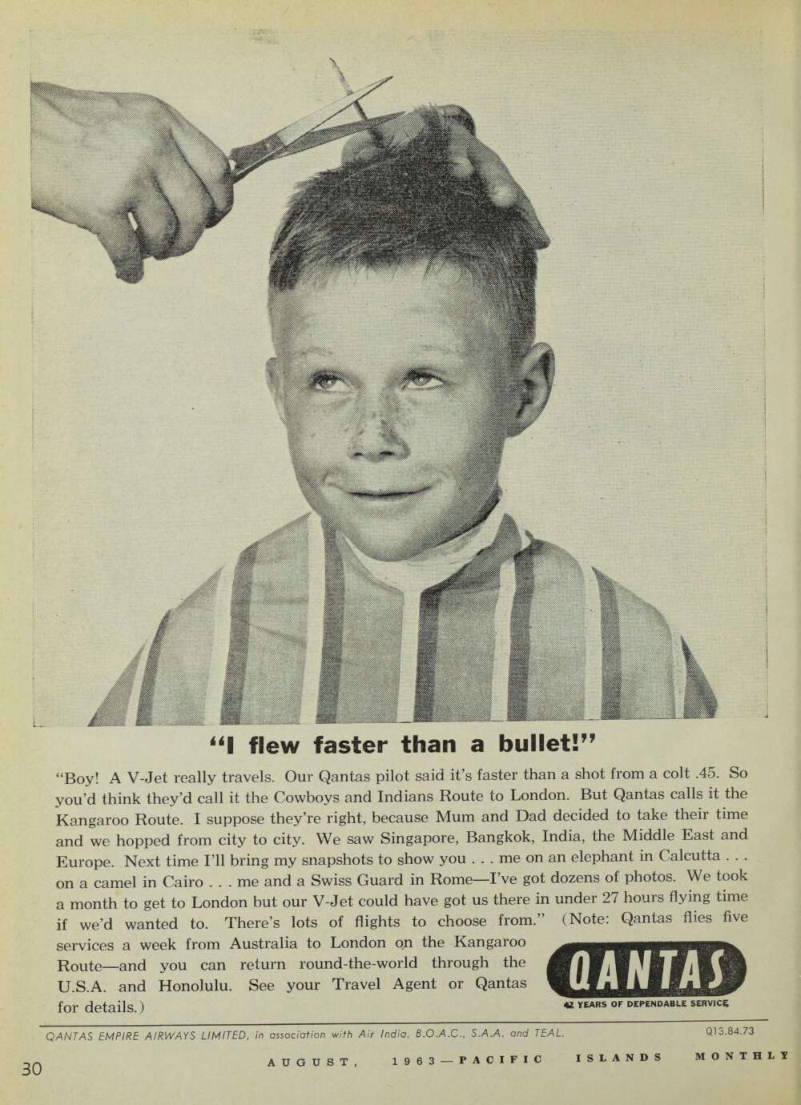
SIGNS OF THE TIMES; It's been a long time since Rabaul's Queen Elizabeth Park was last closed to paying customers only, but this happened in July when the Terri tory Athletic Championships were held, and the Suva Games Fund Appeal was considerably swelled. The sign announces the races in Pidgin. Lower photograph shows a brand new sign now being used in Rabaul by the bomb disposal unit. For 18 years they have been making do with a rough sign on a piece of tin. On the
day the new sign appeared practical
jokers carted it off, but it turned up later.
piece of land for a hotel in the whole of Tutuila.
“Ask yourself if this is consistent with the principles of justice and equality of man, which is the very foundation of our Democracy,” Pago Pago’s News and Views Bulletin, which is published by the local Chamber of Commerce, said recently.
It added: “Hotel development in American Samoa should be a right and privilege extended to anyone born in American Samoa—regardless of colour, race, creed or blood count.”
The same paper said that colour, race, creed and blood count should not be considered in determining whether you are an American Sa moan or not. The only criterion should be: Were you born in Ameri can Samoa? Moreover, no law should arbitrarily take away a man’s citizen ship rights because he happened to be a citizen of the United States.
“There have been many things wrong in certain policies and actions by this present Government Adminis tration,” News and Views Bulletin went on, “but nothing quite as insult ing, ill-considered and foolish as the present alien status of Samoans and part Samoans born here, but who are United States citizens.”
Suva Finally Got
It on Sunday
JI film censors, endowed with a little authority, are not slow to use it when the opportunity comes along, but something went wrong re cently when the film, Never on Sunday, which is said to glamourise prostitution, was scheduled for ex hibition at a Suva cinema.
They stepped in promptly and banned it, but found out the very next day that it had just been shown at the Nadi Airport cinema.
That sort of thing had happened before because films can be censored twice in Fiji, at Lautoka and at Suva.
The Lautoka censors had given the film an A classification (suitable only for persons over 17).
Had the proprietor of the Suva cinema been aware that the film had been screened at Nadi Airport he could have obtained the censor’s cer tificate from there, and could have shown the film without referring it to a Suva censor.
Anyhow, in this case the exhibitors appealed against the Suva ban to the Fiji Film Control Board.
The board, without seeing the film,
approved the ban of the censor, Mr.
James Grundy, but when the exhibi tors kicked up a fuss at this they agreed to see it, saying that they thought the exhibitors wanted a deci sion urgently, and that was why they had rejected the film.
After seeing it, the five members of the board unanimously passed it for adult exhibition. (One member con fided later that if he had had to pay money to see Never on Sunday, he would have walked out.) The next development was the re signation of Mr. Grundy, who gave no reasons.
And the final development was that the management, which had planned to screen Never on Sunday three times, showed it on five nights, and at
two matinees, and had full houses every time.
Fiji’s theatre operators claim that there is no need to censor films in the Colony, anyway, because all English-language films are censored in New Zealand before they reach Fiji. The Colony could save several thousands of pounds spent each year on censorship if it accepted the NZ ratings. Not to mention a few red faces.
The Faces At The
Bar Room Window
USHERS Hotel, whose New Guinea Bar was a meeting place of Islands identities for a generation (until the hotel closed its doors a couple of years ago) opened again
for business in July—with an entirely new face and new purpose.
The block is now BOAC House and the ground floor where the old bar was is now taken up with the BOAC booking office—whose decor includes a lake, a marble bridge, and a fantastic illuminated cloud mural.
We were on hand for the last day of business for the New Guinea Bar —so it was fitting we should turn up for the first day of business for the new tenants.
We had a nice time, thank you, but something was missing. Although there were aviation pioneers galore, there were none of the men who had helped make aviation history in New Guinea and the islands, and who used once to make a group of their own at the bar.
We drank BOAC champagne (beer and rum were the drinks in the Islands’ bar) with Bob Hewlett, for merly of Suva, who now represents the Fiji Visitors Bureau through his prosperous Sydney PR show, and with Bob Allender, former TEAL publicity manager, who recalled the time he went down with mumps at Fiji’s Korolevu Beach Hotel. But we all agreed that it wasn’t the same.
Ushers really was just a distant memory.
The Pacific Air Gap
WHILE we’re on the subject of aviation, and on BOAC in par ticular, there are still many people wondering whether BOAC proposes to bridge its South Pacific gap be tween Auckland and Honolulu, and if so, how. Does it want to fly the South Pacific, and if so will it fly its own flag or make some arrangement with, say, TEAL?
BOAC is playing its cards pretty close to the chest at the moment, but our tip is that it quite definitely plans to close the gap and that it wants to fly its own aircraft. There is traffic enough for BOAC, TEAL and Qantas across the Pacific.
But we suspect BOAC can’t move until the Americans finally settle the last of their big Pacific basin aviation review and say just what rights out of Honolulu and Pago they are pre pared to give whom. The Americans certainly have been at that particular exercise for a long time—surely too long.
First Flight Recalled
WE had a talk the other day with Captain H. T. (“Bunny”) Ham mond, who had arrived from Mel
bourne where he learned that Mr. J.
C. Thomson, known to everyone as “Tommy”, died suddenly in Septem ber last year. It was the first we had heard of Mr. Thomson’s death.
“Tommy” Thomson will be re membered by many NG old hands as Ray Parer’s passenger on the first direct flight from Australia to New Guinea in 1935 in a Fairy Fox. They arrived at Wau with only two drops of petrol in their tank! Their arrival coincided with the opening of the Parer family’s new hotel at Wau.
“Tommy” lived in New Guinea for about three years, engaging in several
activities, one of which was operating the Parer mine. During the war he worked with ANGAU on small ships plying between Australia and the Ter ritory. He managed the Officers’ Club at Lae in 1944.
“Tommy’s” Melbourne flat was decorated with many New Guinea souvenirs and mementos, and he al ways retained his interest in New Guinea affairs. Mrs. Thomson still lives at St. Kilda, Victoria.
Said “Bunny” Hammond: “All the old hands of New Guinea aviation seem to be passing on now”. But “Bunny” himself is still most active.