Spotlight On
pp. 27-28 · Read in the full issue
New Party Puts Spotlight On P-NG Politics
Papua-New Guinea has never been a fertile field for political parties, and considerable doubts have been expressed about their value. But with the historic elections for the Territory’s new House of Assembly less than eight months away, a new party has been founded, and possibly now is the time for it.
CALLED simply the New Guinea Party, it is only the second such organisation to be launched in the Territory. The first, the United Pro gress Party, in which Mr. R. F.
Bunting was a leading light, won some seats in the Legislative Council at the elections of 1961, but failed to get two important candidates placed, and not long afterwards ceased to exist as a political entity.
It was, it was admitted then, “before its time”.
The New Guinea Party is being viewed in the Territory with all the suspicion that a hotel guest looks at mince on his breakfast menu. For the NGP is essentially a re-heat of the leftovers of the United Australia Movement, a right-wing organisation all but annihiliated at a meeting in Port Moresby last year, when it sought public support in the Terri tory.
Its sponsors are the same two Sydney men, solicitor Bruce Miles and barrister Jack Birney who launched the UAM. Its office bearers —Charlie Kilduff, president; Owen Powell, vice-president (both Port Moresby lawyers); and Mick Leahy, general secretary (pioneer NG ex plorer and miner, now a farmer of Zenag in the Morobe district); were amongst the leading local supporters of the UAM.
A New Direction Mr. Miles admits that the NGP has taken up where the UAM left off, but he says the NGP is a more advanced step altogether, because the UAM was not a political party so much as “a general group dedicated to influencing the minds of the people who made the laws”. The UAM, which also had supporters in Aus tralia, was in reality a committee of about 100 men who thought the same
and who carried no party member ship credentials.
Mr. Miles says that the NGP will, on the other hand, attempt to in fluence the minds of the electors, and thus get active supporters into the law-making bodies.
Messrs. Miles and Birney visited New Guinea in July, with a con stitution which they had prepared privately in Sydney, and which they announced ready-cooked. While in NG they approached Mr. Leahy to take on the job as secretary.
Asked in Lae by the New Guinea Times-Courier if a public meeting would be held to start the party and approve the draft constitution, Mr.
Miles remarked wryly that he was a little wary of public meetings in the Territory.
The constitution, as announced, outlined as one of the main objectives of the party, the securing of a close association between Australia and Papua-New Guinea, with representa tion in the Federal Parliament. But it calls for Territory independence if the Commonwealth Government re fuses such representation.
The party also lays stress on the
need to protect Papua-New Guinea from attack from outside, either military or political; calls for the development of Papua and New Guinea as one state, and demands full Territory citizenship for all bona fide residents, irrespective of race, and equal political rights for all citizens. Observers in the Territory see the inclusion of the latter planks in the party platform as an attempt to gain popular support.
The UAM also had as one of its aims the securing of an elected New Guinea member in the Federal Par liament, and at the time put the proposal specifically to the Minister for Territories, Mr. Hasluck. Mr.
Hasluck told the UAM that Cabinet had rejected the idea as being un necessary.
Nobody takes the platform about political independence very seriously, either in or outside the party. Some of the office-bearers take the view that the party platform in its present state is just a political beginning, but at least something to build on. As a party, they think, it will get New Guinea people thinking politics—and enough of the electors’ interest will rub off on the NGP to make it a going concern.
The party is probably aiming to get the greatest public support for its defence policy, and already it seems clear that one of its election issues
is going to be the Indonesian threat from across the western border.
The immediate problem is to find candidates to stand. The party or ganisers have let it be known they would like to contest all 10 reserved (for non-indigenes) electorates if nominees are forthcoming. The task of finding, screening and priming the candidates is going to fall principally on general secretary Mick Leahy.
It is anticipated that little diffi culty will be found in getting people to stand for the seats of North Markham, which includes the Huon Peninsula and Lae; South Markham, covering the Wau-Bulolo area; the Highlands, extending from Kainantu
almost to Telefomin; and East Papua, which includes the whole of the Northern and Milne Bay Districts as well as the south-eastern section of the Central District.
There may be takers also for Port Moresby and one or two of the is lands electorates. It will be interest ing to see who these personalities will be.
The Chances?
And their chances? Not very bright, according to the best-informed observers in the Territory.
Main support will come from plan tation and business interests, who stand most to gain by the implemen tation of a water-tight union with Australia, and from that section of the Public Service that holds bleak hopes of finding rehabilitation within the Australian employment structure after independence.
But it must not be forgotten that even in the reserved electorates vot ing will be from the common roll, and the number of enthusiastic NGP supporters on a list of some 40,000 to 50,000 people is likely to be very small.
The party’s only hope of seeing a representative in the House of Assembly seems to lie in securing dynamic candidates, long-time resi dents who already have the friend ship and confidence of a large section of the native people.
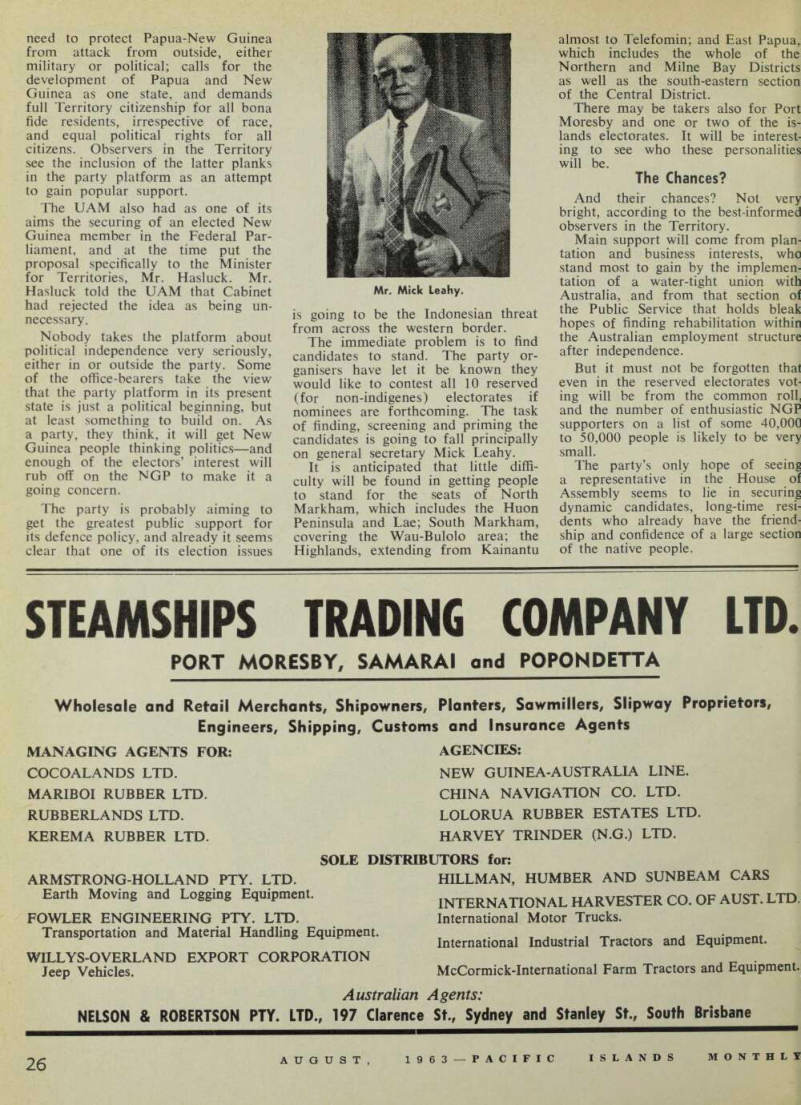
Mr. Mick Leahy.