Tourists May Create New
pp. 85-89 · Read in the full issue
Interest In Norfolk Island's Convict Ruins
From Merval Hoare, on Norfolk Island New interest in the convict relics of Norfolk Island during its two periods as a convict settlement is likely to be aroused if present plans come to fruition to develop the island’s tourist industry in a big way.
THE relics consist of a number of buildings, roads and silos, a pier and a cemetery at three sites —Kingston, Cascade and Longridge. The pier and cemetery are at Kingston.
Kingston, or Sydney Bay, was the site of the first settlement and is still the island’s capital. Cascade (once known as Phillipburgh) and Long ridge (originally Charlottefield and later Queenborough) were out stations.
The buildings at Kingston com prise the largest group of convict built structures. Several are still in use as offices and stores, and some are occupied as residences.
Two stone houses at Longridge are still lived in. But at Cascade little now remains apart from a few broken walls and heaps of stones.
Philip Gidley King, who estab lished the first settlement in March, 1788, and served two terms on the island —as Commandant from 1788 to 1790 and as Lieutenant-Governor from 1791 to 1796—was an energetic and capable coloniser.
His report of October 18, 1796, contained a list of the island’s public buildings, estimated to be worth £6,215.
At Sydney Bay stood a number of good stone buildings: Government House, storehouse, surgeon’s house, magazine, house for officer and soldiers, schoolhouse, gaol, Provost- Marshal’s house, bakehouse, officers’ quarters and the Judge-Advocate’s house.
In addition there were a number of buildings “framed and weather boarded”.
At Queenborough there were five main buildings and at Phillipburgh, seven.
Succeeding Commandants appar ently just added or replaced certain buildings as there is no record of any major construction programme being carried out during the first settlement after King left the island.
In 1803, the London authorities de cided to transfer part of the convict establishment to Van Diemen’s Land, but it was not until February, 1814,
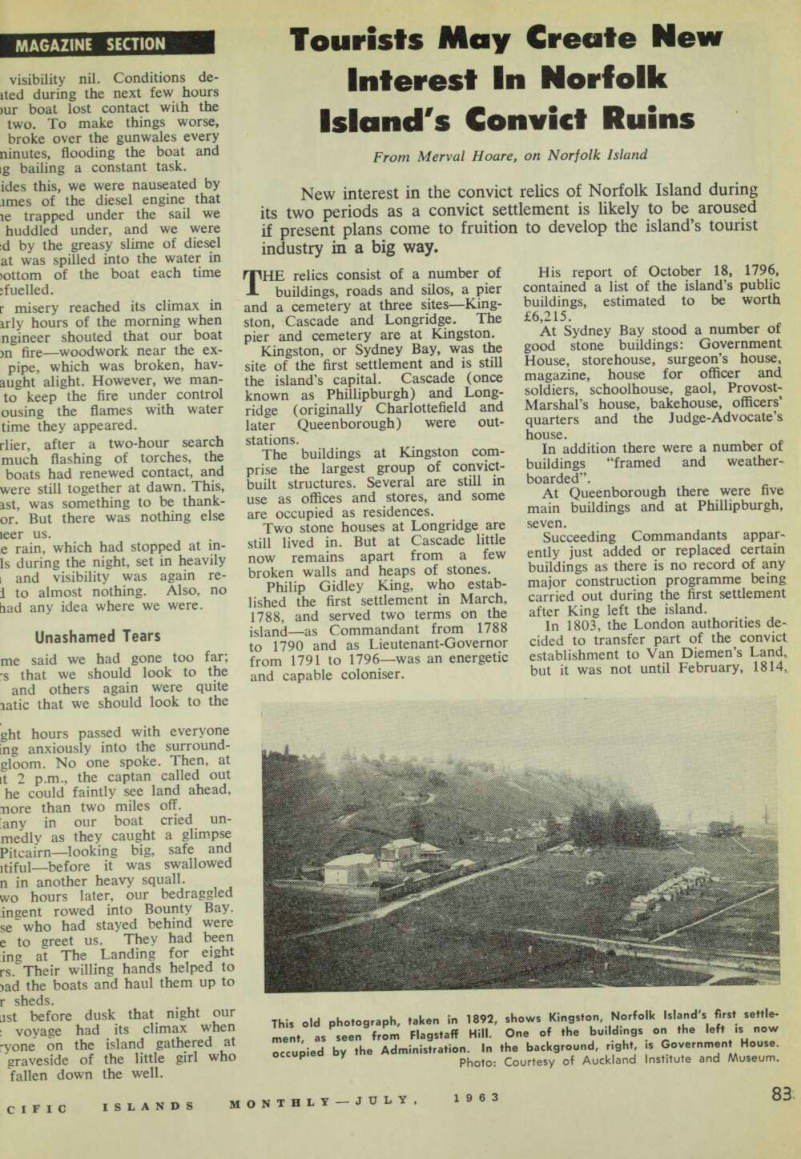
This old photograph, taken in 1892, shows Kingston, Norfolk Island's first settle ment as seen from Flagstaff Hill. One of the buildings on the left is now occupied by the Administration. In the background, right, is Government House. photo: Courtesy of Auckland Institute and Museum.
the island was completely aban d. illiam Hutchinson, the Superm ini, describing the evacuation to irnor Macquarie on March 10, , said: “The Buildings of every ription were Set fire to, and so ipletely destroyed, that I have i pleasure in assuring Your Ex ncy that there remains no in ment for human beings of any to visit that place”. This makes iar that when the first settlement :d, all that remained of 26 years enal occupation were the roads, s of buildings and cemetery. 1824, the British Government led to re-open Norfolk as an d prison for the worst criminals i New South Wales and Van nen’s Land. ccordingly, on June 6, 1825, Cap- Turton of the 40th Regiment, ed at Sydney Bay with a detach t of soldiers, 57 convicts, six ten and six children, aptain Turton found the former tal in a state of “perfect ruin”, proceeded to build temporary ters from the only material at I —the walls, which were still ling.
Working Order
n extensive programme of build and cultivation, carried out under arsh penal system, soon brought island into working order again, angridge became an agricultural re, where, at one stage, about 600 were quartered in stone and den barracks. ascade became a station where ul men no longer subject to the sst custody were quartered in 20- . huts. he “Plan of the Settlement and rison Farm, Norfolk Island, )” shows a cluster of buildings ■ the present Kingston pier, with risoners’ camp, soldiers’ garrison Government House further east, tew of these buildings are still ding. jdge Dowling, who visited the id in September, 1833, to conduct riminal Court, left an interesting nmt of the main settlement, he Judge was the guest of the imandant, Colonel Morrisset, and . Morrisset, and stayed at Gov nent House. “This,” he wrote, “is lain, square building fronting the t on which side, there are three d rooms, and one small one— Commandant’s study.
On the east are other rooms and :es. The house is but one story i. and all the windows with iron
bars, giving it the appearance of a lockup house.
“This expedient was resorted to about two years ago for security against a threatened conspiracy amongst the prisoners to attack the soldiers, which were at that time in a stockade at the back of the house, and not to be got at by forcing a passage through the Government House . . .
“The whole building is constructed of porous limestone, and rough cast on the outsides to keep out the damp air from the sea. The whole of the woodwork is of the native pine, which is as white and soft as American pine, and equally durable for inside work, but subject to very rapid de cay out of doors.
“Fences made of this material re quire renewing every two years.
“The house is very incompletely furnished, and that with the Com mandant’s own furniture brought from Sydney.
Level Ground “The house commands a view of the whole settlement, being erected on a mound gently declining to the level ground on which the settlement is formed.
“The southern part of the settle ment occupies an area of about one hundred acres fronting the south, on the shore.”
Judge Dowling’s comments on other buildings were: • Military Barracks. Immediately under a hill commanding a view of the settlement, are handsome military
barracks for about one hundred soldiers—three floors and remarkably clean, and enclosed with a high wall.
The whole buildings are formed of limestone and pine wood. There are comfortable quarters for four officers, a small hospital detached, and kit chen also detached, with suitable offices.
Parsonage
• Parsonage. Adjacent to the mili tary barracks is a neat verandahed cottage, containing four well-sized rooms, with detached offices in the rear. There being no clergyman on the settlement, this building was ap propriated to the accommodation of Mr. Moore, Mr. Plaistowe and two of the gentlemen nominated to serve on the jury. • Prisoners’ Barracks. Between the military barracks and the sea shore, a little to the westward, are the prisoners’ barracks; a building onl> half completed, intended to form four sides of a square, one apartment deep in each ward, and two stories in height. This building, when com pleted, will accommodate about six hundred prisoners to sleep. It is not intended for messing or eating. 9 Lumber Yard. This building, which is in the course of erection, is close to the prisoners’ barracks on the eastward, and will form three sides of a square for the purpose of employing mechanics. It will form an extensive range, one story from the ground with open-railed windows.
The building is slow in its progress from the want of a sufficient number of mechanics—stone-masons and car penters. (Over)
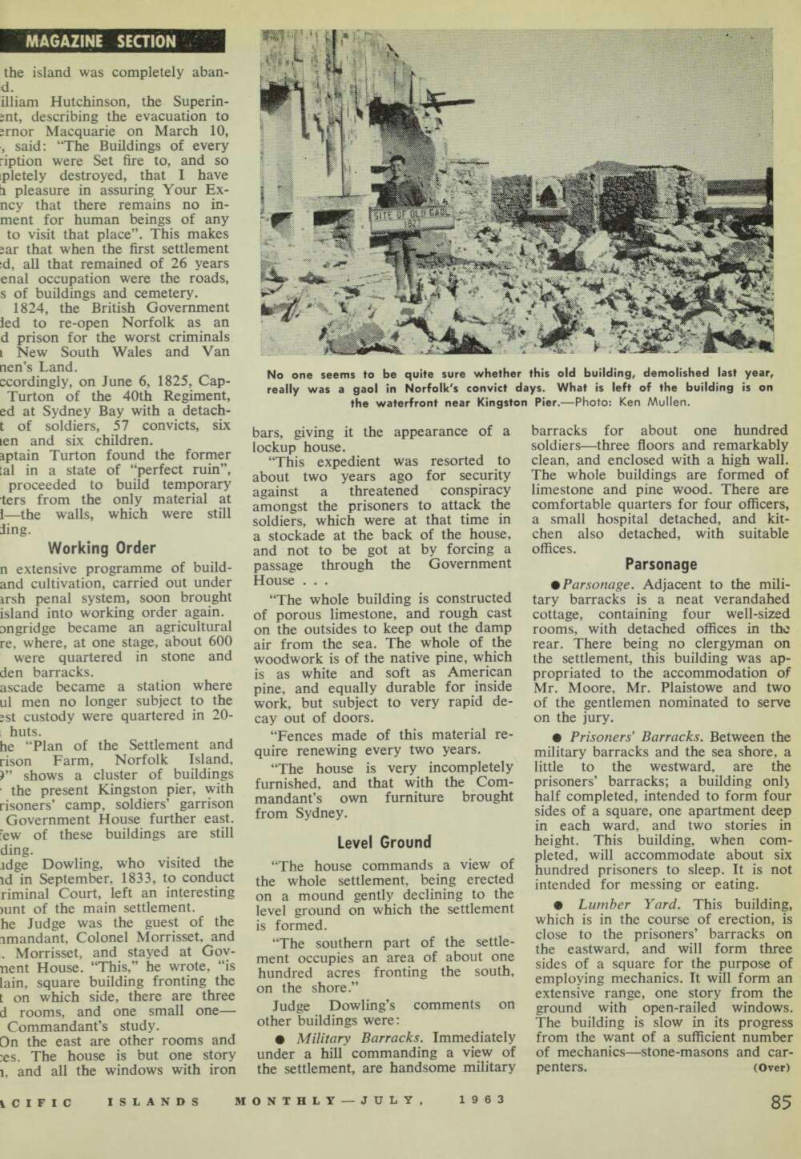
No one seems to be quite sure whether this old building, demolished last year, really was a gaol in Norfolk's convict days. What is left of the building is on the waterfront near Kingston Pier. Photo: Ken Mullen.
early project of the second period was the construction of ’entagonal Prison. Its founda are depicted in a painting by ms Seller dated 1835. e Pentagonal Prison’s founda are all that remain of it today, these are covered with grass i mounds of rubble, ijor Joseph Anderson, a severe nandant, carried out a vigorous ing programme during his term Bice from 1834 to 1839. The ■storey building housing the pre- Administration offices and the ent Commissariat store, now All 5 Church, were erected in his e Royal Engineer’s Office, dated was probably the last public ing erected during the second ment. This closed at the end of 1856, when the last convicts civilians, a very small party, left Jobart. e Pitcairners, numbering 194, arrived early in June, 1856, at took up residence in the more Die Kingston or “town” buildings, i were then in perfect condition, the newcomers were not trades- Sir William Denison, Governor ew South Wales and Governor orfolk Island, arranged in 1858 l few competent persons to join community. One of these was a ;rer and mason, is man, however, stayed only a time before returning to Syd thus leaving the island without ne capable of making proper re to the stone structures.
Reluctant • William Denison, who visited oik twice, tried to persuade the irners to move up into the in r and live on and cultivate their nents. tis, however, they were loath to Deing accustomed to living close her and farming in common, 'entually, some of the Pitcairners sd “up country”, though many, their descendants, continued to py the Kingston buildings, which, the passing years, became some dilapidated. Some were de shed. •ound the turn of the century, occupation of these buildings /eminent House excepted, it be the Chief Magistrate’s residence) me a subject of discord between people and the Government.
A succession of commissions dealt with this matter and various solutions in the form of conditional leases, licences and rentals were put forward.
Around 1906 the Crown’s rights in the Kingston buildings were decided by the Imperial Government, this de cision being confirmed by King Ed ward VII. Occupation licences were issued to the occupants for comple tion.
Some of the people accepted the conditions and remained in undis turbed possession; but most residents rejected the proposals and were evicted in 1908.
Steeped in History
Since then various Government de partments have used some of the buildings; others have remained purely residential.
Naturally, they have all, from time to time, required repairs, and these have almost invariably been carried out at the Government’s expense.
In 1961, the Commonwealth Government approved the expendi ture of £20,000 for the restoration of the Kingston buildings. This work at the time of writing was in progress and local men were being employed.
These old buildings are steeped in history each has its own associations, violent or tragic, domestic or official.
As Norfolk people become aware of their island’s important place in Australian and Pacific history, the history; each has its own associations, be brought to light.
Meanwhile, the “ruins” are Nor folk’s foremost tourist attraction; and, as the island’s future as a tourist re sort is being emphasised more and more, they qualify for the attention they are receiving.
Gerry Heyen.