Magazine Section
pp. 83-85 · Read in the full issue
Pacific Monthly Islands
When Pitcairn Islanders Go For A Holiday 9 They Go To Oeno
• And sometimes it's more adventurous than they bargain for
By H. D. Howse, a former Education Officer on Pitcairn Island When people in Europe, Australia or New Zealand want holiday there are plenty of places in their own countries for em to go to. But where do you go if you live on tiny, isolated tcairn, which has only 1,200 acres?
E answer is that you go to Oeno.
This is an atoll some 75 miles i of Pitcairn, which has an island s its barrier reef about half a long by a quarter wide. The mum height of the island above evel is 10 ft mo is the * only island close eh to Pitcairn for women and Fen to go to in the Pitcairners’ boats. Also, it is the only one the charms of a holiday resort. ic desire to go to Oeno for a lay is known on Pitcairn as ,o fever”. How this originates, I lot know. Apparently someone ests the idea; the idea spreads everyone discusses it and finally Island Council makes a decision, was on Pitcairn in 1961 when the ncil gave permission to as many lie as wished to go to Oeno to e a trip there. The next few days
were hectic with preparations. Provi sions for a four-week absence were collected, these including clothing, water, fruit, tinned goods and bread rolls. , iq^i At nightfall on January 23 1961 —the 171st anniversary of the burn ing of the Bounty by the Pitcairners’ ancestors—l and my family were among the 75 men, women and child ren who waved podbye to the 50odd people who had decided to stay at home.
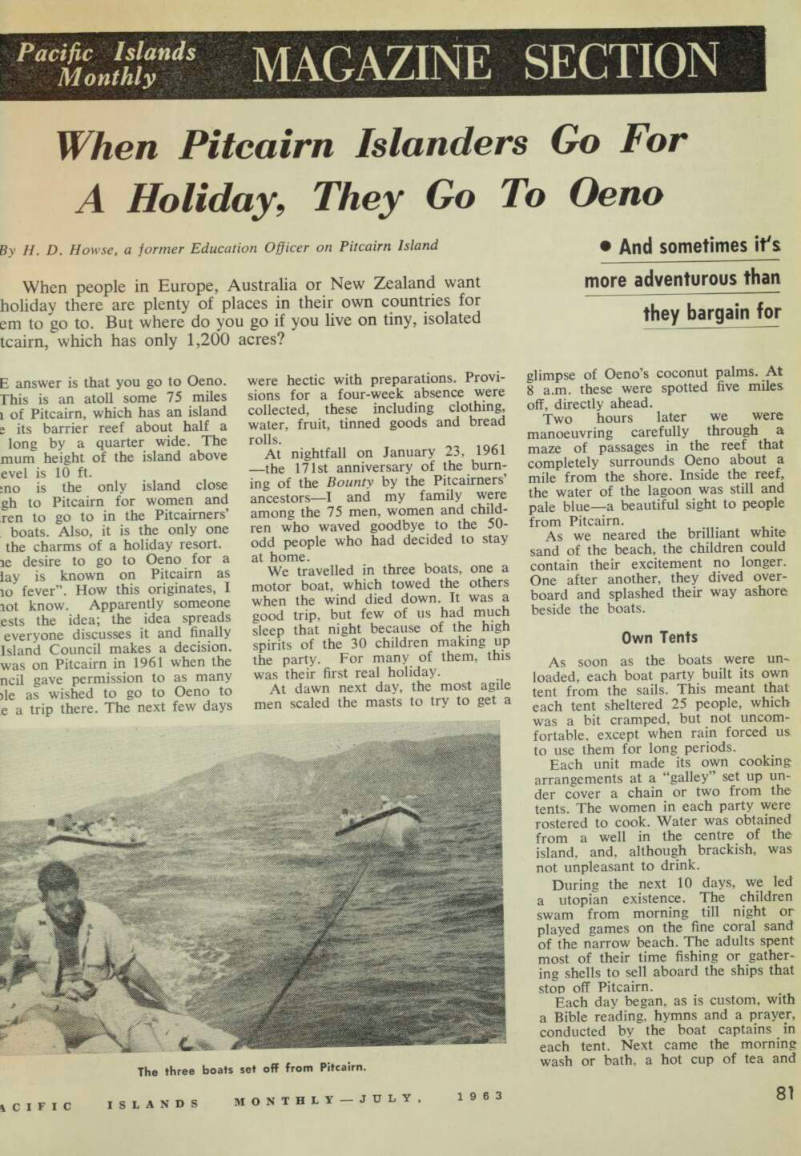
We travelled m three boats, one a motor boat, which towed the others when the wind died down. It w a good trip, but few of us had much sleep that night because of the high spirits of the 30 children making up the party For many of them, this was their first real holiday, At dawn next day, the most agile men scaled the masts to try to get a
glimpse of Oeno’s coconut palms. At 8 a.m. these were spotted five miles off, directly ahead.
Two hours later we were manoeuvring carefully through a maze of passages in the reef that completely surrounds Oeno about a mile from the shore. Inside the reef, the water of the lagoon was still and pale blue —a beautiful sight to people from Pitcairn.
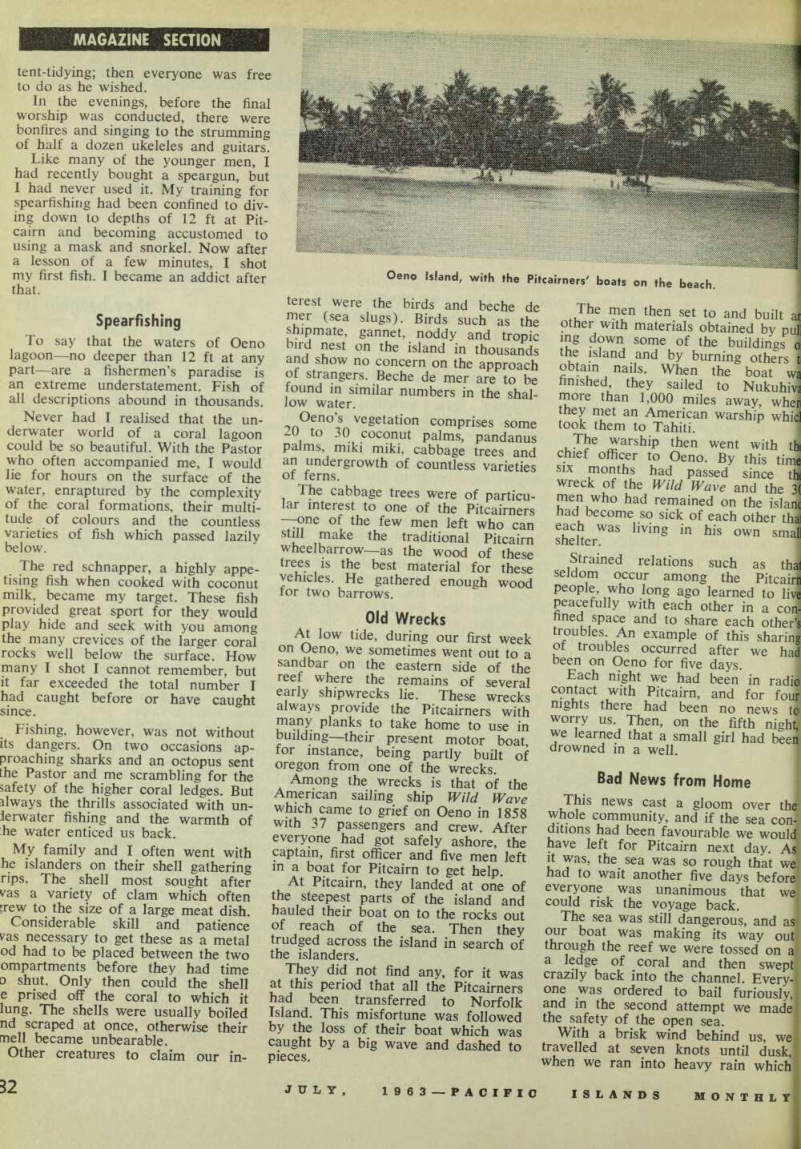
As we neared the brilliant white sand of the beach, the children could contain their excitement no longer.
One after another, they dived over board and splashed their way ashore beside the boats.
Own Tents As soon as the boats were un loaded, each boat party built its own tent from the sails. This meant that each tent sheltered 25 people, which was a bit cramped, but not uncom fortable, except when rain forced us to use them for long periods.
Each unit made its own cooking arrangements at a “galley” set up un der cover a chain or two from the tents. The women in each party were rostered to cook. Water was obtained from a well in the centre of the island, and, although brackish, was not unpleasant to drink.
During the next 10 days, we led a utopian existence. The children swam from morning till night or played games on the fine coral sand of the narrow beach. The adults spent most of their time fishing or gather ing shells to sell aboard the ships that stop off Pitcairn.
Each day began, as is custom, with a Bible reading, hymns and a prayer, conducted by the boat captains in each tent. Next came the morning wash or bath, a hot cup of tea and
The three boats set off from Pitcairn.
tent-tidying; then everyone was free to do as he wished.
In the evenings, before the final worship was conducted, there were bonfires and singing to the strumming of half a dozen ukeleles and guitars.
Like many of the younger men, I had recently bought a speargun, but I had never used it. My training for spearfishing had been confined to div ing down to depths of 12 ft at Pit cairn and becoming accustomed to using a mask and snorkel. Now after a lesson of a few minutes, I shot my first fish. I became an addict after that.
Spearfishing
To say that the waters of Oeno lagoon—no deeper than 12 ft at any part—are a fishermen’s paradise is an extreme understatement. Fish of all descriptions abound in thousands.
Never had I realised that the un derwater world of a coral lagoon could be so beautiful. With the Pastor who often accompanied me, I would lie for hours on the surface of the water, enraptured by the complexity of the coral formations, their multi tude of colours and the countless varieties of fish which passed lazily below.
The red schnapper, a highly appe tising fish when cooked with coconut milk, became my target. These fish provided great sport for they would play hide and seek with you among the many crevices of the larger coral rocks well below the surface. How many I shot I cannot remember, but it far exceeded the total number I had caught before or have caught since.
Fishing, however, was not without its dangers. On two occasions ap proaching sharks and an octopus sent the Pastor and me scrambling for the safety of the higher coral ledges. But dways the thrills associated with un ierwater fishing and the warmth of he water enticed us back.
My family and I often went with he islanders on their shell gathering rips. The shell most sought after yas a variety of clam which often ;rew to the size of a large meat dish.
Considerable skill and patience /as necessary to get these as a metal od had to be placed between the two ompartments before they had time 3 shut. Only then could the shell e prised off the coral to which it lung. The shells were usually boiled nd scraped at once, otherwise their nell became unbearable.
Other creatures to claim our in-
terest were the birds and beche de rner (sea slugs). Birds such as the shipmate, gannet, noddy and tropic bird nest on the island in thousands and show no concern on the approach of strangers. Beche de mer are to be round in similar numbers in the shal low water.
Oeno’s vegetation comprises some 20 to 30 coconut palms, pandanus palms, miki miki, cabbage trees and an undergrowth of countless varieties of ferns.
The cabbage trees were of particu lar interest to one of the Pitcairners —one of the few men left who can u „ make the traditional Pitcairn wheelbarrow—as the wood of these trees is the best material for these vehicles. He gathered enough wood tor two barrows.
Old Wrecks At low tide, during our first week on Oeno, we sometimes went out to a sandbar on the eastern side of the reef where the remains of several early shipwrecks lie. These wrecks always provide the Pitcairners with many planks to take home to use in building—their present motor boat, for instance, being partly built of Oregon from one of the wrecks.
Among the wrecks is that of the American sailing ship Wild Wave which came to grief on Oeno in 1858 with 37 passengers and crew. After everyone had got safely ashore, the captain, first officer and five men left m a boat for Pitcairn to get help.
At Pitcairn, they landed at one of the steepest parts of the island and hauled their boat on to the rocks out of reach of the sea. Then they trudged across the island in search of the islanders.
They did not find any, for it was at this period that all the Pitcairners had been transferred to Norfolk Island. This misfortune was followed by the loss of their boat which was caught by a big wave and dashed to pieces.
The men then set to and built ai other with materials obtained by pul mg down some of the buildings o the island and by burning others I obtain nails. When the boat v/i finished, they sailed to Nukuhivi more than 1,000 miles away, whet they met an American warship whid took them to Tahiti. ,JJ? e warship then went with th chief officer to Oeno. By this tid six months had passed since th wreck of the Wild Wave and the 3i men who had remained on the islan had become so sick of each other tha each was living in his own smal shelter.
Strained relations such as tha seldom occur among the PitcaiH people, who long ago learned to livl peacefully with each other in a coni fined space and to share each other*! troubles. An example of this sharing of troubles occurred after we had been on Oeno for five days.
Each night we had been in radio contact with Pitcairn, and for four nights there had been no news to worry us. Then, on the fifth night, we learned that a small girl had beeri drowned m a well.
Bad News from Home This news cast a gloom over the whole community, and if the sea con ditions had been favourable we would have left for Pitcairn next day. As it was, the sea was so rough that we had to wait another five days before everyone was unanimous that we could risk the voyage back.
The sea was still dangerous, and as our boat was making its way out through the reef we were tossed on a a ledge of coral and then swept crazily back into the channel. Every-I one was ordered to bail furiously,! and in the second attempt we made the safety of the open sea.
With a brisk wind behind us, we travelled at seven knots until dusk, when we ran into heavy rain which
Oeno Island, with the Pitcairners' boats on the beach.
visibility nil. Conditions de ited during the next few hours >ur boat lost contact with the two. To make things worse, broke over the gunwales every ninutes, flooding the boat and [g bailing a constant task, ides this, we were nauseated by rmes of the diesel engine that le trapped under the sail we huddled under, and we were ;d by the greasy slime of diesel at was spilled into the water in >ottom of the boat each time r misery reached its climax in irly hours of the morning when ngineer shouted that our boat m fire —woodwork near the ex pipe, which was broken, hav aught alight. However, we man to keep the fire under control ©using the flames with water time they appeared, rlier, after a two-hour search much flashing of torches, the boats had renewed contact, and were still together at dawn. This, ast, was something to be thank or. But there was nothing else leer us. e rain, which had stopped at in is during the night, set in heavily i and visibility was again re i to almost nothing. Also, no had any idea where we were.
Unashamed Tears
me said we had gone too far; ■s that we should look to the and others again were quite latic that we should look to the ght hours passed with everyone ing anxiously into the surround gloom. No one spoke. Then, at it 2 p.m., the captan called out he could faintly see land ahead, nore than two miles off.
'any in our boat cried un medly as they caught a glimpse Pitcairn—looking big, safe and lt if u l—before it was swallowed n in another heavy squall, wo hours later, our bedraggled ingent rowed into Bounty Bay. se who had stayed behind were e to greet us. They had been ing at The Landing for eight rs. Their willing hands helped to >ad the boats and haul them up to r sheds. ast before dusk that night our voyage had its climax when ■yone on the island gathered at graveside of the little girl who fallen down the well.