New Guinea's
pp. 75-78 · Read in the full issue


Education System Is In Gear At Last
From a Staff Writer in Port Moresby
After 15 years of muddling and frustration , the education ystem of Papua and New Guinea seems at last to be in gear md making progress towards a definite goal.
is over-staffed, fantastically ex pensive and ragged at the edges; it does give definite promise of omplishing the Administration s
Tiary purpose—namely, the pro
tion of indigenous citizens suffici ly literate to read a village council truction or mark a ballot-paper, t is impossible to tell, from the ze of officially slanted statistics iduced by battalions of clerks in Territory, what the “crash pro ,mme” of education has cost and costing. , i- But no one cares, anyhow. Australia shovelling £2O million a year into ■ country, and none among those
arms of perambulating bureaucrats
mid be such a cad as to demand ;asured value for money spent.
The huge programme of native acation is the conception of the inister, Mr. Hasluck, and he is the iving-force, now called crash . ihappily, it is likely to be too late.
Before the plan of producing erate voters —capable of deciding face of subversive blandishments at they will remain with friendly jstralia— can become effective, the 3 lves of de-colonisation will j^ e ion the native people. They will be ked to make decisions on issues aich they cannot see, and enter into ditical contracts which they cannot iderstand.
Only in the last couple of years have we seen the extraordinary spectacle of plane-loads of young to middle-aged Australian males, most of them with only limited academic qualifications and a still less know ledge of New Guinea, being sent urgently to crash-training institutions in the Territory. There they have been instructed in the art of estab lishing a primitive school and im parting a knowledge of the three Rs, and simple English, to junior villagers who have never experienced such a thing before. , . .
It has been heroic, although it has not been scientific. The percentage of casualties was high. The dirt and loneliness of life in the villages, the rigours of the climate, the frustra tions of pioneering a school system like this without traditions or experi ence—it was surprising that these conditions, plus the fact that so many obviously unsuitable persons were recruited, gave a casualty rate as low as 35 per cent.
But some, with the fewest apparent qualifications, made the grade in a remarkable fashion. In Rabaul, they are talking about a lad who, after 12 years as a Navy stoker and a bnet “crashing” in the Rabaul training centre, was sent out among the Tolais. , , The Tolais are tough, but eager
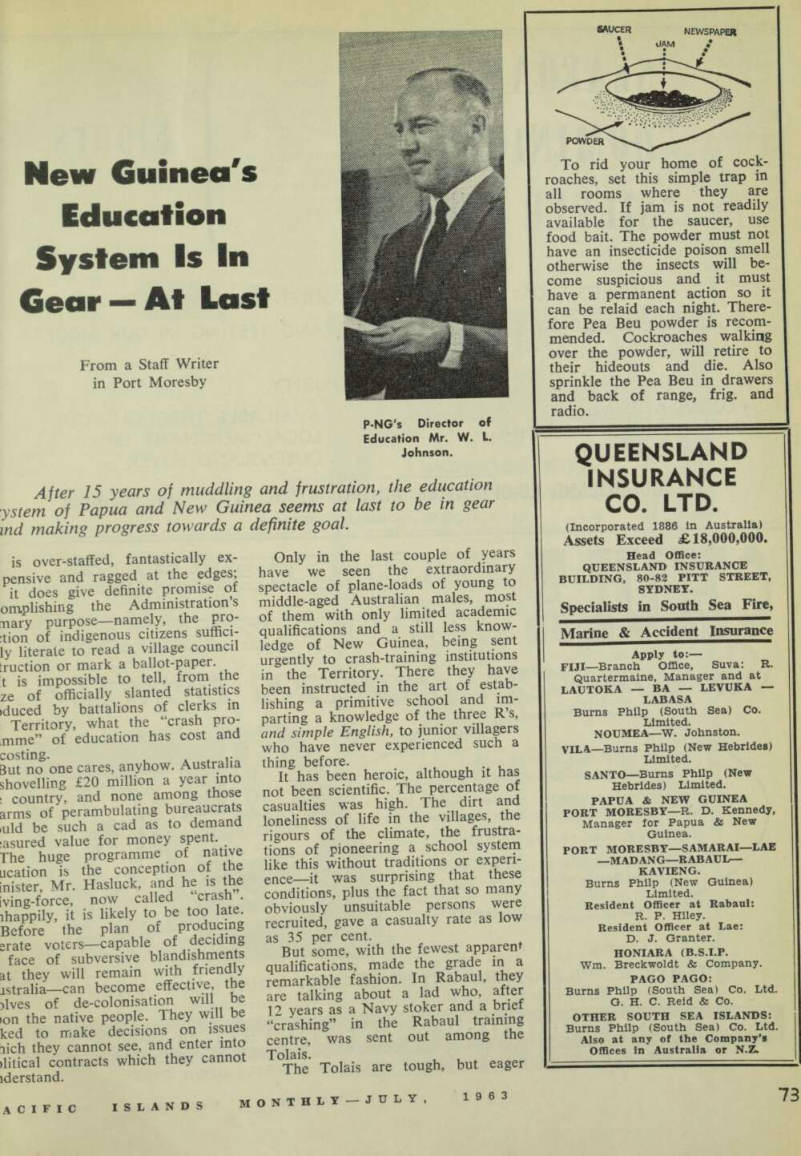
P-NG's Director of Education Mr. W. L.
Johnson.
education. The Navy man has ;ed them so much that they have ;d every child in the area to at his school, and have spent no than £1,500 of their own funds uild him a suitable class-room, le Department is said to be not itisfied with the results of this ordinary method of tackling the .lem of village illiteracy. Quite a ber of natural teachers have been id and placed. is stop-gap measure to maxe a ving before the United Nations e the wolves are howling around Territory, and while adequate dies of native teachers are being dy and painfully trained.
An Appalling Task i spite of rapid progress made in last two or three years, the task before the Education Depart it is an appalling one. Here are round figures: K ., nn Idren of school age . . 450,000 Idren now at school . . 15U,UUU Idren awaiting teachers nd schools 300,000 ichers (not including nissions)— Expatriate 'XX Indigenous • •• ichers still required .. iu,uuu Even if there are finance and ilities for producing 2,000 teachers rear, it will take five years to pro e another 10,000 teachers.
Fhe Administration has plans and rpose. But they do not cope with ; fact that the great majority of tives who are to elect a Parliament Kt year are blankly illiterate.
Meanwhile, much attention is be l given tc secondary and technical iools which draw their supplies of idents from the now numerous
primary schools established around the towns and in the Mission areas.
An extraordinary number of - education advisers and organisers are in circulation in the Territory, doing everything possible to hurry on the output of native teachers, officials, technicians, clerks, and possible undergraduates.
Mr. Don Barrett, so long known as a senior military officer in the Territory, now has the interesting job of providing liaison between members of the Pacific Islands Regiment (which presently will comprise two battalions) and the secondary and technical teachers of the Education Department.
The plan is that the young New Guinean, uhile he soldiers, will also receive educational and technical
training,
p| Minister s extra Plan The “crash” plan is m two parts, There is a new organisation—-a section of the Department of In formation—which distributes masses of printed material, in simple Eng lish, Motuan and Pidgin regularly to the schools everywhere, and to the village elders. The Australian Broad casting Commission’s staff and equip ment in the Territory has been en larged to enable the village com munities generally to receive news.
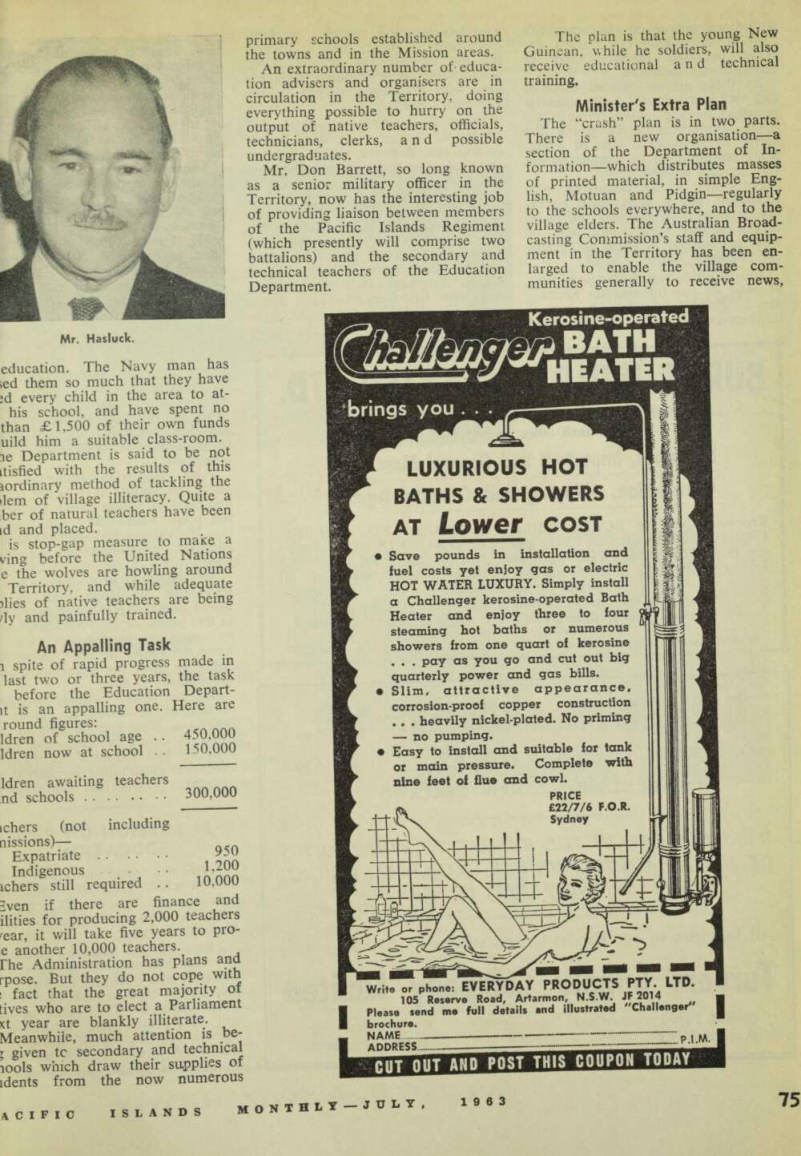
Mr. Hasluck.
advice and instruction on community radio receivers. The latter are being provided cheaply, and in extraordinary numbers.
By these means—printed material and radio broadcasts, both specially prepared for the native communities tne Administration is giving the native communities a sort of super ficial polishing up, a familiarisation with current affairs. *- S no l to be compared with education; but at least, until educa tion is general, it provides the back blocks natives with some idea of rn h d at elec.or P s eC ' ed ° f aS dtizens The Minister was lucky in getting as head of the Information Section,’
Mr. L. Newby, who has an unusual combination of genius and drive and
Who has installed a useful, modern, offset-printing plant; and in obtain mg the co-operation of the ABC which has literally plastered the Terri tory with broadcasts shaped to the Territory’s needs.
There is much in this outline of education, information and broad casting that deserves praise. But the lB fantastic, and it is still grow-
Delay in Training Teachers
Mr. Hasluck has been Minister for Territories for 12 years. Why did he wait until 1960 or 1961 before making this frontal attack upon village illiteracy? If what is being done now had been started a dozen years ago P-NG today might have in sight, if not in action, the factor
hill 18 • so des Perately nee( nere. There is urgent need today a large number of mature yoi natives, capable of discussing abstr Fna S i; 1 ch nS u Wi f h Eur pPeans, of read English books and newspapers, a of advising the millions of villas on what to do in the situations n
immediately confronting them
Those situations have been crea by the breath-taking speed of int nationa! changes, like de-colonisati and the southwards thrust of Asi Communism.
Mr. Hasluck could not have be blind to the need. It was appare to most observers.
Again and again, in the years 1 »nH en ,t.' 94s a ” d 1950 ’ ™ Witt and others pointed out that any re progress towards P-NG self-gover ment was impossible without son degree of general literacy; and thu before illiteracy could be tackled, t Administration must find so m effective way of carrying the simple torm of primary education to tl countless villages which, betwee language 90 *' 6 " ‘ eaSt 7 °° separa P-NG education authorities, lon years ago, should have begun trainin hundreds of young native teachers 1 the point where they could go oi into the villages and start the primar floor atl ° n programme on the groun Mr. Hasluck, of course, could nc guess that Sir Hugh Foot in 196 would demand self-government with in five years, or that Soekarno woul be turning handsprings on ou western frontier in 1963. What he i doing to meet the situation deserve the nation s praise.
But he would have had a bette chance of achieving his great am bition—a New Guinea tied to Aus tralia by love, affection and esteen: -—it he had launched in 1950 the education programme he started with so much “crash” ten years later.