He’s A Saltier
pp. 89-91 · Read in the full issue
A Brett Hilder Profile
He’s A Saltier Salt Than Columbus
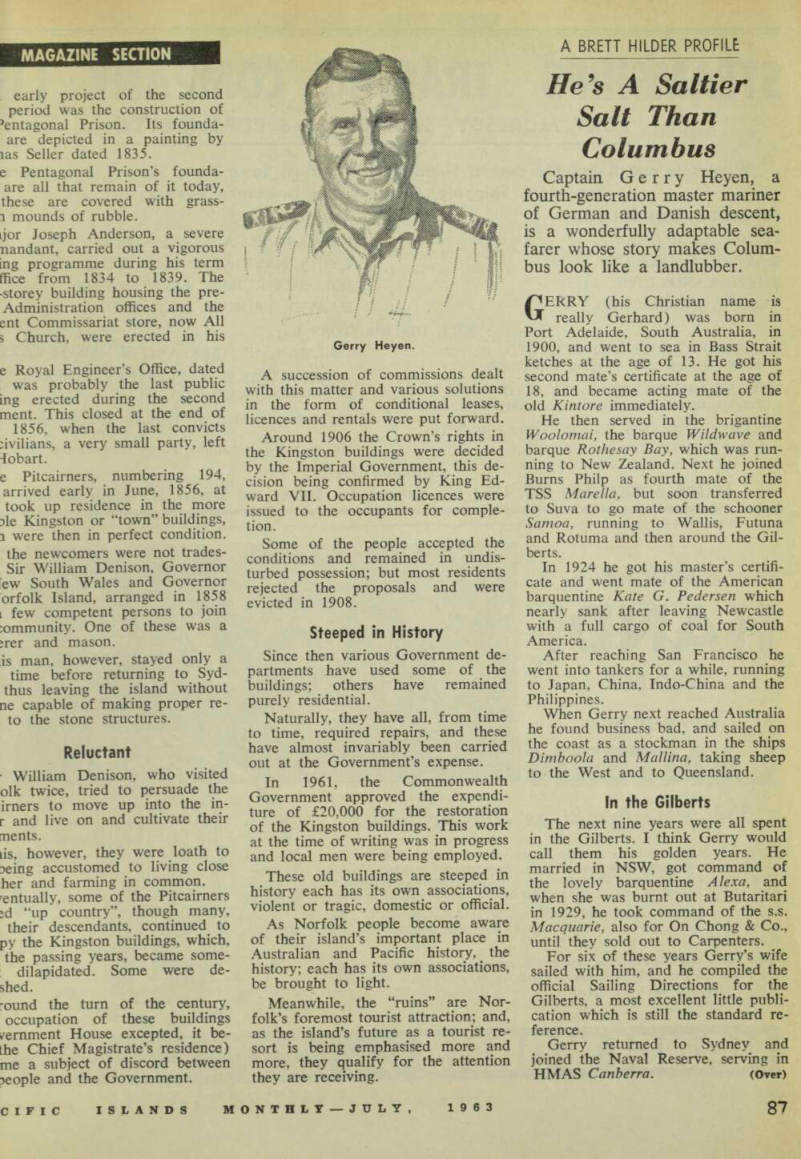
Captain Gerry Heyen, a
fourth-generation master mariner of German and Danish descent, is a wonderfully adaptable sea farer whose story makes Colum bus look like a landlubber.
GERRY (his Christian name is really Gerhard) was born in Port Adelaide, South Australia, in 1900, and went to sea in Bass Strait ketches at the age of 13. He got his second mate’s certificate at the age of 18, and became acting mate of the old Kintore immediately.
He then served in the brigantine Woolomai, the barque Wildwave and barque Rothesay Bay, which was run ning to New Zealand. Next he joined Burns Philp as fourth mate of the TSS Marella, but soon transferred to Suva to go mate of the schooner Samoa, running to Wallis, Futuna and Rotuma and then around the Gil berts.
In 1924 he got his master’s certifi cate and went mate of the American barquentine Kate G. Pedersen which nearly sank after leaving Newcastle with a full cargo of coal for South America.
After reaching San Francisco he went into tankers for a while, running to Japan, China, Indo-China and the Philippines.
When Gerry next reached Australia he found business bad, and sailed on the coast as a stockman in the ships Dimboola and Mallina, taking sheep to the West and to Queensland.
In the Gilberts The next nine years were all spent in the Gilberts. I think Gerry would call them his golden years. He married in NSW, got command of the lovely barquentine Alexa, and when she was burnt out at Butaritari in 1929, he took command of the s.s.
Macquarie, also for On Chong & Co., until they sold out to Carpenters.
For six of these years Gerry’s wife sailed with him, and he compiled the official Sailing Directions for the Gilberts, a most excellent little publi cation which is still the standard re ference.
Gerry returned to Sydney and joined the Naval Reserve, serving in HMAS Canberra. (Over)
then tried to organise a sail ig ship, but couldn’t raise the So he rejoined Burns Philp wo years in the Merkur as 1 mate; then he went into the hate ships Triaster and Triadic ite and relieving master, en war broke out in 1939, he called up and joined HMAS nbla as navigator, sailing to Guinea and on to the Japan coast patrol. A year followed ng the Indian Ocean as far as and Durban. ry was mentioned in dispatches 'ent to Navy Office, Melbourne, vo years.
US Pacific Fleet s period ended when he was led to the US Pacific Fleet in his job being to organise the ign Legion” of seafarers with knowledge of the Pacific to help the planning and execution of merican counter-attack on Jap held territory in the Pacific, s took Gerry to the Gilberts, tails, Saipan, Tinian, Guam, and Guadalcanal, the Palaus, s, Philippines, Iwo Jima and wa. was at Manila, awaiting the in of Japan, when that became
unnecessary, so he returned to Pearl Harbour and was demobbed in Aus tralia in 1946.
The Americans awarded him the Pacific Service Medal with seven campaign stars, the Philippines Lib eration Medal and the Legion of Merit, degree of Officer. He was only allowed to accept the last of these.
Gerry’s next venture was a shark fishing ketch off the South Australian coast. This became a total loss in the Bight during a southerly gale. So he took the job of delivering the bomb scow Kerema to Port Moresby.
On returning to Australia he was appointed Superintendent of the Papua-New Guinea Division of the Directorate of Shipping, based at Rabaul.
He left after 18 months, owing to fever, and joined the Australian Shipping Board as mate, and later as master of the Ransdorp, which he collected from Holland and fitted out in London.
Intelligence Work
He then went master of the Euroa until he was called into Navy Office Melbourne, for three years’ intelli gence work on amphibious warfare.
On rejoining the Shipping Board, he was sent twice to the Clyde to
bring out the ships Nilpena and Noongah.
In 1955, Captain Heyen became a shore-based seadog, and Marine Superintendent of the Australian National Line. In 1961 an old war injury to his knee played up, forcing him to resign, so he was made a “back-room boy”, technical planning and research officer.
He recently contributed a long paper on primitive navigation to the symposium of the Polynesian Society, dealing with Polynesian migrations, and the accidental theory propounded by Andrew Sharp, of New Zealand.
After this bare recital of the sea service so capably carried out in a great diversity of tasks, starting from the very bottom of the ladder and getting right to the top after many setbacks, I am forcibly reminded of the illustrious Captain James Cook.
But I hasten to add that I would much rather be shipmates with Gerry Heyen than with Cook, whose super human attributes elevated him into Polynesian divinity.
I am glad to report that Gerry is compiling his autobiography, and as he is a very good writer, with a wonderful story to tell, it should be a worthy monument to his life—