GEIC Has Two Unique
p. 87 · Read in the full issue
Claims To Fame
Scattered over some two million square miles of the South-West and Central Paci fic are the 31 inhabited and five desert islands which make up the Gilbert and Ellice
Islands Colony.
THE Colony has two unique claims to fame. One is that it is the only territory in the world which doubles its land area at low tide. The other is that it is the only territory which lies in four hemispheres (if this is not a contradiction in terms), as it straddles both the 180th meri dian and the Equator.
One confusing result of this is that two dates apply so that when, for example, it is Sunday morning at Tarawa, it is still only Saturday morning at Canton Island.
Geographically and ethnically, the Colony may be divided into the groups which form its ad ministrative districts.
The Gilbert Islands form a chain 450 miles long from Makin in the north to Arorae in the south, lying across the Equator
between the 170th and 180th me ridians.
The chain continues 200 miles further south as the Ellice Islands, stretching another 360 miles from Nanumea to Niula kita, the southernmost island in the Colony.
About 600 miles east of the Gilbert chain lies the Phoenix group, which includes the five uninhabited islands of the Colony.
Eight hundred miles north-east of the Phoenix Group are the Line Islands, which include Christ mas Island, the site of recent nuclear explosion tests.
The Phoenix and Line Islands have no true indigenous popula tion (although there is archaeolo gical evidence of at least a tran sient population at some period in the past), but three of the Phoenix were settled shortly be fore the war by an overspill from the Gilberts.
One of the three, however, has proved incapable of supporting even a small number of inhabi tants and a further move has taken place, this time to the Solo mon Islands.
Ocean Island, a lone outrider about 250 miles west of the Gil
bert chain, differs from the rest of the islands of the Colony in being formed of upraised coral limestone and of phosphate rock which is quarried, crushed and shipped, mostly to Australia, to form the basis of superphosphate.
Faced with the prospect of their island being slowly removed from under their feet, the indigenous people were resettled on Rabi Island in the Fiji Group some years ago.
The other islands rise only a few feet above sea level.
The individual islands in each group are separated by distances of up to 120 miles and vary in size from minute specks in the ocean such as Niutao, half a mile in circumference, to the narrow strips of land up to 35 miles long forming the eastern or wea ther side of atolls such as Tabi teuea.
The inhabited islands are densely populated, the others be ing too dry and barren to sup port a fixed population.
Except on Ocean Island, the only commercial produce is copra, and the only communication most of the islands have with the out side world is when trading, ad ministrative, or mission ships (based on Tarawa, the Colony headquarters) call, at intervals of anything from a couple of weeks to several months.
G. Douglas.
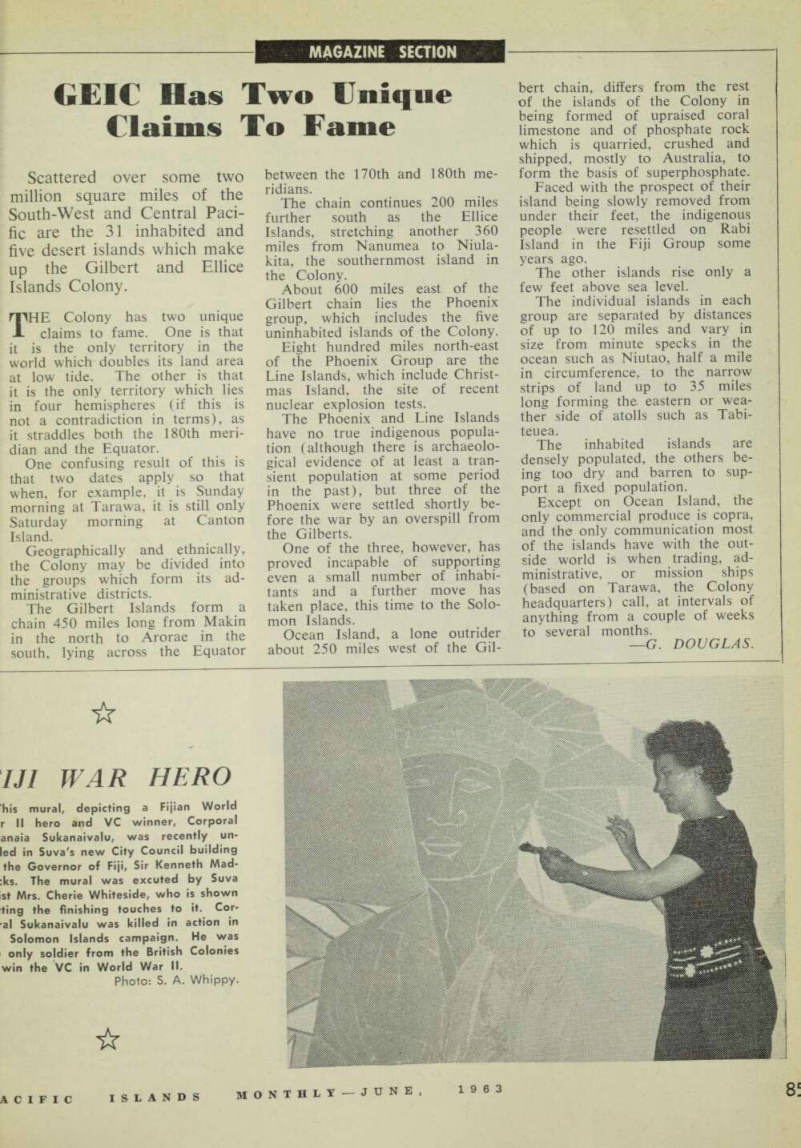
Fiji War Hero
This mural, depicting a Fijian World [?]r II hero and VC winner, Corporal [?]anaia Sukanaivalu, was recently un [?]led in Suva's new City Council building [?]the Governor of Fiji, Sir Kenneth Mad [?]ks. The mural was excuted by Suva [?]st Mrs. Cherie Whiteside, who is shown [?]ting the finishing touches to it. Cor [?]al Sukanaivalu was killed in action in [?]Solomon Islands campaign. He was [?]only soldier from the British Colonies [?]win the VC in World War 11.
Photo: S. A. Whippy.