Governor Pays
pp. 88-91 · Read in the full issue
Farewell Visit To Lau Group
The Governor of Fiji, Kenneth Maddocks, and Li Maddocks recently made a fa well tour of the islands and at< of Lau, the easternmost group
Fiji.
TTiE Governor and his wife be leaving Fiji in Septem after five years’ service in the Cole They were accompanied on tl Lau tour by the Commissio Eastern, Ratu K. K. T. Mara, hereditary high chief of Lau, his v Adi Litia Lababalavu, and I Wright, of the Fiji Public Relati Office, who took the pictures on th two pages.
The party travelled from Suva the Fiji Government’s motor ya Ra Marama, and visited 10 islar ranging from limestone clusters large islands.
At each island, Sir Kenneth j Lady Maddocks were carried ash by Fijian warriors, a treatment served only for the highest of chi and. distinguished guests.
Each island vied with the next its form of entertainment. Rarely p formed ceremonies were brought light; dance teams provided geni languid mekes by women, or vigorc club or spear formations by the mi At some islands, the Governor a his wife sat cross-legged on mats a took part in Fijian feasts prepai in their honour.
They visited schools, dispensarii churches, radio stations, post offic stores, boatbuilders, and agricultui projects.
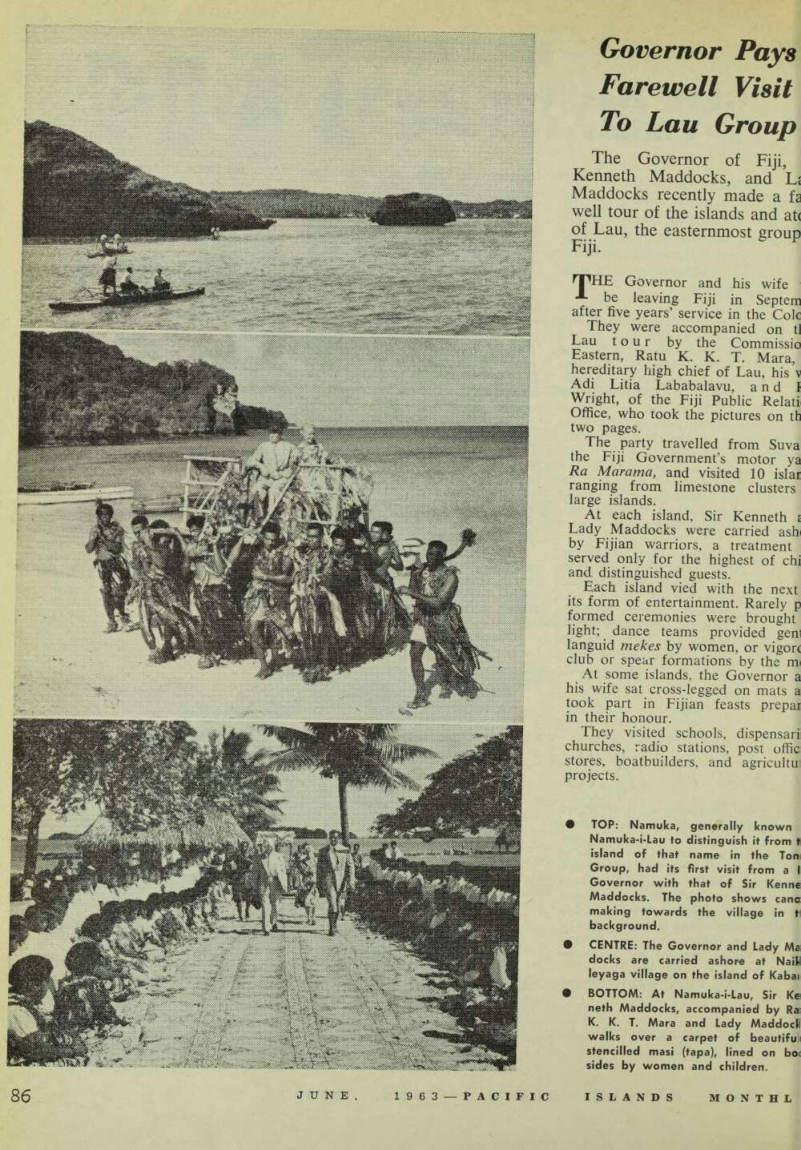
• TOP: Namuka, generally known Namuka-i-Lau to distinguish it from t[?] island of that name in the Ton[?] Group, had its first visit from a [?] Governor with that of Sir Kenne[?] Maddocks. The photo shows can[?] making towards the village in t[?] background.
• CENTRE: The Governor and Lady Ma[?] docks are carried ashore at Nai[?] leyaga village on the island of Kaba[?]
• BOTTOM: At Namuka-i-Lau, Sir Ke[?] neth Maddocks, accompanied by Ra[?] K. K. T. Mara and Lady Maddoc[?] walks over a carpet of beautiful [?] stencilled masi (tapa), lined on bo[?] sides by women and children.
he inhabitants of at least one id, Namuka-i-lau, had not had a rernor visit them before. Although 11, Sir Kenneth was impressed t the buildings in the village, the church, the co-operative store, the efforts the villagers were :ing to improve the quality of r copra by building hot-air ;rs. he Lau islands are scattered over irea of some 44,000 square miles >cean. he distribution of land is uneven, in the north and central areas, ly of the islands are caught to ier in a network of reefs with navigable passages, or set in the st of lagoons which in some cases many times the area of the land f.
Closer to Tonga i the southern part of the group, ;r spaces separate the islands so e are sometimes 40 to 60 miles ipen sea between them. It is quite ible for an inexperienced nayi »r to find himself out of the Fiji ip and into Tonga, for the islands louthern Lau are closer to Tonga i they are to Suva, ongan influence has long been ortant in these islands, and, in 1, in the middle of the last ury, was dominant, ongan place names are common ughout the area and on many ;he islands the Tongan language once spoken as freely as Fijian, erial culture, customs, and tradi s, have all been modified by gan contacts. he economy of the Group is based ely on the growing of coconuts the making of copra. With few ;ptions the islands are of lime e formation and not well endowed i soil. here is a small trade in the manu ure of hardwood artifacts made skilled tradesmen, ananas for export are also grown one or two of the more fertile ids nearest to Suva.
OOTNOTE: Rob Wright says his ares of the Governor’s Lau tour “virtually underwater pictures be ;e they ended up in the drink to er with the camera that took a.” In going ashore from the Marama, at Lakeba, Rob was in nghy which was half swamped by ig wave. His camera, exposure 2r and exposed film were doused, after some skilful work on the back in Suva, he produced a set ligh quality prints as if nothing happened.
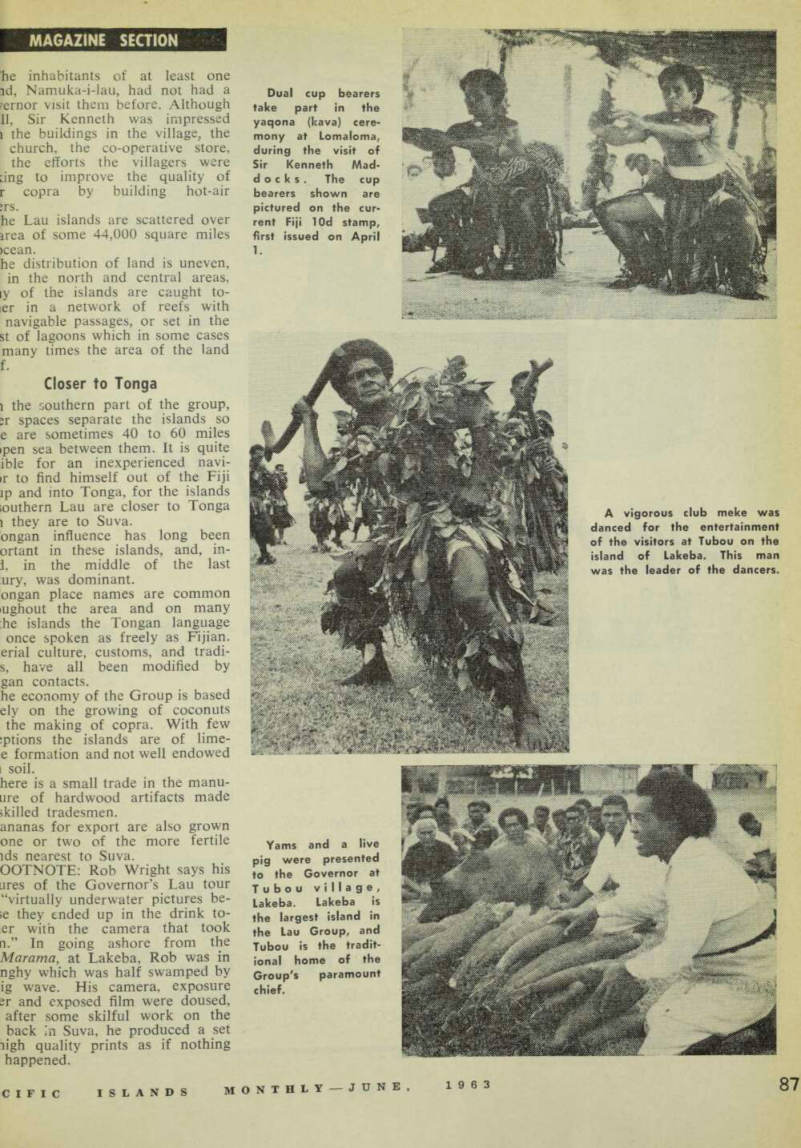
Dual cup bearers take part in the yaqona (kava) cere mony at Lomaloma, during the visit of Sir Kenneth Mad docks. The cup bearers shown are pictured on the cur rent Fiji 10d stamp, first issued on April 1.
Yams and a live pig were presented to the Governor at Tubou village, Lakeba. Lakeba is the largest island in the Lau Group, and Tubou is the tradit ional home of the
Group's paramount
chief.
A vigorous club meke was danced for the entertainment of the visitors at Tubou on the island of Lakeba. This man was the leader of the dancers.
Profound dissatisfact ion with the treatment of *apua and New Guinea vacuees by “an indifferent
nd unsympathetic Australian
jovernment” was a keynote
if talks at the annual meeting if the Pacific Territories As ociation in Sydney on June 9, 943, according to the issue if PIM for that month. Other terns in that issue of 20 years go were:— POLYNESIANS on “a certain small Pacific island” (un lamed because of security re trictions) were learning to jitter lug under the tuition of a US hmy sergeant from Philadelphia vho had once entertained in clubs n the US. The sergeant claimed hat the Polynesians picked up lances more quickly than Ameri an girls. * * * The death was announced of a veil-known New Hebrides planter, dr. Chris E. Hill, of Emae Island, vho had lived in the Condo ninium for about 25 years.
Natives of New Caledonia, who, iccording to a correspondent, vere being changed by the US \rmy into industrious citizens, vere collecting rubber from ban yan trees to help the United Nations war effort. They were be ng paid 50 francs a kilogramme.
Mrs. Isobel Field, 85-years-old step-daughter of Robert Louis
tfeMetdatf
Stevens, said in a letter to PIM from Cirpintaria, California, that she wished to discontinue receiv ing copies of the magazine be cause her eyes were not good enough to read them. She said she had been taking PIM for many years and had always found it interesting. Mrs. Field had been with Stevenson in Samoa when he died in December, 1894. * ♦ * General de Gaulle called off the elections for the New Caledonia Administrative Council on the ground that wartime elections were inadmissible. % Hs Among several resignations from the staff of the Australian De partment of Information was that of Damien Parer, a member of the well-known New Guinea family. He had won kudos as a cameraman with the Australian forces. (See book review section in this issue). ❖ ❖ ❖ The 190 people of Pitcairn Island had begun to make walk ing sticks for disabled soldiers after their offer to care for 35 evacuated British children had been refused because of transport difficulties. * * * The New Zealand Government announced that no more Raro tongan girls would be allowed to leave the island to take up domestic service in New Zealand.
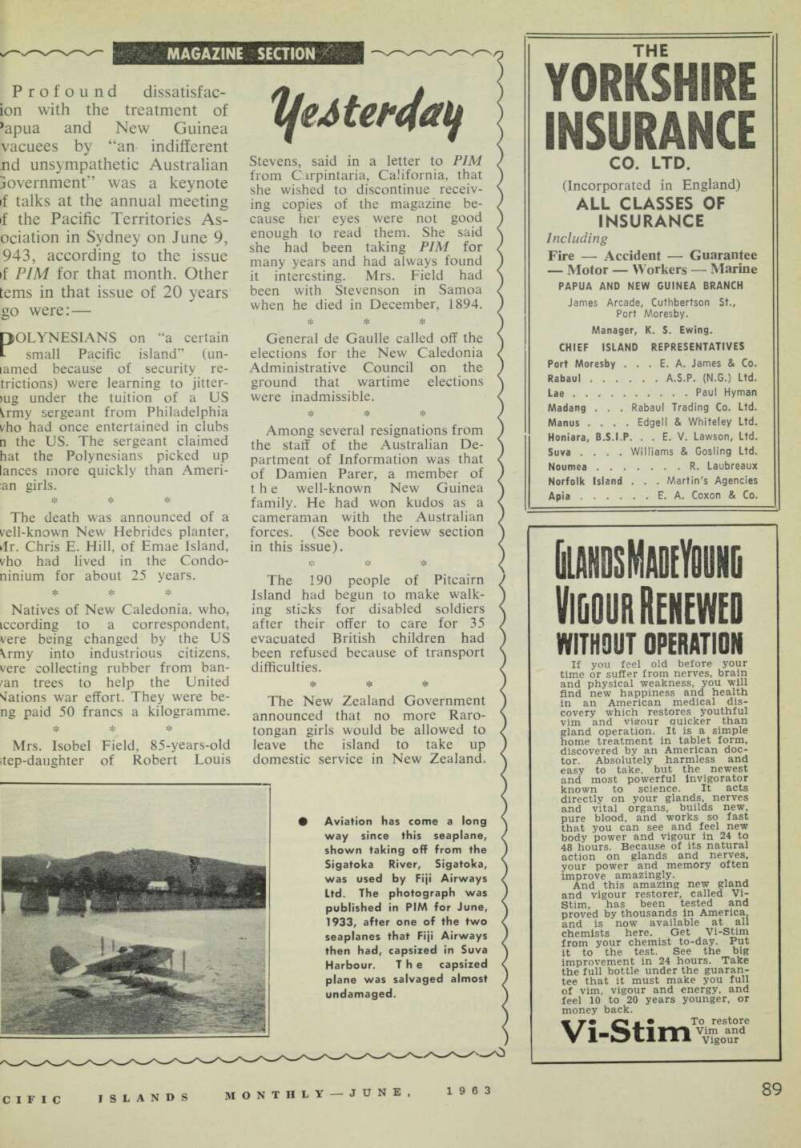
• Aviation has come a long way since this seaplane, shown taking off from the Sigatoka River, Sigatoka, was used by Fiji Airways Ltd. The photograph was published in PIM for June, 1933, after one of the two seaplanes that Fiji Airways then had, capsized in Suva Harbour. The capsized plane was salvaged almost undamaged.