Magazine Section
pp. 83-85 · Read in the full issue
Pacific Islands Monthly
Army Blasters Have Blown The Danger Out Of GEIC Boat Passages
By Captain G. Douglas, Marine Superintendent, Bairiki, Tarawa.
Twelve islands in the Gilbert and Ellice Islands Colony low have safe boat channels into their lagoons thanks to the mthusiasm of a team of Royal Engineers Sappers who have iterally blasted their way through the reefs of the Colony.
HE islands are Nui and Nanu mana in the Ellice Group; nana, Arorae, Bern, Aranuka, rakei, Maiana and Makin in the bert Group; and Hull (Orona), rdner (Nikumaroro) and Sydney mra) in the Phoenix Group.
'he shipping time saved through ig able to work these islands at time will amount to many days the course of a year. •erhaps of more direct interest to average islander is the fact that can now put out in his fishing oe on many days when surf con ons previously made this im sible.
U 1 the islands in the GEIC are icr of the atoll or of the fringing f type. Some atolls have ship sages and vessels can anchor in Itered water inside the lagoons. At ers only boat passages through barrier reef exist and vessels have anchor or drift off, many miles n the landing place.
Landing Difficult
frequently the shore reef inside lagoon is wide, and landing is icult at low tide. )nly some of the fringing reef nds have anchorages—and they invariably precarious. lefore the arrival of the Royal pneers, the boat channels leading oss the reef, if they existed at were generally unsatisfactory. /lost could not be worked except r high tide and all are subject to P hazard. /lost atolls are difficult and all
fringing reef islands are unworkable during westerly weather.
A few isolated pioneering attempts at blasting boat channels across fring ing reefs were made many years ago on one or two of the Ellice Islands.
But it was not until 1960 that a major effort to do this was put in train.
Luckily the interest of the Royal Engineers was enlisted and a team from the Sapper detachment on Christmas Island was able to under take a survey tour of some of the islands where the problem was typical and greatest.
Blasting Feasible
Although little or nothing was known about the uses of explosives on coral reefs, it was decided that improvement by blasting channels would be feasible.
Such a project would have been beyond the Colony’s slender financial resources, but its nature and import ance made it an obvious choice for a Colonial Development and Welfare Fund Scheme and a handsome grant was obtained.
Even so the project would have been difficult had it not been that the Royal Engineers again came to the rescue and agreed to undertake the work.
A period of planning followed be tween the Royal Engineers, the Colonial Office, the Crown Agents for Overseas Governments and Ad ministrations and the GEIC Govern ment.
This was not easy because of the
slowness of communications between Tarawa, Christmas Island and Lon don, (The normal time for airmail from dispatch to receipt is four weeks).
At the UK end, the team had to be picked, stores and explosives chosen and ordered, involved arrange ments made about pay and allow ances, specialist training undertaken, and as much technical information gleaned as was available on the structure of atolls, effects of blast ing on coral, health, diet, etc.
All eight members of the Royal Engineers’ team qualified as aqua lung divers before they left England.
Several also qualified as diving in structors. (Over)
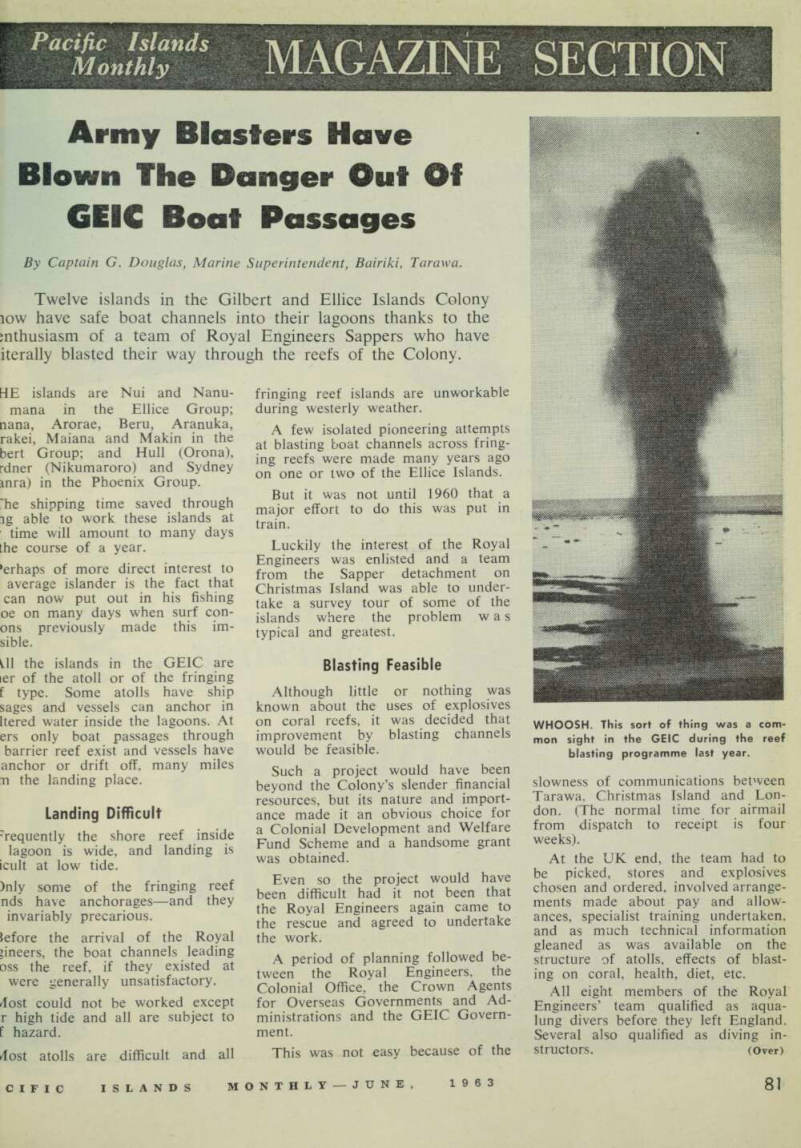
WHOOSH. This sort of thing was a com mon sight in the GEIC during the reef blasting programme last year.
leanwhile, the Colony Govern it had to plan shipping itineraries, e land for storing explosives, d magazines, and arrange for :ers of the Administration and he Medical Department to accom y the team. ine of the most complex problems the delivery to the Colony of big quantity of explosives re ed. Here again events conspired irovide a lucky break. . new vessel for the Colony Gov nent was under construction in ig Kong and was due for corn ion at a convenient time, so the [osives were shipped from the ted Kingdom to Hong Kong in j to connect with the delivery ige of this vessel, RCS Nivanga. he timing turned out to be ideal, explosives arrived in Tarawa just >re the arrival of the Royal En er team. Other stores arrived lin a few days and by early ch, 1962, the team, explosives stores were ready at Tarawa, en islands in the Gilbert, Ellice Phoenix groups were chosen for rovement on the basis of neces feasibility and economic :ntial.
Hazardous Channels 'fith one exception, the intention to create or improve boat mels across fringing reefs where ling had always been difficult and uently hazardous even for canoes, he exception was Aranuka, where ■udimentary natural channel ady existed through the barrier into the lagoon. But this channel narrow and tortuous, and was imbered with coral heads, which esented a grave danger to iches and boats attempting to Jtiate the passage through which
runs a tidal current of up to six knots.
The first island at which improve ment was undertaken was Nui, in the central Ellice Islands, 550 miles from Tarawa.
En route, explosives were dumped at other islands included in the pro ject so that the Royal Engineers, now known as “The Blasters”, could work their way back towards Tarawa with out being saddled with explosives.
The ship could thus carry other cargo and passengers on subsequent voyages.
The first projects were largely ex perimental, to devise suitable tech niques for blasting coral.
Different Structures It was found that the fringing reef flats appeared somewhat similar at all the islands, while varying in width from 120 yards at one to 470 yards at another. But the structure of these flats, normally covered at high water and bare at low water, differed considerably.
A common feature is that there is a surface layer of hard, dense coral 15 inches to 2 ft thick, below which there is a less dense layer. In some cases this consists of branch coral with open interstices, in others of brittle branches, sand and mud.
One to two feet below this again is a second hard layer.
Blasting techniques had to be ad justed to suit the nature, hardness and thickness of the top layer. Vari ous methods were devised, such as drilling patterns of boreholes (mechanically or by hand). These were filled with plastic explosive and fired to produce overlapping craters; firing shaped (beehive) charges to produce holes within which secondary charges could be placed; and firing
surface charges to break up the sur face into fragments.
The channels created were 15 to 20 ft wide and 2 to 3 ft below the adjacent reef surface, giving a depth of water sufficient for surfboats to reach the turning pool at the inshore end at all states of normal tides.
Shelving Chutes
At the icef edges shelving chutes or funnels were created to reduce the energy of the waves and surf.
The technique used at Aranuka was, of course, different. Charges were anchored around the coral heads along the axis of the channel and fired simultaneously to provide a clear passage.
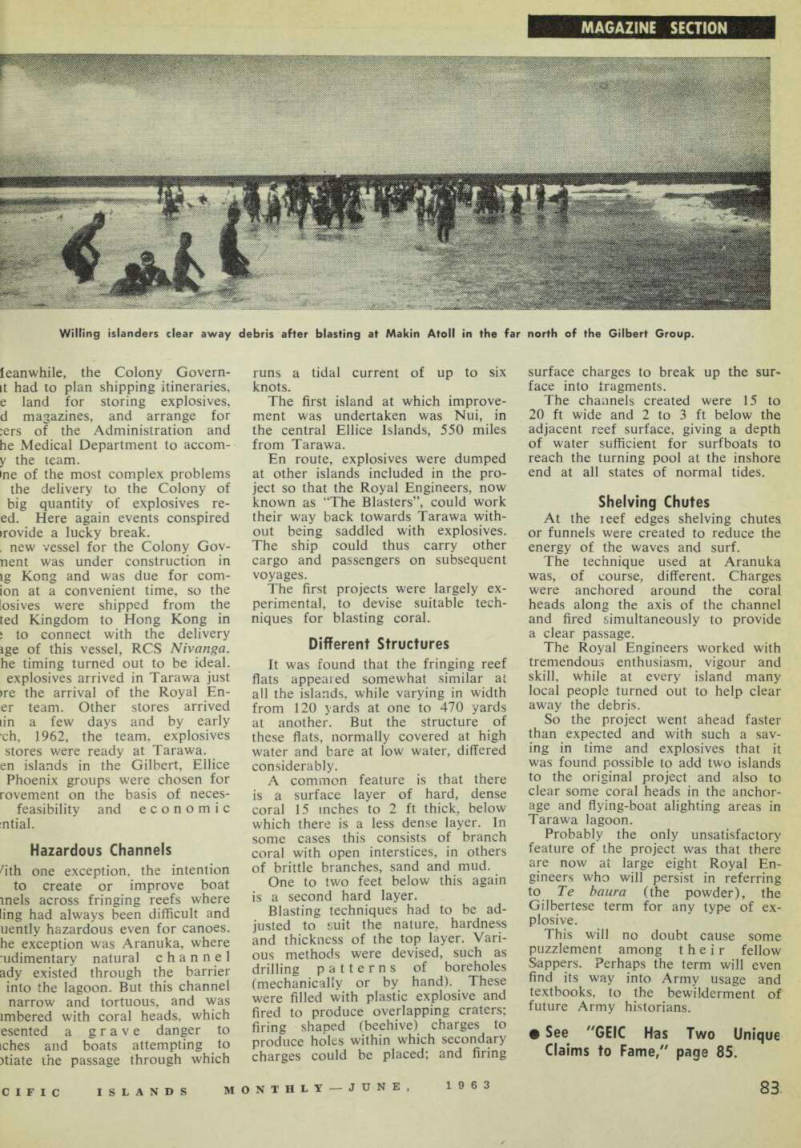
The Royal Engineers worked with tremendous enthusiasm, vigour and skill, while at every island many local people turned out to help clear away the debris.
So the project went ahead faster than expected and with such a sav ing in time and explosives that it was found possible to add two islands to the original project and also to clear some coral heads in the anchor age and flying-boat alighting areas in Tarawa lagoon.
Probably the only unsatisfactory feature of the project was that there are now at large eight Royal En gineers who will persist in referring to Te baura (the powder), the Gilbertese term for any type of ex plosive.
This will no doubt cause some puzzlement among their fellow Sappers. Perhaps the term will even find its way into Army usage and textbooks, to the bewilderment of future Army historians. • See "GEIC Has Two Unique Claims to Fame/' page 85.
Willing islanders clear away debris after blasting at Makin Atoll in the far north of the Gilbert Group.