Yesterday
p. 83 · Read in the full issue
Guinea. Thirty-two planters were to return to Port Moresby in about a month.
SK A resident of the north coast of New Guinea complained that “so called” war correspondents who went to the Territory should un dergo a course of geography be fore departure. He said they made fantastic errors over place names.
In fact, whenever they tried to write about the country itself, as distinct from war operations, they “made themselves ridiculous”. * * * The Government of Fiji an nounced that it required at least 1,000 Indian volunteers for the de fence of Fiji. If the Indians were not recruited by June 1, compul sory national service of Indians would be enforced. * * * An advertisement about the arrival of dress materials in a goods-starved Suva store had caused a near-riot. The shop had had to close on the morning after the advertisement was published, and a police guard had had to ward off a horde of Suva’s fem inine community. * * * A new regulation in Fiji which prohibited the receiving or sending away of either used or unused postage stamps was being hotly criticised by Fiji philatelists. The Government had given no reason
SOME form of war damage in surance for the protection of British territories was being con sidered when PIM was published 20 years ago. Fiji was expected to lead the way with a new set of laws to cover insurance for Fiji.
Other territories expected to have war insurance were Tonga, the New Hebrides (neither of which suffered war damage), the Solo mons and the Gilbert and Ellice Groups. Other events reported in PIM for May, 1943, were:— The Rev. L. D. Fullerton (now chairman of the Fiji Indian Dis trict of the Methodist Mission) was accepted for service with the Methodist Overseas Mission in Fiji. «f» It was announced in April that American forces had occupied Funafuti in the Ellice Islands “some time ago”. It was also re ported that American forces had twice raided Japanese establish ments at Nauru and Tarawa, Gil bert Islands. * * * Brigadier D. M. Cleland, of Western Australia, was appointed chairman of the Production Con trol Board, which was to take over from ANGAU all matters re lating to production in New
for the regulation, and the stamp collectors could not imagine what purpose it served. Some thought it had something to do with cen sorship; others that it was an at tempt to conserve Government paper. * * * Banana exports from Western Samoa were decreasing because planters could get better prices for fruit of indifferent quality on the local market than they could for the high quality fruit required for export. The export price was 5/6 a case. * * ♦ Joesoep, a well-known charac ter among New Caledonia’s Javanese, ended on Pam Islet, off the northern tip of New Cale donia, after he had drifted for 23 days in a launch he had taken from Mare Island, in the Loyalty Group. Joesoep had hoped to cross the 80 miles from Mare to New Caledonia, but the currents drifted him north-westwards along the whole 250 miles of the New Caledonian coast. * * * A strange epidemic of “cat cholera” which swept Tahiti in January and February had sub sided, after having wiped out about three-quarters of the cat population. Most of the victims were cats that were not fully grown.
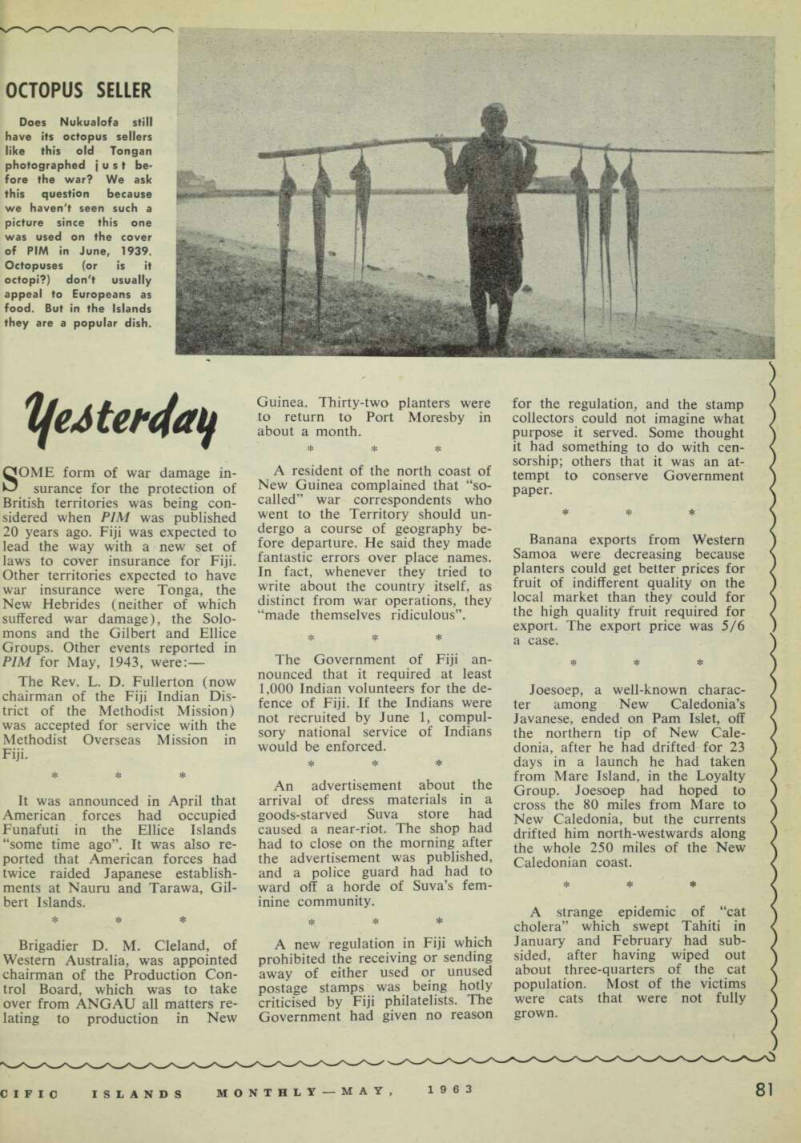
Octopus Seller
Does Nukualofa still have its octopus sellers like this old Tongan photographed just be fore the war? We ask this question because we haven't seen such a picture since this one was used on the cover of PIM in June, 1939.
Octopuses (or is it octopi?) don't usually appeal to Europeans as food. But in the Islands they are a popular dish.