Forbidden Bath Led
p. 85 · Read in the full issue
To King’s Death
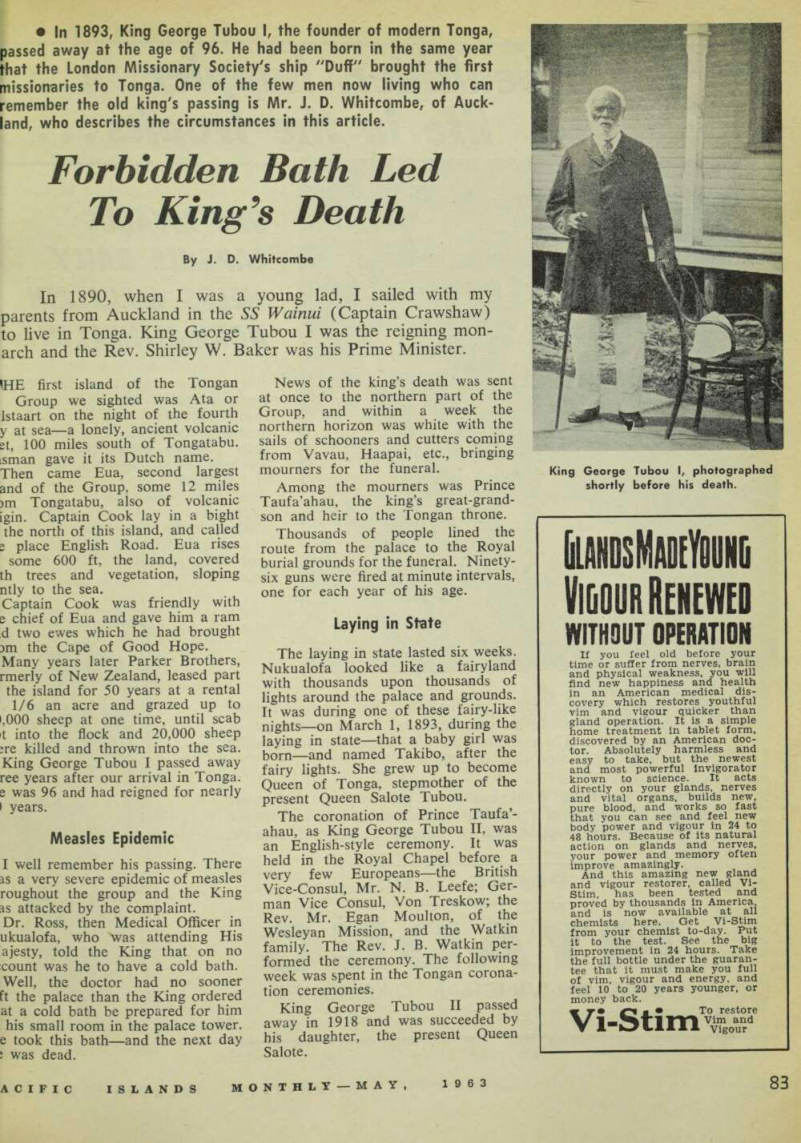
• In 1893, King George Tubou I, the founder of modern Tonga, passed away at the age of 96. He had been born in the same year that the London Missionary Society's ship "Duff" brought the first missionaries to Tonga. One of the few men now living who can remember the old king's passing is Mr. J. D. Whitcombe, of Auck land, who describes the circumstances in this article.
By J. D. Whitcombe
In 1890, when I was a young lad, I sailed with my parents from Auckland in the SS Wainui (Captain Crawshaw) to live in Tonga. King George Tubou I was the reigning mon arch and the Rev. Shirley W. Baker was his Prime Minister.
IHE first island of the Tongan Group we sighted was Ata or Istaart on the night of the fourth yat sea—a lonely, ancient volcanic et, 100 miles south of Tongatabu. isman gave it its Dutch name.
Then came Eua, second largest and of the Group, some 12 miles >m Tongatabu, also of volcanic igin. Captain Cook lay in a bight the north of this island, and called 2 place English Road. Eua rises some 600 ft, the land, covered th trees and vegetation, sloping ntly to the sea.
Captain Cook was friendly with e chief of Eua and gave him a ram and two ewes which he had brought 3m the Cape of Good Hope.
Many years later Parker Brothers, rmerly of New Zealand, leased part the island for 50 years at a rental 1/6 an acre and grazed up to i,OOO sheep at one time, until scab >t into the flock and 20,000 sheep ire killed and thrown into the sea.
King George Tubou I passed away ree years after our arrival in Tonga, e was 96 and had reigned for nearly » years.
Measles Epidemic
I well remember his passing. There as a very severe epidemic of measles roughout the group and the King as attacked by the complaint.
Dr. Ross, then Medical Officer in ukualofa, who was attending His ajesty, told the King that on no count was he to have a cold bath.
Well, the doctor had no sooner ft the palace than the King ordered at a cold bath be prepared for him his small room in the palace tower, e took this bath—and the next day ; was dead.
News of the king’s death was sent at once to the northern part of the Group, and within a week the northern horizon was white with the sails of schooners and cutters coming from Vavau, Haapai, etc., bringing mourners for the funeral.
Among the mourners was Prince Taufa’ahau, the king’s great-grand son and heir to the Tongan throne.
Thousands of people lined the route from the palace to the Royal burial grounds for the funeral. Ninety six guns were fired at minute intervals, one for each year of his age.
Laying in State The laying in state lasted six weeks.
Nukualofa looked like a fairyland with thousands upon thousands of lights around the palace and grounds.
It was during one of these fairy-like nights—on March 1, 1893, during the laying in state —that a baby girl was born —and named Takibo, after the fairy lights. She grew up to become Queen of Tonga, stepmother of the present Queen Salote Tubou.
The coronation of Prince Taufa’ahau, as King George Tubou 11, was an English-style ceremony. It was held in the Royal Chapel before a very few Europeans —the British Vice-Consul, Mr. N. B. Leefe; Ger man Vice Consul, Von Treskow; the Rev. Mr. Egan Moulton, of the Wesleyan Mission, and the Watkin family. The Rev. J. B. Watkin per formed the ceremony. The following week was spent in the Tongan corona tion ceremonies.
King George Tubou II passed away in 1918 and was succeeded by his daughter, the present Queen Salote.
King George Tubou I, photographed shortly before his death.