First Settlers Of
p. 81 · Read in the full issue
Were Pygmies The
Norfolk Island?
By Robert Langdon
Most people who know anything about the Pacific believe that when Captain Cook discovered Norfolk Island in 1774, he was the first man ever to set foot on it.
THERS, perhaps, vaguely remem ber reading somewhere that dence has been found on the ,nd to indicate that it was once abited by Polynesians. lut even the most learned an opologists do not seem to know t Norfolk was apparently settled g before the advent of the Poly ians—possibly by the same ne id people who settled Tasmania usands of years ago.
Recently, while doing some re rch at Sydney’s Mitchell Library, ame across three letters, written the 1790’5, which suggest that this > the case.
"he letters were written by Philip lley King, Commandant and later utenant-Governor of Norfolk ,nd from 1788 to 1796, who es tished the island’s first penal lement. As far as I know, none these letters has ever been pub ed.
'he first letter, written in Sydney October 25, 1790, to the famous □ralist Sir Joseph Banks, spoke “some stone axes, chizzles and er tools” that had been found derground some depth in the in or part of Norfolk Island”.
Plantain Trees 'hese articles, King thought, ved that the island had formerly n inhabited. “Indeed,” he said, always thought so from the plan i trees which now bear fruit and many as can be consumed.” n another letter to Banks from rfolk on May 8, 1792, King said was sending Banks a stone axe a box, and that other hatchets nd on Norfolk had been “carried ne earlier.”
Cing went on to speak about Nor m’s bananas, which, he said, had iderfully multiplied and were “as d as any generallly met with.” ;rtainly these trees are not indi ous,” he said.
Cing’s third letter, of May 29,
1793, was addressed to “Mr. Secre tary Dundas,” and told how two Maoris, who had been brought to Norfolk from New Zealand, had been shown some of the stone axes that had been found there.
King said that the Maoris had “expressed great pleasure” on see ing these axes and had “made us understand that they were well acquainted with them, and convinced us that they are the same as the stones axes made and used in New Zealand.”
"Probable Proof"
King added: “This circumstance, added to that of the great number of banana trees and the cane found here on my first landing, is a very probable proof of this island hav ing been formerly inhabited.”
According to an article in the Journal of the Polynesian Society of 1929, King also described the finding of a canoe at Norfolk in a letter dated May 24, 1793, which is now in the National Library, Can berra.
The same article said that a Mr.
H. N. Hiskens had dug up a “large, ground-edged implement” on Mr.
T. E. Adams’ property in the in terior of the island, about 500 ft. above sea level. It also reported that a Mr. H. R. Rabone had found a number of small adzes “in the process of being fashioned” in the sand dunes at Emily Bay.
Other adzes were found on Nor folk following a cyclone which swept the island in May, 1936, and were described in a news item in PIM for July of that year.
In the light of all these dis coveries, it is obvious that Norfolk Island was inhabited for a time in pre-European times. But what is not so obvious is: Where did all the early settlers come from?
Because of the similarity between the stone axes found in King’s time and those of New Zealand, and because Captain Cook found flax
and other plants common to New Zealand growing on the island, it would seem that at least some of the early settlers were Polynesians, from New Zealand.
But how does one account for the bananas, which King claimed were, not indigenous? These could not have come from New Zealand, as. that country is too cold for bananas.
So where did they come from?
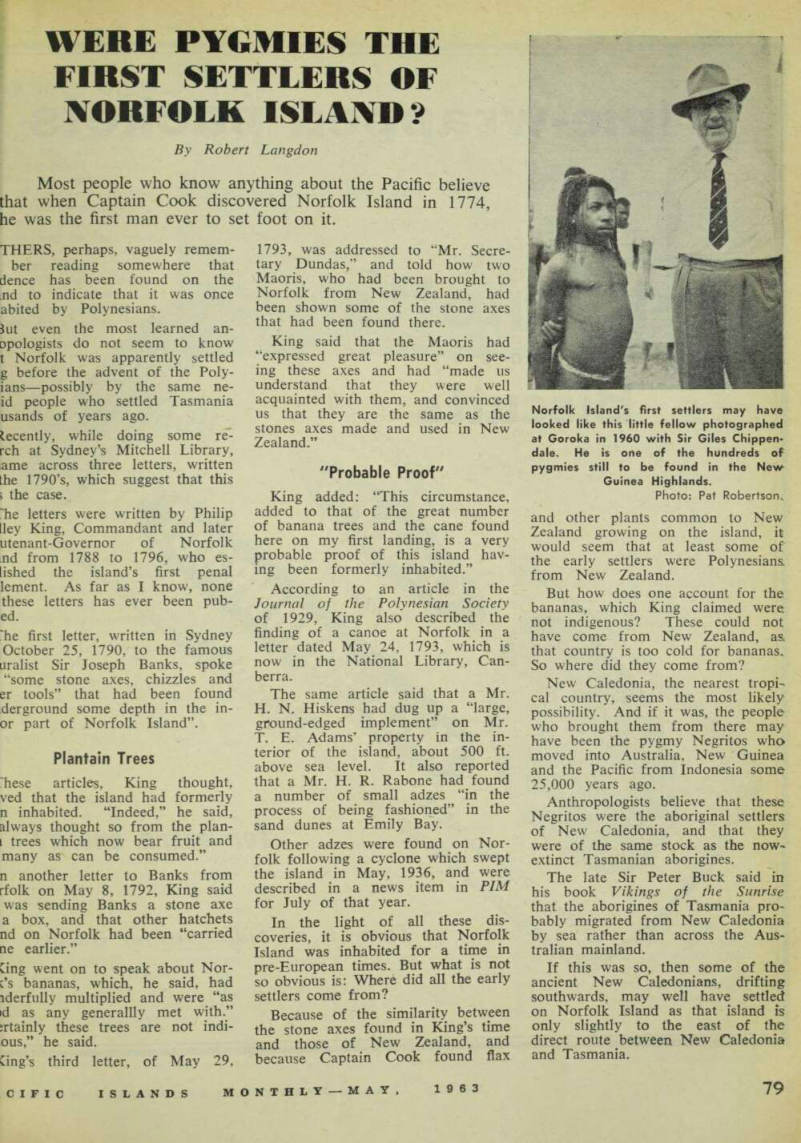
New Caledonia, the nearest tropi cal country, seems the most likely possibility. And if it was, the people who brought them from there may have been the pygmy Negritos who moved into Australia, New Guinea and the Pacific from Indonesia some 25,000 years ago.
Anthropologists believe that these Negritos were the aboriginal settlers of New Caledonia, and that they were of the same stock as the now extinct Tasmanian aborigines.
The late Sir Peter Buck said in his book Vikings of the Sunrise that the aborigines of Tasmania pro bably migrated from New Caledonia by sea rather than across the Aus tralian mainland.
If this was so, then some of the ancient New Caledonians, drifting southwards, may well have settled on Norfolk Island as that island is only slightly to the east of the direct route between New Caledonia and Tasmania.
Norfolk Island's first settlers may have looked like this little fellow photographed at Goroka in 1960 with Sir Giles Chippen dale. He is one of the hundreds of pygmies still to be found in the New Guinea Highlands.
Photo: Pat Robertson.