Papua's "Last
p. 80 · Read in the full issue
Frontier"
Lang in September, 1962, says that in many cases the people of one hamlet in the area seem to be un aware of the existence of another settlement within four hours walk of their own homestead area.
But all the tribes are acutely aware of the location and activities of the Biamis as they are feared as warlike raiders.
The Nomad River country was first visited by the Hides and O’Malley exploratory patrol in 1935, and by the C. Champion and Turner patrol four years later.
However, these patrols merely passed through part of the region and saw very few people.
The next patrol was made in 1947 by Mr. D. J. Clancy, now Acting District Commissioner, at Sohano, Bougainville; and in 1953, Patrol Officer D. Calder visited the area.
Extended Patrol In 1959, Assistant District Officer B. Mcßride made an extended patrol, which included the Biami region where the people’s attitude varied from evading contact to outright hos tility. Some of the younger men made a show of force, and it was obvious that the Biamis wanted the patrol out of their area. The young warriors were eager to attack, but the older men counselled caution.
Good relations have been estab lished with the other tribal groups in the Nomad country, and some are already cutting patrol tracks and ob taining bush timber for the erection of patrol rest houses.
However, none would accept em ployment on airstrip construction and other work at the station either for cash wages or steel, though axes and knives represent wealth to these people who still use stone axes to clear heavy timber for garden plots.
Mr. Hoad says they are obviously unaccustomed to work and are dis inclined to acquire the ability.
There is almost no steel in the area, and although the people won’t work for it, there have been blatant thefts of axes and knives from patrols and an attempt to break into the station store.
The lack of steel and other trade goods confirms the theory that the Nomad people have no contacts with those of other areas who obtain steel along traditional native trade routes.
Although some of the men from
most of the tribal groups have visited the station periodically, there has been only one party of about 12 Biamis, all young warriors, who ap peared in January last year.
Mr. Lang, who was then QIC at the station, said their sole intention was to reconnoitre the post, and they thoroughly explored the place. They made no attempt to be friendly and seemed surly and suspicious.
No Interpreter
Mr. Lang was unable to talk to them as no interpreter then available understood the Biami language. At dusk the party disappeared into the bush and since then no Biami has been seen at or near the station.
Patrolling into the Biami country will start when Administration in fluence has been consolidated in other areas where most of the population live.
Throughout the Nomad country the people live in large communal houses about 60 ft. long and 25 ft. high with a raised floor. In some hamlets all the people live in the one com munal house.
Inside, the houses are dark and there is no ventilation. Mr. Hoad says those seen so far are extremely dilapidated. He says these communal homesteads may have been built to serve as a tribal fortress against attack, but they are not being main tained and are just about falling to pieces.
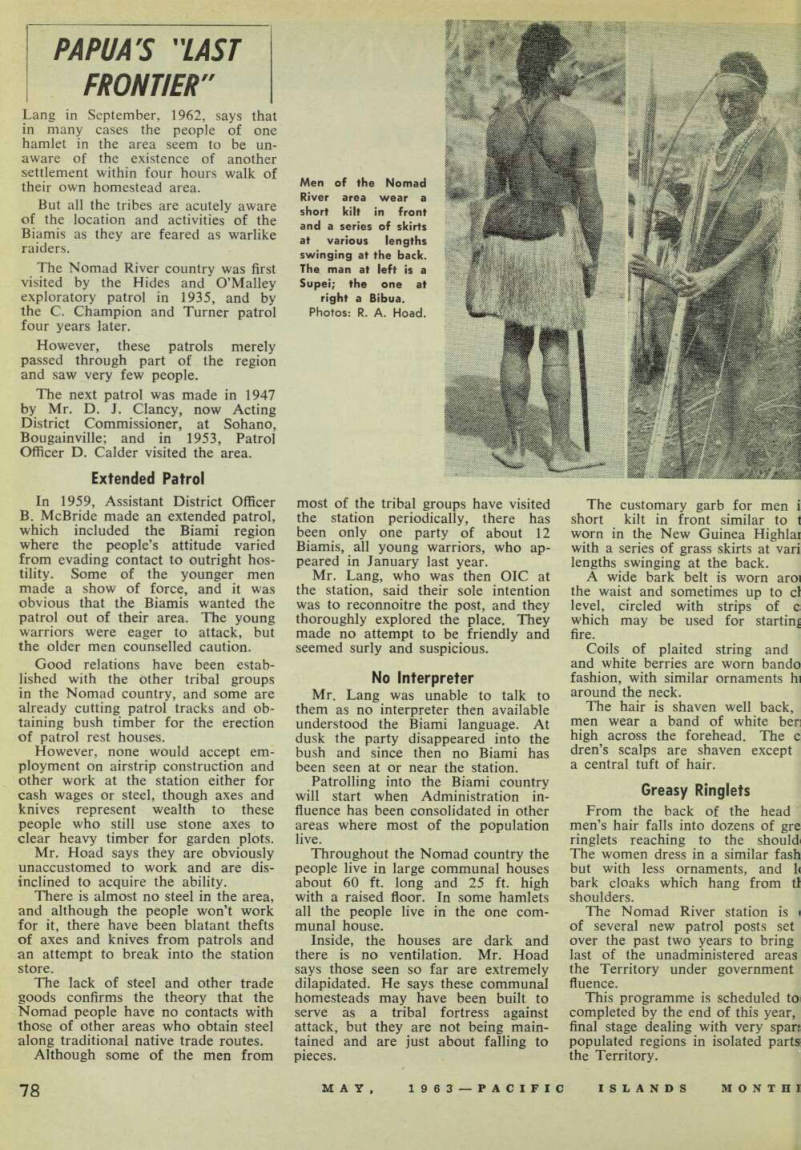
The customary garb for men i short kilt in front similar to t worn in the New Guinea Highlai with a series of grass skirts at vari lengths swinging at the back.
A wide bark belt is worn aroi the waist and sometimes up to cl level, circled with strips of c which may be used for starting fire.
Coils of plaited string and and white berries are worn bando fashion, with similar ornaments hi around the neck.
The hair is shaven well back, men wear a band of white ber high across the forehead. The c dren’s scalps are shaven except a central tuft of hair.
Greasy Ringlets
From the back of the head men’s hair falls into dozens of gre ringlets reaching to the should' The women dress in a similar fash but with less ornaments, and 1< bark cloaks which hang from tl shoulders.
The Nomad River station is • of several new patrol posts set over the past two years to bring last of the unadministered areas the Territory under government fluence.
This programme is scheduled td completed by the end of this year, final stage dealing with very spars populated regions in isolated parts the Territory.
Men of the Nomad River area wear a short kilt in front and a series of skirts at various lengths swinging at the back.
The man at left is a Supei; the one at right a Bibua.
Photos: R. A. Hoad.