Magazine Section
p. 79 · Read in the full issue
Pacific Islands Monthly
Patrol Officers Move
Into "Last Frontier"
Area Of Papua
By J. K. McCarthy, Director of Native Affairs in Papua-New Guinea.
Officers of the P-NG Native Affairs Department have recently completed the long and difficult task of establishing a patrol post in the isolated Nomad River country east of the Strickland and 200 miles north west of Daru in the Western District of Papua.
The area is the home of the Supei, Daba, Gebusi, Alibu, Bibua and Biami tribes. The Biami are a war like raiding group.
Until now, most of the natives have kept strictly within their own areas, neither making nor seeking con tacts outside their tribal boundaries.
HE Nomad River Post has been established to administer a large lated area of country with a very rse and scattered population of li-nomadic people. These groups re had almost no contact with other >es as they are cut off by un abited country. fheir only affinity is with the savi people to the south-east, them es a semi-nomadic type keeping their own tribal grounds, Access from the west is only sible along turbulent rivers and ough “hungry” country where it not possible to obtain any type local food except for an occasional id of wild sago. fo the north are the Central ages, and to the south is the Great man Plaeau, a desolate “no man’s d”.
Vork on the construction of the rol post and an airstrip started December 24, 1961, when Acting distant District Officer M. Lang ched the Nomad River after an tit-day overland journey from mga on the Upper Fly River, fhe project was difficult because local labour or local foodstuffs re available, and nearly 200
labourers had to be taken overland from Kiunga.
Fortnightly airdrops were made to get food and other supplies to the new station.
The only suitable site for an air strip was in heavy rain forest, involv ing extensive timber clearing and stumping, and the movement of more than 12,000 cubic yards of earth for benching and filling the strip.
Deep drains had to be cut and stone-lined to ensure proper drainage, and finally the runway planted with grass to get a satisfactory surface.
Later extension of the runway will require movement of another 13,000 cubic yards of earth.
Many Hazards
Basic camp equipment and supplies which could not be dropped by air craft, were moved by powered canoe up the Elevala and Rentoul Rivers, swift-flowing streams presenting many hazards to canoe travel because of driftwood and snags.
The officer responsible for the transport of equipment and carriers from Kiunga said it “was no picnic getting canoes loaded with carriers and bulk stores up the rivers”. He
said there were some tense moments when strong currents made headway impossible and the canoes were swept backwards downstream.
So far the new patrol post com prises very temporary native material buildings erected quickly to provide shelter during construction of the airstrip, the first essential to ensure regular supplies by air.
The runway, at present suitable for Cessna planes, was opened last January, and work has now started on extending the strip to take it to Piaggio standard and later DC3.
Another task is to build better type native material houses for the station staff, a District Office, bulk store and other essential buildings.
Simultaneously, Native Affairs staff will start regular patrolling through out the area.
Patrol Officer R. A. Hoad, who took over station construction from Acting Assistant District Officer M.
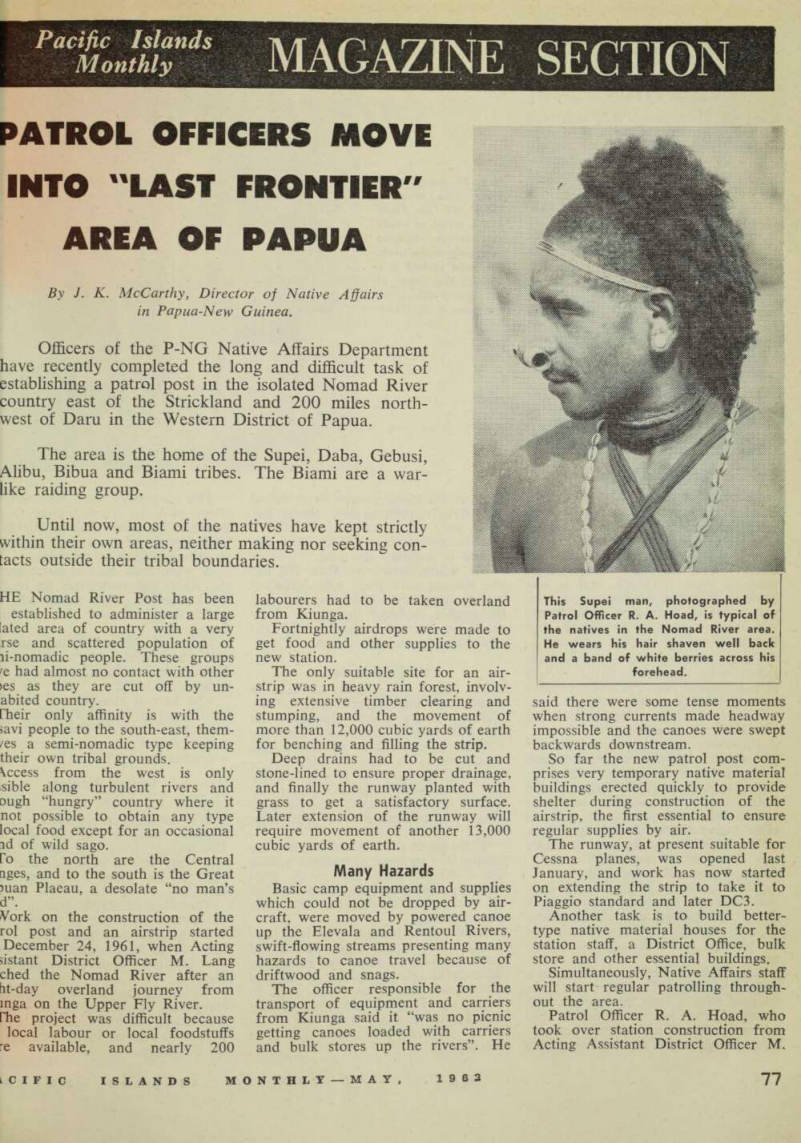
This Supei man, photographed by Patrol Officer R. A. Hoad, is typical of the natives in the Nomad River area.
He wears his hair shaven well back and a band of white berries across his forehead.