Gallows
p. 95 · Read in the full issue
The Month S New Reading
From Quarterdeck To
Since John Knatchbull, son of a British baronet and a rela tive of Sir Joseph Banks, was hanged in Sydney in 1844 for murder, he has figured in everything written about him as a villain. It now turns out he was not as black as was painted.
The fellow was a “psycho case”, and in these enlightened days he probably would have escaped the hangman.
3IS is the main message of a book launched in Sydney in rch, amid a splurge of publicity. ;ures and photostats were cir ited to reviewers, advance articles ut the book—with such ggerated headlines as “Was he the ickiest man in all our history?”— eared in the newspapers, and the the book came out leading ney citizens were entertained with ctails in the old Woolloomooloo >1 outside of whose walls itchbull had been publicly hanged years previously.
Not Ned Kelly r. Colin Rodericks John Knatch (from Quarterdeck to Gallows ) plenty of interest for students of traliana. It is doubtful if it has general appeal its publishers ously think it has, for John tchbull does not enjoy the popu notoriety of a Ned Kelly, and average Australian probably n’t care a jot whether Knatchbull a dastardly dog or a misunder i nut, hn Knatchbull was an educated , who had commanded a man o’ for the Royal Navy in Nelson’s
day. He was transported to Aus tralia in 1824, at the age of 34, for stealing—and there seems to be evidence that his sentence was much more severe than it should have been because the judge was biased against him. Knatchbull himself blamed his brother for influencing the judge.
Knatchbull spent 19 years in NSW, including seven, from 1832 to 1839, at Norfolk Island under Major Joseph Anderson, a tyrant whom Dr.
Roderick helps paint in his true colours.
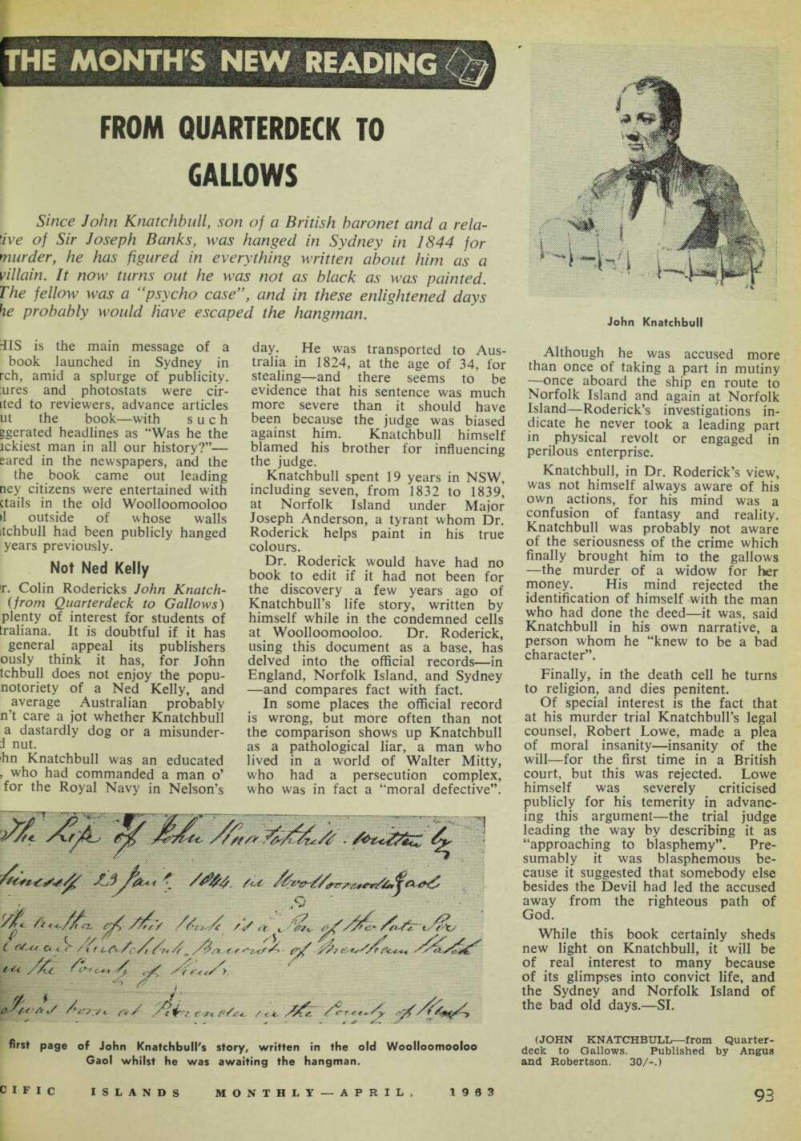
Dr - Roderick would have had no book t 0 edit if it had not been for the discovery a few years ago of Knatchbull’s life story, written by himself while in the condemned cells at Woolloomooloo. Dr. Roderick, using this document as a base, has delved into the official records—in England, Norfolk Island, and Sydney —and compares fact with fact.
In some places the official record is wrong, but more often than not the comparison shows up Knatchbull as a pathological liar, a man who lived in a world of Walter Mitty, who had a persecution complex, who was in fact a “moral defective”.
Although he was accused more than once of taking a part in mutiny —once aboard the ship en route to Norfolk Island and again at Norfolk Island—Roderick’s investigations in dicate he never took a leading part in physical revolt or engaged in perilous enterprise.
Knatchbull, in Dr. Roderick’s view, was not himself always aware of his own actions, for his mind was a confusion of fantasy and reality.
Knatchbull was probably not aware of the seriousness of the crime which finally brought him to the gallows —the murder of a widow for her money. His mind rejected the identification of himself with the man who had done the deed—it was, said Knatchbull in his own narrative, a person whom he “knew to be a bad character”.
Finally, in the death cell he turns to religion, and dies penitent.
Of special interest is the fact that at his murder trial Knatchbull’s legal counsel, Robert Lowe, made a plea of moral insanity—insanity of the will—for the first time in a British court, but this was rejected. Lowe himself was severely criticised publicly for his temerity in advanc ing this argument—the trial judge leading the way by describing it as “approaching to blasphemy”. Pre sumably it was blasphemous be cause it suggested that somebody else besides the Devil had led the accused away from the righteous path of God.
While this book certainly sheds new light on Knatchbull, it will be of real interest to many because of its glimpses into convict life, and the Sydney and Norfolk Island of the bad old days.—Sl. (JOHN KNATCHBULL—from Quarter deck to Gallows. Published by Angus and Robertson. 30/-.)
first page of John Knatchbull's story, written in the old Woolloomooloo Gaol whilst he was awaiting the hangman.
John Knatchbull