Volcanic Island
pp. 91-93 · Read in the full issue

Wanted: One Barren,
To Be Landlords Of
By a Staff Writer
Two European residents of the New Flebrides have given officials of the Joint Court in Vila a minor headache by lodging a claim to the title over Matthew Island, a barren, volcanic islet about 150 miles south-east from Aneityum.
HE two residents are Mr. Bob Paul, an Australian, of Tanna, J a Mr. Martinez, a Frenchman, Vila. They have not told court [dais why they want a title to the md. In fact, when asked, they ; reported to have “just laughed”.
Dn the face of it, any ambition become landlords of Matthew and is only a laughing matter, :ause, as a piece of real estate, i island is one of the most useless reels of land in the South Pacific, [t is miles from anywhere. There no water on it. It has no vegeta n except grass, and no animal life art from crabs and sea birds.
Besides all this, it is volcanically ive—so much so that its appear :e has altered several times in the it few years.
Still, there is nothing to stop any ; who wants to from laying claim such a place, and it is the busi ts of the Joint Court to sit in Igment on land claims in the New brides. rhis is where the headache comes for neither the Joint Court nor pone else has any idea whether itthew Island is in the New brides or not.
Vulcanologists say that it is part that Group, but the few reference oks that bother to mention it say is part of New Caledonia, rhe convention of 1906 between ance and Great Britain on the joint ministration of the New Hebrides es not throw any light on the
matter, as it does not define what the Group consists of.
The reference books are of no real help either, as they do not say how, when or why New Caledonia took Matthew Island under its admini strative wing.
However, as the island is value less and difficult to land on, it seems probable that no one from New Caledonia has ever planted the French flag on it and taken formal possession.
It is understood that the Joint Court has referred the matter of sovereignty to London and Paris in the hope that someone there has a dossier of information about it.
If these inquiries should reveal that no one has, in fact, physically taken possession of the island and that New Caledonia’s claim is merely based on an official proclamation, then a complex problem in inter national law could arise.
The problem is: Can a nation annex an island simply by saying it is theirs? If not, then who does own Matthew Island?
Probably the only body competent to deal with this question is the International Court of Justice at The Hague. And one can imagine learned lawyers arguing their heads off for years before this august body without really convincing anyone, as there is no international agreement on what a nation must do to obtain sovereignty over unoccupied lands or islands.
The United States view, announced
in 1938 when the question of sovereignty over several Central Pacific Islands arose, is that: • First claim to title over un discovered territory rests on dis covery. • But if discovery is not followed up by “reasonable occupation”, this is insufficient. • The United States has the right to occupy any island because of (a) discovery, (b) former occupation, (c) failure of any other nation to occupy, or a combination of the three.
The British view seems to be that the planting of a flag and/or the erection of a “this is ours” notice is sufficient to establish sovereignty.
This is all that has happened in the case of several uninhabited Pacific islands which Great Britain claims, among which are Oeno, Henderson and Ducie Islands in the vicinity of Pitcairn Island.
As far as is known, no one has ever lived on Matthew Island. So, according to the United States view, the first claimant to the title over the island would be Great Britain as its discoverer, Captain Thomas Gilbert, was an Englishman.
Captain Gilbert, who also dis covered the Gilbert Islands, was a merchant seaman whose ship, Charlotte, was part of the First Fleet which brought the first convicts to Australia in 1788.
The ship was owned by a man called Matthew who chartered it to the British Government as a convict transport. After the convicts were landed in Sydney, Captain Gilbert made a voyage to Canton to collect a cargo of merchandise to take back to England. It was on this voyage that Matthew Island was discovered and named after the Charlotte’s owner.
Gilbert sighted the island after a squall at 1 p.m. on May 27, 1788, and at 6 p.m. it bore east and was four or five miles distant.
“It appeared like a high rock ris ing out of the water,” Gilbert wrote, “and seemed to be about five or six miles in circumference. The top of it appeared to be fertile; and I
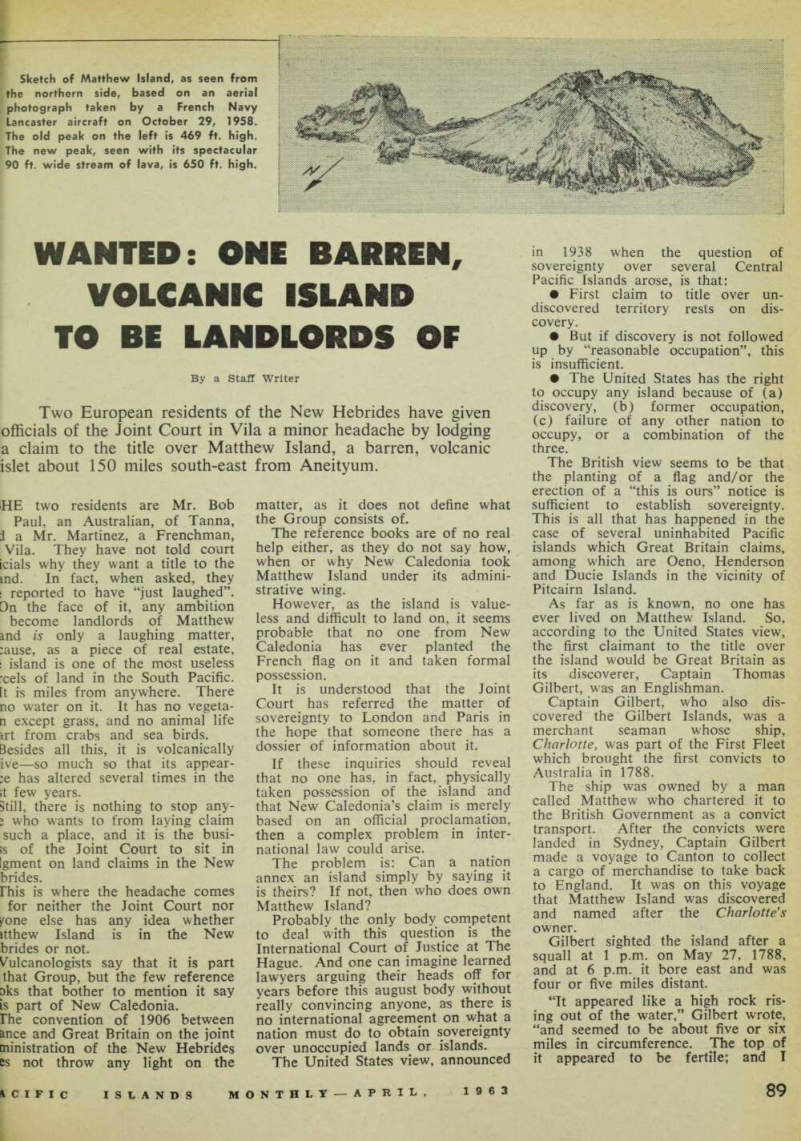
Sketch of Matthew Island, as seen from the northern side, based on an aerial photograph taken by a French Navy Lancaster aircraft on October 29, 1958.
The old peak on the left is 469 ft. high.
The new peak, seen with its spectacular 90 ft. wide stream of lava, is 650 ft. high.
ought I saw something on it which id the resemblance of an animal eding It was surrounded on all les w,th a great variety of b.rds At seven wore ship to the southird and made short tacks fore d on, intending to land in the arning in order to take possession it and to procure refreshments lich we stood much in need of; t finding at daylight that the rrent had set considerably to leeird, and the sea running very high, did not think it prudent to get a at out.”
Captain Gilbert thus failed to fulfil eat Britain’s present-day ideas on at is necessary to establish r ereignty over the island. But if tain tvanted to occupy the island some purpose, no doubt Captain bert’s act of discovery would be d as a strong argument in support her right to do this. )n the other hand, if the United tes wanted to occupy the island, vould no doubt claim that it had ry right to do so as Gilbert’s :overy was not followed up by asonablc occupation”, n view of all this, where do ssrs. Paul and Martinez stand in ard to their claim to Matthew n d? t would seem that: ► In applying to the Joint Court Vila, they are applying to the mg body for a title to the island, sovereignty is already claimed by nee, and its administration (such
as it is) is in the hands of the New Caledonian Government , If th wish avoid djs ti French so y vereigm the ° X>, U a , to the appr * pr y iate co y rt ia Caledonia ‘ T . ’ r- * u re P re P t 0 dispute French sovereignty, then they would ~, ave to apply to the International Court of Justice, • If they wanted to make out a strong case for themselves before the International Court, the best thing to do would be to occupy Matthew Island, renounce their present citizen ship, and declare themselves Matthew Islanders and heads of a Matthew Island Government. (This, at any rate > might give them the support of the United States!) To occupy the island would not be an easy matter. For one thing, it is away from the regular trade routes, so it would be necessary to charter a ship to get to it.
Secondly, as there is nothing to live on except crabs, grass, seabirds and possibly fish, prospective colonists would have to take their own food with them or be prepared to live an extremely hard and under nourished life. They would have to take clothing and building materials, too.
Finally, if any colonists did man age to establish themselves on the island, they would probably live in daily terror of being blown off the island again by a volcanic eruption
or of being washed into the sea by a stream of lava.
Until a few years ago, the nautical instructions maintained that the island had only one summit. But in 1949, the captain of a passing merchant ship reported that another summit had appeared to the west of the old one and that the island itself was three times bigger than it was said to be.
Since then, units of the French Navy have visited the island in 1954, 1958, 1960 and 1962, and each time volcanic activity has caused the island to look a little different from what it did before.
In 1954, an oceanographer and a geologist landed on the island and found numerous dead sea birds strewn all over the place. The bodies of the birds were not in a state of putrefaction, so the scientists con cluded that they had been killed in an eruption only a few days earlier.
There was no sign of life on the island at that time.
In 1958, a French Naval Lancaster aircraft flew over Matthew Island and took a number of photographs.
When compared with photographs taken in 1954, it was found that the appearance of the new summit had changed—obviously as a result of volcanic activity during the previous four years. The airmen also reported that no living birds were seen.
Stream of Lava After Mr. Roland Priam, the Mines Officer of the New Hebrides Condominium Government, visited Matthew Island on July 27 last year in the French Naval vessel Dunkerquoise, he reported that a great deal of sulphureous steam was rising from the craters of the new peak, and a spectacular stream of lava, about 90 ft wide, was running into the sea.
Mr. Priam also reported that the island was surrounded by greenish yellow water which seemed to in dicate the presence of submarine fumaroles (gas-emitting holes) on the submerged slopes.
The island was bare of vegetation except for a few plants on the rocky slopes of the old peak, but thousands of sea birds had found a haven there. A few crabs were also seen.
No one is known to have visited Matthew Island since the Dunker quoise. So it could be that it is now 10 times bigger than it was when Captain Gilbert discovered it, or, conversely, it may have exploded and disappeared in smithereens beneath the sea.
If it is still there—whatever its shape or form—my view is that any one who wants it can have it.
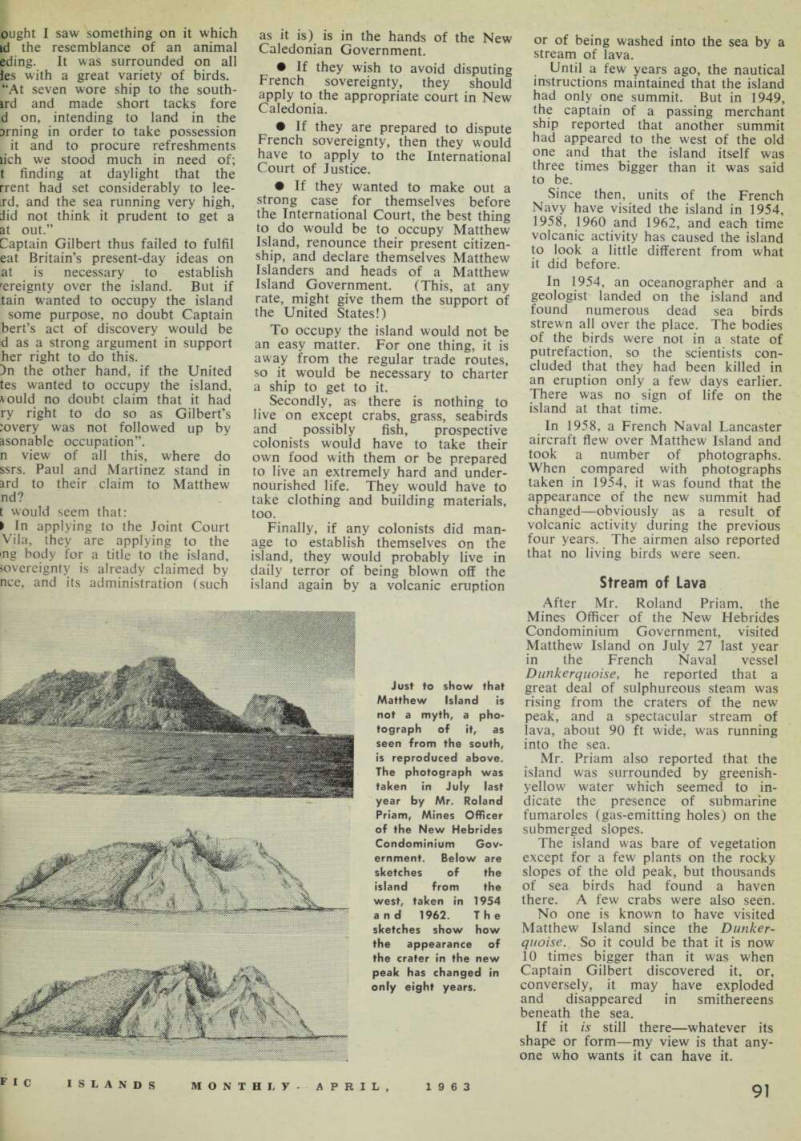
Just to show that Matthew Island is not a myth, a pho tograph of it, as seen from the south, is reproduced above.
The photograph was taken in July last year by Mr. Roland Priam, Mines Officer of the New Hebrides Condominium Gov ernment. Below are sketches of the island from the west, taken in 1954 and 1962. The sketches show how the appearance of the crater in the new peak has changed in only eight years.