Army Now!
p. 79 · Read in the full issue
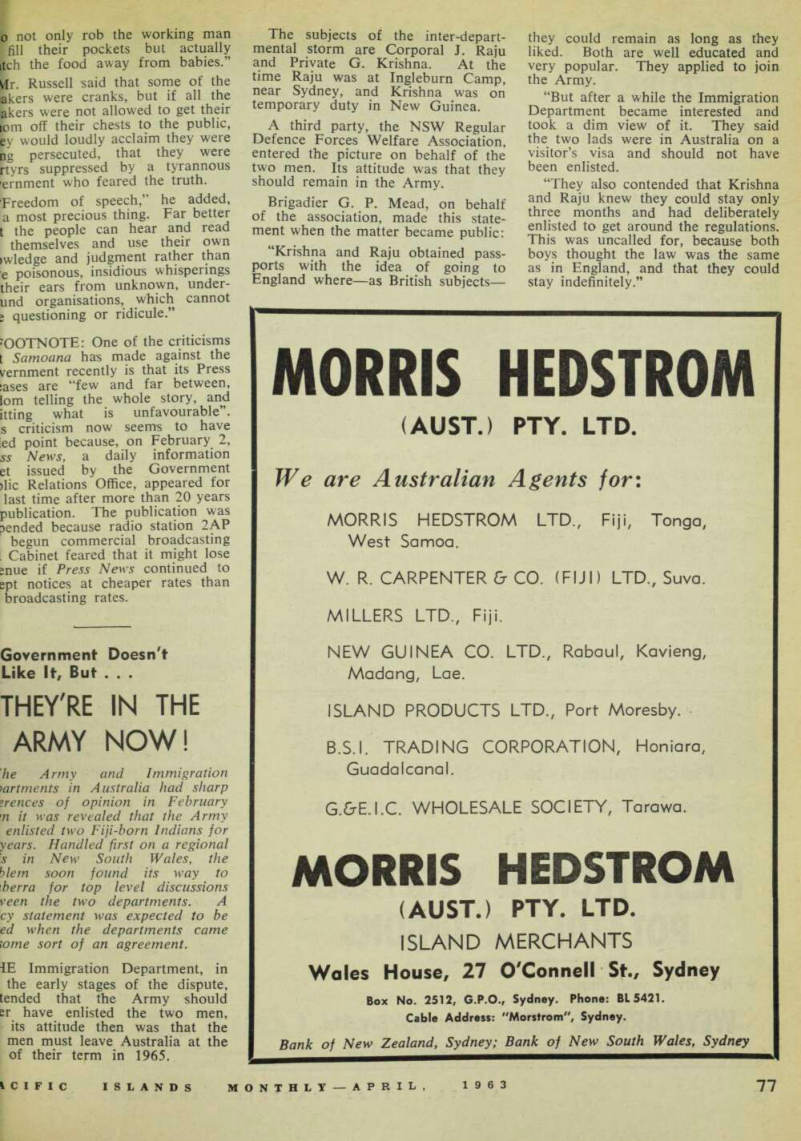
Government Doesn't Like It, But . . .
They're In The
he Army and Immigration mrtments in Australia had sharp ?rences of opinion in February •n it was revealed that the Army enlisted two Fiji-born Indians for years. Handled first on a regional s in New South Wales, the blem soon found its way to iberra for top level discussions veen the two departments. A cy statement was expected to be ed when the departments came jome sort of an agreement.
IE Immigration Department, in the early stages of the dispute, tended that the Army should er have enlisted the two men, its attitude then was that the men must leave Australia at the of their term in 1965.
The subjects of the inter-departmental storm are Corporal J. Raju and Private G. Krishna. At the time Raju was at Ingleburn Camp, t n p e mnnr»r < !f e J’, and £ rishnawas on porary duty in New Guinea.
A third party, the NSW Regular Defence Forces Welfare Association, entered the picture on behalf of the two men. Its attitude was that they should remain in the Army.
Brigadier G. P. Mead, on behalf of the association, made this statement when the matter became public: . , Krishna and Raju obtained passports with the idea of going to England where—as British subjects—
they could remain as long as they liked. Both are well educated and very popular. They applied to join the Army.
“But after a while the Immigration Department became interested and took a dim view of it. They said the two lads were in Australia on a visitor’s visa and should not have been enlisted.
“They also contended that Krishna ?. nd Ra ) u k " ew they could stay only P. onth ! and ]* a ? deliberately ® n J. lsted *° get ar ° und th ? regulations This was uncalled for, because both boys thought the law was the same as in England, and that they could stay indefinitely.”