Should Speech Be Free?
pp. 77-79 · Read in the full issue
Samoans Beg To Differ
From an Apia Correspondent The question of freedom of speech has had quite an airing in estem Samoa lately following Prime Minister Mataafa’s criticism critics in general and local newspapers in particular in his New ;ar radio speech. ( PIM, Feb., p. 127.)
OME letter writers to the news papers have supported their ime Minister; others have sported the Press; and the editor the Samoan Bulletin, Mr. Russell, s found it timely and apparently :essary to write an article on the tiefits of free speech.
One letter writer to Samoana said felt something should be done out the newspapers’ criticisms, lich he claimed were “a very ious breach of custom”.
“As a Samoan,” he said, “I feel it the remarks by the Samoa lletin and Samoana newspapers unst our Prime Minister in his iw Year speech . . . are not in :ordance with custom and tradition this land.
“Samoan people regard the use of ise remarks against their matais as yery serious breach of custom.”
Another correspondent in Samoana d he agreed wholeheartedly with ; Prime Minister’s remarks, and it freedom of speech should be ifined to matais.
“The views of the two newspapers i foreign views which certainly do t apply to conditions in Western noa and the manner in which we
run our Government under the administration of the matai system,” he said.
“According to our custom and tradition, insulting words create practically all troubles in Western Samoa and trouble arises in a Samoan family when a taule’ale’a insults his matai.
“True Samoan people respect their leaders and freedom of speeches, in my opinion, should apply to matais only.”
A third correspondent, supporting the Press, said he could not under stand the narrow-minded idea that the Government should be run under the administration of the so-called matai system, and that freedom of speech should be restricted to matais.
He went on: “It seems to be the habit, whenever one wishes to support one’s views on matters such as we have had lately, to bring up the matai system. But the matai have already given their consent that from now on the country will adopt a much wider way of government, based on democratic principles, of which freedom of speech is one of the most important.
Sydney Example
“It is a shame that only our two local papers were criticised by the PM. It’s sure good proof that these were the only people in this country who truly realised the importance of self-government, and the results that will arise if we, with those who run the Government, ignore our obliga tions in this respect.
“Do we consider our two local newspapers as outsiders? I don’t think so. They are owned within this country.”
Mr. Russell’s article on freedom of speech drew attention to the “amaz ing degree” of freedom of speakers in Sydney’s Domain on Sunday after noons, “To listen to them, one is appalled for a start,” Mr. Russell said. “The Prime Minister of Australia, his Cabinet, Members of Parliament and the Judges of the Courts are bluntly called thieves, crooks and grafters
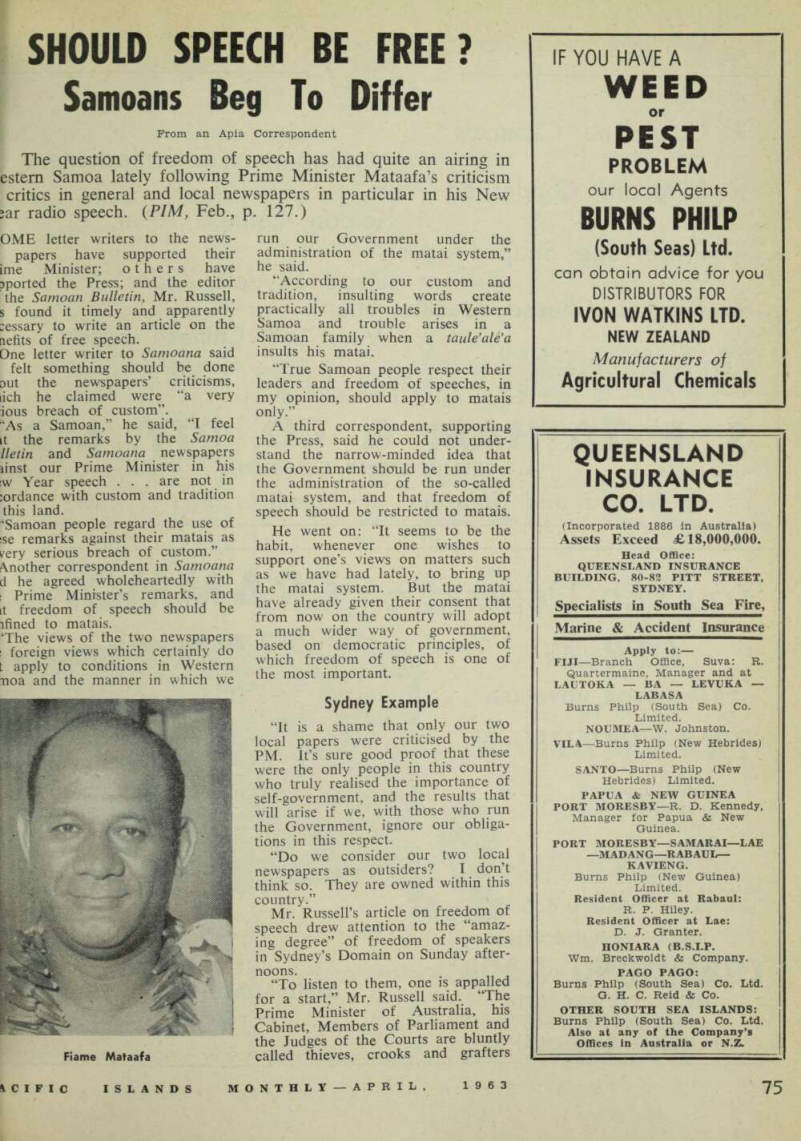
Fiame Mataafa
o not only rob the working man • fill their pockets but actually itch the food away from babies.”
Hr. Russell said that some of the lakers were cranks, but if all the akers were not allowed to get their 10 m off their chests to the public, ey would loudly acclaim they were ng persecuted, that they were ityrs suppressed by a tyrannous 'eminent who feared the truth.
Freedom of speech,” he added, a most precious thing. Far better t the people can hear and read themselves and use their own »wledge and judgment rather than e poisonous, insidious whisperings their ears from unknown, under und organisations, which cannot
; questioning or ridicule.”
? OOTNOTE: One of the criticisms t Samoana has made against the vernment recently is that its Press :ases are “few and far between, lorn telling the whole story, and itting what is unfavourable”, s criticism now seems to have :ed point because, on February 2, ss News, a daily information et issued by the Government >lic Relations Office, appeared for last time after more than 20 years publication. The publication was pended because radio station 2AP begun commercial broadcasting . Cabinet feared that it might lose ;nue if Press News continued to ept notices at cheaper rates than broadcasting rates.