Hopeful Signs
pp. 71-75 · Read in the full issue

BSIP Development Shows Hopeful Signs
It was what the BSIP prouced and sold overseas which ould establish the standard of t, . , . .v vmg in the Protectorate, the inancial Secretary, Mr. L. M. lavies, said when he produced ic IQAq hnHopt is izuj uuugci. .
E revealed that m 1962 exports were valued at £1,635,000, while nports, at £2,233,000, left a trade ap of £598,000. This showed that le Protectorate was buying much lore than she was apparently earnig overseas.
That was something which could ot continue indefinitely, he said.
Because of the low copra price the ading position was expected to eteriorate. To offset the wrong alance of trade it would be ecessary to produce locally some of ic goods now imported, and to raise xports. ...
Mr. Davies told the Legislative 'ouncil that the population increased rom 106,000 in 1957 to 130,000 in 963. By far the greatest increase 'as in the younger groups, which leant that the Protectorate had an icreasing number of young people a feed and to educate before there ras an increased number of workers o contribute substantially to the conomy. .
Nevertheless, Mr Davies throughiut his review of the Protectorate s inancial position, was optimistic ather than pessimistic. .
As an indication he quoted Savings lank investments, making a comlarison between 1957 and 1962. In December, 1957, £189,000 was on leposit in 2,360 accounts. Five years ater the figure had risen to £406,000
in more than 7,000 individual ac counts* “J ho u s f “ s who are tempted to doubt whether some of the basic principles of a cash economy and of savings are understood will wel come these figures,” Mr. Davies said, Increasing company registrations were also a pointer to a sound economy, and so was the amount in vested in buildings, plant, factories, plantations, etc.
Although 1962 copra production of 23,700 tons was less than 1961, it was comforting to see output main tained at a fair level. It was also most encouraging to see that in 1962 Solomon Islanders produced more than h a if G f the total production for t h e fi rst t i me Encouragement The seco nd and equally encourag ing f ea ture was the rate of new planting achieved by Levers, who, wit h a production of 5,300 tons a year> acco unted for about 23 per cent, Q f t Q ta i copra exports. It was corn forting to know that the plantation production at least was secured for t^e future Davies said that he was sure would be watching, with excite emerging cocoa industry, Sq (he Government had spent £200,000 directly on the industry, p anned t 0 spend a further £ „ 00( f 0 in 1963 The seve n bags of COCQa exported in i 960 became 21 tons j n 1962, and would increase , efold ; n i 964 to 240 tons, 1 . ... , . .It is true that wh f a u ere A going on the world price had[faltered and some of our factors' locally continue to make gloomy forecasts
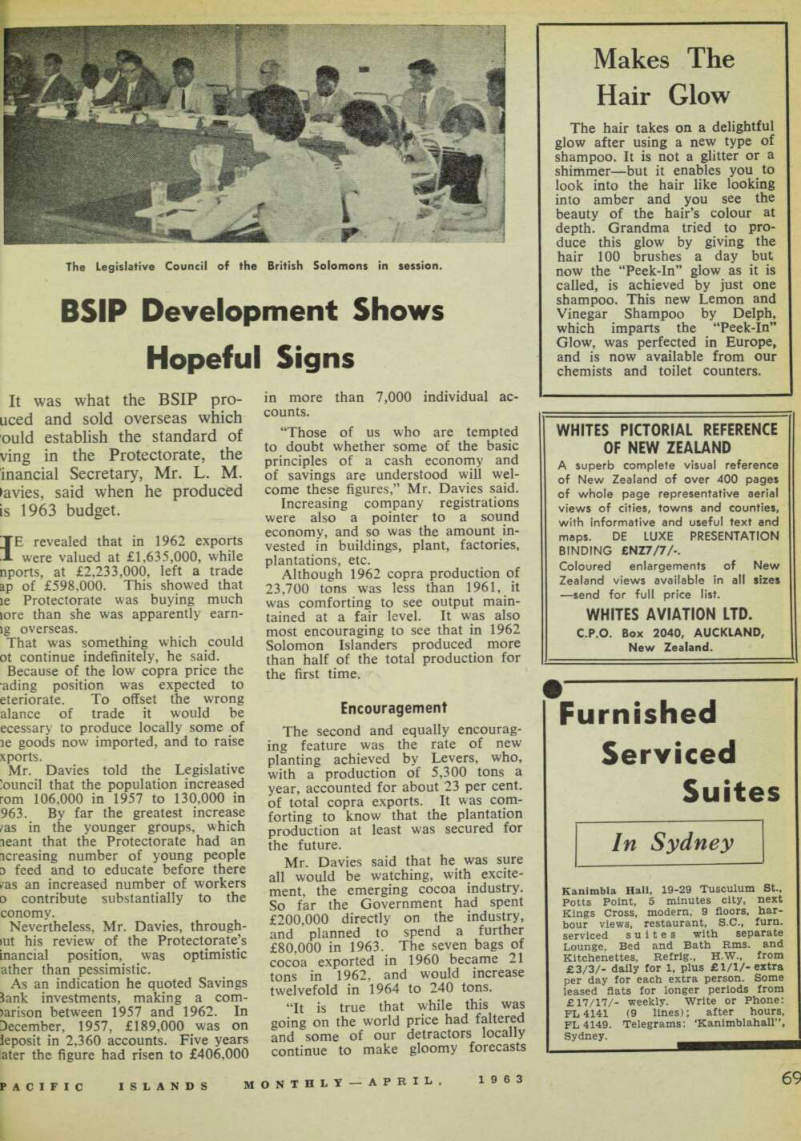
The Legislative Council of the British Solomons in session.
)out the future of this enterprise,” 5 said.
But he added that members of the Hindi might be reassured by a atement in a leading British news iper at the end of 1962 forecasting firm future in cocoa. The upward »nd in consumption was strong and It likely to be reversed very easily.
“I have high hopes for this in istry,” he said.
Mr. Davies said that provision was ain made in the 1963 Estimates r an expanded land survey service d 1963 should see the first registra m of guaranteed land title.
“I am sure that land owners will :reasingly appreciate the economic d financial benefit of secure title land which, among other things, 11 enable them to raise capital on is security so that an owner can velop his own land if he so sires,” he said.
Capitalist Optimism
He continued that there were en uraging signs that capitalists viewed ; BSIP resources with some timism. The Government was re iving more inquiries and more time is being spent by representatives of ivate firms in surveying and making juiries in the Protectorate.
“There is also a hopeful atmos ere, not only in Honiara, but in tier parts of the Protectorate, in lich investment, particularly in ires and other enterprises, is being ade,” Mr. Davies said. “An ex nsion of our secondary industry the production of tin cans has curred during the year, while the st one, biscuit making, has become small exporter. The charges are acting new permanent buildings, w schools and houses, “Generally I feel the country is ginning to stir and wake up. I pe it will stay awake, for there is jch to be done.”
Laziness Referring to labour matters Mr. ivies said no industry could cope th deep ingrained laziness. Noth l would do greater harm in the xt few years than for labour to ntinue to enjoy a reputation for v productivity or not taking advan ce of training courses.
Low production was the only ele ;nt which might jeopardise reason le progress to national solvency, ople could be educated to appreci -5 that, but regrettably higher educa m did not always result in higher oductivity. with the 1963 Estimates r. Davies said that Protectorate
revenue —money raised from the Protectorate’s produce and by her own efforts was estimated at £965,000, or an increase of £90,000 over the 1962 Estimate. Of this sum, £64,000 was expected to accrue from revenue as part of the proceeds of the sale of the BSI Trading Corporation. Import duties were expected to yield £311,000 in 1963.
The High Commissioner, Sir David Trench, reviewing the previous 14 months, referred to several matters with which the Financial Secretary dealt in detail. He said jt was pleasing to see the increased interest shown in the Protectorate by over
seas business enterprises in a number of fields.
The quickening of interest in the utilisation of timber resources was particularly promising, and it was also gratifying to note that there had been a marked increase in the ex penditure on geological prospecting by mining companies and private persons.
The Commonwealth Geophysical Company of Canada had continued its prospecting projects and the Homestake Mining Companies had taken out prospecting licences cover ing 250 square miles of Guadalcanal.
The Geological Survey Department
ad continued its survey work on [alaita, Ysabel and Bellona. Some reliminary work had been done in reparation for the forthcoming geo lemical prospecting research project, ad the nickel prospecting project as continued on St. George Island y a prospector financed by over ;as interests.
On the commercial side Sir David ud he was pleased to note the litiative shown by investments made i new stores and enterprises in Gizo, uki, Honiara and elsewhere.
During the session the Acting hief Secretary, Mr. R. Davies, said lat some members had referred to axiety being experienced in the rotectorate about changes in the orld outside. He could give an isurance that there was no question I Britain deserting the people of le Solomons. He was surprised that ayone had thought it necessary to ik. The Government’s job was to lucate the people to play an ever icreasing part in the modern world.
On the political side a motion that le Government should immediately it a target date for election of icmbers to the Legislative Council dore the end of 1964, with the bject of at least one European mem sr being elected before that date, as lost. The Acting Chief Sec tary said the Government had mch sympathy with the motion, and lere was “no conflict of opinion”.
However, too much haste could e just as embarrassing as delay. ; was essential that the step should e properly planned. The Govern lent’s first task was to introduce a roper system of elected local [Hindis. A Local Government Bill )r a later meeting of the council r ould contain provision for making
electoral rolls in local council areas.
He hoped these would form a sound foundation for further advance.
The council unanimously approved proposals contained in an Education White Paper as a general aim of policy. The Chief Education Officer, Major G. F. Bovey, who moved the motion, said the proposals were based on the need to produce each year boys and girls with adequate secondary education for training as teachers, AMD’s, administrators, and in many other occupations, Bishop Hill supporting the motion said he voted for it m the belief that the Government would administer it in a liberal way, and would recognise the right of the churches m matters concerning their faith.
Father J. M. Wall said he had been waiting for something like 29 years
for the White Paper. The paper took missions in as co-operators and the missions generally were in full agreement with it.
Some aspects had appeared to missions as disorganising what they had built up in carrying the burden of education during about 60 years, and be asked the Government for an assurance that, in implementing the P lan > the Government would deal as as possible with missions, allowing them to co operate, and not regarding them as servants The Acting Secretary for Protector ate Affairs, £j r . M . A. Andrew, gave the assura ’ nce Father Wall sought, He said proposals for detai , e d opera tion of the plan would all come before the Education Advisory Corn mittee, on which missions were repre sented.
Sir David Trench