First General
pp. 65-69 · Read in the full issue
Fiji Prepares For
Election
Prom a Suva Correspondent Fiji’s new constitution which broadens the franchise and in creases the size of the Legisla tive Council is now in full opera tion following its publication as
a supplement to the Fiji Royal
Gazette. The first general elec tion under the constitution will be held late in April or early in
May.
THE new council will consist of a Speaker, the Colonial Secretary, the Financial Secretary and the Attorney-General as ex officio members, 16 other official members (heads of Government departments) and 18 unofficial members. The Government thus retains a majority of one, although it is doubtful if it would ever use it. If a majority of unofficial members show them selves opposed to a measure the Government, rather than wield the big stick, would gracefully enough back down as in the past.
Other Changes
The new constitution also deals with the office of Governor and the set-up of the Executive Council.
Exco will consist of the Colonial Secretary, the Financial Secretary, the Attorney-General and members appointed by the Governor. In the past the Executive Council has com prised those officers, plus the Sec retary for Fijian Affairs, and four unofficial members, one of each race elected by their colleagues in the Legislative Council, and another European.
Till the change in the constitution, the Legislative Council was made up of a Speaker, 16 official members (including the ex-officio members) and 15 unofficial members.
In the old council the set-up among the unofficial members was; Five Fijians chosen from a panel of 10 submitted by the Council of Chiefs, three elected and two nominated Europeans and three elected and two nominated Indians. (Over)
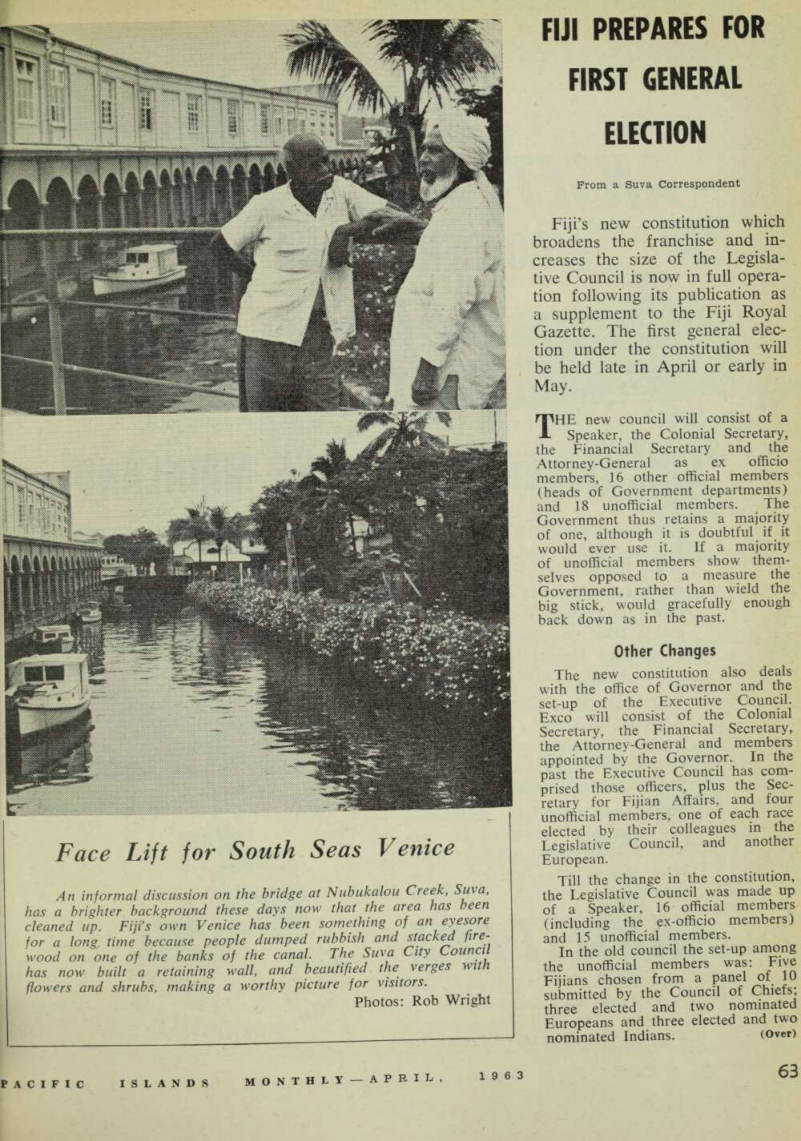
Face Lift for South Seas Venice
An informal discussion on the bridge at Nubukalou Creek, Suva, has a brighter background these days now that the area has been cleaned up. Fiji’s own Venice has been something of an eyesore for a long time because people dumped rubbish and stacked fire wood on one of the banks of the canal. The Suva City Counci has now built a retaining wall, and beautified the verges with flowers and shrubs, making a worthy picture for visitors.
Photos: Rob Wright
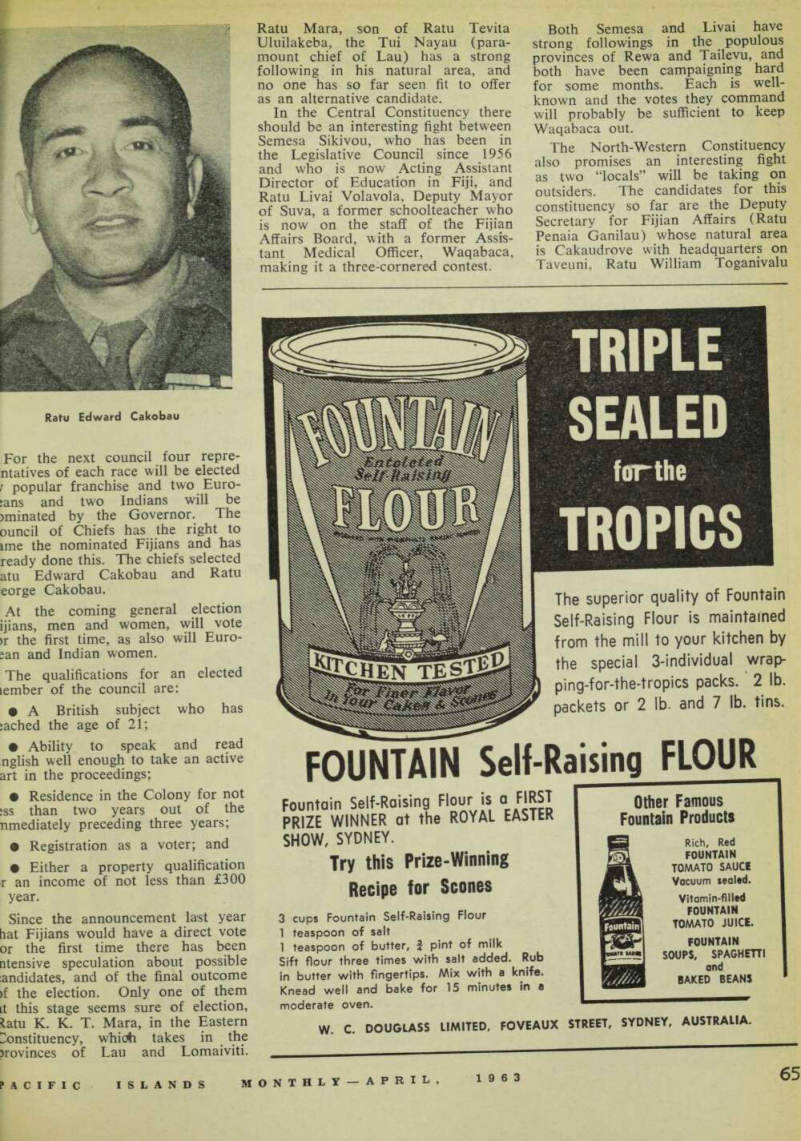
For the next council four repre ntatives of each race will be elected j popular franchise and two Euro pans and two Indians will be )minated by the Governor. The ouncil of Chiefs has the right to ime the nominated Fijians and has ready done this. The chiefs selected atu Edward Cakobau and Ratu
eorge Cakobau.
At the coming general election ijians, men and women, will vote >r the first time, as also will Euro ;an and Indian women.
The qualifications for an elected lember of the council are: • A British subject who has pached the age of 21; • Ability to speak and read nglish well enough to take an active art in the proceedings; • Residence in the Colony for not pss than two years out of the nmediately preceding three years; • Registration as a voter; and • Either a property qualification r an income of not less than £3OO year.
Since the announcement last year bat Fijians would have a direct vote or the first time there has been ntensive speculation about possible :andidates, and of the final outcome >f the election. Only one of them it this stage seems sure of election, latu K. K. T. Mara, in the Eastern Constituency, whidi takes in the provinces of Lau and Lomaiviti.
Ratu Mara, son of Ratu Tevita Uluilakeba, the Tui Nayau (para mount chief of Lau) has a strong following in his natural area, and no one has so far seen fit to offer as an alternative candidate.
In the Central Constituency there should be an interesting fight between Semesa Sikivou, who has been in the Legislative Council since 1956 and who is now Acting Assistant Director of Education in Fiji, and Ratu Livai Volavola, Deputy Mayor of Suva, a former schoolteacher who is now on the staff of the Fijian Affairs Board, with a former Assis tant Medical Officer, Waqabaca, making it a three-cornered contest.
Both Semesa and Livai have strong followings in the populous provinces of Rewa and Tailevu, and both have been campaigning hard for some months. Each is well known and the votes they command will probably be sufficient to keep Waqabaca out.
The North-Western Constituency also promises an interesting fight as two “locals” will be taking on outsiders. The candidates for this constituency so far are the Deputy Secretary for Fijian Affairs (Ratu Penaia Ganilau) whose natural area is Cakaudrove with headquarters on Taveuni, Ratu William Toganivalu
Ratu Edward Cakobau
from the chiefly island of Bau, head jarters of Tailevu Province), Peni faqasima, a Suva City Councillor, id a native of Nadroga, and the introversial Apisai You Tora better known as Mr. Mohammed ora), of Ba Province.
This constituency embraces the rovinces of Nadroga-Navosa, Ba nd Ra, which are noted for their arochialism. This parochialism is n unknown quantity, and could litigate against Ratu Penaia, who as a distinguished war record, ulminating as commander of the iji Battalion in Malaya, and who as been a hard worker for Fijian welfare. Ratu Penaia has declared lat he will not go in for any Hyde ark electioneering campaign, but lans to confine himself to a few roadcast addresses and some news aper publicity.
Unknown Quantity
Ratu William Toganivalu is some liing of an unknown quantity in the lolitical sphere and if the going is ikely to be hard for Ratu Penaia •ecause he is not natural to the area, t will be harder for Ratu William.
Peni Naqasima has had some ex lerience of local body politics after 8 months on the Suva City Council, ind a good background in Fijian idministration as a clerk in the Fijian )ffice. If parochialism comes into t he will command more votes than mybody else in Nadroga-Navosa, but le may not do so well in Ba and *a.
Tora has a certain following in the trade union movement, and could pick up a few votes among the workers. He is very confident, but could get a shock when the numbers go up. His decision to stand for the council had an interesting side effect —as a professed candidate for the Legislative Council he dis qualified himself as a member of the Sugar Advisory Council. The Government invited Tora to resign— Tora refused. After considerable correspondence between the Colonial Secretary (Mr. P. D. Macdonald) and Tora, the Governor ended the matter by revoking Tora’s appoint ment.
The Northern Fijian Constituency will see Ravuama Vunivalu, a mem ber of the council and an outsider, taking on three who are natural to the area. Ravuama, who hails from Tailevu, will have as one of his opponents, Adi Salanieta Tuiloma loma, paramount chief of Labasa, so far the only woman candidate of any race. Provincialism could also play a part in this election, and Ravuama is personally not well known there. He recently spent a week’s leave in Vanua Levu and Cakaudrove, but that is believed to have been his only visit ever to that part of the group. Two school teachers, also born in Vanua Levu, may stand, and could complicate the issue. Ravuama’s prospects, at the best, are shaky.
But the interest will be keen till the numbers go up—strangely enough the Europeans and Indians seem more interested in the Fijian elections than they are in selecting their own representatives for the next five years.
Ravuama Vunivalu
Mohammed Tora